Explained
Work Lights, Explained
After reading, you'll understand which work light specs predict how useful a light will be, and which ones are there to produce a big number.
In this guide
Work lights are sold on lumens, and lumens is the easiest specification in the category to publish and the least informative on its own. It measures light leaving the fixture, not light landing on your work, and it says nothing about how long the battery holds out. Around it sits a cluster of specs that mostly go unpublished: beam angle, colour rendering, ingress protection, and runtime at each setting. Knowing which of those is missing tells you a lot.
The 30-second version
- Lumens without runtime is half a spec, because the same battery gives very different hours at different outputs.
- Weight sorts the category, into lights you hold and lights you place, and they are not substitutes.
- An IP rating is the only weather evidence, and many work light pages do not carry one.
- Flood and spot are different tools, and the pages we read do not give the beam angle that would tell them apart.
- A visibility distance is not an illumination figure, since being seen from far away is a different property from lighting something up.
The products this guide is about
Our verdict on each, with the full reasoning on the companion review.
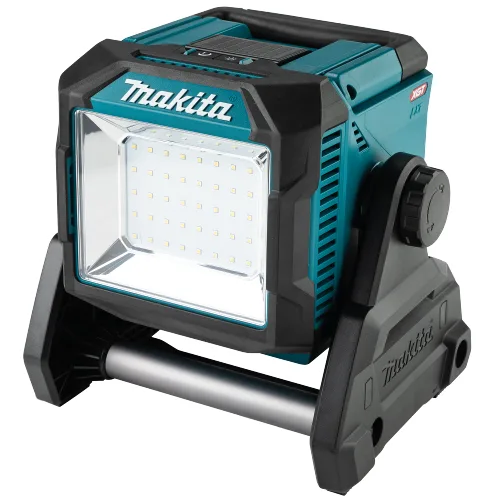
- Buy Makita ML005G 40V max XGT LED Work Light The only light here that tells you how long each brightness setting lasts, and it runs on AC as well as battery. Amazon
- Buy DeWalt DCL043 20V MAX LED Pivoting Work Light A 1,500 lumen handheld spotlight with a pivoting head at 1.75 lbs, built to throw a beam rather than fill a room. Amazon
- It depends DeWalt DCL074 Tool Connect 20V MAX All-Purpose Cordless Work Light The brightest light here by a wide margin, with an IP54 rating, in a 10.38 lb package. Amazon
- Skip Craftsman CMCL020B V20 Cordless Work Light 140 lumens, which is headlamp territory being sold as a work light. Amazon
What actually matters
- Lumens - total light output from the fixture. Useful for ranking lights within a category, useless for predicting how well lit your work will be, because it says nothing about where the light goes.
- Runtime - how long the light runs at a given output on a given battery. This is what converts a lumen figure into something you can plan around, and it is the spec most often left out.
- Brightness levels - discrete settings that let you trade output for hours. A light with three levels is three different tools; a light with one is whatever the designer chose.
- IP rating - the IEC 60529 ingress code, two digits for solids and liquids. IP54 means dust-protected and splash-resistant, which is the practical minimum for a light that lives outdoors.
- Beam angle - how widely the light spreads. A narrow beam throws far and leaves the edges dark; a wide beam washes an area evenly. Rarely published, so LED count and diffuser shape are the available clues.
- CRI - colour rendering index, how faithfully the light shows colours against daylight. It matters when you are matching wire colours or paint, and it is almost never stated on jobsite lights.
- Mounting and power - whether the light stands, hangs, clamps, takes a tripod, and whether it can run on mains. These decide where the light can actually be used more than the output does.
The specs, in plain English
Green flags vs red flags
Green flags
- Runtime published for each brightness setting, not just a single headline figure.
- An IP rating stated, with both digits, on any light meant to work outdoors.
- Multiple brightness levels with the lumens given for each.
- An AC adapter included or offered, so the light survives the batteries running out.
- A stated mounting method, whether that is a hook, a stand, a clamp or a tripod thread.
Red flags
- A lumen figure with no runtime anywhere on the page.
- A beam distance quoted on a light sold as an area light, or lumens quoted on one sold as a spotlight, with no beam angle either way.
- No ingress rating on a light photographed outdoors.
- A single brightness level, which removes any way to trade output for hours.
- A very low lumen figure presented as a feature, such as increased brightness at 140 lumens.
Who's who: the brands
- Makita - Publishes runtime at each brightness level on the ML005G, which also comes with an AC adapter.
- DeWalt - The widest range across handheld and area lights on one battery platform, with ingress ratings on the larger models.
- Milwaukee - A large jobsite lighting line built around one battery system, including tower and balloon lights for whole-site illumination.
- Craftsman - Budget lights on the V20 platform, such as the 140 lumen CMCL020B.
- Klein Tools - Focused on electrician-facing lighting, including headlamps and clamp lights sized for panel and conduit work.
How to read a listing without getting fooled
Start by finding the runtime and notice if there is not one. A lumen figure alone lets you rank lights but not plan with them, and on a battery light the hours are the constraint you will actually meet. Then check whether there is more than one brightness level, because that is what lets you choose between bright and long. Look for a two-digit IP code if the light will ever be outside; its absence means the manufacturer has not made a claim. Read the weight as a category rather than a number, since under about 2 lbs and over about 8 lbs are different kinds of tool. Finally, work out whether the light floods or throws, because beam angles are rarely stated. A quoted beam distance is a sign of a light built to throw, and buying a spotlight to light a bench is the most common mistake in this category.
How much should you spend?
Budget work lights buy you a small body and a low output, and the trap is that a very dim light is not a cheap version of a bright one, it is a different and much less useful object. The mid-range is where handheld lights land around 1,000 to 2,000 lumens with more than one brightness level, and for most home and vehicle work that tier is the whole answer. Premium buys area lighting, runtimes, ingress ratings and mains adapters, and on the bigger lights those are the features that make the output usable rather than just impressive. If the budget is tight, buy a good handheld rather than a cheap area light.
Questions, answered
Why does my work light get dim before the battery is empty?
High-output LEDs generate real heat, and most lights reduce output as the fixture warms up to protect the emitters and the driver. That is called thermal step-down and it is normal, though it is almost never mentioned on a product page. It is one reason a published runtime at a stated brightness is worth more than a peak lumen figure: the peak may only be available for the first few minutes.
Can I leave a cordless work light running outside overnight?
Only if it has an ingress rating that covers it. IP54 means dust-protected and safe from splashing water from any direction, which is enough for dew and light rain. It is not a rating for a hose or for standing water. A light with no IP rating published has not made any claim at all, and battery contacts are exactly where moisture causes trouble.
Is a corded work light still worth having?
For anything that runs all day in one place, yes. A corded light has no runtime limit, no thermal budget shaped by a battery, and usually costs less per lumen. The reason cordless has taken over is that most work happens in places where dragging a cord is worse than swapping a pack. A light that offers both, like the Makita here with its included AC adapter, sidesteps the choice.
What is the point of a light with a Tool Connect or app feature?
DeWalt says its Tool Connect app lets you control and monitor the DCL074 remotely on the jobsite. That is convenience and tracking rather than lighting, and it does not make the light brighter or last longer. For a home user it is a feature you will set up once and not think about again.
Or jump to the head-to-head: Makita ML005G 40V max XGT LED Work Light vs DeWalt DCL043 20V MAX LED Pivoting Work Light.