Explained
Bench Vises, Explained
After reading, you'll understand which three dimensions decide what fits in a vise, what a published PSI figure does and does not tell you, and why the mounting instructions are the part of the manual that matters most.
In this guide
First-time buyers pick a vise the way they pick a wrench, by the size printed on it, and that size is jaw width. Jaw width is the least predictive number on the spec sheet. Two vises with the same jaw width here differ by more than an inch and a half in jaw opening. Meanwhile the two figures that decide whether a part fits, throat depth and jaw opening, are published inconsistently, and the material the vise is cast from is published inconsistently on top of that.
The 30-second version
- Jaw width names the vise, but throat depth and jaw opening decide what actually fits between the jaws.
- A published PSI figure describes the casting alloy, not how hard the vise may be clamped or struck, and the two are often confused.
- Clamping force claims exist but are not comparable, because the same maker publishes them in pounds on one model and inch pounds on another, with no stated test method.
- The only vise specification anyone cites has been withdrawn, so a reference to it is a design lineage rather than a live conformance claim.
- The bench fails before the vise does, which is why the good manuals specify bolt diameter, bolt grade and a backing plate rather than saying bolt it down securely.
The products this guide is about
Our verdict on each, with the full reasoning on the companion review.
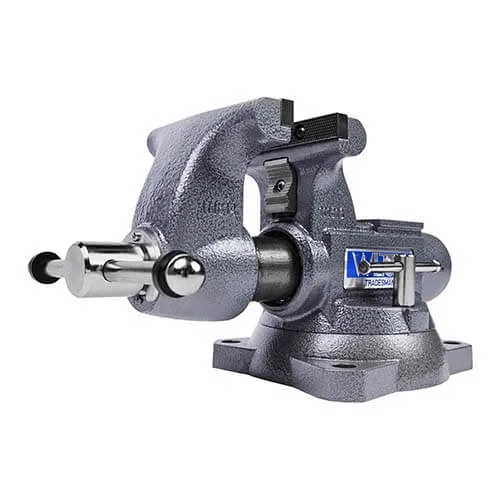
- Buy Wilton Tradesman 1755 Bench Vise The most completely documented vise here, with a mounting specification precise enough that you can size the bolts before the box arrives. Amazon
- Buy Yost Model 855-D2 Multi-Purpose Reversible Combination Vise A 60,000 PSI ductile iron combination vise whose reversible front jaw makes the opening-versus-throat trade visible as two published numbers instead of a marketing line.
- It depends Yost Model ADI-6 6 Inch Austempered Ductile Iron Bench Vise The only vise here that ties its casting to a named ASTM specification and publishes a jaw load figure, which is either exactly what you need or more metallurgy than your bench will ever load. Amazon
- Skip Olympia Tools 6 in. Mechanic's Bench Vise 38-616 A widely stocked 6 inch vise whose own listing publishes the two least useful numbers and leaves out the one that decides what fits.
What actually matters
- Throat depth - the vertical distance from the top of the jaws down to the vise body, which limits how deep a workpiece can sit. It is the figure that decides whether you can clamp a plate low enough to work on its edge without the body getting in the way.
- Jaw opening - how far the jaws separate at maximum. Look for a note on how it was derived, because at least one maker states its figure is based on the lead screw engaging half the nut thread length rather than the point where the jaw falls off the screw.
- Casting grade - published as a tensile figure in psi, sometimes with the alloy named as grey cast iron, ductile iron, austempered ductile iron or cast steel. The figure describes the metal, not the tool, and it is only comparable when the alloy is named alongside it.
- Replaceable jaws - hardened serrated inserts that bolt on and can be renewed when the teeth round over. Check the pipe jaws separately, since some vises pair replaceable top jaws with pipe jaws described as permanent.
- Swivel base and lockdowns - a rotating base with one or more lock handles. Manuals in this category say to hand-tighten those lockdowns only and never to use a pipe extension on them, because the handles are meant to bend before the bolts strip.
- Mounting hardware - hole diameter, bolt diameter, bolt grade and bolt length, or a backing plate specification. An undersized mount tears out the benchtop and takes the bench with it, which is why manuals also tell you to check that the underside of each hole is clear of legs and drawers.
- Anvil surface - the flat machined pad behind the jaws. Makers provide it and advertise it, but none of the manuals we read publish a limit on what may be struck there, so treat it as a light forming surface rather than a rated anvil.
The specs, in plain English
Green flags vs red flags
Green flags
- A spec table that lists jaw width, jaw opening, throat depth, pipe capacity and weight together in one place.
- A downloadable manual with a mounting template that names hole diameter, bolt diameter and a minimum bolt grade.
- A casting figure with the alloy named alongside it, and better still a cited ASTM designation.
- Replaceable jaws and pipe jaws that appear in a parts list with their own part numbers.
- First-party jaw covers offered in your exact jaw width, which tells you the maker expects you to protect finished work.
Red flags
- Jaw width and jaw opening published with no throat depth anywhere on the listing or in a manual.
- A psi figure with no alloy named, so you cannot tell whether it is grey iron, ductile iron or something else.
- A clamping force number with no stated test method or standard behind it.
- Pipe jaws described as permanent while the top jaws are sold as replaceable.
- Mounting instructions that say only to bolt the vise down securely, with no bolt size, bolt grade or backing plate guidance.
Who's who: the brands
- Wilton - A division of JPW Industries known for its enclosed round channel Tradesman and Bullet vises, and for manuals that publish a full dimensional table, an exact mounting template and a lifetime warranty with no end date.
- Yost - Producing vises since 1908 by its own account, Yost publishes more material and load data than anyone else here, spanning grey cast iron, ductile iron, austempered ductile iron and structural cast steel lines.
- Palmgren - A long-running industrial bench and pipe vise line sold mainly through industrial distributors rather than general retail, with ranges separated by ductile iron grade.
- Olympia Tools - A budget-focused hand tool brand whose bench vises are widely stocked at general retailers and are specified by jaw width, jaw opening and a casting psi figure rather than a full dimensional table.
- Eastwood - An automotive restoration retailer that sells vises alongside its own tools, with a vise range that overlaps heavily with Yost's.
How to read a listing without getting fooled
Start at the bottom of the listing, not the top. Find the throat depth first; if it is not there, check whether the maker publishes a manual, because several put the full technical statistics table in the manual and nothing on the web page. Then read the jaw opening and look for a footnote on how it was measured. Next, find the material, and check whether the maker names the alloy alongside the psi figure or just gives a number; a figure with an ASTM designation attached is worth far more than a bare number. Then read the base description for the swivel angle and how many lockdowns it has, and read the jaw description twice, once for the top jaws and once for the pipe jaws, because those are often specified differently. Finally, download the manual before you buy and read the mounting section, since that is where you will find out whether your bench needs a backing plate and what size bolts to order.
How much should you spend?
Budget vises tend to publish the least: a jaw width, a jaw opening, a casting psi figure without the alloy named, and often no throat depth at all. Mid-range vises are where published material grades start appearing consistently, typically ductile iron with a stated tensile figure, along with replaceable jaws, a full 360 degree base and measured anvil areas. Premium vises buy you two things beyond the casting: documentation, meaning a complete dimensional table, an exact mounting template and a parts list with numbers for every wear item, and warranty terms that run for the life of the product. The specialist tier above that, austempered ductile iron, is a genuine metallurgical step up with a standards-backed grade behind it, but it is aimed at people who load a vise hard enough to notice, and paying for it is not the same as needing it.
Questions, answered
Does a swivel base make the vise less rigid?
It is a common belief, and no maker we read publishes anything to support or deny it. What manufacturers do publish is that swivel lockdowns must be hand-tightened only and never leaned on with a pipe extension, because the handles are designed to bend before the bolts overstress. Makers also sell stationary base versions of the same vise families alongside the swivel ones without claiming a rigidity difference. If you never rotate the vise, a stationary base removes a joint and a pair of lockdowns you have to keep tight, which is a maintenance argument rather than a published performance one.
Is ductile iron really tougher than grey cast iron?
Yes, and the difference is in ductility rather than raw strength. Grey iron carries its carbon as graphite flakes, and standard grades are classified on tensile strength alone with no ductility requirement, which is why it can crack rather than bend. Ductile iron is treated so the graphite forms spheres, and its grade designations explicitly include a minimum percentage elongation. Austempered ductile iron goes further again through heat treatment. That is why casting grade is worth reading when a maker publishes it, and why a bare psi figure with no alloy named tells you less than it appears to.
Are soft jaws something I have to buy aftermarket?
Not necessarily. At least one maker here sells a full first-party range of jaw covers sized to jaw widths from 2-1/2 inches up to 8 inches, in magnetic aluminium, rubber-faced magnetic aluminium, non-magnetic aluminium and plastic, described as protecting fine work from serrated jaw facings. Some vise models also ship with top jaws that are reversible from serrated to smooth, which gives you a soft face without buying anything. Check the accessory listings for your jaw width before assuming you need to improvise.
Can I mount a vise on a hollow-core or thin benchtop?
Not without reinforcing it. Manuals in this category are unusually direct about the bench: one asks that a backing plate, an 18 by 18 by 2 inch piece of wood or an 18 by 18 by 1/4 inch metal plate, go under the top before the vise is bolted through it, with bolts protruding at least an inch beyond and a flat washer, lock washer and locking nut on each. Another specifies bolts two inches longer than the benchtop thickness at a minimum grade, and tells you to confirm that the underside of each hole is clear of legs, brackets and drawers. Both also say to recheck the nuts periodically and never to weld the base to anything.
Or jump to the head-to-head: Wilton Tradesman 1755 Bench Vise vs Yost Model 855-D2 Multi-Purpose Reversible Combination Vise.