Explained
Caulk Guns, Explained
After reading, you'll understand what dispense force and thrust ratio mean, and which cartridge format actually suits how you buy sealant.
In this guide
Caulk guns look too simple to have specifications, which is why the ones that matter are often left off the page. The tool is a motor or a lever pushing a rod into a tube, and the only questions are how hard it pushes, how fast, and what shape of tube it accepts. Manual guns describe the first of those as a thrust ratio; powered guns should describe it as a force in pounds, and not every maker does. Around that sit cartridge formats and a few features that change how clean the job is.
The 30-second version
- Dispense force is the specification, because it decides whether the tool can move cold adhesive or only warm sealant.
- Thrust ratio is the manual equivalent, and a low ratio will fight you on anything thick.
- Anti-drip changes the mess, by retracting the rod the moment you release instead of leaving it loaded.
- Format decides usefulness, since a gun that only takes one cartridge size is only useful for products sold in it.
- Length matters in corners, and the cordless guns compared here run from about 16 to 27 inches for the same job.
The products this guide is about
Our verdict on each, with the full reasoning on the companion review.
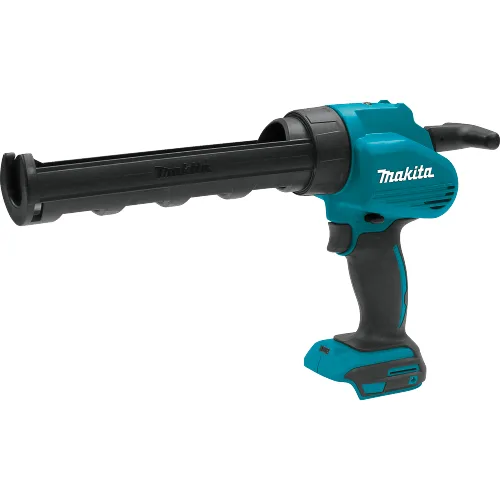
- Buy Makita XGC01Z 18V LXT Cordless Caulk Gun, 10 oz States both its dispense force and its rate, and 1,100 lbs is the highest force figure in this group. Amazon
- Buy DeWalt DCE580B 20V MAX Cordless Caulking Gun, 300 and 600 ml Takes both 300 and 600 ml sausage packs on quick-change trays, with an anti-drip retract that actually earns its place. Amazon
- It depends DeWalt DCE570B 20V MAX 29 oz Adhesive Gun The same tool as the DCE580B sized for 29 oz cartridges, which is either exactly right or entirely wrong for you. Amazon
- Skip Craftsman CMCE600B V20 Cordless Caulk Gun Publishes 550 lbs of force but no rate, and lists no work light, which the other three have. Amazon
What actually matters
- Dispense force - how hard the tool pushes the plunger, in pounds. It is the spec that determines which materials the gun can move, and cold construction adhesive is the hard case that separates tools.
- Dispense rate - how fast material comes out, usually in inches per minute. It is what makes a bead repeatable across a long run rather than dependent on your trigger finger.
- Cartridge format - standard 10 oz rigid cartridges, larger 29 oz cartridges for adhesive, or soft foil sausage packs in 300 and 600 ml. They are not interchangeable without changing the barrel or tray.
- Anti-drip - a mechanism that retracts the plunging rod on trigger release so material stops flowing. Without it the tube stays pressurised and keeps oozing.
- Speed control - a dial that caps the maximum rate, a variable trigger that modulates within it, or both. Both is meaningfully better than either alone.
- Length - how far the tool extends from the nozzle. It decides whether you can work an inside corner or under a fixture, and the cordless guns compared here vary by more than 10 in.
- Thrust ratio - the manual gun equivalent of dispense force, expressed as a mechanical advantage such as 10:1 or 26:1. Higher means less hand force for the same push.
The specs, in plain English
Green flags vs red flags
Green flags
- A dispense force stated in pounds on the product page.
- A dispense rate given in inches per minute, ideally with the number of speed settings.
- Both a variable speed trigger and a separate maximum-rate dial.
- Anti-drip retract described explicitly rather than implied.
- Quick-change trays so one tool covers more than one cartridge format.
Red flags
- No force figure and no rate figure anywhere on the page.
- A speed dial with no variable trigger, which leaves bead ends uncontrolled.
- No stated capacity, so you cannot tell which tubes will fit.
- A very long body sold for bathroom and kitchen work.
- Feature bullets standing in for every performance number.
Who's who: the brands
- Makita - Publishes dispense force and a speed range, and builds the shortest cordless gun of the four.
- DeWalt - The widest range of cordless barrel guns across cartridge and sausage formats, with quick-change trays and anti-drip on the two guns compared here.
- Milwaukee - A large cordless caulk and adhesive gun line on one battery platform, aimed at trade users running volume.
- Craftsman - Budget entry on the V20 platform, with a rotating cartridge holder, a stated 550 lbs of force and no published rate.
- Newborn - A manual caulk gun specialist, and the reference point for thrust ratios, dripless mechanisms and smooth-rod guns.
How to read a listing without getting fooled
Look for a force figure in pounds first, and note that some makers leave it out. If it is not there, you are buying on feature bullets and you should weight the physical specs more heavily as a result. Next find the capacity and the format, because a gun that only accepts 29 oz cartridges is useless for the 10 oz tube in your hand. Check whether there is a variable trigger as well as a dial, since a dial alone gives you one speed per setting. Read the overall length against where you will actually use it, because the spread across cordless guns is over 10 in. and a long tool cannot get into a corner. Anti-drip is worth looking for by name.
How much should you spend?
A good manual gun with a high thrust ratio and a dripless mechanism costs very little and will handle household sealant indefinitely, so the case for going cordless is volume and cold adhesive rather than capability in general. In the powered category the budget tier may list fewer features, such as no work light. Mid to premium is where interchangeable trays appear, and a manufacturer may or may not tell you what the tool pushes. If you run one tube a year, buy the manual gun and spend the difference on better sealant.
Questions, answered
Is a cordless caulk gun worth it for a homeowner?
For one bathroom, no. A manual gun with a 10:1 or better thrust ratio and a dripless release does that job for a fraction of the cost. The case for cordless starts when you are running many tubes in a session, when the material is stiff construction adhesive, or when you want a consistent bead over a long run, because a motor holds a rate that a hand cannot. Grip strength is the other reason, and it is a good one.
How do I get a neat bead?
Cut the nozzle small and at an angle, smaller than you think you need, because you can always cut more. Keep the gun moving at a steady speed matched to the flow, which is exactly what a rate setting on a powered gun buys you. Push the bead rather than pulling it if you want it forced into the joint. Tool the bead within a few minutes with a wet finger or a shaped tool, before it skins.
What is the difference between caulk, sealant and adhesive?
Caulk usually means a paintable filler for gaps in interior trim, often acrylic latex, which stays fairly rigid. Sealant means a flexible waterproof joint material, usually silicone or a hybrid polymer, which stays elastic and generally will not take paint. Construction adhesive is a structural bonding product, much thicker than either, and it is the material that decides whether your gun has enough force.
Why does material keep coming out after I stop squeezing?
Because the tube is still under pressure from the plunger. On a manual gun there is a release lever, usually a thumb tab at the back, and pressing it drops the pressure immediately. On a powered gun that function is called anti-drip and it retracts the rod automatically, which is why all four tools above advertise it. If your gun has neither, expect to keep a rag under the nozzle.
Or jump to the head-to-head: Makita XGC01Z 18V LXT Cordless Caulk Gun, 10 oz vs DeWalt DCE580B 20V MAX Cordless Caulking Gun, 300 and 600 ml.