

Tools & DIY
The Best Caulk Guns: 4 Compared (and One to Skip)
We compared four cordless caulk and adhesive guns on dispense force, flow rate and cartridge capacity, and the published performance numbers differ a lot from maker to maker.
The short version
Makita's XGC01Z is the pick and the tool here that tells you the most about what it can do: 1,100 lbs of dispense force and 0 to 66 inches per minute across five speed settings, in a 10 oz body at 5.1 lbs with battery. DeWalt's DCE580B is the value buy if you use larger tubes, taking 300 and 600 ml sausage packs with interchangeable trays, an anti-drip retract and both a variable trigger and a speed dial. The DCE570B is the depends pick, the same tool sized for 29 oz cartridges, which is the right choice only if that is the size you buy. Skip the Craftsman CMCE600B: it states 550 lbs of force but no rate, and lists no work light. Best for: anyone running more than a couple of tubes at a time, or fighting cold adhesive with a hand gun.
Our picks at a glance
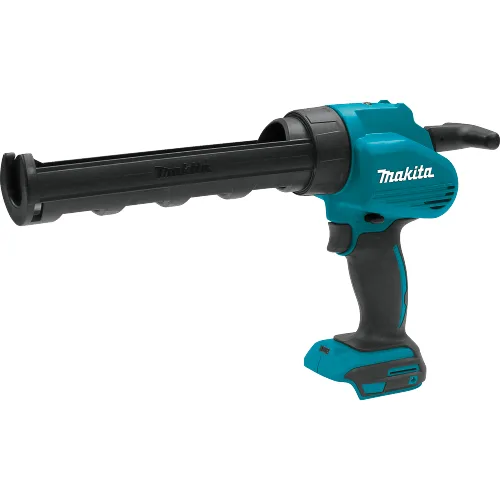
- Makita XGC01Z 18V LXT Cordless Caulk Gun, 10 oz - Buy. States both its dispense force and its rate, and 1,100 lbs is the highest force figure in this group.
- DeWalt DCE580B 20V MAX Cordless Caulking Gun, 300 and 600 ml - Buy. Takes both 300 and 600 ml sausage packs on quick-change trays, with an anti-drip retract that actually earns its place.
- DeWalt DCE570B 20V MAX 29 oz Adhesive Gun - It depends. The same tool as the DCE580B sized for 29 oz cartridges, which is either exactly right or entirely wrong for you.
- Craftsman CMCE600B V20 Cordless Caulk Gun - Skip. Publishes 550 lbs of force but no rate, and lists no work light, which the other three have.
The verdict in 30 seconds
What mattered most
- Dispense force
- Dispense rate
- Capacity
- Speed control
- Anti-drip retract
- Work light
A cordless caulk gun has exactly one job: push a viscous material out of a tube at a controlled rate. The specification that describes that job is dispense force, measured in pounds, because it decides whether the tool can move cold construction adhesive or only warm bathroom silicone. Across four current cordless guns, Makita publishes force and rate, Craftsman publishes force, and DeWalt publishes a speed figure but no force. Here is what each one actually states.
States both its dispense force and its rate, and 1,100 lbs is the highest force figure in this group.
Best for: Anyone using standard 10 oz cartridges who wants to know in advance whether the tool will push what they are putting in it.
- 1,100 lbs of dispense force published, the highest force figure stated in this comparison (Craftsman states 550 lbs).
- 0 to 66 inches per minute across a 5-speed dial, plus a variable speed trigger, so the bead rate is repeatable.
- 15-7/8 in. long, the shortest gun here, and 5.1 lbs including the battery (battery sold separately).
- Built-in LED light, a 360 degree rotatable cartridge holder and an overload indicator.
- Runs on the 18V LXT platform.
- 10 oz capacity (it also fits 300 ml cartridges), which rules out the larger sausage packs and 29 oz cartridges the DeWalts take.
- Brushed motor, stated on Makita's own spec sheet.
- Its drip-reduction feature relieves pressure on release rather than retracting the rod, per Makita's wording.
- Bare tool, with battery and charger sold separately.
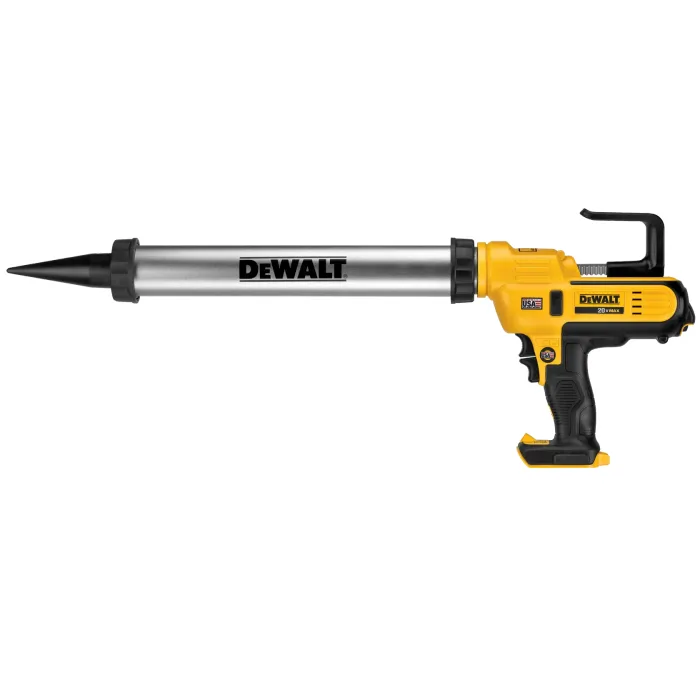
Takes both 300 and 600 ml sausage packs on quick-change trays, with an anti-drip retract that actually earns its place.
Best for: Anyone working from sausage packs rather than cartridges, where one tool covering both common sizes is worth more than a published force figure.
- Quick-connect interchangeable canister trays cover 300 ml and 600 ml sausage packs on one tool.
- Anti-drip automatically retracts the plunging rod when you release the trigger.
- Variable speed trigger plus a separate dial for setting maximum and minimum flow.
- LED light and a hang hook, at 4.9 lbs.
- DeWalt publishes no dispense force, and its only speed figure is a 21 in/min line in the description.
- 26.07 in. long, over 10 in. longer than the Makita, which matters in a corner.
- Brushed motor, listed in the spec table.
- Bare tool, battery and charger extra.
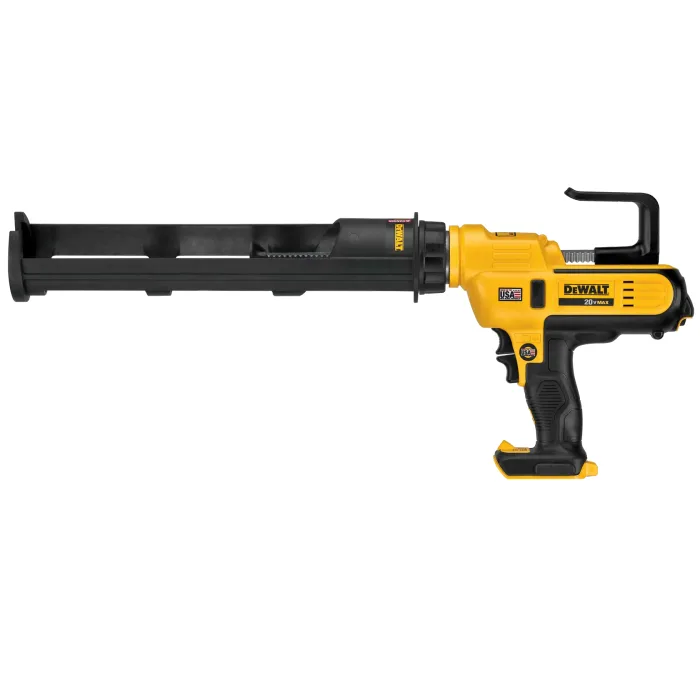
The same tool as the DCE580B sized for 29 oz cartridges, which is either exactly right or entirely wrong for you.
Best for: Subfloor adhesive and other jobs that come in 29 oz tubes, where reloading a 10 oz gun six times is the actual problem.
- 29 oz capacity, sized for the large cartridges used for construction adhesive and subfloor work.
- Same anti-drip retract, variable speed trigger and speed dial as the DCE580B.
- LED light and hang hook, at 4.7 lbs.
- Quick-connect interchangeable trays, so it is not locked to one size.
- No dispense force published, same as its sibling.
- 26.69 in. long, the longest tool in this comparison.
- 29 oz cartridges are a much narrower product range than 10 oz tubes.
- Brushed motor.
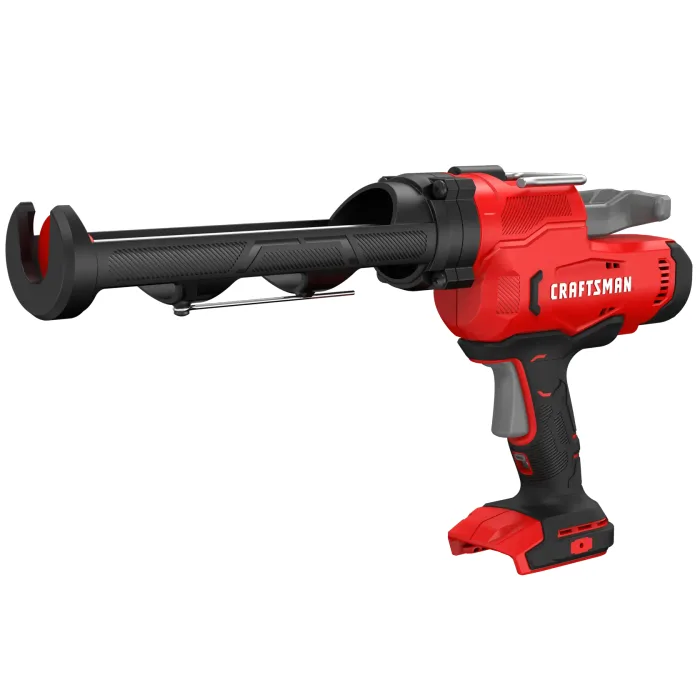
Publishes 550 lbs of force but no rate, and lists no work light, which the other three have.
Best for: Someone who wants the lowest-tier option with a rotating holder and a stated 550 lbs of force. The missing rate and light listing are the trade.
- The cartridge holder rotates a full 360 degrees, which helps in a corner (the Makita's does too).
- Anti-drip retract on trigger release, matching both DeWalts, plus a variable speed trigger and speed dial.
- 4.65 lb listed weight and 19.13 in. long, shorter and lighter than either DeWalt.
- Publishes 550 lbs of dispensing force, about half the Makita's 1,100 lbs.
- No dispense rate published.
- Weighs 4.65 lbs, close to the DeWalts, so the shorter body is the main physical gain.
- No LED work light is listed, which both DeWalts and the Makita carry.
| Criteria | XGC01Z 18V LXT Cordless Caulk Gun, 10 oz Top pick Buy it Buy | DCE580B 20V MAX Cordless Caulking Gun, 300 and 600 ml Buy it Buy | DCE570B 20V MAX 29 oz Adhesive Gun It depends Buy | CMCE600B V20 Cordless Caulk Gun Skip it Buy |
|---|---|---|---|---|
| Best for | Anyone using standard 10 oz cartridges who wants to know in advance whether the tool will push what they are putting in it. | Anyone working from sausage packs rather than cartridges, where one tool covering both common sizes is worth more than a published force figure. | Subfloor adhesive and other jobs that come in 29 oz tubes, where reloading a 10 oz gun six times is the actual problem. | Someone who wants the lowest-tier option with a rotating holder and a stated 550 lbs of force. The missing rate and light listing are the trade. |
| Price tier | $$$ · premium | $$$ · premium | $$$ · premium | $ · budget |
| Dispense force | 1,100 lbs | Not published | Not published | 550 lbs |
| Dispense rate | 0 - 66 in./min | 21 in/min speed listed | 21 in/min speed listed | Not published |
| Capacity | 10 oz (also 300 ml) | 300 and 600 ml sausage | 29 oz | Not published |
| Speed control | 5-speed dial plus variable trigger | Variable trigger plus dial | Variable trigger plus dial | Variable trigger plus dial |
| Anti-drip retract | Yes (drip reduction) | Yes | Yes | Yes |
| Work light | Yes | Yes | Yes | Not listed |
| Length | 15-7/8 in. | 26.07 in. | 26.69 in. | 19.13 in. |
| Weight | 5.1 lbs with battery | 4.9 lbs | 4.7 lbs | 4.65 lbs |
Which one is right for you?
- Anyone using standard 10 oz cartridges who wants to know in advance whether the tool will push what they are putting in it. Buy it Makita XGC01Z 18V LXT Cordless Caulk Gun, 10 oz
- Anyone working from sausage packs rather than cartridges, where one tool covering both common sizes is worth more than a published force figure. Buy it DeWalt DCE580B 20V MAX Cordless Caulking Gun, 300 and 600 ml
- Subfloor adhesive and other jobs that come in 29 oz tubes, where reloading a 10 oz gun six times is the actual problem. It depends DeWalt DCE570B 20V MAX 29 oz Adhesive Gun
- Someone who wants the lowest-tier option with a rotating holder and a stated 550 lbs of force. The missing rate and light listing are the trade. Skip it Craftsman CMCE600B V20 Cordless Caulk Gun
How we judged the field
Five things decide a cordless caulk gun. Dispense force comes first, because it is the spec that answers whether the tool can push what you intend to put in it, and cold adhesive is a genuinely hard case. Dispense rate comes second, since a consistent bead depends on the tool running at a repeatable speed rather than whatever your finger produces. Third is capacity and whether the tool can change between sizes, because a gun locked to one cartridge format is only half bought. Fourth is anti-drip, which sounds like a convenience and is actually the difference between a clean job and sealant on the floor. Fifth is length, because a 26 in. tool cannot be worked into an inside corner.
The field splits by what goes in the barrel. Standard 10 oz cartridge guns cover almost everything sold to homeowners. Larger 29 oz cartridge guns exist for construction adhesive. Sausage guns take soft foil packs in 300 and 600 ml and are what trade users buy in volume. We took the leading 10 oz tool, both DeWalt barrel guns to show what the two large formats cost in length, and the Craftsman as the budget option.
Makita XGC01Z 18V LXT Cordless Caulk Gun, 10 oz
Buy itThe XGC01Z is the best-specified tool in this comparison. Makita publishes 1,100 lbs of dispense force, which is the number that tells you whether the gun will move cold construction adhesive rather than only warm silicone, and 0 to 66 inches per minute across a 5-speed dial, which is the number that tells you whether your bead will be consistent. Craftsman states 550 lbs of force but no rate, and DeWalt states neither a force nor a rate beyond a 21 in/min speed line. It is also physically the most usable tool in the group by a wide margin: 15-7/8 in. long against the DeWalts’ 26 in. and change, which is the difference between reaching into an inside corner and not. Makita’s 5.1 lbs includes the battery, so the bare tool is lighter than that figure suggests. It also carries a built-in LED and a 360 degree rotatable holder. The gaps are real: 10 oz and 300 ml cartridges only, and a brushed motor stated on the spec sheet. Buy it if you use standard cartridges.
DeWalt DCE580B 20V MAX Cordless Caulking Gun, 300 and 600 ml
Buy itThe DCE580B is the tool to buy if your sealant comes in foil. Quick-connect interchangeable canister trays let one gun run both 300 ml and 600 ml sausage packs, which covers the two sizes trade users actually buy, and sausage packs are cheaper per volume and leave far less waste than rigid cartridges. The control set is the best in the group on paper: a variable speed trigger for modulating a bead plus a separate dial for setting maximum and minimum flow, so you can cap the rate for a long consistent run and still ease off at the ends. Anti-drip retracts the plunging rod as soon as you release, which is what keeps the material off the floor. There is an LED and a hang hook, at 4.9 lbs. What DeWalt does not tell you is how hard it pushes, and at 26.07 in. it is a long tool to work in a confined space.
DeWalt DCE570B 20V MAX 29 oz Adhesive Gun
It dependsThe DCE570B is the DCE580B with a different barrel, and whether that is the right tool depends entirely on what you buy. Twenty-nine ounce cartridges are the format for construction adhesive, subfloor adhesive and the heavier sealants, and if that is your work then a 10 oz gun means reloading three times as often on a job where the adhesive is skinning over while you do it. The control set is identical to its sibling: variable trigger, speed dial, anti-drip retract, LED, hang hook. It is 4.7 lbs and the longest tool here at 26.69 in., which is the trade a big cartridge forces. Like the DCE580B it publishes no force figure. The reason it is the depends pick rather than a buy is that 29 oz is a narrow format, and if you mostly run standard tubes you will have bought a tool that does not take them without swapping trays.
Craftsman CMCE600B V20 Cordless Caulk Gun
Skip itThe CMCE600B is the one to skip, and it starts with a genuinely good idea. The cartridge holder rotates a full 360 degrees, as the Makita’s does, and that is exactly what you want when the bead runs into a corner and you would otherwise have to twist your wrist. It has the anti-drip retract, it is 19.13 in. long and 4.65 lbs, both better than either DeWalt. Then the omissions show. Craftsman states 550 lbs of force, half the Makita’s figure, and publishes no dispense rate or capacity. The page lists a variable speed trigger and a speed dial, but no work light, which the other three carry. Good idea, thin specification. This is a close call against the DeWalts rather than a clear skip, and the verdict rests mostly on the missing rate and light.
Sources
Specs in this review come from these pages.
Makita XGC01Z 18V LXT Cordless Caulk Gun, 10 oz vs DeWalt DCE580B 20V MAX Cordless Caulking Gun, 300 and 600 ml: which should you buy?
The Makita XGC01Z and the DeWalt DCE580B are not the same tool, and the choice is settled by what you put in them rather than which is better. The Makita takes 10 oz cartridges, which is what almost everything sold to a homeowner comes in, and it is the tool here with the highest published force: 1,100 lbs, at 0 to 66 in. per minute across five settings. At 15-7/8 in. it is over 10 in. shorter than the DeWalt, and that is the difference between working a bath surround comfortably and fighting it.
The DeWalt takes sausage packs in both 300 and 600 ml on swappable trays, which is the format trade users buy, and it has the better control combination of a variable trigger and a maximum-rate dial plus an anti-drip retract. What it will not tell you is how hard it pushes. If you buy sealant at a hardware store in rigid tubes, take the Makita and enjoy knowing its numbers. If you buy sealant by the box in foil packs, the DeWalt is the tool, and you will have to judge its force by using it.
What to look for
- A published dispense force in pounds: it is the spec that answers whether the gun will move cold adhesive, and the two DeWalts here omit it.
- A dispense rate: inches per minute is what makes a bead repeatable, and only the Makita here states a range.
- Both a variable trigger and a speed dial: the dial caps the rate for a consistent run, the trigger controls the ends and the corners.
- Anti-drip retract: without it the plunger stays loaded and material keeps oozing after you let go.
- Cartridge format, and whether trays swap: a gun locked to one size is only useful for the products sold in that size.
- Overall length: the tools here run from 15-7/8 in. to 26.69 in., and the long ones cannot be worked into an inside corner.
Our final take
Dispense force is the specification that defines a caulk gun and the one both DeWalts decline to publish. The Makita XGC01Z states 1,100 lbs and 0 to 66 inches per minute, is over 10 in. shorter than either DeWalt, and is the tool we would buy for standard cartridges. The DeWalt DCE580B is the right answer for sausage packs and has the best control set here, and you will be judging its power by feel rather than by figure. The DCE570B is that same tool for 29 oz cartridges, which is exactly right if that is what your adhesive comes in. The Craftsman has a fully rotating holder and 550 lbs of stated force, and gives up the dispense rate and a listed work light.
Questions, answered
What does dispense force actually tell me?
It is the push the tool can put behind the plunger, quoted in pounds, and it decides which materials the gun can move. Thin bathroom silicone needs very little. Cold construction adhesive in a 29 oz tube in an unheated garage needs a great deal, and that is where hand guns fail and cheap powered ones stall. Makita publishes 1,100 lbs for the XGC01Z and Craftsman publishes 550 lbs for the CMCE600B. The two DeWalts publish no force figure, so there is nothing to compare there.
Cartridge, sausage pack, or both?
Cartridges are the rigid plastic tubes most sealants come in, usually 10 oz for household products and up to 29 oz for adhesives. Sausage packs are soft foil tubes, sold in 300 and 600 ml, that produce far less waste and need a barrel gun with a nozzle assembly. If you buy at a hardware store you will mostly meet cartridges. If you buy trade quantities of sealant, sausages are cheaper per volume and lighter to carry, and the DeWalt DCE580B covers both common sizes on swappable trays.
Is anti-drip worth paying for?
Yes, and it is the feature that most changes how the tool behaves. Without it the plunger stays under load when you let go, so material keeps oozing out of the nozzle onto whatever is below. An anti-drip mechanism retracts the rod the moment the trigger releases, which stops the flow almost immediately. All four guns here advertise an anti-drip or drip-reduction feature.
Do I need variable speed, or is a dial enough?
Both, ideally, and they do different things. A dial sets the maximum rate so the tool cannot run faster than the bead you want, which makes a long run consistent. A variable trigger lets you modulate within that, which is what you need at the start and end of a bead and around a corner. All four guns here list both.
Why does my caulk gun struggle in cold weather?
Because sealant and adhesive get dramatically stiffer as temperature drops, and the force needed to push them rises with it. A tube that flows easily at room temperature can be close to solid at freezing. The usual remedies are to keep tubes somewhere warm until you use them, to cut the nozzle a little wider, and to buy a tool with enough force in hand. It is also why a published force figure is more useful than it looks, since the hard cases are all cold ones.
Deciding between the top two? See our head-to-head: Makita XGC01Z 18V LXT Cordless Caulk Gun, 10 oz vs DeWalt DCE580B 20V MAX Cordless Caulking Gun, 300 and 600 ml.
More in Tools & DIY
Caulk Guns, Explained Plain-English guide → Makita XGC01Z 18V LXT Cordless Caulk Gun, 10 oz vs DeWalt DCE580B 20V MAX Cordless Caulking Gun, 300 and 600 ml Head-to-head →  The Best Circuit Breaker Finders: 4 Compared (and One to Skip)
  The Best Circular Saws: 4 Compared (and One to Skip)
  The Best Clamp Meters: 4 Compared (and One to Skip)
  The Best Cordless Drills: 4 Compared (and One to Skip)