

Tech & Gadgets
The Best Circuit Breaker Finders: 4 Compared (and One to Skip)
We compared four currently sold breaker finders on the one thing that decides whether they work: what each maker tells you to do when the receiver lights up on two breakers next to each other.
The short version
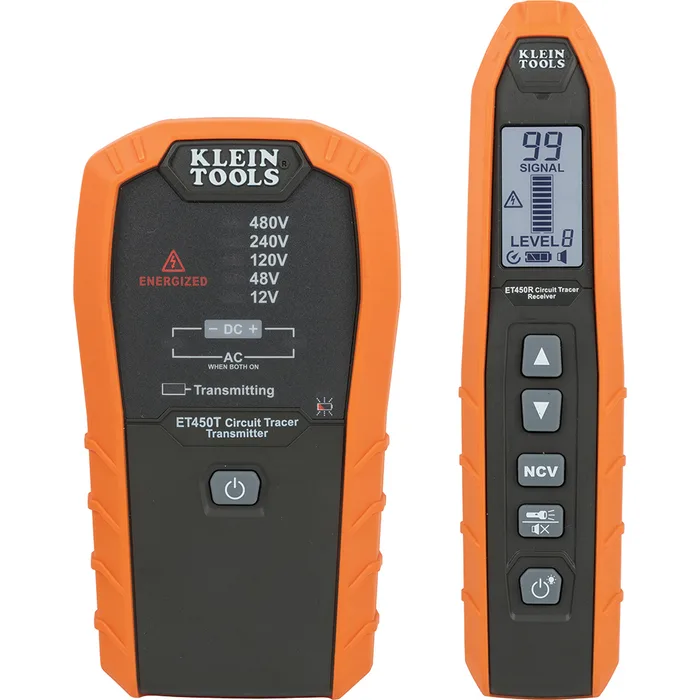
The Klein Tools ET450 wins because it is the only unit here that turns the guess into a comparison: a 0 to 99 signal number, eight sensitivity levels, and a manual that tells you exactly what to do when two breakers tie, which is to pull the panel cover and probe the individual wires. The Fluke BK120 is the value pick and the most honestly documented plug-in finder we found, because Fluke prints the fix for the adjacent-breaker case directly in the user guide, tells you to confirm by tripping the breaker and watching the transmitter go dark, and rates both halves CAT III 150 V. The Klein ET310 is the depends pick: it adds full receptacle wiring indications and a GFCI button to the transmitter, which is useful if that is the second job you have, but it gives you a beep rate instead of a number and is rated only CAT II 120 V. Skip the Extech CB10, whose only tie-breaker is a sensitivity knob you turn down by feel, which publishes no measurement category rating at all, and whose own specification page states that the UL mark does not indicate the product has been evaluated for the accuracy of its readings. One thing applies to all four: a breaker finder maps a panel, it does not prove a conductor is dead. Best for: anyone labelling a panel or killing one circuit without shutting down the house.
Our picks at a glance
- Klein Tools ET450 Advanced Circuit Tracer Kit - Buy. The one here that replaces a beep with a number, and the only one that will follow a circuit you have already switched off.
- Fluke BK120 SmartTrace Breaker Finder - Buy. The plug-in finder whose maker actually writes down what to do when the receiver picks two breakers instead of one.
- Klein Tools ET310 Digital Circuit Breaker Finder with GFCI Outlet Tester - It depends. A breaker finder whose transmitter is also a full receptacle tester, which is either exactly what you wanted or a feature you already own.
- Extech CB10 AC Circuit Breaker Finder and GFCI Receptacle Tester - Skip. A competent little receptacle tester bolted to a receiver whose entire answer to a false hit is a knob you turn down by feel.
The verdict in 30 seconds
What mattered most
- Type
- Works on a de-energised run
- Signal strength readout
- Sensitivity control
- Maker's fix for two breakers responding
- Safety rating
A circuit breaker finder is a transmitter you plug into an outlet and a receiver you sweep along a panel, and the whole category lives or dies on a single problem the packaging never mentions. The signal does not stay politely on one breaker. It couples into the ones beside it, and the characteristic failure is a confident indication on the wrong breaker. Every manual we read has a paragraph about that, and not one manufacturer publishes a number for how well its receiver separates neighbours. We picked four units that are on sale now and judged them on how honestly each maker documents that problem and what it gives you to solve it.
The one here that replaces a beep with a number, and the only one that will follow a circuit you have already switched off.
Best for: Anyone who maps panels often enough to want a number instead of a beep, or who needs to trace a run that is already dead.
- The receiver shows signal strength as 0 to 99 on the LCD plus a ten segment bar, so two candidate breakers become two numbers rather than two beeps.
- Eight sensitivity levels, and Klein tells you which to use: 1 to 3 for energised circuits and 4 to 8 for de-energised ones, where the signal is weaker.
- Traces energised or de-energised breakers, fuses and wires, with the receiver also carrying an 80 to 1000 V AC non-contact function and a 6 lumen light.
- Klein's preferred remote ground connection will trip GFCI receptacles, and the manual lists the workarounds rather than fixing it.
- The direct ground connection avoids that but Klein notes wires are less traceable that way because parallel conductors cancel each other out.
- Tracing depth is specified at 0 to 1.64 ft (0.5 m) depending on the medium, so it is not a deep underground locator.
- It is a lead-and-clip kit in a hard case with a 600 V 0.5 A fuse in the transmitter, not something you keep in a shirt pocket.
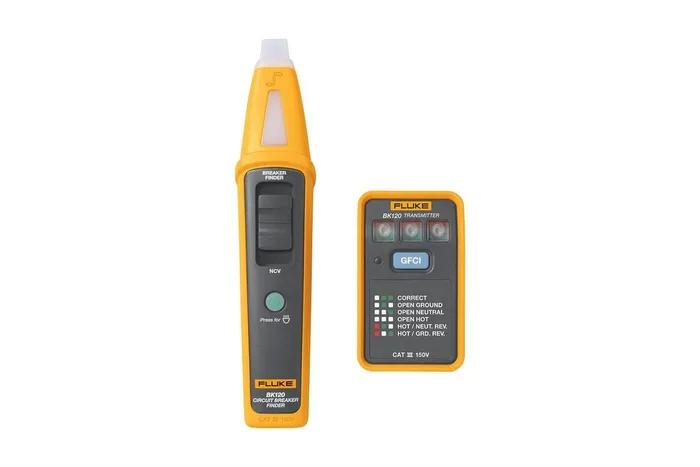
The plug-in finder whose maker actually writes down what to do when the receiver picks two breakers instead of one.
Best for: The homeowner or service tech who wants one pocket tool for panel mapping and wants the maker's own procedure for the ambiguous case.
- The user guide states that if the finder detects two adjacent breakers on the second scan you reset it, turn it 180 degrees and rescan, which is a published answer to the failure that defines this category.
- Fluke also tells you to confirm the result by tripping the breaker and checking that the transmitter in the socket has gone dark, which is the only free verification there is.
- Both halves are rated CAT III 150 V and IP40, with the transmitter carrying UL 1436 and CSA C22.2 No. 160, and the receiver adds a 90 to 240 V AC non-contact mode with dual sensitivity.
- The transmitter is line powered at 110 to 125 V AC, so there is no way to trace anything that is not energised.
- The breaker indication is a green light and a beep with no signal strength number, so a tie is resolved by rotating the tool rather than by reading two values.
- Fluke notes an inaccurate reading may occur if the tip is placed at any angle other than flat on the breaker face.
- The transmitter's specified operating range is 5 to 40 C (41 to 104 F), which a hot attic or a cold garage can sit outside.
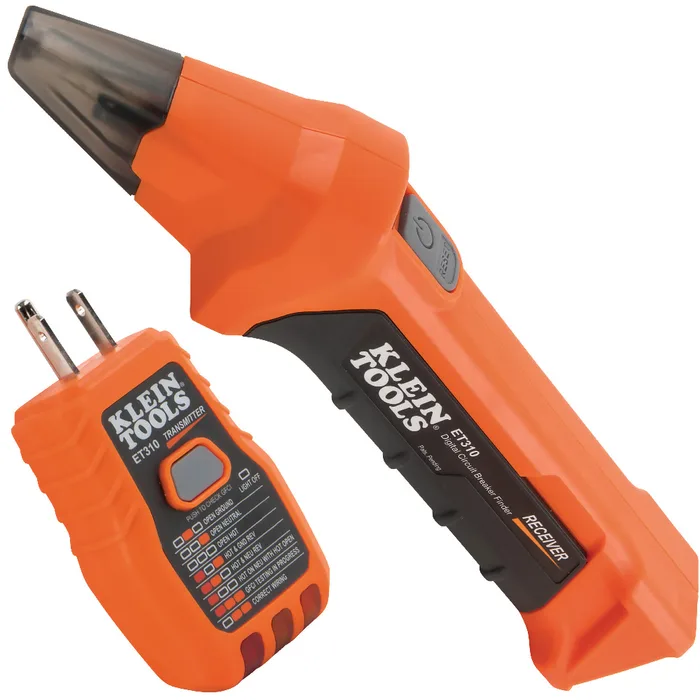
A breaker finder whose transmitter is also a full receptacle tester, which is either exactly what you wanted or a feature you already own.
Best for: Someone who wants the panel mapping and the outlet wiring check in one purchase and works only on grounded 120 V circuits.
- The transmitter indicates correct wiring, open ground, open neutral, open hot, hot and ground reversed, hot and neutral reversed, and hot on neutral with open hot, plus a GFCI test button.
- The receiver runs a two-pass routine: one sweep of the whole panel where it learns and you ignore every indication, then a second sweep where a continuous beep and a red status light mark the breaker.
- Klein conforms it to UL 61010-1, 61010-2-030 and 1436, certifies it to the matching CSA standards, and rates it IP40 with 6.6 ft (2 m) drop protection.
- The receiver gives you a beep rate and a status light, not a signal number, so there is nothing to compare when two breakers both respond.
- There is no sensitivity control at all, which leaves the reset-and-rescan routine as your only recourse.
- CAT II 120 V is the lowest safety rating in this group, and CAT II is the category for utilisation points rather than the distribution part of the installation.
- The transmitter is powered by the circuit it is plugged into, so a de-energised run is out of reach, and Klein tells you to stop if the outlet reads incorrectly wired.
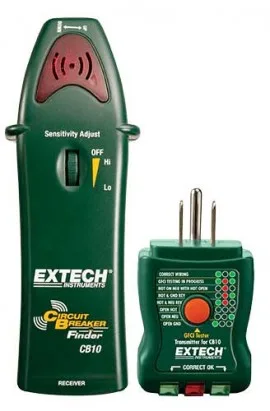
A competent little receptacle tester bolted to a receiver whose entire answer to a false hit is a knob you turn down by feel.
Best for: Nobody who has the option of the Fluke, though it is not a dangerous tool so much as an undocumented one.
- The receiver has a genuine variable sensitivity control, from HI down to LO, which is more than most finders in this tier offer.
- The transmitter doubles as a receptacle tester with a GFCI button and prints its own list of the conditions it cannot detect.
- Small and light at 5.9 oz (167 g) with the transmitter line powered and a single 9 V cell in the receiver.
- Extech publishes no measurement category rating for it, where the other three here name CAT II 120 V, CAT III 150 V and CAT III 600 V for a tool you hold inside an open panel.
- The specification table's own approvals line says the UL mark does not indicate that this product has been evaluated for the accuracy of its readings.
- There is no signal strength readout and no learning pass, so separating two candidate breakers means dialling sensitivity down and re-sweeping until only one still beeps.
- The transmitter is line powered at 90 to 120 V AC, and the GFCI test asks you to hold the button for at least 8 seconds.
| Criteria | ET450 Advanced Circuit Tracer Kit | BK120 SmartTrace Breaker Finder | ET310 Digital Circuit Breaker Finder with GFCI Outlet Tester | CB10 AC Circuit Breaker Finder and GFCI Receptacle Tester |
|---|---|---|---|---|
| Verdict | Buy it | Buy it | It depends | Skip it |
| Best for | Anyone who maps panels often enough to want a number instead of a beep, or who needs to trace a run that is already dead. | The homeowner or service tech who wants one pocket tool for panel mapping and wants the maker's own procedure for the ambiguous case. | Someone who wants the panel mapping and the outlet wiring check in one purchase and works only on grounded 120 V circuits. | Nobody who has the option of the Fluke, though it is not a dangerous tool so much as an undocumented one. |
| Price tier | $$$ · premium | $$ · mid-range | $$ · mid-range | $ · budget |
| Type | Lead and clip tracer kit in a hard case | Plug-in transmitter plus handheld finder | Plug-in transmitter that docks in the receiver | Plug-in transmitter plus handheld receiver |
| Works on a de-energised run | Yes, at sensitivity levels 4 to 8 | No, transmitter is line powered | No, transmitter is powered by the circuit | No, transmitter is line powered |
| Signal strength readout | 0 to 99 numeric plus a 10 bar graph | Green light and beep, no number | Beep rate and a red status light, no number | Beep and flashing LED, no number |
| Sensitivity control | 8 levels, set by buttons | None published | None, two-pass learning routine instead | Variable knob, HI to LO |
| Maker's fix for two breakers responding | Pull the panel cover and probe the individual wires | Reset, turn the finder 180 degrees and rescan | Reset away from the panel and rescan both passes | Reduce sensitivity and sweep again |
| Safety rating | CAT III 600 V transmitter, receiver CAT III 600 V and CAT II 1000 V | CAT III 150 V on both units | CAT II 120 V | None published |
| Standards named by the maker | UL 61010-1, 61010-2-030; CSA C22.2 No. 61010-1, 61010-2-030 | Transmitter UL 1436 and CSA C22.2 No. 160; receiver IEC 61010-1 and 61010-2-030 | UL 61010-1, 61010-2-030, 1436; CSA C22.2 No. 61010-1, 61010-2-030, 160 | UL and CE only |
| Non-contact voltage in the receiver | Yes, 80 to 1000 V AC | Yes, 90 to 240 V AC, dual sensitivity | No | No |
Which one is right for you?
- Anyone who maps panels often enough to want a number instead of a beep, or who needs to trace a run that is already dead. Buy it Klein Tools ET450 Advanced Circuit Tracer Kit
- The homeowner or service tech who wants one pocket tool for panel mapping and wants the maker's own procedure for the ambiguous case. Buy it Fluke BK120 SmartTrace Breaker Finder
- Someone who wants the panel mapping and the outlet wiring check in one purchase and works only on grounded 120 V circuits. It depends Klein Tools ET310 Digital Circuit Breaker Finder with GFCI Outlet Tester
- Nobody who has the option of the Fluke, though it is not a dangerous tool so much as an undocumented one. Skip it Extech CB10 AC Circuit Breaker Finder and GFCI Receptacle Tester
How we judged the field
Five things separate a breaker finder that saves an afternoon from one that costs you a server reboot. First, whether it gives you a number. A beep tells you a breaker responded; a signal strength value tells you which of two responded harder, and that single difference is most of the category. Second, whether sensitivity can be changed, because the only reliable way to narrow a field of candidates is to keep turning the gain down until one survives. Third, what the maker says about the adjacent-breaker case, which is the failure everyone actually hits and which most brands quietly ignore. Fourth, whether it works with the power off, because tracing a dead run is a genuinely different job that plug-in transmitters cannot do at all. Fifth, the safety rating and the standards actually named on the sheet, since this is a tool you hold inside an open panel.
The field splits on the third and fourth points. On one side sit the plug-in finders: a transmitter that draws its power from a live 120 V outlet and a receiver you sweep across breaker faces. They are small, cheap and limited to energised circuits. On the other sit the tracer kits, which carry their own batteries, clip onto conductors, and inject a signal whether or not the breaker is on. Those give you a numeric readout and adjustable gain, and their manuals are far more candid about what goes wrong. We took the best-documented tracer, the plug-in finder whose maker publishes the ambiguity procedure, a plug-in finder that folds in a full receptacle tester, and the budget unit whose specification page tells you more than the marketing does.
Klein Tools ET450 Advanced Circuit Tracer Kit - buy
The ET450 is the tool we would hand to anyone who does this more than twice a year, and the reason is arithmetic. Its receiver puts a 0 to 99 signal number and a ten segment bar on the LCD, so two suspicious breakers stop being two beeps and become two values. Eight sensitivity levels let you keep squeezing until only one survives, and Klein tells you which end of the range to use: 1 to 3 for energised circuits, 4 to 8 for de-energised ones where the field is weaker. It traces breakers, fuses and wires either way, through drywall, cement block or ground, to a specified depth of 0 to 1.64 ft (0.5 m). The receiver adds an 80 to 1000 V AC non-contact function and a 6 lumen light. It is rated CAT III 600 V and conforms to UL 61010-1 and 61010-2-030. The trade is bulk and fiddle: leads, clips, a fused transmitter and a hard case, plus the fact that Klein’s preferred remote ground connection will trip GFCI receptacles. Buy it if you want the answer to be a number.
Fluke BK120 SmartTrace Breaker Finder - buy
The BK120 is the pick for people who want one tool in a pouch, and it earns the spot on documentation as much as hardware. Fluke prints the thing nobody else prints: if the finder detects two adjacent breakers on the second scan, reset it, turn it 180 degrees and rescan. Then it tells you to confirm the result by tripping the breaker and checking that the transmitter in the socket goes dark, which is the only verification that costs nothing. The transmitter runs on 110 to 125 V AC, draws about 6 mA, indicates six wiring conditions and runs a 6 to 8 mA GFCI test, and it is rated CAT III 150 V to UL 1436 and CSA C22.2 No. 160. The receiver adds a 90 to 240 V AC non-contact mode with dual sensitivity, a flashlight and two AAA cells. What you give up is the number: the breaker indication is a green light and a beep, so a tie is resolved by geometry rather than by reading two values. It is for the person who wants competence in a pocket.
Klein Tools ET310 Digital Circuit Breaker Finder with GFCI Outlet Tester - it depends
The ET310 is a fair tool sold on a premise you should check against your own toolbox. As a finder it does the standard trick well: reset the receiver away from the panel, sweep every breaker once while it learns and ignore everything it says, then sweep again, and a continuous beep with a red status light marks the target. What lifts it is the transmitter, which is a full receptacle tester indicating correct wiring, open ground, open neutral, open hot, hot and ground reversed, hot and neutral reversed, and hot on neutral with open hot, plus a GFCI button. Klein conforms it to UL 61010-1, 61010-2-030 and 1436, rates it IP40 with 6.6 ft (2 m) drop protection, and prints the conditions it does not indicate. That last list is shared ground with our outlet tester comparison, and if you already own a tester from that piece you are paying twice for it here. There is also no sensitivity control and no signal number, and CAT II 120 V is the lowest rating in this group.
Extech CB10 AC Circuit Breaker Finder and GFCI Receptacle Tester - skip
The CB10 is the one to walk past, and not because it is dangerous. It works, it is small at 5.9 oz (167 g), the transmitter is a decent receptacle tester with a GFCI button, and it has a real variable sensitivity knob, which is more than the Klein plug-in offers. The problem is what Extech publishes and what it does not. There is no measurement category rating anywhere in the specification table for a receiver you hold inside an open panel, where the other three name CAT II 120 V, CAT III 150 V and CAT III 600 V. The approvals line reads UL and CE, followed by Extech’s own sentence that the UL mark does not indicate that this product has been evaluated for the accuracy of its readings, which is a remarkable thing to find on a device whose entire job is to be accurate. And with no signal number and no learning pass, resolving two candidate breakers means dialling sensitivity down and sweeping again until one drops out. Take it only if the alternative is guessing.
Klein Tools ET450 Advanced Circuit Tracer Kit vs Fluke BK120 SmartTrace Breaker Finder: which should you buy?
The ET450 and the BK120 solve the same problem at opposite ends of the effort scale. Both inject a signal and sweep a panel for it, both are honest about the adjacent-breaker case, and both come from makers who publish the procedure rather than the marketing. The difference is what you get when two breakers answer. The ET450 hands you two numbers and eight gain settings, so you narrow the field by measurement, and when a tie survives all of that Klein tells you to pull the panel cover and touch the receiver tip to individual wires. The BK120 hands you a green light, and Fluke’s answer to a tie is to reset the finder, rotate it 180 degrees and try again. The rotation trick works more often than it sounds like it should, because the receiver’s antenna is directional, but it is a coin flip resolved by geometry rather than a comparison.
The second difference is the job around the job. The ET450’s transmitter carries its own batteries and clips onto conductors, so it traces de-energised runs, sorts a single wire out of a bundle, follows conduit and finds opens, none of which a line-powered transmitter can attempt. The BK120’s transmitter is also a receptacle tester and its receiver is also a non-contact voltage detector, which is two fewer things in the bag for a service call. Buy the ET450 if you map panels for a living, if you ever need to follow a wire that is already dead, or if the cost of picking the wrong breaker is measured in downtime. Buy the BK120 if you want one competent tool for a house, a small shop or a van, and you are willing to confirm every result by tripping the breaker.
What to look for
- A number, not a noise: a receiver that displays signal strength lets you compare two candidate breakers directly, where a beep or a lamp only tells you that something responded, and comparison is the entire difficulty in this category.
- Adjustable sensitivity: the reliable way to narrow a field of suspects is to keep reducing gain and rescanning until one breaker survives, which is impossible on a unit with a single fixed threshold.
- A published procedure for the tie: the manuals worth trusting say what to do when two breakers read the same, whether that is rotating the receiver 180 degrees or pulling the deadfront to probe individual conductors, and a maker that stays silent is telling you something.
- Battery powered transmitter if you need dead circuits: plug-in transmitters draw their power from the outlet, so they simply cannot signal a de-energised run, and only a tracer with test leads and its own cells will do that job.
- A measurement category rating you can read: you use this inside an open panel, so look for CAT II or CAT III with a voltage next to it and the 61010 standard parts named, rather than a bare approvals logo.
- A free confirmation step: trip the breaker you found and check that the transmitter in the outlet goes dark, which Fluke prints as step five and which turns a probable answer into a checked one.
Our final take
Buy the Klein ET450 if you want the ambiguity resolved by measurement, if you trace dead runs, or if picking the wrong breaker costs you real money. Buy the Fluke BK120 if you want a pocket tool for a house or a van from a maker willing to print what to do when the answer is unclear. Take the Klein ET310 if the receptacle tester in its transmitter is a purchase you were going to make anyway, and skip it if you already own one. Skip the Extech CB10 on what its own specification page says. And hold every result loosely: finding a breaker is a hypothesis about a panel, not proof that anything is dead.
Questions, answered
Why does my breaker finder light up on two breakers next to each other?
Because the signal does not stay on one conductor, and every maker in this category knows it. The transmitter injects a tone onto the circuit, the wires in a panel run in tight parallel bundles, and the field couples into the neighbours. IDEAL's SureTrace manual describes the mechanism plainly, noting that a capacitively coupled conductor causes signal bleed-off onto the other adjacent conductors, and that in a closed circuit the transmitter's signal can be detected upstream through the feeder panel and the distribution transformer. What is missing across the whole category is a number: not one manufacturer we checked publishes a discrimination figure, a separation specification or a success rate for its receiver. What they publish instead is a procedure. Fluke tells you to reset the finder and turn it 180 degrees. Klein tells you to remove the panel cover and touch the receiver tip to the individual wires. Treat a single confident indication as a strong hypothesis, not a result.
Does the circuit have to be live for a breaker finder to work?
For the plug-in kind, yes, and it is not a limitation you can work around. The transmitters in the Fluke BK120, the Klein ET310 and the Extech CB10 are all powered by the circuit they are plugged into, so an unenergised run gives them nothing to draw from and nothing to transmit. Tracers are the exception. The Klein ET450 connects to the conductors with test leads and its own batteries and will trace energised or de-energised breakers, fuses and wires, with Klein noting that energised circuits typically need sensitivity levels 1 to 3 while de-energised ones may need 4 to 8. The reason is the physics: an open circuit carries no current, so the field it radiates is much weaker than a closed one. If tracing dead runs is part of your job, that is the whole reason to buy a tracer instead of a finder.
If the finder identifies the breaker, does that mean the wire is safe to work on?
No, and no manufacturer claims it does. A breaker finder tells you which handle is probably associated with a circuit. It says nothing about whether the conductor in front of you is at zero volts, and it cannot see a second feed, a shared neutral that is still energised, or a mislabelled circuit. Fluke's own safety sheet for the BK120 is blunt about it: do not rely on the product to detect the presence or absence of voltage for safety purposes, and a voltmeter or two-pole voltage detector is necessary to confirm the absence of hazardous voltage before starting work. That verification is a separate instrument and a separate discipline, and we cover what qualifies for it in our [non-contact voltage tester comparison](/best-non-contact-voltage-testers). Use the finder to pick the breaker. Use a contact tester to prove the result.
Can I use one without opening the panel?
Only for the first step. The Klein ET450 lets you touch the receiver tip to each panel cover to work out which panel carries the signal, which is genuinely useful in a building with several, but the very next instruction is to open the cover, because identifying a breaker means putting the receiver flat against the breaker faces. Fluke says the same thing in different words, asking you to hold the finder perpendicular to the breakers with the flat surface of the tip directly on the breaker, and warning that a reading taken at any other angle may be inaccurate. The tie-breaking step goes further still: both Klein and IDEAL tell you to pull the deadfront and probe individual conductors when two breakers read the same. That is energised work inside a panel, with everything that implies, and it is the honest reason this is a tool for people who are comfortable there.
Will AFCI or GFCI breakers, or a shared neutral, throw the reading off?
We could not find a manufacturer that publishes a warning specific to AFCI or GFCI breakers, so treat any claim about that as unverified. What the manuals do document is the physics that makes crowded panels hard. Klein notes that a direct ground connection makes wires less traceable because hot and neutral running in parallel cancel each other out, which is why its preferred method separates them with a remote ground. IDEAL describes the same cancellation and adds that capacitive coupling bleeds signal onto adjacent conductors. Anything that changes how hot and neutral are paired changes the field the receiver sees, which is a good reason to be sceptical of a single reading in a panel full of shared neutrals. On GFCI protection there is a concrete difference: Klein warns that the ET450's remote ground method will trip GFCI receptacles and lists workarounds, while IDEAL states its transmitter can be used on GFCI protected circuits. Klein and Fluke both tell you to unplug appliances on the circuit under test to reduce erroneous readings.
More Tech & Gadgets reviews
 The Best Clamp Meters: 4 Compared (and One to Skip)
  The Best Laptops for College Students: 4 Compared (and One to Skip)
  The Best CPU Coolers: 4 Compared (and One to Skip)
  The Best Crimping Tools: 4 Compared (and One to Skip)
  The Best Cut-Resistant Gloves: 4 Compared (and One to Skip)
  The Best Digital Calipers: 4 Compared (and One to Skip)