

Tools & DIY
The Best Crimping Tools: 4 Compared (and One to Skip)
We compared hand crimpers for electrical terminals and ferrules on the thing that actually decides whether a crimp holds: whether the die profile matches the terminal you are crimping, and whether the tool completes the cycle before it lets go.
The short version
The Knipex 97 33 01 MultiCrimp is our pick, because it solves the real problem instead of hiding it: three dies in a belt magazine, each one labelled for a specific terminal family, swapped without tools. The Ideal Crimpmaster 30-500 is the value choice and works the same way, with a ratchet that will not release the connector until the cycle completes and a die set you unbolt with a screwdriver when the job changes. The Wiha 43612 is a genuinely excellent tool that only does one thing, insulated and non-insulated end sleeves from 26 to 8 AWG, so it suits panel and control wiring and nothing else. Skip the Klein 1010, not because it is a bad multi-tool but because its published crimping spec puts insulated and non-insulated terminals through one unratcheted stamped jaw, and those two families need different profiles. None of these makers publishes a pull-out force figure, so the number to check is in the standards rather than the catalogue. Best for: anyone crimping more than one family of terminal who wants the joint to survive being pulled on.
Our picks at a glance
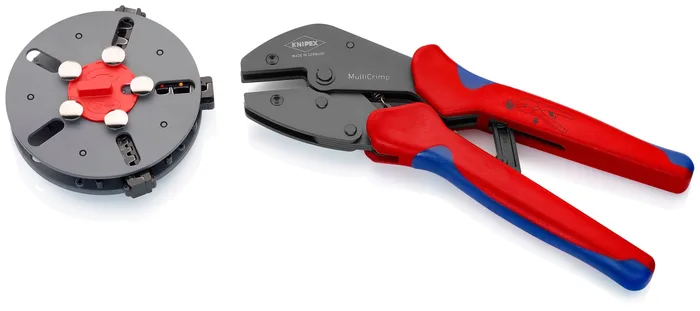
- Knipex 97 33 01 MultiCrimp Crimping Pliers - Buy. One lever-action frame with three labelled dies in a belt-clip magazine, each cut for a different terminal family.
- Ideal Electrical Crimpmaster 30-500 Ratcheting Crimp Tool with Insulated Terminal Die Set - Buy. A ratcheting frame that will not open until the cycle finishes, sold with the insulated terminal die set and thirteen die sets available.
- Wiha 43612 Ratchet Crimper for End Sleeves - It depends. A German-made ratcheting ferrule crimper with six fixed positions that does end sleeves beautifully and nothing else at all.
- Klein Tools 1010 Long Nose Multi Tool Wire Stripper, Wire Cutters, Crimping Tool - Skip. A well made American stripper and cutter whose crimping section is one stamped jaw asked to serve two terminal families with no ratchet.
The verdict in 30 seconds
What mattered most
- Terminal families the dies suit
- Ratchet or cycle lock
- Interchangeable dies
- Stated capacity
- Maker names a terminal standard
- Published pull-out force figure
A crimp is not a squeeze. Done correctly it compresses the terminal barrel around the strands hard enough to break down the surface oxides and force clean metal against clean metal, which is why the goal is a gas tight joint rather than a tight grip. That only happens if the die profile in the tool matches the barrel it is closing, because insulated terminals, non-insulated terminals and ferrules are all formed differently. We looked at four tools that sit at four different points on that problem, from a die-changing frame to a jaw stamped into the back of a wire stripper.
One lever-action frame with three labelled dies in a belt-clip magazine, each cut for a different terminal family.
Best for: Someone who crimps insulated terminals one week and ferrules the next and wants the same frame to do both properly.
- Three dies cover non-insulated open plug connectors, insulated terminals and butt connectors, and insulated and non-insulated ferrules.
- Dies change without any additional tool, and the locking system holds them in the frame.
- Knipex states the capacity for each die separately rather than quoting one blanket range.
- Tops out at 6.0 mm2, so heavier cable lugs need the five-die 97 33 02 or a different tool.
- The magazine is one more thing to lose, and the dies are not cheap to replace individually.
- We found no pull-out force figure or pull-test standard published for this model.
- It is the most expensive way to buy a first crimper if you only ever use one terminal type.
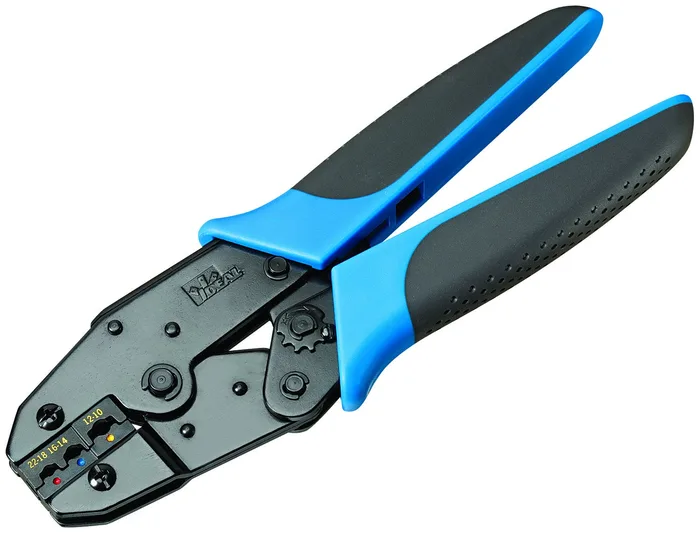
A ratcheting frame that will not open until the cycle finishes, sold with the insulated terminal die set and thirteen die sets available.
Best for: The buyer who mostly crimps insulated ring and spade terminals but wants a route to other terminal families later.
- Ideal states the ratchet prevents under-crimping by not releasing the connector until a full crimping cycle is completed.
- The supplied 30-579 die set is colour coded red 22-18, blue 16-14 and yellow 12-10 AWG, matching standard insulated terminals.
- Die sets swap with a flathead or Phillips screwdriver, and the frame is also sold on its own as the 30-506.
- Changing dies needs a screwdriver, so in practice you will buy a second frame rather than swap mid-job.
- Only the insulated terminal die is included; ferrules and non-insulated lugs mean buying more.
- Ideal states the tool requires no factory calibration, which is a convenience claim and not a crimp force specification.
- Warranty is listed as limited one year.
- Ideal states it is a general purpose crimper, not intended for applications requiring calibrated tools.
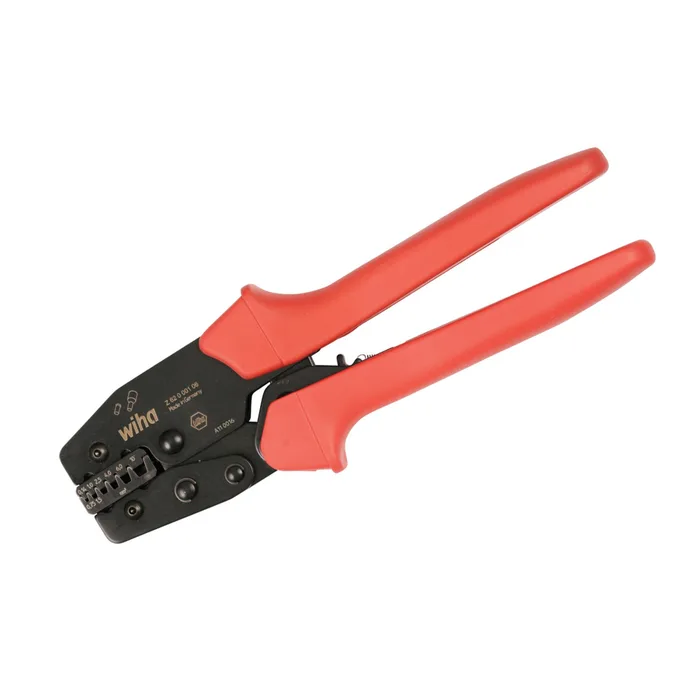
A German-made ratcheting ferrule crimper with six fixed positions that does end sleeves beautifully and nothing else at all.
Best for: Control panel and DIN rail work, where nearly every stranded conductor gets a ferrule before it enters a terminal block.
- Six crimp positions covering insulated and non-insulated end sleeves from 26 to 8 AWG.
- Factory set auto release at the end of the crimp cycle, so the tool decides when the crimp is finished.
- Wiha's no-hassle guarantee covers repair or replacement within twelve months of purchase.
- Ferrules only. It will not crimp ring terminals, spade terminals or butt connectors.
- Fixed dies, so there is no upgrade path when the job changes.
- The US listing gives no crimp profile, no DIN reference and no pull-force figure, although Wiha's wider catalogue does cite DIN 46228 for ferrule tools.
- Priced above tools that cover three terminal families, which only makes sense if ferrules are most of your work.
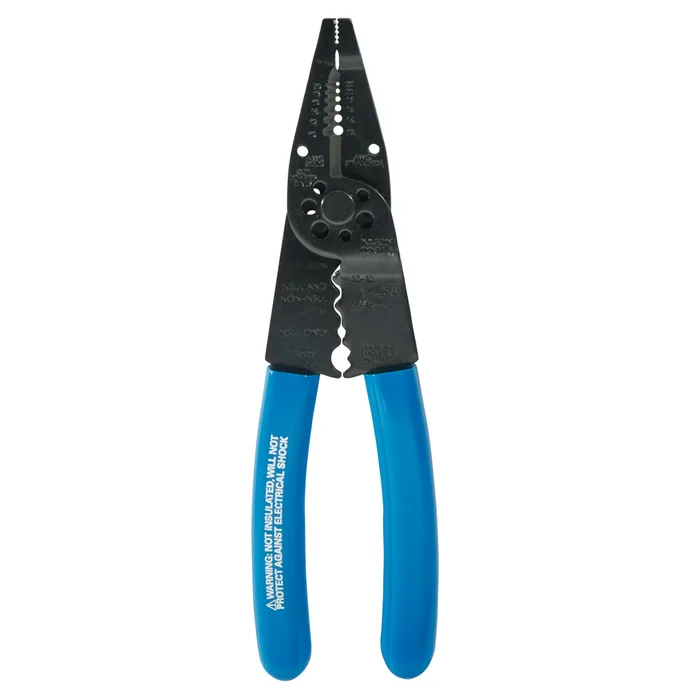
A well made American stripper and cutter whose crimping section is one stamped jaw asked to serve two terminal families with no ratchet.
Best for: Buy it as a stripper and cutter, which it is very good at, and crimp with something else.
- Excellent as a stripper and cutter: 10-20 AWG solid and 12-22 AWG stranded, plus screw shearing from 4-40 to 10-24.
- Light at 6.9 ounces and 8.25 inches long, so it lives in a pouch rather than a toolbox.
- Made in USA, and the cutting and stripping holes sit ahead of the pivot for tight spaces.
- Klein's published crimping capacity is 10-22 AWG insulated and non-insulated terminals, two families that need different die profiles, through one jaw.
- No ratchet is listed anywhere in the specification, so nothing stops you opening the tool mid-crimp.
- How hard you squeeze is the only variable you control, and the joint that results is not repeatable between people.
- It is not a crimping tool that also strips; it is a stripper with a crimp shape stamped into it.
| Criteria | 97 33 01 MultiCrimp Crimping Pliers Top pick | Crimpmaster 30-500 Ratcheting Crimp Tool with Insulated Terminal Die Set | 43612 Ratchet Crimper for End Sleeves | 1010 Long Nose Multi Tool Wire Stripper, Wire Cutters, Crimping Tool |
|---|---|---|---|---|
| Verdict | Buy it | Buy it | It depends | Skip it |
| Best for | Someone who crimps insulated terminals one week and ferrules the next and wants the same frame to do both properly. | The buyer who mostly crimps insulated ring and spade terminals but wants a route to other terminal families later. | Control panel and DIN rail work, where nearly every stranded conductor gets a ferrule before it enters a terminal block. | Buy it as a stripper and cutter, which it is very good at, and crimp with something else. |
| Price tier | $$$ · premium | $$ · mid-range | $$$ · premium | $ · budget |
| Terminal families the dies suit | Non-insulated open plug connectors, insulated terminals and butt connectors, insulated and non-insulated ferrules | Insulated terminals with the supplied die set; other families need other die sets | Insulated and non-insulated end sleeves (ferrules) only | Insulated and non-insulated terminals, both through the same jaw |
| Ratchet or cycle lock | Integral lock with self-releasing mechanism | Will not release the connector until a full crimping cycle is completed | Factory set auto release at the end of the crimp cycle | None listed |
| Interchangeable dies | Yes, 3 dies, changed by hand with no tool | Yes, 13 die sets available, changed with a screwdriver | No, 6 fixed positions | No, fixed stamped jaw |
| Stated capacity | 0.25 to 6.0 mm2 depending on die | 22 to 10 AWG with the supplied 30-579 die set | 26 to 8 AWG | 10 to 22 AWG terminals |
| Maker names a terminal standard | None found for these three dies | No standard named on the listing | None on the US listing; Wiha's catalogue cites DIN 46228 for ferrule tools | No standard named |
| Published pull-out force figure | None | None | None | None |
| Weight | Not confirmed | Not published on the listing | 1.2 lb | 6.9 oz |
| Strips wire as well | No | No | No | Yes, 10-20 AWG solid and 12-22 AWG stranded |
Which one is right for you?
- Someone who crimps insulated terminals one week and ferrules the next and wants the same frame to do both properly. Buy it Knipex 97 33 01 MultiCrimp Crimping Pliers
- The buyer who mostly crimps insulated ring and spade terminals but wants a route to other terminal families later. Buy it Ideal Electrical Crimpmaster 30-500 Ratcheting Crimp Tool with Insulated Terminal Die Set
- Control panel and DIN rail work, where nearly every stranded conductor gets a ferrule before it enters a terminal block. It depends Wiha 43612 Ratchet Crimper for End Sleeves
- Buy it as a stripper and cutter, which it is very good at, and crimp with something else. Skip it Klein Tools 1010 Long Nose Multi Tool Wire Stripper, Wire Cutters, Crimping Tool
How we judged the field
Five things decide whether a hand crimper produces a joint that lasts. First, whether the die profile matches the terminal family, because an insulated barrel, a non-insulated barrel and a ferrule are formed into three different shapes and a die cut for one will not properly close the others. Second, whether the tool completes its cycle: NASA-STD-8739.4A requires a full-cycle ratcheting mechanism that prevents the dies releasing before the crimp is finished, and the FAA requires the same in Advisory Circular 43.13-1B. Third, whether the maker actually tells you which terminals the die suits, rather than printing a bare AWG range. Fourth, the honesty of the capacity claim, since a range that spans everything usually means a profile optimised for nothing. Fifth, whether the crimping section is a real supported die or a shape stamped into a stripper.
The field splits cleanly along the first of those. At the top are frames with interchangeable dies, where changing terminal family means changing the die, and Knipex and Ideal are the two most credible routes into that. Below them sit excellent single-purpose tools with fixed dies, of which Wiha’s ferrule crimper is a good example, superb inside its lane and useless outside it. At the bottom are combination tools that put several terminal families through one unratcheted jaw, and Klein’s 1010 is the most widely bought example. We picked one of each so the trade-off is visible rather than argued.
Knipex 97 33 01 MultiCrimp Crimping Pliers
Buy itThe Knipex 97 33 01 is built around the admission that no single die serves every terminal. The lever-action frame takes three interchangeable dies stored in a round fibreglass-reinforced magazine with a belt clip: one for non-insulated open plug connectors in 4.8 and 6.3 mm widths from 0.5 to 6.0 mm2, one for insulated terminals, plug connectors and butt connectors over the same range, and one for insulated and non-insulated ferrules from 0.25 to 6.0 mm2. Dies swap by hand with no tool and lock into the frame, which matters because a die that moves under load does not close the barrel evenly. Knipex describes the mechanism as an integral lock with a self-releasing action, and quotes each die’s capacity separately rather than one blanket figure. The frame runs out at 6.0 mm2, so heavier compression lugs need the five-die 97 33 02. For anyone whose work moves between terminal types, this is the tool that removes the excuse.
Ideal Electrical Crimpmaster 30-500 Ratcheting Crimp Tool with Insulated Terminal Die Set
Buy itThe Ideal Crimpmaster 30-500 gets to the same architecture by a different route and for less. You buy a black oxide high carbon steel frame with the 30-579 insulated terminal die set already fitted, colour coded red for 22-18, blue for 16-14 and yellow for 12-10 AWG, matching the standard insulated terminal colours. Ideal is unusually direct about what the ratchet does: it prevents under-crimping by not releasing the connector until a full crimping cycle is completed, and there is a release lever between the handles if you need to abort. Thirteen die sets exist across terminals, coax and modular plugs, and the frame alone is sold as the 30-506. The catch is the swap: dies are held by screws and need a flathead or Phillips, so in practice people who work across families end up owning two frames rather than changing dies on a ladder. Warranty is a limited one year.
Wiha 43612 Ratchet Crimper for End Sleeves
It dependsThe Wiha 43612 is the tool to buy if your work is ferrules, and the wrong tool if it is not. Wiha lists six crimp positions covering insulated and non-insulated end sleeves from 26 to 8 AWG, softgrip handles, and a factory set auto release at the end of the crimp cycle, which is the same completion guarantee the aerospace standards ask for. It is made in Germany and covered by Wiha’s repair or replace guarantee within twelve months. What it cannot do is anything with a ring, spade or butt terminal, because the dies are fixed and cut for sleeves. It also sits at a premium tier despite covering one family, which only makes financial sense if ferrules are most of what you crimp. Worth noting that Wiha’s wider catalogue names DIN standards per tool, including DIN 46228 for ferrule crimpers, even though the US listing for this model does not.
Klein Tools 1010 Long Nose Multi Tool Wire Stripper, Wire Cutters, Crimping Tool
Skip itThe Klein 1010 is a good tool being asked to do something it is not built for. As a stripper and cutter it is genuinely excellent, handling 10-20 AWG solid and 12-22 AWG stranded, shearing screws from 4-40 through 10-24, made in the USA, and light enough at 6.9 ounces to live in a pouch. The problem is the crimping section. Klein’s own published capacity is 10-22 AWG insulated and non-insulated terminals, and those are two families that need two different die geometries: an oval compression for the insulated sleeve, an indenter and nest for the bare barrel. One stamped opening cannot be both. There is no ratchet anywhere in the specification, so the crimp ends when your grip does, and the result varies between users, between terminals and between the start and end of a long day. Buy it for what it is good at and crimp with a dedicated tool.
Sources
Specs in this review come from these pages.
- FAA Advisory Circular 43.13-1B, Chapter 11: Aircraft Electrical Systems (faa.gov)
- NASA-STD-8739.4A, Crimping, Interconnecting Cables, Harnesses, and Wiring (standards.nasa.gov)
- UL Standards, UL 486A-486B Wire Connectors (shopulstandards.com)
- IEC 60352-2, Solderless connections, Part 2: Crimped connections (webstore.ansi.org)
- Knipex MultiCrimp 97 33 01 product page (knipex-tools.com)
- Wiha crimping tools catalogue, with DIN references by terminal type (wiha.com)
Knipex 97 33 01 MultiCrimp Crimping Pliers vs Ideal Electrical Crimpmaster 30-500 Ratcheting Crimp Tool with Insulated Terminal Die Set: which should you buy?
Both the Knipex and the Ideal are the right kind of tool, and the choice comes down to how often your terminals change. The Knipex holds three dies in a magazine on your belt and swaps them by hand in seconds, which is the difference between owning the correct die and actually using it. The Ideal holds one die at a time, fixed with screws, and expects you to plan the job before you start. If your week alternates between insulated ring terminals on a vehicle and ferrules going into a terminal block, the Knipex will change your habits and the Ideal will not.
If your terminals rarely change, the calculation reverses. The Ideal frame plus the insulated terminal die set does the single most common job in this category at a mid-range tier, with a ratchet whose behaviour Ideal describes plainly, and the thirteen-die catalogue means you are not locked out of coax or modular plugs later. Buy the Knipex if variety is the problem you have. Buy the Ideal if consistency is, and put the difference toward a second frame when a second terminal family turns up.
What to look for
- Match the die to the terminal, not just the wire gauge: insulated barrels, bare barrels and ferrules are formed into three different shapes, and a tool that lists one AWG range for all of them is telling you it optimised for none.
- Insist on a full cycle ratchet: NASA-STD-8739.4A requires a mechanism that stops the dies releasing before the crimp is complete, and the FAA requires the same in AC 43.13-1B, which is the single cheapest reliability upgrade in the category.
- Understand what the ratchet does not promise: completion is not calibration, and both standards treat crimp force adjustment as a separate matter that only the maker or a calibration lab should touch.
- Look for a named terminal family or a named standard: Wiha cites DIN 46228 for ferrule tools and DIN 46234 elsewhere in its catalogue, Knipex names the connector types per die, and a listing that names neither is asking you to guess.
- Pull test your own work: NASA-STD-8739.4A defines minimum tensile values by wire size, and UL 486A-486B does the same for connectors, so a crimp that moves under a firm hand pull is suspect.
- Do not crimp anything that matters with a stripper: a combination tool’s stamped jaw is unsupported and unratcheted, which is fine for a temporary accessory lead and not fine for current in a vehicle, boat or panel.
Our final take
Buy the crimper that forces you to pick a die. The Knipex 97 33 01 does that best, because three labelled dies live in a magazine on your belt and change by hand, and the tool holds them without play while the barrel deforms. The Ideal Crimpmaster 30-500 gets you the same discipline for less if you can plan the job before you start, and its ratchet behaviour is described more plainly than anyone else’s here. The Wiha 43612 is a lovely tool with one job, so buy it only if ferrules are most of your work. Whatever you choose, keep the crimper on your wire stripper for stripping. The joint you cannot see is the one you should be most careful about.
Questions, answered
Do insulated terminals, non-insulated terminals and ferrules really need different dies?
Yes, and the tool makers organise their entire catalogues around it. Knipex ships the MultiCrimp with one die for insulated terminals, a separate one for non-insulated open plug connectors and a third for ferrules. Ideal sells a bare frame and thirteen die sets, including separate insulated and non-insulated terminal dies. The reason is that the three barrels are formed differently: an insulated terminal is compressed through its plastic sleeve into an oval, a non-insulated barrel is indented by a nest and indenter, and a ferrule is squeezed into a square or hexagon. Terminal makers set crimp height specifications per terminal, so using the wrong profile gives you a joint that looks crimped and has not made the metal to metal contact the terminal was designed for.
Does a ratcheting crimper guarantee a correct crimp?
No, and this is the most common misunderstanding in the category. What the ratchet guarantees is completion, not force. NASA-STD-8739.4A requires crimp tools to contain a full-cycle ratcheting mechanism that prevents the indenters from releasing before the crimp cycle has been completed, and it treats calibration as a completely separate requirement, one that only the tool maker or a calibration laboratory may adjust. The FAA says the same thing in Advisory Circular 43.13-1B, requiring that the ratchet cannot be disengaged prior to or during the crimp cycle and separately requiring go and no-go gauges to check crimp dimensions. So a ratchet stops you letting go halfway. It does not tell you the die was right, that the wire was the right size for the barrel, or that the tool has not drifted.
Is crimping actually better than soldering for stranded wire that vibrates?
The standards bodies clearly prefer crimping, though the evidence they publish is procedural rather than comparative. FAA Advisory Circular 43.13-1B directs that solderless crimp style copper terminal lugs should be used for aircraft wiring and lists solderless terminals among the approved junction devices. NASA-STD-8739.4A goes further and prohibits crimping solid wire and crimping solder tinned stranded wire. The usual explanation, that solder wicks up the strands and creates a rigid point where the wire then fatigues, is physically sensible and widely repeated in industry material, but we did not find a standards body publishing a side by side fatigue comparison. Treat it as a strong professional consensus backed by mandatory practice rather than as a measured result.
How much pull-out force should a crimp survive, and can I check it?
Standards exist with real numbers, even though no consumer crimper maker we checked prints one. UL 486A-486B sets minimum tensile values for crimped wire connectors. NASA-STD-8739.4A lists 142 newtons at 18 AWG, 290 newtons at 14 AWG and 459 newtons at 12 AWG for copper wire, and for sizes not listed it uses no less than 60 percent of the wire's own tensile strength. IEC 60352-2 covers the same ground internationally. At home you cannot measure that precisely, but a firm hand pull that shifts the wire in the barrel is already a failed crimp.
Is the crimper on my combination wire stripper good enough?
For anything that matters, no. Look at what those tools claim: Klein lists the 1010's crimping capacity as 10-22 AWG insulated and non-insulated terminals, which are two families that need two different die geometries, served by one stamped opening. There is no ratchet, so the crimp ends when your hand gets tired, and the jaw is unsupported so the barrel can roll rather than being held while it deforms. That is fine for a low current accessory you can re-do, and genuinely bad for anything carrying current in a vehicle, a boat or a panel. Keep the combination tool for stripping and cutting, which it does well, and spend separately on a crimper with a ratchet and a die that names the terminal it was cut for.
Does the stripper I already own matter here?
It matters more than it looks. A crimp is only as good as the conductor going into it, and a stripper that nicks a strand puts the weak point right where the terminal grips. It also matters that the gauge markings on a stripper assume a particular insulation, so a hole marked for one wire type can bite into another. Our [wire stripper comparison](/best-wire-strippers/) covers which tools state that and which stay quiet about it.
Deciding between the top two? See our head-to-head: Knipex 97 33 01 MultiCrimp Crimping Pliers vs Ideal Electrical Crimpmaster 30-500 Ratcheting Crimp Tool with Insulated Terminal Die Set.
More Tools & DIY reviews
 The Best Cut-Resistant Gloves: 4 Compared (and One to Skip)
  The Best Digital Calipers: 4 Compared (and One to Skip)
  The Best Drill and Driver Bit Sets: 4 Compared (and One to Skip)
  The Best Electric Screwdrivers: 4 Compared (and One to Skip)
  The Best Extension Cords for Tools: 4 Compared (and One to Skip)
  The Best Fall Protection Harnesses: 4 Compared (and One to Skip)