

Tools & DIY
The Best Digital Calipers: 4 Compared (and One to Skip)
We compared four 6 inch digital calipers on the spec that actually decides whether you can trust a reading: published accuracy, not display resolution. Also body material, IP rating, battery type and data output.
The short version
The Mitutoyo 500-196-30 is the one to buy if you want a caliper you can stop thinking about: plus or minus 0.001 inch published accuracy across the full 0 to 6 inch range, an ABSOLUTE induction encoder, and a silver oxide SR44 cell that Mitutoyo rates at roughly 3.5 years of normal use. The iGaging OriginCal 100-700-06 is the value pick and gets you the same published 0.02 mm accuracy plus an IP54 rating, an SPC output with USB connection available and a CR2032 cell you can buy in any supermarket. The VINCA DIPA-0605 is the depends pick: it is IP67 rated for coolant and washdown at a mid-range price, which is the right answer for a wet workshop, but its listing does not state a battery type and the non-Bluetooth version has no data port at all. Skip the Neiko 01417A, a plastic bodied caliper that publishes 0.1 mm resolution and plus or minus 0.2 mm accuracy, roughly ten times coarser than a steel caliper in the same budget tier. The number that decides everything here is accuracy, not the count of digits on the screen. Best for: anyone who wants a caliper whose published accuracy they can actually rely on.
Our picks at a glance
- Mitutoyo 500-196-30 ABSOLUTE Digimatic Caliper - Buy. The reference 6 inch caliper: published accuracy of plus or minus 0.001 inch, an absolute induction encoder that never needs re-zeroing, and a battery life measured in years.
- iGaging OriginCal 100-700-06 iP54 Absolute Digital Caliper - Buy. Publishes the same 0.001 inch / 0.02 mm accuracy as the reference tool, adds IP54 sealing and an SPC output with USB connection available, and runs on a CR2032 you already own.
- VINCA DIPA-0605 iP67 Digital Caliper - It depends. Full IP67 coolant and water proofing with plus or minus 0.02 mm published accuracy at a mid-range price, if you can live with a thinner spec sheet.
- Neiko 01417A 6 Inch Digital Caliper - Skip. An honestly specified but genuinely coarse plastic caliper: 0.1 mm resolution and plus or minus 0.2 mm accuracy, when steel calipers in the same budget tier publish 0.01 mm and 0.02 mm.
The verdict in 30 seconds
What mattered most
- Range
- Resolution
- Published accuracy
- Frame material
- IP rating
- Battery
A digital caliper is the one measuring tool most workshops use every single day, and it is also the tool people buy worst. The listings are full of resolution figures, and resolution is the number that does not tell you how right the reading is. Accuracy is a separate, published figure, and the gap between the two is where bad purchases happen. We picked four 6 inch calipers whose makers publish real specification sheets, then judged them on accuracy, construction, sealing and how they handle power.
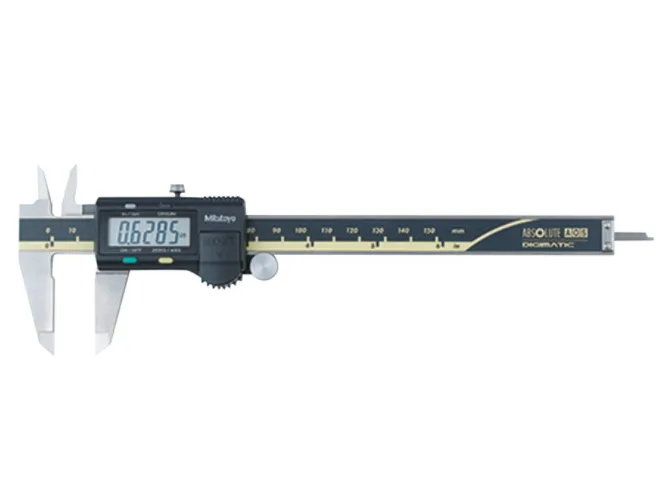
The reference 6 inch caliper: published accuracy of plus or minus 0.001 inch, an absolute induction encoder that never needs re-zeroing, and a battery life measured in years.
Best for: Anyone who wants one caliper for the next decade and would rather buy the reference tool than audit a spec sheet.
- Accuracy of plus or minus 0.001 inch (the metric models in the same series are specified at plus or minus 0.02 mm) is stated for the full 0 to 150 mm range, not just near zero.
- The ABSOLUTE electromagnetic induction encoder holds its origin through power cycles, and Mitutoyo states the maximum response speed is unlimited, so you cannot outrun it by sliding fast.
- Mitutoyo rates the single SR44 silver oxide cell at approximately 3.5 years under normal use, and the caliper ships in a fitted plastic case.
- This order number is the version without the SPC data output port; if you want to log readings you need the 500-171-30 instead.
- No IP rating is published for this model, so coolant, chips and washdown mean stepping up to the separate coolant proof order numbers such as 500-752-20.
- SR44 silver oxide cells are less widely stocked than the CR2032 lithium cells the cheaper calipers use.
- It costs several times what a competent budget caliper costs for the same headline accuracy figure.
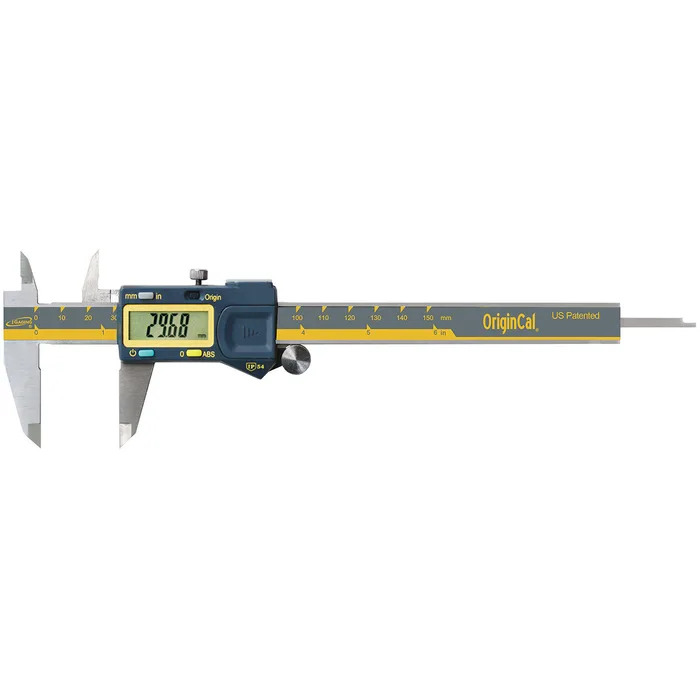
Publishes the same 0.001 inch / 0.02 mm accuracy as the reference tool, adds IP54 sealing and an SPC output with USB connection available, and runs on a CR2032 you already own.
Best for: The hobby machinist, 3D printer owner or woodworker who wants a genuinely specified caliper and a data port without a premium outlay.
- iGaging publishes accuracy per order number, and the 6 inch 100-700-06 is specified at 0.001 inch / 0.02 mm at 0.0005 inch / 0.01 mm resolution.
- IP54 rating for moisture and dust, a hardened stainless steel frame, and an SPC output with USB connection available for logging readings.
- Absolute encoding memorises the origin zero, and the 3V CR2032 cell is the single most available battery format there is.
- IP54 is splash and dust resistance, not coolant proofing, so it is the wrong tool to leave in a flood of cutting fluid.
- Specifications are listed per order number, so check the accuracy line for the length you actually order rather than assuming the 6 inch figure carries over.
- The catalogue does not publish a jaw hardness figure or an auto power off time for this model.
- Fit and finish of the slider is a step below the Japanese tool, and the data kits are an extra purchase.
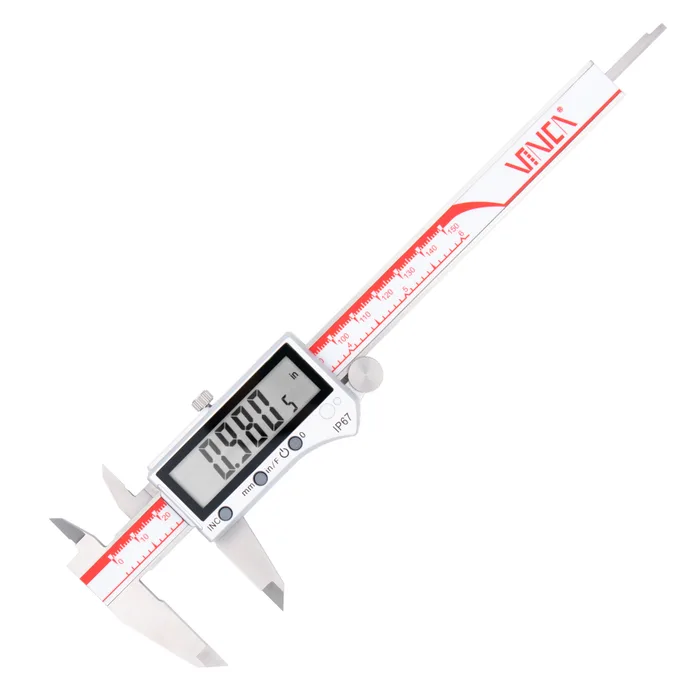
Full IP67 coolant and water proofing with plus or minus 0.02 mm published accuracy at a mid-range price, if you can live with a thinner spec sheet.
Best for: Someone working around coolant, water or grinding dust who wants sealing they can trust without paying premium metrology prices.
- IP67 rating means it is specified against water and coolant, not merely splashes, which is the single biggest durability upgrade a shop caliper can have.
- Published accuracy of plus or minus 0.001 inch / 0.02 mm at 0.0005 inch / 0.01 mm resolution puts it level with far more expensive tools on paper.
- Inch, metric and 1/128 inch fraction display plus an incremental mode that shows how far off a target size each part is.
- The product listing does not state a battery type, so you are ordering without knowing what cell it takes.
- This version has no data output; wireless logging means buying the DIPA-0605B variant instead.
- Auto power off is fixed at five minutes with no stated adjustment, which is a nuisance during slow layout work.
- No jaw hardness, no standard cited, and no inspection certificate offered, so the accuracy claim is the maker's word alone.
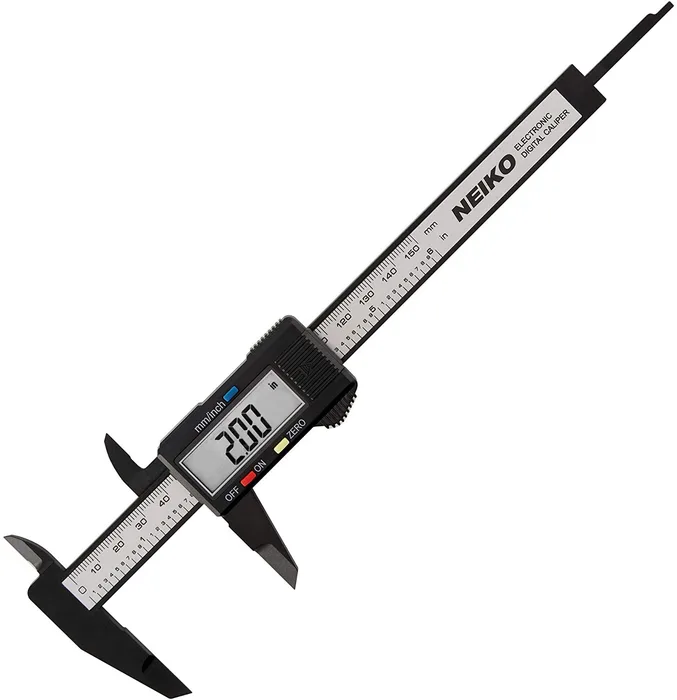
An honestly specified but genuinely coarse plastic caliper: 0.1 mm resolution and plus or minus 0.2 mm accuracy, when steel calipers in the same budget tier publish 0.01 mm and 0.02 mm.
Best for: Almost nobody buying a first caliper; at most, a spare for measuring soft, painted or delicate items where a steel jaw would mark the work.
- Neiko does publish both figures, accuracy of plus or minus 0.01 inch / 0.2 mm and resolution of 0.01 inch / 0.1 mm, which is more than many budget listings manage.
- Light enough to live in a pocket or a toolbox drawer, and it will not scratch soft or painted work the way ground steel jaws can.
- Ships with an LR44 cell installed plus a spare, has an auto-off function, and zeroes at any point on the slide.
- Plus or minus 0.2 mm accuracy cannot confirm a press fit, a bearing seat or a 3D print tolerance; it is a rough-and-ready gauge, not a measuring instrument.
- The 0.1 mm resolution is ten times coarser than the steel calipers here, and the price tier is the same, so you give away an order of magnitude for nothing.
- The plastic beam and jaws deflect under measuring force, which stacks on top of the already loose specification rather than cancelling it.
- No IP rating, no data output and no serviceable jaw hardness figure are published.
| Criteria | 500-196-30 ABSOLUTE Digimatic Caliper Top pick | OriginCal 100-700-06 iP54 Absolute Digital Caliper | DIPA-0605 iP67 Digital Caliper | 01417A 6 Inch Digital Caliper |
|---|---|---|---|---|
| Verdict | Buy it | Buy it | It depends | Skip it |
| Best for | Anyone who wants one caliper for the next decade and would rather buy the reference tool than audit a spec sheet. | The hobby machinist, 3D printer owner or woodworker who wants a genuinely specified caliper and a data port without a premium outlay. | Someone working around coolant, water or grinding dust who wants sealing they can trust without paying premium metrology prices. | Almost nobody buying a first caliper; at most, a spare for measuring soft, painted or delicate items where a steel jaw would mark the work. |
| Price tier | $$$ · premium | $ · budget | $$ · mid-range | $ · budget |
| Range | 0 to 6 in / 0 to 150 mm | 0 to 6 in / 0 to 150 mm | 0 to 6 in / 0 to 150 mm | 0 to 6 in / 0 to 150 mm |
| Resolution | 0.0005 in / 0.01 mm | 0.0005 in / 0.01 mm | 0.0005 in / 0.01 mm, 1/128 in | 0.01 in / 0.1 mm |
| Published accuracy | plus or minus 0.001 in | 0.001 in / 0.02 mm | plus or minus 0.001 in / 0.02 mm | plus or minus 0.01 in / 0.2 mm |
| Frame material | Not stated in the catalogue | Stainless steel | Stainless steel | Plastic |
| IP rating | None published | IP54 | IP67 | None published |
| Battery | SR44 silver oxide, approx 3.5 years claimed | 3V CR2032 | Not published | LR44, spare included |
| Data output | No port on this order number | SPC output, USB connection available | None on this version | None published |
| Inspection certificate | Not stated for this order number | Not stated | Not offered on this listing | Not offered |
Which one is right for you?
- Anyone who wants one caliper for the next decade and would rather buy the reference tool than audit a spec sheet. Buy it Mitutoyo 500-196-30 ABSOLUTE Digimatic Caliper
- The hobby machinist, 3D printer owner or woodworker who wants a genuinely specified caliper and a data port without a premium outlay. Buy it iGaging OriginCal 100-700-06 iP54 Absolute Digital Caliper
- Someone working around coolant, water or grinding dust who wants sealing they can trust without paying premium metrology prices. It depends VINCA DIPA-0605 iP67 Digital Caliper
- Almost nobody buying a first caliper; at most, a spare for measuring soft, painted or delicate items where a steel jaw would mark the work. Skip it Neiko 01417A 6 Inch Digital Caliper
How we judged the field
Five things decide whether a digital caliper is worth owning. First, published accuracy: the maker has to state, in writing and per order number, how far a reading may sit from truth, and a listing that gives you resolution and nothing else is telling you it has not been tested. Second, how that accuracy is stated across the range, because error grows with length and a single headline figure often only applies to the short end. Third, construction: a stainless beam that resists flex and jaws hard enough to survive daily contact, because a bent or worn jaw quietly destroys a specification that was fine on the day it left the factory. Fourth, sealing, since coolant and grinding dust kill capacitive scales faster than anything else. Fifth, power, because a caliper with a proprietary cell or a scale that keeps counting when the screen is blank is a caliper that is flat when you need it.
The field splits cleanly into three groups. At the top are the metrology houses, Mitutoyo among them, who publish accuracy per order number and build IP67 and carbide-jaw variants of the same tool. In the middle sits a band of specification-literate value brands, iGaging and Clockwise Tools among them, who publish per-model accuracy tables that hold up to reading and offer data output options. At the bottom are the anonymous budget calipers, where the display resolution is the headline and the accuracy figure is either absent or, when it is present, an order of magnitude worse than buyers assume. We took one from the top, one from the value band, one that is unusual enough to be a conditional buy, and one from the bottom that sells in enormous numbers and should not.
Mitutoyo 500-196-30 ABSOLUTE Digimatic Caliper
Buy itThe Mitutoyo 500-196-30 is what everyone else is measured against, and the spec sheet explains why. It is a 0 to 6 inch, 0 to 150 mm caliper with 0.0005 inch / 0.01 mm resolution and a published accuracy of plus or minus 0.001 inch, which Mitutoyo states for the whole range rather than the easy part of it. The scale is an ABSOLUTE electromagnetic induction encoder, so it holds its origin through power cycles and Mitutoyo lists the maximum response speed as unlimited, meaning you cannot generate a false reading by sliding it quickly. One SR44 silver oxide cell is rated at roughly 3.5 years under normal use. The trade-off is specific: this particular order number has no SPC data output port, and no IP rating is published for it, so a wet shop needs one of the separate coolant proof numbers. It is for the person who wants to buy once and stop reading spec sheets.
iGaging OriginCal 100-700-06 iP54 Absolute Digital Caliper
Buy itThe iGaging OriginCal 100-700-06 is the interesting one, because it publishes the same headline number as the Japanese tool. iGaging’s own catalogue specifies the 6 inch model at 0.001 inch / 0.02 mm accuracy with 0.0005 inch / 0.01 mm resolution, on a stainless steel frame, with an iP54 rating for moisture and dust and an SPC data output with USB connection available. Power is a 3V CR2032, the most available cell on earth, and the absolute encoding memorises the origin zero so it wakes up where you left it. What you give up is margin and finish: iP54 is splash resistance, not coolant proofing, the slider feel is a rung below the reference tool, and accuracy is listed per order number, so check the line for the length you buy. For a bench that stays broadly dry, this is the sensible buy.
VINCA DIPA-0605 iP67 Digital Caliper
It dependsThe VINCA DIPA-0605 exists for one reason: it is iP67 rated at a mid-range price. Dust tight and protected against temporary immersion is a genuinely different class of protection from splash resistance, and it is normally something you pay premium metrology money for. The rest of the sheet holds up too, with a stainless steel body, plus or minus 0.001 inch / 0.02 mm published accuracy, 0.0005 inch / 0.01 mm resolution, a 1/128 inch fraction mode that woodworkers will use, and an incremental mode that shows how far each part sits from a target size. The gaps are real, though. The listing does not state what battery it takes, this version has no data output at all, auto power off is fixed at five minutes, and there is no inspection certificate or cited standard behind the accuracy claim. Buy it if your workshop is wet and you accept a thinner paper trail.
Neiko 01417A 6 Inch Digital Caliper
Skip itThe Neiko 01417A is the caliper that sells in enormous numbers and should not. To Neiko’s credit the figures are published rather than hidden: 0 to 6 inch and 0 to 150 mm range, resolution of 0.01 inch / 0.1 mm, accuracy of plus or minus 0.01 inch / 0.2 mm, an LR44 cell with a spare in the box and a physical on and off control. Read those numbers next to the others on this page and the problem is obvious. The resolution is ten times coarser and the accuracy roughly ten times worse than a stainless caliper sitting in the same budget tier, so you are not saving anything, you are just buying less tool. The plastic beam and jaws make it worse, because they deflect under measuring force and add error on top of an already loose specification. It cannot confirm a bearing seat, a press fit or a 3D print tolerance. It is for measuring soft or painted items you do not want scratched, and nothing else.
Sources
Specs in this review come from these pages.
- Mitutoyo, AOS Absolute Digimatic Caliper CD-AX/APX Series, Bulletin No. 2129 (mitutoyo.com)
- Mitutoyo, Small Tool Instruments catalogue, Calipers section (D) (mitutoyo.com)
- Mitutoyo, Quick Guide to Precision Measuring Instruments: Calipers (www2.mitutoyo.co.jp)
- ISO 13385-1:2019, Dimensional measuring equipment: design and metrological characteristics of callipers (iso.org)
- iGAGING Master Catalog 2026 (Internet Archive copy; igaging.com no longer serves a valid TLS certificate) (web.archive.org)
- Clockwise Tools, VINCA DIPA-0605 IP67 Digital Caliper product page (clockwisetools.com)
- Penn Tool Co, iGaging 6 inch IP54 Digital Caliper Absolute Origin 100-700-06 product page (penntoolco.com)
Mitutoyo 500-196-30 ABSOLUTE Digimatic Caliper vs iGaging OriginCal 100-700-06 iP54 Absolute Digital Caliper: which should you buy?
The choice between the Mitutoyo 500-196-30 and the iGaging OriginCal 100-700-06 is not really a fight about accuracy, because both makers publish the same headline figure for a 6 inch caliper: plus or minus 0.001 inch, or 0.02 mm. What separates them is everything around the number. Mitutoyo backs it with an absolute induction encoder with unlimited response speed, and a silver oxide cell rated at about 3.5 years, and it has a spare-parts and calibration ecosystem behind it. iGaging backs it with an iP54 rating the Mitutoyo does not have, an SPC output the Mitutoyo model does not have, a CR2032 you can buy anywhere, and a far smaller outlay.
So choose on how you work rather than on prestige. If the caliper is going to be checked against gauge blocks, used for inspection anyone else relies on, or simply expected to still be right in ten years, buy the Mitutoyo and accept that the data port lives on a different order number. If you want a specified tool for a home shop, a print farm or a woodworking bench, want to log readings, and would rather put the difference towards a decent micrometer, buy the iGaging. The one thing not to do is spend the Mitutoyo money on an unspecified caliper because it displayed more digits.
What to look for
- Accuracy, stated separately from resolution: the display step tells you what the screen can show, and only the published accuracy figure tells you how far from truth the reading may sit.
- Accuracy quoted across the whole range: error can grow with length, and Mitutoyo loosens its inch specification to 0.0015 inch at 12 inches, so check the number for the size you are actually buying.
- A stainless steel beam and jaws: plastic and composite beams flex under measuring force, and that deflection lands directly on the reading rather than cancelling out.
- An IP rating that matches the room: IP54 is dust protected and splash resistant, IP67 is dust tight and survives temporary immersion, and for a dry bench neither is worth trading accuracy for.
- A common battery and a real off control: a CR2032, LR44 or SR44 you can buy locally beats a proprietary cell, and a caliper that genuinely powers down rather than dimming the screen is one you will not find flat.
- A data port if you will ever log readings: SPC, USB or Bluetooth output is usually a different order number rather than an add-on, so decide before you buy rather than after.
Our final take
Buy the Mitutoyo 500-196-30 if you want the reference tool, and the iGaging OriginCal 100-700-06 if you want the same published accuracy plus sealing and a data port for a fraction of the outlay. Take the VINCA DIPA-0605 only if your workshop is genuinely wet, because IP67 at a mid-range price is a real bargain and the thinner spec sheet is the cost of it. Leave the Neiko 01417A on the shelf. And whichever you buy, remember that the specification is a ceiling, not a promise: a caliper does not obey Abbe’s principle, so measuring near the beam with a light, constant force is worth more than any extra digit on the display.
Questions, answered
Is a caliper that displays 0.001 mm more accurate than one that displays 0.01 mm?
Not necessarily, and often not at all. Resolution is the smallest step the display can show; accuracy is how far the reading can legitimately sit from the true size, and it is a separate published figure. Mitutoyo puts the point directly in its own guidance, stating that there is no relationship between resolution and accuracy. Read the accuracy line, then treat resolution as a readability feature.
How accurate does my caliper actually need to be?
For almost all workshop, hobby machining, 3D printing and woodworking use, plus or minus 0.02 mm is comfortably enough. That is the figure Mitutoyo publishes for its metric 0 to 150 mm 500 series calipers and the figure iGaging publishes for the 6 inch OriginCal, so you can get it in both the premium and the budget tier. Chasing a finer number on a caliper is usually the wrong move, because at that level your technique and the tool's design limits dominate. If you genuinely need better than 0.01 mm on an outside dimension, the right answer is a micrometer, which clamps on a constant-force ratchet and sits much closer to the measuring axis.
Why do I get a different reading every time I measure the same part?
Almost always technique, not the instrument. A caliper's jaws stick out well away from the scale, so it does not obey Abbe's principle and any tilt of the slider is multiplied at the jaw tips. Mitutoyo works the example: an error slope of 0.01 mm in 50 mm on 40 mm deep jaws produces 0.008 mm of error at the tip, which is a large fraction of a good caliper's whole specification. Mitutoyo also notes that a caliper has no constant-force device, so the user has to supply an appropriate and constant measuring force. Measure as close to the beam as the part allows, close the jaws with light and repeatable pressure, and stop rocking the tool.
Is an IP rating worth paying for?
It depends entirely on where the tool lives. IP54, which the iGaging OriginCal carries, means dust protected and splash resistant, which covers a normal bench and the occasional wet hand. IP67, which the VINCA DIPA-0605 carries and which Mitutoyo builds into separate coolant proof order numbers, means dust tight and protected against temporary immersion in water, which is the specification you want around flood coolant, grinding slurry or washdown. Mitutoyo air leak tests every coolant proof unit before it ships. If your caliper never sees more than swarf and hand oil, the money is better spent on the accuracy specification.
Should I buy a 6 inch caliper or go straight to 8 or 12 inch?
Buy the shortest one that covers your work. Published accuracy can get worse as the range grows, and you can see it in Mitutoyo's own table: its inch models step from plus or minus 0.001 inch at 6 and 8 inches to plus or minus 0.0015 inch at 12 inches. Longer beams also flex more, and Mitutoyo warns that beam distortion is a major error source on long calipers and that accuracy depends heavily on how the tool is supported. A 6 inch caliper plus a steel rule beats one long caliper for most people.
Deciding between the top two? See our head-to-head: Mitutoyo 500-196-30 ABSOLUTE Digimatic Caliper vs iGaging OriginCal 100-700-06 iP54 Absolute Digital Caliper.
More Tools & DIY reviews
 The Best Drill and Driver Bit Sets: 4 Compared (and One to Skip)
  The Best Electric Screwdrivers: 4 Compared (and One to Skip)
  The Best Extension Cords for Tools: 4 Compared (and One to Skip)
  The Best Fall Protection Harnesses: 4 Compared (and One to Skip)
  The Best Fish Tapes: 4 Compared (and One to Skip)
  The Best Framing Nailers: 4 Compared (and One to Skip)