Explained
Digital Calipers, Explained
After reading, you'll understand why a finer display does not mean a better caliper, what accuracy figures are worth trusting, and why how you hold the tool matters more than the last digit.
In this guide
First-time buyers almost always shop on resolution, because it is the number the listing puts first and it looks like precision. It is not. Resolution is the size of the step the display can show, and a caliper can show a 0.001 mm step while being specified no better than 0.01 mm. The figure that governs whether your part is in tolerance is accuracy, and it lives further down the page, if it is on the page at all.
The 30-second version
- Resolution is display, accuracy is truth, and they are separate published figures that are frequently an order of magnitude apart.
- For nearly all workshop work 0.02 mm is plenty, and you can buy that specification in both the premium and the budget tier.
- A caliper breaks Abbe's principle by design, so slider tilt at the jaw tips can add more error than the whole instrument specification allows.
- Measuring force is yours to control, because a caliper has no ratchet or friction thimble to standardise it the way a micrometer does.
- Accuracy is a ceiling, not a guarantee, and worn jaws, a warm workpiece or a rocked tool all spend that budget before you read the screen.
The products this guide is about
Our verdict on each, with the full reasoning on the companion review.
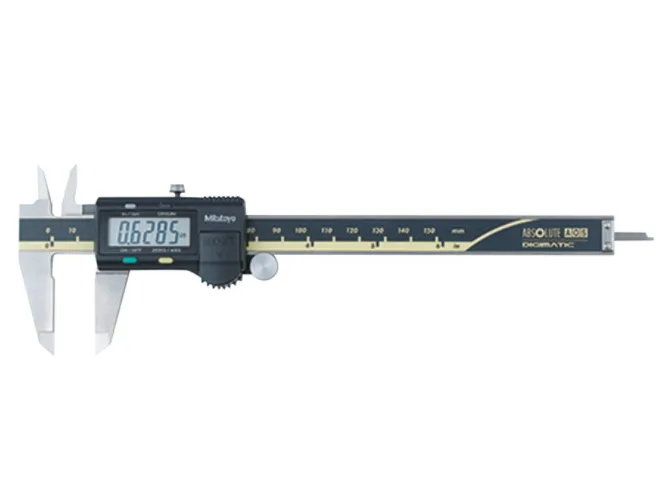
- Buy Mitutoyo 500-196-30 ABSOLUTE Digimatic Caliper The reference 6 inch caliper: published accuracy of plus or minus 0.001 inch, an absolute induction encoder that never needs re-zeroing, and a battery life measured in years. Amazon
- Buy iGaging OriginCal 100-700-06 iP54 Absolute Digital Caliper Publishes the same 0.001 inch / 0.02 mm accuracy as the reference tool, adds IP54 sealing and an SPC output with USB connection available, and runs on a CR2032 you already own. Amazon
- It depends VINCA DIPA-0605 iP67 Digital Caliper Full IP67 coolant and water proofing with plus or minus 0.02 mm published accuracy at a mid-range price, if you can live with a thinner spec sheet. Amazon
- Skip Neiko 01417A 6 Inch Digital Caliper An honestly specified but genuinely coarse plastic caliper: 0.1 mm resolution and plus or minus 0.2 mm accuracy, when steel calipers in the same budget tier publish 0.01 mm and 0.02 mm. Amazon
What actually matters
- Published accuracy - the maximum permissible difference between what the caliper shows and the true size, stated by the maker for a given range. If a listing gives you resolution and no accuracy figure, the honest reading is that nobody has committed to one.
- Resolution - the smallest increment the display can show, typically 0.01 mm or 0.0005 inch on a decent caliper. It affects readability and how easy small differences are to see, but it does not improve how close the reading is to truth.
- Range - how far the jaws open, usually 100, 150, 200 or 300 mm. Accuracy specifications loosen as the range grows within the same product family, so buying more range than you need costs you precision as well as money.
- Abbe error - the error that appears because a caliper's jaws sit well off the axis of its scale, so any tilt of the slider is amplified at the jaw tips. It is the single largest reason two people measuring the same part get two answers.
- Measuring force - the pressure you apply when closing the jaws. A caliper has no constant-force device, so inconsistent force tilts the moving jaw and changes the reading, which is why light and repeatable beats firm.
- IP rating - a two digit code for dust and water protection. IP54 means dust protected and splash resistant; IP67 means dust tight and able to survive temporary immersion, which is what coolant and washdown actually demand.
- Battery and power management - the cell type and how the caliper sleeps. A common CR2032, LR44 or SR44 keeps you running, and an absolute scale that holds its origin means waking up ready rather than re-zeroing every time.
The specs, in plain English
Green flags vs red flags
Green flags
- A published accuracy figure given per order number and per range, not one blanket number for a whole product line.
- A stainless steel beam and jaws, with carbide-tipped variants offered in the same family for abrasive work.
- An IP rating that matches how you work, with IP67 reserved for coolant, water and washdown rather than claimed everywhere.
- A standard battery format such as CR2032, LR44 or SR44, ideally with a stated battery life.
- An inspection or calibration certificate included or available as an option, which means someone actually measured the tool.
Red flags
- Resolution stated prominently and no accuracy figure anywhere in the listing or the manual.
- A claimed accuracy finer than the display resolution, which ISO 13385-1 does not allow.
- A plastic or unspecified composite beam sold as if it were equivalent to steel rather than a lightweight compromise.
- Vague sealing language such as water resistant or splash proof with no IP number attached.
- No stated battery type, or a cell you can only buy from the seller who sold you the caliper.
Who's who: the brands
- Mitutoyo - The Japanese metrology house whose 500 series is the default reference, publishing accuracy per order number.
- Starrett - An American precision tool maker with a long-established electronic caliper line.
- iGaging - A value brand that publishes per-model accuracy figures, including an IP54 absolute line with an SPC output and USB connection available.
- Clockwise Tools (VINCA) - A value brand whose VINCA digital calipers include an IP67 stainless model with published plus or minus 0.02 mm accuracy.
- Neiko - A budget tool brand best known for very cheap calipers, including a plastic bodied 6 inch model specified at 0.1 mm resolution.
How to read a listing without getting fooled
Work down a caliper listing in a fixed order and most of the noise disappears. Find the range first, because every other number depends on it. Then find the accuracy figure, and check whether it is quoted for your range or for the shortest model in the family; if there is no accuracy figure at all, stop reading and move on. Only then look at resolution, and treat it as a readability feature rather than a precision claim. Next check the body material and whether the jaws are plain hardened steel or carbide tipped. Then look for an actual IP number rather than adjectives. Finally check the battery format, whether the tool has a genuine off state, and whether a data output port is included or lives on a different order number, because manufacturers routinely split those into separate SKUs and buyers routinely order the wrong one.
How much should you spend?
Budget calipers can be genuinely good now, and the specification-literate value brands publish the same plus or minus 0.02 mm accuracy for a 6 inch tool that the reference makers do, which is the single most useful thing to know about this category. What the premium tier buys you is not a better headline number at 6 inches but everything around it: an absolute induction encoder, multi-year battery life, carbide jaw options, coolant proof variants and a repair and calibration path. Mid-range is where sealing lives, and an IP67 caliper at a mid-range price is one of the few genuine bargains here if you work anywhere wet. The bottom of the budget tier is where the trap sits, because plastic bodied calipers with 0.1 mm resolution sell alongside stainless ones with 0.01 mm resolution at almost identical prices, so the cheap choice costs you an order of magnitude of capability while saving you nothing.
Questions, answered
What do DIN 862 and ISO 13385 actually specify?
They are the standards that define what a caliper's stated performance means, so that two makers' numbers can be compared. ISO 13385-1, second edition 2019, sets out the metrological characteristics and how they are tested, including partial surface contact error measured both near the beam and at the jaw tips. Crucially it states that maximum permissible error can never be smaller than the digital step, and where a maker publishes no figure at all its Annex B supplies defaults. DIN 862 is the German standard covering the same equipment and has long been referenced on European spec sheets.
Can a digital caliper replace a micrometer?
No, and the reason is structural rather than a matter of quality. A micrometer's anvil and spindle sit on the same axis as its measuring screw, so it obeys Abbe's principle, and its ratchet or friction thimble applies a repeatable measuring force. A caliper does neither: the jaws stand off from the scale and the force is whatever your hand supplies. That is why a good 150 mm caliper is specified around plus or minus 0.02 mm while a decent micrometer is an order of magnitude tighter. Use the caliper for speed and versatility and the micrometer when the tolerance is genuinely tight.
Why do cheap digital calipers keep going flat?
Many budget calipers only blank the display rather than truly powering down, so the scale keeps counting and drawing current whenever the tool is put away with the jaws open. The better designs address it in one of two ways. Some use an absolute scale that does not need to track position continuously, which is how Mitutoyo can rate a single SR44 cell at roughly 3.5 years of normal use. Others use an aggressive auto power off, such as the five minute timeout on the VINCA DIPA-0605. Either way, check for a stated battery life or a stated auto off behaviour rather than assuming.
Are carbon fibre calipers any good?
They are good at exactly one job: measuring large things without wearing your arm out. Carbon fibre is used on long calipers, and the published accuracy tells you why: Mitutoyo's carbon fibre range starts at 450 mm and is specified at plus or minus 0.04 mm. Jaw material is the other tell, and Mitutoyo lists ceramic jawed versions of that range. For a 150 mm caliper, steel wins outright.
Or jump to the head-to-head: Mitutoyo 500-196-30 ABSOLUTE Digimatic Caliper vs iGaging OriginCal 100-700-06 iP54 Absolute Digital Caliper.