Explained
Extension Cords, Explained
After reading, you'll understand gauge, ratings and jacket codes, and how to pick a cord that can safely run your tools.
In this guide
Extension cords all look alike, and packaging leans on words like heavy duty that have no fixed meaning. The useful information is in small print: the gauge, the amp and watt rating, and the jacket code. Those numbers decide whether a cord suits holiday lights or a circular saw. Once you can read them, choosing takes a minute.
The 30-second version
- Lower gauge means thicker wire, so 12 gauge carries more than 16 gauge.
- The printed rating is what counts, and it should meet or exceed your tool's draw.
- Length reduces capacity, so buy the shortest cord that reaches.
- A W means outdoor rated, and indoor cords should stay indoors.
- Heavy duty is a marketing word, so check the amps and watts behind it.
The products this guide is about
Our verdict on each, with the full reasoning on the companion review.
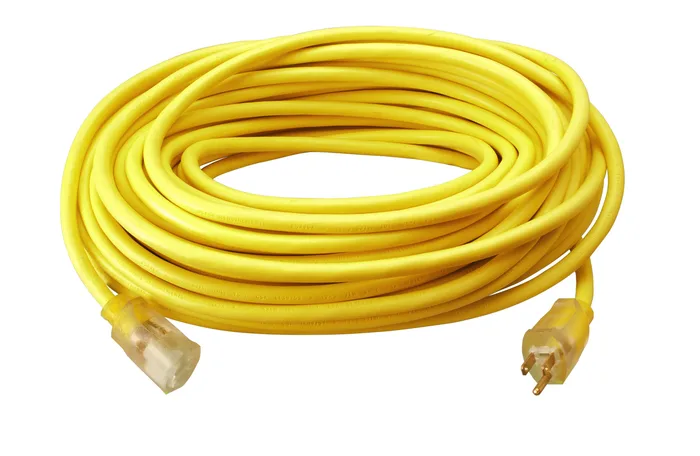
- Buy Southwire 12/3 SJTW 50 ft Lighted Extension Cord A heavy 12 gauge outdoor cord rated 15 amps, made for high-draw tools and equipment.
- Buy Southwire 14/3 SJTW 50 ft Extension Cord A lighter 14 gauge outdoor cord that still carries a 15 amp rating at 50 feet.
- It depends Iron Forge Cable 25 ft Coiled 14/3 SJEOW Extension Cord A coiled, oil-resistant 14 gauge cord that stays tidy at the bench but reaches only about 20 feet.
- Skip Iron Forge Cable 150 ft 16/3 SJTW Outdoor Extension Cord A very long 16 gauge cord marketed as heavy duty but rated for only 10 amps.
What actually matters
- Wire gauge - Thicker wire, with a lower number, carries more current with less loss. Tools usually want 12 or 14 gauge.
- Amp and watt rating - The rating printed on the cord is its limit. Match or exceed your tool's label.
- Length - Longer cords lose more voltage and can carry lower ratings. Shorter is better when it reaches.
- Jacket code - Letters like SJTW describe the jacket. W means outdoor rated, O means oil resistant.
- Conductors - Three conductors include a ground for three-prong tools.
- Plug build - Molded plugs and strain relief resist damage at the most stressed point.
- Lighted end - It confirms power at the tool end, which helps when troubleshooting.
The specs, in plain English
Green flags vs red flags
Green flags
- A clear gauge and amp rating printed on the cord
- 12 or 14 gauge for tools
- An outdoor W in the jacket code
- A molded plug with strain relief
- A safety certification mark
Red flags
- Heavy duty claims on a 16 gauge cord
- Very long cords with a low amp rating sold for tools
- No rating printed anywhere
- Indoor cords used outdoors
- Damaged jackets or missing ground prongs
Who's who: the brands
- Southwire - Large wire and cable maker with a wide range of outdoor extension cords in several gauges.
- Iron Forge Cable - Sells extension cords, coiled cords and power cables widely online.
- Coleman Cable - Long-standing extension cord brand now part of Southwire.
How to read a listing without getting fooled
Start with the gauge and conductor count, such as 12/3, then find the amp and watt rating, which is the cord's limit. Compare that rating with the label on your tool. Check the length, since the same gauge may carry a lower rating when longer. Finally, read the jacket code for an outdoor W and look for a safety certification mark.
How much should you spend?
Thin 16 gauge cords are the budget tier and suit lights and small appliances. 14 gauge cords are budget to mid-range and cover most DIY tools at moderate lengths. 12 gauge cords cost more because of the extra copper, which buys headroom for high-draw tools and long runs.
Questions, answered
Is it safe to leave an extension cord plugged in permanently?
Extension cords are meant for temporary use. For permanent power, an electrician can add an outlet. Leaving cords in place invites damage and overheating.
Should I use a cord that feels warm?
A cord that feels warm under load may be undersized for the tool or damaged. Unplug it and check the rating against the tool. Replace damaged cords rather than taping them.
Can I run a cord under a rug?
Avoid it. Rugs hide damage and trap heat, and foot traffic wears the jacket. Route cords where they can be seen and will not be stepped on.
What cord do I need for a space heater?
Many space heater makers advise plugging directly into a wall outlet rather than using an extension cord. Check your heater's manual before using any cord with it.
Or jump to the head-to-head: Southwire 12/3 SJTW 50 ft Lighted Extension Cord vs Southwire 14/3 SJTW 50 ft Extension Cord.