Explained
Framing Nailers, Explained
After reading, you'll know which collation angle your code allows and why nail length range decides the rest.
In this guide
A framing nailer's magazine angle looks like an ergonomic detail. It decides what shape of nail head you can drive, and some codes only accept one of them.
The 30-second version
- The angle fixes the head shape, since 21 degree plastic strip takes full round head nails and 30 degree paper tape is predominantly clipped head.
- Some codes reject clipped heads, most often in high wind and seismic areas, because a clipped head has less bearing area and lower withdrawal resistance.
- A 16d common nail is 3-1/2 inches, so a tool that stops at 3-1/4 cannot drive the fastener many framing schedules specify.
- Paper is tidy, plastic is tough, because paper collation shears cleanly and drives in with the nail while plastic shatters into fragments but ignores damp.
- Thirty degree magazines are more compact, which is the practical reason they exist, letting the nose reach between closely spaced studs.
The products this guide is about
Our verdict on each, with the full reasoning on the companion review.
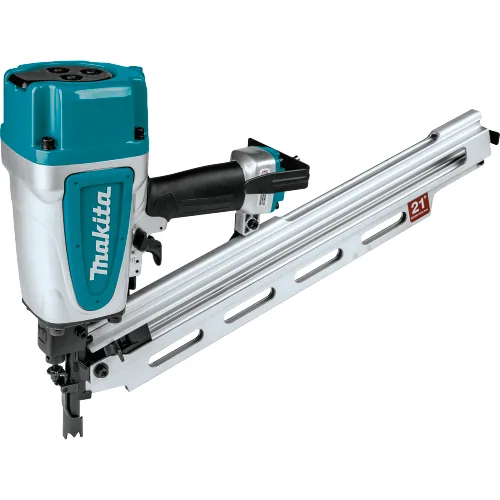
- Buy Makita AN924 21 Degree Full Round Head Framing Nailer Full round head nails to a full 3-1/2 inches, which is the combination that satisfies codes that reject clipped heads. Amazon
- Buy DEWALT DCN920B 20V MAX XR Brushless Cordless 21 Degree Plastic Collated Framing Nailer Full round head nails to 3-1/2 inches with no hose, the code-safe collation in a cordless body.
- It depends Metabo HPT NR90AD(S1) 3-1/2 Inch 30 Degree Paper Collated Framing Nailer A 7.0 lb, 30 degree paper strip pneumatic that drives the full 3-1/2 inch range, on clipped head nails only. Amazon
- Skip DEWALT DCN930B 20V MAX XR Brushless Cordless 30 Degree Paper Collated Framing Nailer The 30 degree twin of the DCN920B, giving up the full round head and the heaviest shanks for a bigger magazine.
What actually matters
- Collation angle - 21 or 30 degrees on most framing guns, occasionally 28. Determines the head shape available to you and therefore whether the tool satisfies your code.
- Head shape - full round head holds more and is accepted where clipped heads are not; clipped head allows tighter collation and is prohibited by some jurisdictions.
- Nail length range - typically 2 in. up to 3-1/4 or 3-1/2 in. The top of the range decides whether 16d framing nails are available to you.
- Shank diameter - commonly .113 to .148 in. Heavier shanks carry more load and are specified in some connection details.
- Collation material - paper tape shears cleanly and softens when wet; plastic strip is weatherproof and throws fragments when fired.
- Power source - pneumatic is lighter at the nose and faster between shots but needs a compressor, hose and fittings; cordless removes all of that at a premium.
The specs, in plain English
Green flags vs red flags
Green flags
- The head shape is stated explicitly, not left to be inferred from the magazine angle.
- Nail length range is given as a span with a stated maximum.
- Shank diameter range is published.
- Collation material is named as paper or plastic.
- Trigger actuation modes are described and the mode selector is explained.
Red flags
- Only the collation angle is given, with no mention of head shape.
- A maximum nail length appears with no minimum, or no length range at all.
- Framing nailer is claimed with a maximum length under 3 inches.
- Magazine capacity and weight lead the listing while collation is buried.
- Code compliance is claimed without naming full round head.
Who's who: the brands
- Makita - States head type in the product name and its AN924 reaches a full 3-1/2 inches.
- DEWALT - Runs parallel pneumatic and cordless lines at both collation angles, which makes the cost of each choice easy to see.
- Bostitch - Long-standing framing nailer maker, common on sites and known for 21 and 28 degree tools.
- Metabo HPT - The former Hitachi framing guns. Its NR90AD(S1) 30 degree paper strip nailer drives 2 to 3-1/2 inch nails up to .148, and its manual lists clipped-head nails for that model.
- Paslode - Built the cordless framing category around fuel-cell tools, still favoured where a compressor is impractical.
How to read a listing without getting fooled
Find out what your local code accepts before you look at a tool, because that decides the collation angle and therefore the whole purchase. Then read the maximum nail length and check it against 3-1/2 inches. Then shank diameter, then collation material as a site preference. Read magazine capacity and weight last, and add a compressor, hose and fittings to any pneumatic tool's price before comparing it with cordless.
How much should you spend?
Budget and mid-range buy pneumatic guns, where the tool is cheap and the air system is the real cost. Premium buys cordless, which removes the compressor entirely and adds a battery platform, and it is worth it in proportion to how far you work from power. Note that a premium price does not guarantee the longest nail range, which is worth checking rather than assuming.
Questions, answered
How do I find out whether clipped heads are allowed here?
Ask the building department that will inspect the work, or read the fastening schedule on the approved plans, which usually specifies nail type as well as size and spacing. The restriction is a local amendment in many places rather than a blanket national rule, so a general answer from the internet is not reliable. If you cannot get a clear answer, buying a full round head tool removes the question entirely.
Can I put full round head nails in a 30 degree gun?
Not usually. The magazine angle and the nail spacing are matched, and clipped or offset heads are what allow the tighter spacing a 30 degree strip needs. Some offset full round head nails are made for 30 and 34 degree tools, so it is worth checking what the manufacturer lists, but you cannot simply load standard 21 degree plastic collated nails into a paper tape gun.
Is a framing nailer safe to use with a bump trigger?
It is faster and riskier. Carpentry injury research associates contact or bump triggers with a higher injury rate than sequential triggers. For production sheathing on a flat deck the speed argument is real; for anything where you are moving, reaching or working at height, sequential is the mode to be in.
Why does my nailer leave nails proud on hardwood?
Usually depth of drive, and on a pneumatic gun it can be air pressure at the tool rather than at the compressor, since a long or narrow hose drops pressure under flow. Set depth on scrap of the same material first. If the tool is at the correct pressure and depth and still leaves nails proud in engineered lumber, the fastener may simply be too heavy for the material and a smaller shank will seat properly.
Or jump to the head-to-head: Makita AN924 21 Degree Full Round Head Framing Nailer vs DEWALT DCN920B 20V MAX XR Brushless Cordless 21 Degree Plastic Collated Framing Nailer.