Explained
Hex Key Sets, Explained
After reading, you'll understand what a ball end working angle buys and costs, why a hardness number is only useful in context, which inch and metric sizes are close enough to cause damage, and which standards on a listing are still current.
In this guide
Hex keys look like the one tool category with nothing to learn. Then a socket screw rounds out and you find yourself drilling it, and the reason turns out to be either a key from the wrong measurement system or a final tightening done on a ball end. Almost nothing on a typical listing helps you avoid either. The specs that would help, arm length, working angle, hardness and across-flats tolerance, are the ones most often left off, while the ones that are printed, such as an alloy family or a decades-old federal specification number, tell you much less than they appear to.
The 30-second version
- A ball end trades strength for angle, because its neck is narrower than the tip, and no maker publishes how much torque you give up.
- Final tightening belongs on a straight hex tip, which is precisely why L-key makers put the ball on the long arm and leave the short arm square.
- The dangerous inch and metric pairs are the close ones, 5/32 against 4 mm and 5/16 against 8 mm, not the obviously mismatched 3/16 against 5 mm.
- ISO 2936 is the live standard, while DIN 911 is withdrawn and the federal specification GGG-K-275D was cancelled, though it still appears on listings.
- Harder is not simply better, because hardness buys wear resistance and torque capacity at the cost of the ductility that keeps a twisting key from shattering.
The products this guide is about
Our verdict on each, with the full reasoning on the companion review.
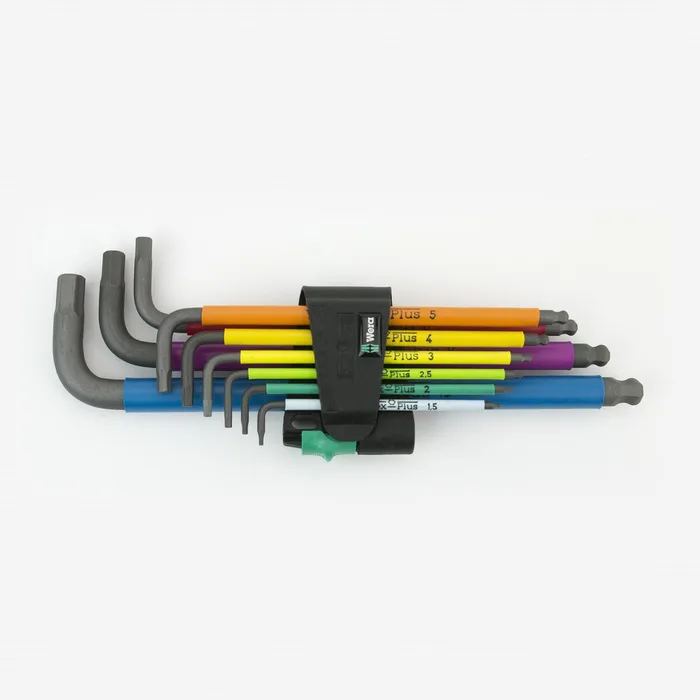
- Buy Wera 950/9 Hex-Plus Multicolour 1 L-key set, metric, BlackLaser, 9 pieces The only set here whose drive profile is designed to stop socket screws rounding out, with a published torque figure to go with it. Amazon
- Buy Bondhus 10937 Balldriver BLX13 Ball End L-Wrench Set, 13-Piece Inch The best documented hex keys you can buy, from the company that invented the ball end and still publishes the numbers behind it. Amazon
- It depends Wiha 33496 SoftGrip Hex T-Handle Metric Set, 8 Piece A T-handle set that is genuinely faster and more comfortable than L-keys for repetitive bench work, and genuinely worse everywhere else. Amazon
- Skip Klein Tools 70540M Compact Folding Hex Key Set, 8-Key, Metric A perfectly decent pocket tool that a lot of people buy as their only hex keys, which is the mistake. Amazon
What actually matters
- Working angle - the maximum angle at which a ball end can turn a screw while fully seated. Bondhus states 25 degrees and argues that more angle requires a thinner neck and therefore less strength, while Wiha, PB Swiss and Klein each quote up to 30 degrees for their ball end L-keys.
- Arm length - how far the key reaches, published size by size in the better listings. It is the difference between reaching a screw at the bottom of a counterbore and having to disassemble something to get at it.
- Across-flats clearance - the gap between the key and the socket wall, which Bondhus puts at about 0.0005 inch, or 0.0127 mm, or less on each side. Everything that goes wrong with hex keys is a story about that gap getting bigger.
- Rockwell hardness - measured on the C scale and expressed as HRC or RC. ISO 2936 sets 52 HRC as the minimum for keys up to 18 mm, and Bondhus states about 59 RC as a typical figure for a small tool.
- Ductility - the ability to deform before breaking. A hex key needs enough of it to twist and warn you rather than shatter, which is why makers describe heat treatment as a balance rather than a maximum.
- Drive profile - the shape of the contact between key and socket. Wera's Hex-Plus bears on the flats instead of the corners and Wera claims as much as 20 percent more applied torque from that change alone.
- Format - L-key, T-handle, folding or bit-and-driver. Format decides reach, speed and whether you can tighten to a specified torque, and it matters more to everyday use than any material claim on the packet.
The specs, in plain English
Green flags vs red flags
Green flags
- The listing gives arm or blade lengths size by size rather than just a piece count.
- A ball end working angle is stated as a number of degrees rather than described as wide or generous.
- The maker publishes an alloy family and, better still, a hardness figure, even if it is described as typical.
- Keys are colour coded by size and have the size marked on the shaft, not only on the holder.
- The set keeps a straight hex tip somewhere, usually on the short arm, so there is something to finish a tightening on.
Red flags
- Precision ground or precision machined appears with no tolerance, no dimension and no standard behind it.
- The only standard quoted is a withdrawn or cancelled one, such as DIN 911 or GGG-K-275.
- Every tip in the set is a ball, which leaves nothing designed for high torque or final tightening.
- Inch and metric keys are sold together in a single holder with no colour or marking separating the systems.
- The size range skips awkwardly, such as jumping from 8 mm to nothing, which usually means the set was built to a price rather than to a job.
Who's who: the brands
- Wera - German, best known for the Hex-Plus profile and colour coded sets, and the maker most focused on stopping socket screws round out rather than on steel claims.
- Bondhus - American, invented the ball end, and publishes a lot of usable technical detail about angles, hardness and heat treatment.
- Wiha - German brand with strong T-handle, L-key and precision driver lines, describing its blades as Chrome-V-Moly super tool steel and quoting up to 30 degrees for its ball end L-keys.
- PB Swiss Tools - Swiss, quoting up to 30 degrees for its ball point L-keys and backing them with a lifetime guarantee.
- Klein Tools - American electrical trade brand with wide big-box availability, strongest in folding and T-handle sets, and quoting up to 30 degrees for its L-style ball end keys.
How to read a listing without getting fooled
Start at the bottom of the listing, where the dimensions live, not at the top where the adjectives are. Find the size range first and check it covers what you own, including 10 mm if you touch bikes or furniture. Then look for arm or blade length; if it is absent, assume the reach is unremarkable, because makers who have a long arm say so. Next find the ball end working angle in degrees, and if the listing only says ball end, note that as a gap rather than a feature. Then look for a material and a hardness figure, and read them as a pair, since an alloy family alone tells you almost nothing. Finally, check any standard that is quoted and check its status, because ISO 2936 is current while DIN 911 and GGG-K-275 are not, and a listing built on dead references is usually a listing nobody has revisited in a decade.
How much should you spend?
Budget sets buy you a usable size range and heat-treated steel with almost nothing published about either, which is fine for occasional furniture and bicycle work and risky on anything you will take apart repeatedly. Mid-range is where the specifications appear: published working angles, a stated hardness or alloy, chamfered tips and a proper holder that keeps sizes in order, and it is the tier most people should aim for because a rounded socket screw costs more time than the difference between tiers. Premium buys either a proprietary drive profile aimed at protecting the fastener, or a maker that states which standard the keys are built to, plus finishes and colour coding that reduce the chance of grabbing the wrong key. Spending more than that mostly buys country of manufacture and a longer guarantee rather than a measurably better tip.
Questions, answered
Do hex keys wear out, and how would I know?
Yes, and the usual sign is a key that felt snug when new and now feels loose in the same screw after a handful of uses. Bondhus attributes that specific pattern to burrs left on the tip by imprecise cutting, which make a key feel tight at first and then wear off, after which the loose fit chews both tool and screw. Rounded corners on the tip are the other tell, and they are easy to see against a new key. Once a tip is visibly rounded, replace it rather than trying to make it work.
Does 'precision ground' or 'chamfered' mean anything measurable?
Chamfered means something real but small: a bevel cut on the tip to remove burrs so the key seats to full depth. Makers describe the purpose rather than a dimension, and Bondhus explicitly says the style of chamfer is not the point, only that burrs are gone. Precision ground is not a defined term and carries no number at all. The genuinely measurable property is the across-flats tolerance, which ISO 2936 governs and which almost no maker publishes for its own product, so treat both phrases as intent rather than evidence.
Is a hex bit in a driver or socket as good as an L-key?
For some jobs it is better. A hex bit in a socket is the only common format that lets you tighten a socket head screw to a specified torque, because it works with a torque wrench, and a bit in a ratcheting driver is faster than an L-key on a long screw. What you lose is the L-key's short arm, which fits places a driver handle cannot, and the ball end's angled entry. Most workshops end up with both, using L-keys for access and bits when the fastener has a torque figure attached.
Why do some sets skip sizes like 5.5 mm, 7 mm or 9 mm?
Because those sizes are rare in general hardware, so a nine or ten piece metric set usually runs 1.5, 2, 2.5, 3, 4, 5, 6, 8 and 10 mm and leaves the rest out. That is reasonable for most people, but it bites if you work on machinery, older equipment or anything with set screws, where 5.5 and 7 mm turn up. Check the listed sizes against what you actually own before buying, since a missing size is the one gap you cannot work around safely.
Or jump to the head-to-head: Wera 950/9 Hex-Plus Multicolour 1 L-key set, metric, BlackLaser, 9 pieces vs Bondhus 10937 Balldriver BLX13 Ball End L-Wrench Set, 13-Piece Inch.