Explained
Insulated Hand Tools, Explained
After reading, you'll understand what the double triangle and 1000 V marks mean, why tools are proof tested at ten times their rating, what OSHA actually requires, and exactly what retires a tool.
In this guide
The single mistake in this category is buying grip and thinking you bought protection. Klein, for one, does not hide this; it states on its own pages that plastic dipped handles are not intended for protection against electrical shock. The confusion comes from listings, photographs and habit. Once you know which three or four marks belong on a genuine insulated tool, the whole category sorts itself in about ten seconds per product.
The 30-second version
- The double triangle is the only mark that counts, and it should appear on the tool with 1000 V immediately beside it.
- Tools are proof tested well above their rating, typically at 10,000 V AC individually, and then rated and marked for 1000 V AC working.
- Insulated, insulating and hybrid are three defined categories, and IEC 60900:2018 added the third one, so the words are not interchangeable.
- OSHA requires insulated tools near exposed energized parts, but only after it has required you to deenergize the circuit if that is feasible.
- There is no mandated annual retest, because the required control is inspection before every use and destruction of any damaged tool.
The products this guide is about
Our verdict on each, with the full reasoning on the companion review.
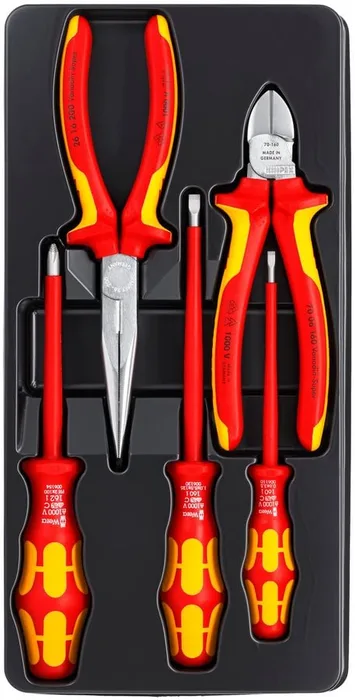
- Buy Knipex 00 20 13 5 Pc 1000V Insulated Pliers and Screwdriver Set A small, honest, fully marked set from a maker that publishes exactly what it tests and how. Amazon
- Buy Klein Tools 33526 Basic 1000V Insulated Tool Kit, 8-Piece Eight properly marked insulated tools in one zip case, which is closer to what an actual service call needs. Amazon
- It depends Wiha 43449 Screwdriver Set SoftFinish slimVario electric One insulated handle plus insulated slimBits, which halves what you carry and doubles what you have to inspect.
- Skip Klein Tools D213-9NE Lineman's Pliers, New England Nose, 9-Inch A superb plier that is not an insulated tool, and Klein says so in plain language on its own product page. Amazon
What actually matters
- IEC 60900:2018 - the international standard for hand tools used on or near live parts up to 1000 V AC and 1500 V DC. The fourth edition, published in June 2018, applies to insulated, insulating and hybrid hand tools and added hybrid tools as a new category.
- ASTM F1505 - the North American specification, currently ASTM F1505-16(2026), covering testing and the corresponding design and performance requirements for insulated and insulating hand tools at the same 1000 V AC and 1500 V DC ceiling. It names the tool types covered, from screwdrivers and pliers to knives and tweezers.
- The double triangle symbol - IEC 60417 symbol 5216, meaning suitable for live working. Next to it you should find 1000 V, plus the maker's name, the tool reference and the standard. Absence of this set is the fastest disqualifier there is.
- Proof test versus working rating - the tool is tested far above what it is rated for so that the rating carries margin. Knipex and Wiha both publish individual testing at 10,000 V AC, and Knipex describes this as a ten times safety buffer over the 1000 V limit.
- Two layer construction - a contrasting inner colour under the outer coating so damage is visible. Klein uses white under orange and Knipex uses yellow under red. This is what turns inspection from a guess into a look.
- Inspection before every use - the actual safety control. Knipex instructs users to check before every use whether the insulation is damaged in any way and to discard defective tools. Klein instructs users to inspect before use and destroy the tool if the insulation becomes damaged in any way.
- Cleanliness - Klein warns that moisture, films and other surface contaminants are conductive and that insulated tools must be kept clean, dry and free of surface contaminants. A dirty insulated tool is not a fully insulated tool.
The specs, in plain English
Green flags vs red flags
Green flags
- The double triangle and 1000 V are moulded or printed on the tool body, visible in the product photography.
- The maker names a specific standard and edition, such as IEC 60900:2018 or ASTM F1505-16(2026), rather than saying meets international standards.
- The maker states that each tool is individually proof tested, not batch tested.
- The insulation is two contrasting layers so a cut exposes a warning colour.
- The listing or documentation includes an explicit inspection and retirement instruction.
Red flags
- The words 1000 V appear only on packaging or in a rendered graphic, never on the tool itself.
- The description leans on insulated grip, comfort grip or ergonomic handle without naming a standard.
- A claimed VDE or certification mark with no certificate number you can check against the certifier's database.
- A single colour handle with no contrasting inner layer, sold as an insulated tool.
- A very wide multi tool set advertised as 1000 V rated where only some of the pieces could plausibly have been tested.
Who's who: the brands
- Knipex - German plier specialist that publishes its process in detail, including individual dielectric testing at 10,000 V AC and VDE third party testing to DIN EN and IEC 60900.
- Klein Tools - The default in North American electrical work, with a clearly separated insulated line and unusually blunt warnings that its plastic dipped tools are not insulated.
- Wiha - German maker known for the SoftFinish electric slimVario system of an insulated handle with interchangeable insulated slimBits for deep set screws.
How to read a listing without getting fooled
Start at the tool, not the headline. Zoom into the product photograph and look for the double triangle with 1000 V beside it, moulded into the handle or the blade collar. Then read the specification block for a named standard with an edition or year, and note whether the maker claims ASTM F1505 as well as IEC 60900, because a North American employer's written procedure is more likely to name the ASTM one. Check whether the maker says each tool is individually tested and at what voltage. Look at the colour scheme: two contrasting layers is a design decision about inspectability, and a single colour handle in this category deserves suspicion. Finally, read the warnings, because the good makers put the retirement rule in writing, and a listing with no inspection or retirement instruction is a listing that has not thought about the tool being used.
How much should you spend?
Correctly marked insulated hand tools generally sit in the mid-range and premium tiers, because individual proof testing and two layer moulding cost money per unit rather than per design. A budget tier price on something claiming a 1000 V rating is a strong signal that something is wrong. Where you can save is coverage rather than quality: a mid-range kit from a mainstream maker with eight correctly marked tools is better value than a premium three piece set, and adding tools one at a time as the work demands them beats buying a large case where half the pieces stay in their pockets. Buy the standard, not the piece count.
Questions, answered
What does the double triangle symbol actually mean?
It is IEC 60417 symbol 5216, suitable for live working. It signifies that the tool was built and tested as a tool for use on or near live parts, which is a different claim from having a plastic handle. On a compliant tool it appears alongside the working voltage limit, 1000 V for the tools in this category, plus the maker's name and the tool reference. If the symbol is absent from the tool itself, treat the tool as uninsulated no matter what the listing says.
What is a hybrid hand tool?
It is the third category IEC 60900 recognises, alongside insulated tools and insulating tools. Insulated tools are conductive tools covered in insulating material; insulating tools are made of insulating material; hybrid tools combine both approaches. The fourth edition of IEC 60900, published in June 2018, added hybrid tools as a category and included an informative annex giving examples of all three. The practical takeaway is that insulated and insulating are technical terms with distinct meanings, not synonyms a marketer can swap.
Can I repair or tape over a nick in the insulation?
No. The insulation was tested as a continuous system on that specific tool, and tape restores appearance rather than dielectric performance. Klein's instruction is to stop using the tool if the orange coating cracks, breaks or becomes damaged, and to destroy the tool if the insulation is damaged in any way. Knipex tells users that defective tools must be discarded. Destroy means render it unusable so it cannot quietly return to the toolbag, which is why the two colour construction exists in the first place.
Do insulated tools protect me from arc flash?
They are not arc flash protection and should not be treated as such. Their purpose is shock protection where the tool might contact an energized part, and a well insulated tool can also reduce the chance of you creating a fault in the first place. Arc flash exposure is managed through your employer's risk assessment, arc rated clothing and other personal protective equipment, which sit outside the scope of IEC 60900 and ASTM F1505 entirely. Klein's own framing is worth repeating: insulated tools are designed only to reduce the chance of injury where the tool may make contact with an energized source.
Or jump to the head-to-head: Knipex 00 20 13 5 Pc 1000V Insulated Pliers and Screwdriver Set vs Klein Tools 33526 Basic 1000V Insulated Tool Kit, 8-Piece.