Explained
Laser Levels, Explained
After reading, you'll understand how to convert any maker's accuracy claim into a number you can compare, what Class 2 means for your eyes, what green actually costs, and why a receiver is not optional outdoors.
In this guide
Laser levels are one of the few tool categories where the headline number is genuinely comparable between brands, and almost nobody compares it correctly. The trap is that levelling accuracy is an angle dressed up as a distance, so the same fraction can describe tools that differ by a factor of three. The second trap is that the safety label sounds alarming and is not, while the ingress rating sounds reassuring and sometimes is not. Sort those two out and the rest of the spec sheet is easy.
The 30-second version
- An accuracy figure is only a figure with its distance, so convert everything to millimetres at 10 metres before you compare two tools.
- Class 2 is the normal, safe answer, and the regulator's ceiling for levelling lasers sits a tier above it at 5 milliwatts.
- Green is easier to see for a measurable reason, and the published cost is battery life rather than a narrower temperature range.
- A pendulum laser tells you when it cannot level, by flashing the lines and often beeping, so the silent wrong reading people fear is not the failure mode.
- No pulse mode means no outdoor work, because a receiver detects a rapidly flashing beam rather than making a faint line brighter.
The products this guide is about
Our verdict on each, with the full reasoning on the companion review.
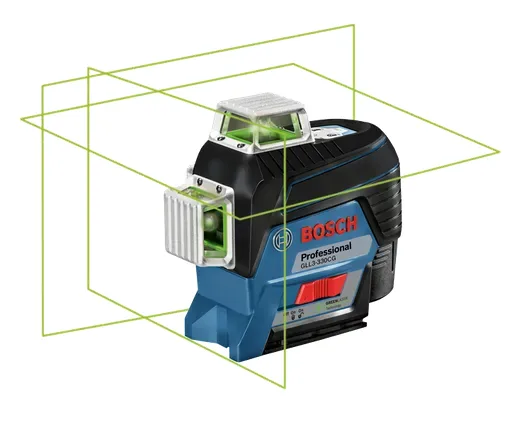
- Buy Bosch GLL3-330CG 360 Degree Three-Plane Green Line Laser The best-documented 360 degree green line laser here, with accuracy published in both inches-at-a-distance and millimetres-at-10-metres. Amazon
- Buy Huepar ZK03CG Pro 3x360 Degree Green Cross Line Laser States a tighter accuracy figure than the Bosch and backs it with a beep as well as a flashing line when it goes out of range.
- It depends Stabila LAX 600 G 12 V System Cross Line Laser The most thoroughly documented and best sealed tool here, tied to a battery system most buyers do not own. Amazon
- Skip Bosch GLL40-20G Self-Leveling Green Cross Line Laser A green beam and a Bosch badge on a tool whose own manual concedes roughly three times the error of the GLL3-330CG. Amazon
What actually matters
- Levelling accuracy is the only number that separates a layout tool from a picture-hanging toy. It is always published with a distance or as millimetres per metre, and once you normalise it the current field runs from about 2 mm to about 8 mm at 10 metres.
- Self-levelling range is how far off level the tool can be set and still correct itself, typically plus or minus 3 or 4 degrees. A wider range means less fiddling with the tripod, and outside the range the tool stops levelling rather than levelling badly.
- Out-of-level warning is what turns a limitation into a safe one. Many makers document a flashing beam, and some add a tone, so you are told rather than left guessing.
- Manual or pendulum lock mode deliberately switches levelling off so you can project a line at any angle. This is the one state where the tool really is not levelling, which is why makers flash the beam in a distinct pattern to remind you.
- Pulse or receiver mode flashes the beam at high frequency so an electronic detector can find it in sunlight. Without it, outdoor range is whatever your eye can pick out, which is not much on a bright day.
- Ingress protection is an IEC 60529 code where the first digit is solids and the second is water. A zero in the second digit means no water protection, IP54 handles splashes, IP65 handles jets, and the difference shows up the first time a tool spends a day in the rain.
- Beam colour is a visibility choice grounded in how the eye works, not a quality tier. Both colours are sold in the same accuracy classes by the same makers, so pick colour last, after the accuracy figure.
The specs, in plain English
Green flags vs red flags
Green flags
- The accuracy figure appears with its distance in both imperial and metric on the same line.
- A downloadable manual exists with a technical data table listing operating and storage temperature ranges, not just a bullet list.
- The laser class cites the standard and edition, for example Class 2 in accordance with IEC 60825-1:2014.
- A named receiver is listed as a compatible accessory, which means the pulse mode is real.
- The out-of-level behaviour is described in the manual, ideally with the flash pattern spelled out.
Red flags
- An accuracy claim with no distance attached, or a distance that appears only in a retailer's listing and not on the maker's page.
- An unusual fraction such as 1/13 inch, which signals a metric figure converted to look small.
- An IP rating whose second digit is zero, dressed up as weather resistance.
- A drop rating in metres with no test standard named anywhere.
- No mention of a pulse or receiver mode on a tool being sold for outdoor or site use.
Who's who: the brands
- Bosch - Publishes a full technical data table for each tool and gives accuracy in both an imperial fraction at a stated distance and millimetres per metre, from a two AA cross line up to long-range rotary lasers.
- Stabila - German maker whose manuals cite the laser class to a named edition of IEC 60825-1 and footnote the accuracy as valid only inside the operating temperature range, with IP65 sealing on the LAX 600 series.
- Leica Geosystems - Publishes levelling accuracy in millimetres per metre on the Lino line lasers, which is the convention that needs the least arithmetic.
- Milwaukee - One of the few to publish an impact figure alongside the ingress rating, listing 1 m impact resistance with IP54 on the M12 green 3-plane laser.
- Huepar - Direct seller whose specification lists are unusually complete for the price tier, including operating temperature and battery details, though the figures are its own declarations.
How to read a listing without getting fooled
Start at the accuracy line and ignore everything above it. Find the distance, convert to millimetres at 10 metres, and write that one number down for every tool on your list. Then check the laser class and confirm it names a standard rather than just saying Class 2, and note whether the tool also carries a US Class II marking, because the two describe the same thing under different regulations. Next find the self-levelling range and the sentence in the manual that says what happens outside it. Then look for a named receiver, because that is the only reliable proof that pulse mode exists rather than being a checkbox. Finally read the IP code digit by digit and treat any drop figure with no named test standard as the maker's own opinion. If a listing gives you a bullet list and no manual, assume the numbers came from a marketing brief and go find the PDF.
How much should you spend?
Budget tier tools are compact cross line lasers running on AA cells, and their published accuracy is typically three or four times looser than the layout tools, with ingress ratings that may include no water protection at all and often no receiver mode. Mid-range is where the useful jump happens: three 360 degree planes, a rechargeable pack, an accuracy figure around 2 mm at 10 metres, a pulse mode and a real out-of-range alert. Premium buys you a manufacturer's full documentation, a stronger seal, integration with a power tool battery system, and in the rotary category an accuracy figure quoted at 100 feet rather than 30. The honest reading is that the step from budget to mid-range buys a materially better tool, while the step from mid-range to premium mostly buys sealing, battery ecosystem and documentation rather than a tighter line.
Questions, answered
Do I need a green laser, or will red do?
Green is genuinely easier to see, and the reason is the eye rather than the laser. On the CIE photopic curve the eye is considerably more sensitive at 520 nm than at 635 nm, so equal power looks much brighter in green. The published cost is runtime: Bosch lists 6 hours for its green 360 laser against 8 hours for the identical red one on the same pack. If you work in bright rooms or at distance, green earns it. If you work in a basement, red will save you battery.
Is a laser level accurate enough to set a floor or a course of block?
A good line laser at 2 mm to 3 mm at 10 metres is fine for cabinets, tiling, dropped ceilings and interior layout. For long external runs the maths turns against you, because the error scales with distance. That is where rotary lasers come in, with accuracy quoted at 100 feet rather than 30. If your working distance is beyond about 15 metres, price a rotary and a receiver rather than stretching a line laser.
What is the difference between the self-levelling range and the accuracy?
They answer different questions. The self-levelling range, usually plus or minus 3 or 4 degrees, is how crooked you can set the tool down and still have it correct itself. The accuracy is how true the line is once it has finished levelling. A wide self-levelling range on a loose tool still gives you a badly placed line, and a tight accuracy figure is no help if the tool is tipped past its range and flashing at you.
Should I trust a drop rating?
Treat it as a claim rather than a certification. Ingress protection at least has a defined test method in IEC 60529, even though most tool makers declare their own result rather than publishing a third-party certificate. Drop figures generally have no named standard attached at all, so a 1 metre rating from one maker is not comparable with a 1 metre rating from another. What matters more in practice is the instruction every maker gives and most people ignore: after any heavy impact, run the accuracy check in the manual before you trust the tool again.
Or jump to the head-to-head: Bosch GLL3-330CG 360 Degree Three-Plane Green Line Laser vs Huepar ZK03CG Pro 3x360 Degree Green Cross Line Laser.