

Tools & DIY
The Best Laser Levels: 4 Compared (and One to Skip)
We compared four self-levelling line lasers you can buy right now on the one number that decides everything, which is the accuracy figure and the distance the maker attaches to it, plus what each tool does when it cannot level itself.
The short version
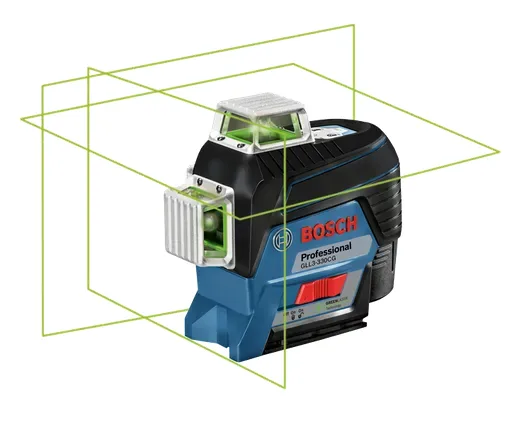
The Bosch GLL3-330CG is the pick for most people because Bosch publishes the whole technical data table and the accuracy is stated in both inch and metric forms, plus or minus 2.40 mm at 10 m. The Huepar ZK03CG is the value choice, with a stated plus or minus 2 mm at 10 m, an out-of-range beep as well as a flashing line, and a wider stated operating temperature range than the Bosch. The Stabila LAX 600 G is the depends pick: IP65 sealing and the best-documented manual of the group, but it runs only on Stabila's 12 V CAS battery, with no AA fallback, so it suits a trade user already in that system and nobody else. Skip the Bosch GLL40-20G, because Bosch's own manual puts its levelling accuracy at plus or minus 0.8 mm per metre, roughly three times the error of the GLL3-330CG, its manual lists no ingress protection rating, and it lists no receiver mode, so it cannot be used outdoors with a detector. The manuals for these tools describe a flashing beam when the tool is tipped past its self-levelling range, so a silent out-of-level failure is not how they are meant to behave. Best for: anyone hanging cabinets, tiling, framing or setting a course of block who wants to know what the number on the box actually promises.
Our picks at a glance
- Bosch GLL3-330CG 360 Degree Three-Plane Green Line Laser - Buy. The best-documented 360 degree green line laser here, with accuracy published in both inches-at-a-distance and millimetres-at-10-metres.
- Huepar ZK03CG Pro 3x360 Degree Green Cross Line Laser - Buy. States a tighter accuracy figure than the Bosch and backs it with a beep as well as a flashing line when it goes out of range.
- Stabila LAX 600 G 12 V System Cross Line Laser - It depends. The most thoroughly documented and best sealed tool here, tied to a battery system most buyers do not own.
- Bosch GLL40-20G Self-Leveling Green Cross Line Laser - Skip. A green beam and a Bosch badge on a tool whose own manual concedes roughly three times the error of the GLL3-330CG.
The verdict in 30 seconds
What mattered most
- Accuracy, as the maker states it
- Same figure normalised to 10 m
- Beam and wavelength
- Laser class
- Self-levelling range and warning
- Receiver or pulse mode
A laser level's accuracy figure is meaningless on its own. Bosch publishes plus or minus 5/16 inch at 30 feet for one of its green cross line lasers and plus or minus 3/32 inch at 30 feet for one of its 360 degree lasers, which is the same distance and more than three times the error. Both tools say Class 2 on the label, both self-level, both project green lines. We picked four currently sold models and judged them on the specification each maker actually publishes, not on the number a retailer retyped.
The best-documented 360 degree green line laser here, with accuracy published in both inches-at-a-distance and millimetres-at-10-metres.
Best for: Anyone who wants one 360 degree tool for full-room layout and wants every number they are relying on printed in the maker's own manual.
- Bosch publishes levelling accuracy as plus or minus 3/32 inch at 30 feet and plus or minus 2.40 mm at 10 m, so the distance is never in doubt.
- Receiver mode pulses the lines at high frequency for the LR8 detector, taking the working range from a 200 ft diameter to a 330 ft diameter.
- Runs on a 12 V Max lithium-ion pack or on four AA cells through an adapter, so a dead battery does not end the day.
- IP54 only, which is splash protection rather than the IP65 jet protection Stabila publishes.
- Bosch states the green version gets 6 hours from the BAT414 pack against 8 hours for the identical red model, so the green beam costs you runtime.
- Bosch publishes no drop rating for it at all, only the instruction to recheck accuracy after any heavy impact.
- The 14 F lower operating limit rules out genuinely cold mornings, and Bosch warns that extreme temperatures can impair accuracy.
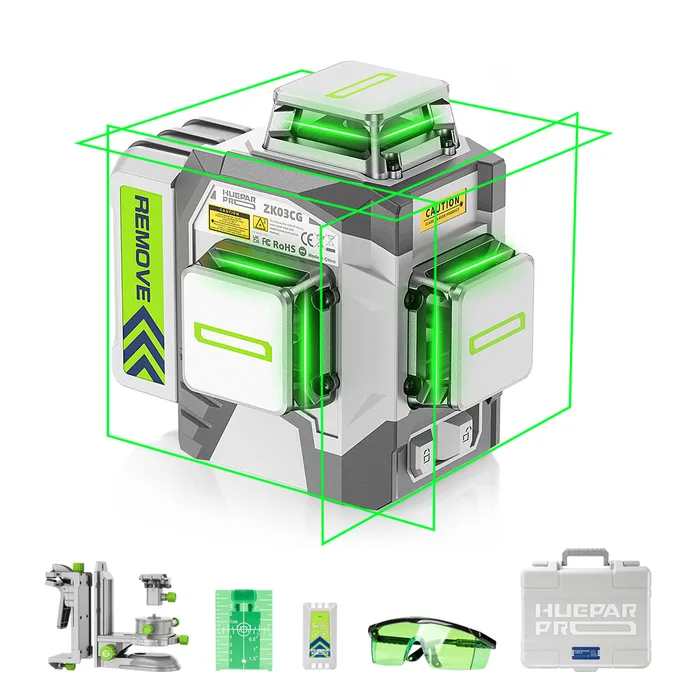
States a tighter accuracy figure than the Bosch and backs it with a beep as well as a flashing line when it goes out of range.
Best for: A DIY user or a one-tool tradesperson who wants three 360 degree planes and a rechargeable pack without buying into a power tool battery system.
- Levelling accuracy is stated plainly as plus or minus 2 mm at 10 m, which is the easiest figure in this group to compare against anything else.
- It beeps and flashes the line when tipped past its plus or minus 3 degree compensation range, so the warning is audible as well as visual.
- Huepar publishes an operating range of minus 10 C to plus 50 C, a wider window at the top end than the Bosch tools.
- The self-levelling range is plus or minus 3 degrees against plus or minus 4 degrees for the other three, so it is fussier about where you stand it.
- IP54, and Huepar publishes no drop rating.
- Every figure here is Huepar's own declaration, with no third-party test report published alongside it.
- The headline is written as plus or minus 1/13 inch at 33 ft, a fraction nobody uses, which exists only because the metric figure was converted.
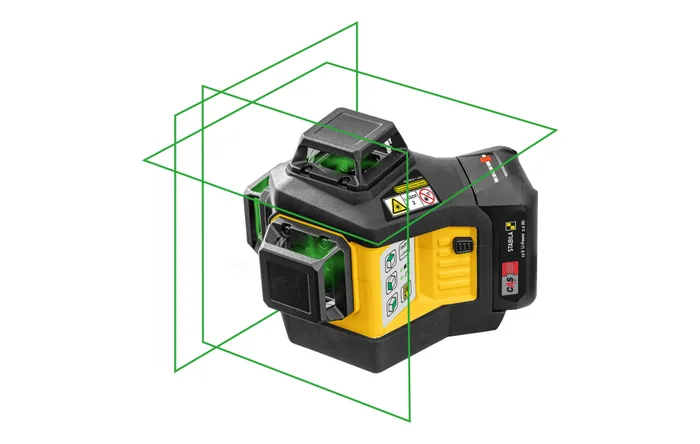
The most thoroughly documented and best sealed tool here, tied to a battery system most buyers do not own.
Best for: A trade user working in wet or dusty conditions who is already in the CAS 12 V battery system or is willing to buy into it.
- IP65 sealing per Stabila, the highest ingress rating in this group and a step up from the IP54 splash protection on the others.
- The manual states levelling accuracy as plus or minus 0.3 mm per metre and laser class 2 in accordance with IEC 60825-1:2014, with the operating and storage ranges alongside.
- The lines are pulsed as standard for use with a Stabila line receiver, so the outdoor path is built in rather than a mode you switch on.
- Stabila states it can only be operated with a 12 V lithium-ion CAS system battery pack, so there is no AA fallback.
- Green runtime is stated at up to 15 hours against up to 28 hours for the identical red LAX 600 on the same pack.
- At plus or minus 0.3 mm per metre it is looser on paper than the Bosch and the Huepar, and Stabila footnotes the figure as valid only inside the operating temperature range.
- No drop rating is published, only the IP65 figure.

A green beam and a Bosch badge on a tool whose own manual concedes roughly three times the error of the GLL3-330CG.
Best for: Only someone who hangs pictures across a single room and will never need a detector.
- Bosch publishes the accuracy honestly in both forms, plus or minus 5/16 inch at 30 feet and plus or minus 0.8 mm per metre.
- Runs on two AA cells and weighs half a pound, so it lives in a bag without thought.
- The manual states the lines flash 1 second off and 3 seconds on continually when it is tipped past 4 degrees, so it does warn you.
- At plus or minus 0.8 mm per metre it is about three times the error of the GLL3-330CG at the same stated distance, which is roughly 8 mm across a 10 m room.
- Bosch's manual lists no ingress protection rating, so do not count on any dust or water protection.
- No receiver or pulse mode is listed, so there is no way to work outdoors with a detector and the working range stops at 40 ft.
- The manual states a lower operating limit of plus 5 C, which rules out an unheated garage in winter.
| Criteria | GLL3-330CG 360 Degree Three-Plane Green Line Laser Top pick | ZK03CG Pro 3x360 Degree Green Cross Line Laser | LAX 600 G 12 V System Cross Line Laser | GLL40-20G Self-Leveling Green Cross Line Laser |
|---|---|---|---|---|
| Verdict | Buy it | Buy it | It depends | Skip it |
| Best for | Anyone who wants one 360 degree tool for full-room layout and wants every number they are relying on printed in the maker's own manual. | A DIY user or a one-tool tradesperson who wants three 360 degree planes and a rechargeable pack without buying into a power tool battery system. | A trade user working in wet or dusty conditions who is already in the CAS 12 V battery system or is willing to buy into it. | Only someone who hangs pictures across a single room and will never need a detector. |
| Price tier | $$$ · premium | $$ · mid-range | $$$ · premium | $ · budget |
| Accuracy, as the maker states it | ±3/32 in at 30 ft (±2.40 mm at 10 m) | ±2 mm at 10 m (±1/13 in at 33 ft) | ±0.3 mm/m (±3/16 in over 50 ft) | ±5/16 in at 30 ft (±0.8 mm/m) |
| Same figure normalised to 10 m | ±2.40 mm | ±2 mm | ±3 mm | about ±8 mm |
| Beam and wavelength | Green, 500 to 540 nm | Green, 505 to 520 nm | Green, 510 to 530 nm | Green, 500 to 540 nm |
| Laser class | Class 2, stated under 10 mW | Class 2 to IEC/EN 60825-1:2014, under 1 mW | Class 2 to IEC 60825-1:2014, under 1 mW | Class 2, stated under 5 mW |
| Self-levelling range and warning | ±4°, lines flash rapidly plus a fast-beat audio alarm | ±3°, line flashes quickly plus a beep | ±4°, the beam flashes | ±4°, lines flash 1 s off and 3 s on |
| Receiver or pulse mode | Yes, 15 to 330 ft diameter with the LR8 receiver | Yes, 130 to 197 ft with a Huepar receiver | Yes, lines are pulsed for a Stabila line receiver | None listed |
| Ingress protection | IP54 | IP54 | IP65 | Not stated in manual |
| Operating temperature | -10 C to +40 C | -10 C to +50 C | -10 C to +40 C | +5 C to +40 C |
Which one is right for you?
- Anyone who wants one 360 degree tool for full-room layout and wants every number they are relying on printed in the maker's own manual. Buy it Bosch GLL3-330CG 360 Degree Three-Plane Green Line Laser
- A DIY user or a one-tool tradesperson who wants three 360 degree planes and a rechargeable pack without buying into a power tool battery system. Buy it Huepar ZK03CG Pro 3x360 Degree Green Cross Line Laser
- A trade user working in wet or dusty conditions who is already in the CAS 12 V battery system or is willing to buy into it. It depends Stabila LAX 600 G 12 V System Cross Line Laser
- Only someone who hangs pictures across a single room and will never need a detector. Skip it Bosch GLL40-20G Self-Leveling Green Cross Line Laser
How we judged the field
Five things decide whether a laser level earns its place. First, the accuracy figure and the distance welded to it, because an offset without a distance is not a specification. Second, the laser class, because it tells you what an accidental hit in the eye actually amounts to and the tools here land in the same place. Third, beam colour, which is a visibility decision with a published cost in runtime rather than a quality decision. Fourth, what the tool does when it is tipped past its self-levelling range, because a warning is the difference between a wasted afternoon and a wall that is out. Fifth, whether it can be seen or detected outdoors, which comes down to a pulse mode and a matching receiver, plus an ingress rating that means what it says.
The field splits cleanly along the accuracy line. At one end sit the 360 degree layout tools, where the makers publish figures in the range of roughly 2 mm to 3.2 mm at 10 m once you normalise their different conventions. At the other end sit the compact cross line tools, where the same brands publish figures three or four times looser without the price dropping proportionally. We picked one tool from each of the two buy tiers, one that is excellent but tied to a battery system, and one that shows what the loose end of the range looks like from a brand people trust. Two of the four are Bosch on purpose, because the sharpest possible demonstration of the accuracy-at-a-distance problem is two tools from one maker quoting the same 30 foot distance with a threefold difference between them.
Bosch GLL3-330CG 360 Degree Three-Plane Green Line Laser
Buy itThe GLL3-330CG is the tool to buy if you want the numbers handed to you rather than reconstructed. Bosch’s technical data table gives levelling accuracy as plus or minus 3/32 inch at 30 feet and, on the same line, plus or minus 2.40 mm at 10 m, which is easy to compare directly. It self-levels to plus or minus 4 degrees in under 4 seconds, flashes the lines rapidly and sounds a fast-beat alarm when it cannot, and switches to a receiver mode that pulses the lines at high frequency so a receiver can find them out to a 330 ft diameter. The costs are real and Bosch states them: IP54 rather than IP65, no published drop rating, a lower operating limit of 14 F, and 6 hours of runtime from the 12 V pack against 8 hours for the identical red model. It takes four AA cells through an adapter, which is the feature that saves a day when the pack dies. This is the one for anyone doing full-room layout who wants a documented tool rather than a claimed one.
Huepar ZK03CG Pro 3x360 Degree Green Cross Line Laser
Buy itThe ZK03CG is the value pick because it does the two things that matter most and does not pretend to do more. Huepar states levelling accuracy as plus or minus 2 mm at 10 m, the plainest figure in this comparison, and it warns you audibly as well as visually, beeping and flashing the line the moment you tip it past its compensation range. Its published operating window of minus 10 C to plus 50 C is wider at the top than the Bosch quotes, and it uses a removable 8000 mAh pack. Two things hold it back. The compensation range is plus or minus 3 degrees rather than the plus or minus 4 degrees the others offer, so it is more particular about how level the surface already is, and every figure on the page is Huepar’s own declaration with no third-party report behind it. The headline written as plus or minus 1/13 inch at 33 ft is a conversion artefact, not a different claim. For a DIY user or a solo tradesperson, it is the sensible buy.
Stabila LAX 600 G 12 V System Cross Line Laser
It dependsThe LAX 600 G is the best-documented tool here and the one most people should not buy. Stabila’s manual gives you everything: levelling accuracy of plus or minus 0.3 mm per metre, laser class 2 in accordance with IEC 60825-1:2014, a green diode at 510 to 530 nm, operating and storage ranges, and a footnote saying the accuracy holds only inside the operating temperature range. The housing is sealed to IP65 per Stabila, a higher rating than the IP54 on the other tools here, and the lines are pulsed as standard so a Stabila line receiver should work without a mode change. The catch is stated just as plainly: the LAX 600 series can only be operated with a 12 V lithium-ion CAS system battery pack. Stabila does not list an AA fallback. Add that green runtime drops to 15 hours where the red LAX 600 manages 28 hours on the same pack, and on paper the accuracy is looser than the Bosch. This is a tool for someone already in the CAS system working somewhere wet.
Bosch GLL40-20G Self-Leveling Green Cross Line Laser
Skip itThe GLL40-20G is what happens when a good badge meets a cheap pendulum, and Bosch does not hide it. The manual states levelling accuracy as plus or minus 5/16 inch at 30 feet, which Bosch itself converts to plus or minus 0.8 mm per metre, or roughly 8 mm across a 10 m room. That is about three times the error of the GLL3-330CG quoted at the identical distance. The manual lists no ingress protection rating, so do not count on dust or water protection. There is no receiver or pulse mode listed anywhere in the manual, which ends any conversation about outdoor use, and the working range stops at 40 ft. The operating range starts at plus 5 C, so an unheated garage in February is outside spec. It does warn you correctly, flashing the lines 1 second off and 3 seconds on when tipped past 4 degrees, and it runs on two AA cells. None of that redeems a levelling tool that is out by most of a centimetre across a room.
Sources
Specs in this review come from these pages.
- FDA, Surveying, Leveling, and Alignment Laser Products, guidance issued January 31, 2023 (fda.gov)
- IEC 60825-1:2014, Safety of laser products, Part 1: Equipment classification and requirements (webstore.iec.ch)
- Bosch GLL3-330C and GLL3-330CG operating and safety instructions (ocsmedia.boschtools.com)
- Stabila LAX 600 series operating instructions (stabila.com)
- Bosch GLL40-20G operating and safety instructions (ocsmedia.boschtools.com)
- CIE, spectral luminous efficiency for photopic vision (cie.co.at)
Bosch GLL3-330CG 360 Degree Three-Plane Green Line Laser vs Huepar ZK03CG Pro 3x360 Degree Green Cross Line Laser: which should you buy?
The choice between the GLL3-330CG and the ZK03CG is not really about accuracy, because the two published figures are 2.40 mm and 2 mm at 10 m and that gap is smaller than the error you will introduce with a pencil line. It is about what stands behind the number and what happens when something goes wrong. Bosch gives you a full technical data table, a named receiver, a manual that describes the out-of-level behaviour precisely, and the ability to drop in four AA cells when the pack dies. Huepar gives you a tighter headline, an audible alert, which the Bosch also offers through its own alarm tone, a wider top-end temperature range, and a much smaller outlay.
Buy the Bosch if the tool has to earn money, if you already own 12 V Max packs, or if the idea of a stated figure with no test report behind it bothers you. Buy the Huepar if this is a tool you will reach for a few times a year, if you would rather not join a battery platform, and if you can live with the tighter plus or minus 3 degree self-levelling window that means you set it on something roughly flat rather than anything at all. The one thing that should not decide it is beam colour, because both are green and both makers publish the runtime penalty that comes with it.
What to look for
- Accuracy needs a distance: convert whatever the maker prints into millimetres at 10 metres before you compare it with anything, because plus or minus 1/8 inch at 30 feet and plus or minus 1/8 inch at 100 feet are three different tools wearing the same headline.
- Trust the manual over the listing: DEWALT’s own page states plus or minus 1/8 inch at 30 feet for the DW089LG while retailer listings restate the same tool as 1/8 inch per 100 feet, and only one of those can be right.
- Class 2 is the answer, not a warning: IEC 60825-1 treats Class 2 as protected by the blink reflex and the FDA sets the ceiling for levelling lasers at Class IIIa with a 5 milliwatt accessible emission limit, so a tool that says Class 2 or Class II is at the safe end of what is even permitted.
- Green buys visibility and spends runtime: the eye is considerably more sensitive at 520 nm than at 635 nm on the CIE photopic curve, and Bosch and Stabila both publish shorter battery life for the green version of the identical tool.
- Read the second digit of the IP code: IP54 is splashing water, IP65 is jets, and a zero in the second position means no water protection at all.
- Check for a pulse or receiver mode before you plan outdoor work: a receiver detects a rapidly flashing beam rather than seeing it, so a tool with no pulse mode cannot be rescued by buying a detector.
Our final take
Buy the Bosch GLL3-330CG if a laser level is a working tool, because its claims are printed in a manual you can read before you spend. Buy the Huepar ZK03CG if it is an occasional tool, because it states a tighter figure, beeps as well as flashes when it goes out of range, and does not ask you to join a battery system. Consider the Stabila LAX 600 G only if you are already in the CAS 12 V system and work somewhere that IP65 earns its keep. Leave the Bosch GLL40-20G alone: Bosch’s own manual gives it plus or minus 0.8 mm per metre, no ingress protection rating listed, and no receiver mode.
Questions, answered
Why is plus or minus 3 mm meaningless without a distance?
Because levelling accuracy is an angle expressed as an offset, and the offset grows with distance. Plus or minus 3 mm at 10 m and plus or minus 3 mm at 30 m describe tools that differ by a factor of three. The makers know this, which is why every one of them attaches a distance: Bosch writes plus or minus 3/32 inch at 30 feet, Milwaukee writes plus or minus 1/8 inch at 33 feet, and Stabila uses millimetres per metre. The safest habit is to convert whatever you see into millimetres at 10 metres before you compare anything. Where the distortion usually creeps in is not the maker but the listing: DEWALT's own page states plus or minus 1/8 inch at 30 feet for the DW089LG, while several retailer listings restate the same tool as 1/8 inch per 100 feet, which would be more than three times better than DEWALT claims.
Is a laser level actually dangerous to look at?
The ones on the shelf are Class 2 under IEC 60825-1, which the standard treats as protected by the natural aversion response, the involuntary blink and head turn that ends the exposure. The FDA reaches the same conclusion in its guidance on surveying, levelling and alignment laser products, which says the class limits for these tools consider the normal human aversion reflex. That is not permission to stare. It means a glancing hit is not an injury. The regulatory ceiling is higher than what is on the shelf: the FDA sets an upper class limit of Class IIIa for these products, which has an accessible emission limit of 5 milliwatts for visible wavelengths, and says it does not intend to object to emissions within the IEC Class 1, 2 and 3R limits. So a Class 3R levelling laser is legal, but the line lasers in this guide are all Class 2.
Does green really cost you anything compared with red?
It costs runtime, and the makers publish the numbers. Bosch's own technical data table lists the red GLL3-330C and the green GLL3-330CG side by side: 8 hours from the BAT414 pack for red against 6 hours for green, and 6 hours against 4 hours on AA cells. Stabila does the same thing, quoting up to 28 hours for the red LAX 600 and up to 15 hours for the green LAX 600 G on the same 12 V pack. What green does not appear to cost, at least in what Bosch publishes, is cold tolerance. Bosch gives both the red and green versions of the GLL3-330 an identical minus 10 C to plus 40 C range.
What happens if I set the tool up outside its self-levelling range?
It tells you, according to the manuals of all four tools. Bosch's manual says that if the surface deviates by more than 4 degrees the laser lines begin to flash rapidly and, with the audio signal on, a fast-beat tone sounds for up to 30 seconds. Stabila's manual says the laser beam flashes if the inclination is too steep and states plainly that the unit cannot level itself automatically. Huepar says the line flashes quickly and the tool beeps beyond its 3 degree range. The failure people actually worry about, a tool silently projecting a line that is off, is not how a pendulum laser behaves when it is out of range. The real risk sits elsewhere: in manual mode the pendulum is locked deliberately and the tool is no longer levelling at all, which is why Stabila makes the beam flash twice every 5 seconds in that mode and Bosch lights a red indicator and flashes the beams slowly for the first 30 seconds.
Do I need a receiver, or is that an upsell?
Outdoors it is not an upsell. A line laser is only visible where the eye can pick the line out of the ambient light, which is why makers footnote working range as dependent on lighting and Bosch footnotes that the working range can be decreased by unfavourable conditions such as direct sun. A receiver does not make the line brighter, it detects it electronically. To be detected the tool has to pulse the beam, which is what receiver or pulse mode does: Bosch's manual describes it as the laser lines flashing at very high frequency so the receiver can find them. That is why Bosch's GLL3-330CG range goes from a 200 ft diameter by eye to a 15 to 330 ft diameter with a receiver. If a tool has no pulse mode, as the GLL40-20G does not, no receiver will help it and outdoor work is off the table.
Deciding between the top two? See our head-to-head: Bosch GLL3-330CG 360 Degree Three-Plane Green Line Laser vs Huepar ZK03CG Pro 3x360 Degree Green Cross Line Laser.
More Tools & DIY reviews
 The Best Locking Pliers: 4 Compared (and One to Skip)
  The Best Log Splitters: 4 Compared (and One to Skip)
  The Best Miter Saws: 4 Compared (and One to Skip)
  The Best Moisture Meters: 4 Compared (and One to Skip)
  The Best Digital Multimeters: 4 Compared (and One to Skip)
  The Best Non-Contact Voltage Testers: 4 Compared (and One to Skip)