

Tools & DIY
The Best Locking Pliers: 4 Compared (and One to Skip)
We compared four locking pliers on what their makers actually publish: jaw capacity, what the jaws are forged from, how the release works, and whether anything holds the adjusting screw where you set it.
The short version
The Channellock 102-10 is the pick, because Channellock is the only maker here that publishes a lock nut to retain the jaw adjustment, and it prints a full dimensional table: 2.48 in. jaw capacity, 1.61 in. jaw length, 9.37 in. overall length, 2.85 in. handle span, 1.34 lbs. The Knipex 41 14 250 is the premium alternative and the more precise document, giving separate published jaw openings of 1 27/64 in. for round, square and hex stock, gripping jaws in forged chrome vanadium electric steel, and Germany as the stated country of origin. The Milwaukee 48-22-3410 suits someone who wants wear parts on file, because Milwaukee's service bulletin lists a spring kit and an adjusting bolt kit against this exact catalog number, but its product page never states a jaw capacity or a separate length. Skip the Irwin IRHT82573 Fast Release: its product page carries no specifications section at all, its three quantified claims carry footnote markers whose text is not shown, and Irwin reserves the line about maximum locking force for its trigger release models rather than this one. None of the four publishes a jaw hardness figure or a clamping force. Best for: anyone who wants a tool that holds a setting and a maker that will tell you the numbers before you buy.
Our picks at a glance
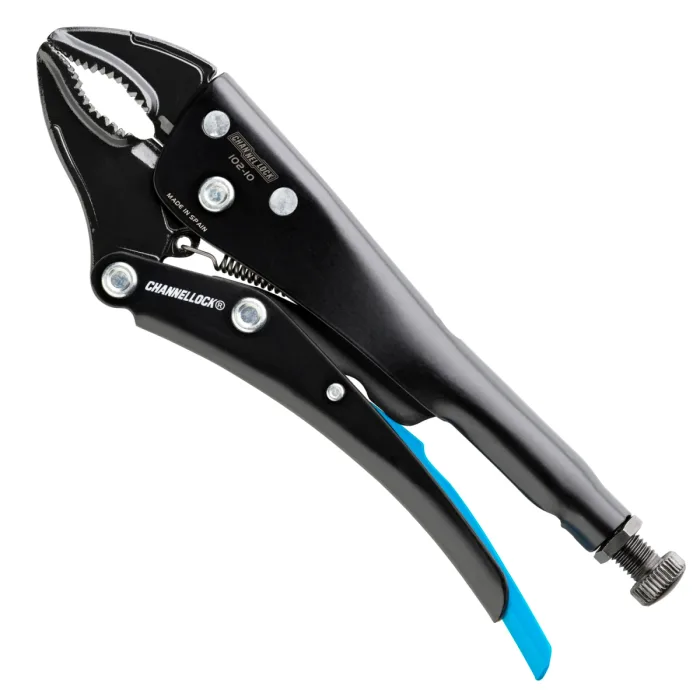
- Channellock 102-10 10-inch Curved Jaw Locking Pliers w/ Cutter - Buy. The only one of the four whose maker page lists a lock nut to retain the jaw adjustment, backed by the fullest dimensional table in the group.
- Knipex 41 14 250 Grip Pliers with Universal Jaws, 10 in. - Buy. Publishes three separate jaw openings, names the steel the jaws are forged from, and states the country of origin.
- Milwaukee 48-22-3410 10 in. TORQUE LOCK Curved Jaw Locking Pliers with Grip - It depends. The only one here with published part numbers for the two things that wear out, but the product page gives no jaw capacity.
- Irwin IRHT82573 New Fast Release Curved Jaw Locking Pliers CR, 10 in. - Skip. Irwin's own page carries no specifications section for it, and Irwin keeps the maximum locking force line for its trigger release models instead.
The verdict in 30 seconds
What mattered most
- Jaw style
- Published jaw capacity
- Published overall length
- Jaw material as published
- Published jaw hardness
- Release mechanism
A locking plier has one job, which is to hold on after you let go. That makes two numbers matter more than anything else printed on the packaging: how wide the jaws open, and what the jaws are made of. The odd thing about this category is how few makers print either. We compared the manufacturer pages for four tools that people actually buy, using only what the maker itself publishes, and let the gaps show.
The only one of the four whose maker page lists a lock nut to retain the jaw adjustment, backed by the fullest dimensional table in the group.
Best for: Anyone buying one general purpose locking plier who wants to check every number before it arrives.
- Channellock publishes the numbers in full: jaw capacity 2.48 in., jaw length 1.61 in., overall length 9.37 in., handle span 2.85 in., joint thickness 0.79 in., weight 1.34 lbs.
- The listed lock nut feature retains jaw adjustment, which is the setting that quietly drifts on a locking plier used all day.
- Forged steel jaws, an extended release lever described as one handed and pinch preventing, a coiled spring and an epoxy resin coating for rust and weld spatter.
- No jaw hardness figure and no clamping force are published.
- It is sold as a 10 inch tool but the published overall length is 9.37 in., so measure before you assume it fills the same slot as your old one.
- Channellock's own page states its locking pliers are made in Spain, while it lists its snips, non locking pliers, drivers, pry bars and ratcheting wrenches as 100 percent made in the USA.
- No replacement spring or adjusting screw part number is listed on the product page.
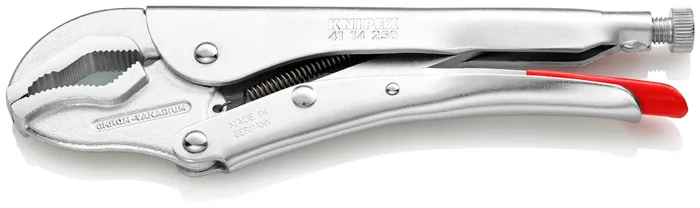
Publishes three separate jaw openings, names the steel the jaws are forged from, and states the country of origin.
Best for: Someone who clamps round stock, hex and flat material in the same day and wants the capacity for each printed rather than guessed.
- Max jaw opening is published as 1 27/64 in. for round pipe, square stock and hex, so you can check the fit for the shape you actually clamp rather than a single headline number.
- Materials are broken out: gripping jaws in chrome vanadium electric steel, forged, on a high strength rolled steel pliers body.
- The technical table gives country of origin Germany, weight 1.29 lbs., a bright zinc plated galvanized finish, and a serrated gripping surface.
- Bare handles with no grip sleeves, which is a preference rather than a fault but is worth knowing before it arrives.
- No jaw hardness figure and no clamping force are published, and no product standard is cited on the page.
- Nothing is published about a lock nut or any other feature that holds the adjusting screw setting.
- This jaw has no wire cutter; in the Knipex range the cutter sits on the round jaw 41 04 250 instead.
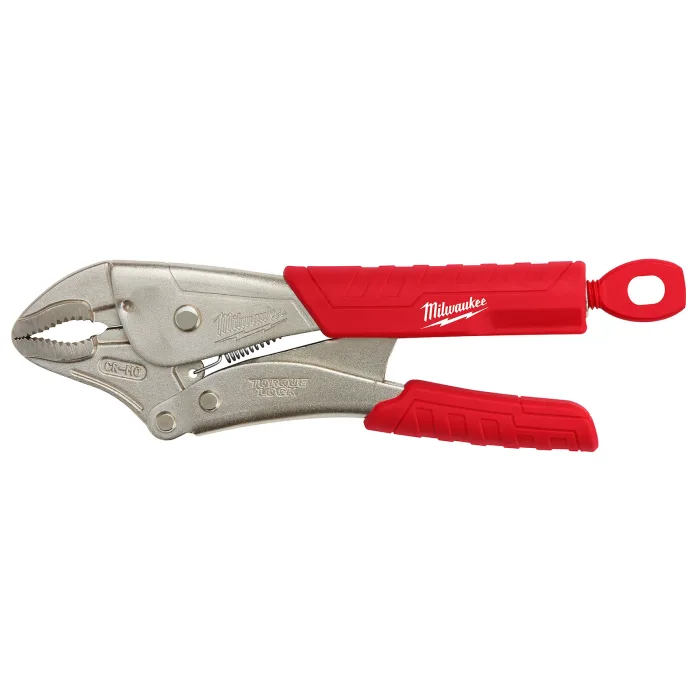
The only one here with published part numbers for the two things that wear out, but the product page gives no jaw capacity.
Best for: Someone who expects to own the tool for a decade and wants a spring and adjusting bolt part number on file before they need it.
- Milwaukee service bulletin 54-49-3130 lists a spring kit, 40-50-0945, and an adjustment bolt kit, 06-14-0105, against this exact catalog number.
- The adjusting screw has a screwdriver through hole, which Milwaukee describes as giving clearance to generate more torque when setting the jaws.
- Forged alloy steel with hardened jaws, overmoulded anti pinch grips, and a limited lifetime warranty.
- The product page gives the length only in the title, with no separate length or width figure.
- No jaw capacity appears on the product page or in the service bulletin.
- The more locking force claim has no stated comparison and no figure behind it.
- Country of origin is not published on the product page, and no jaw hardness is given.
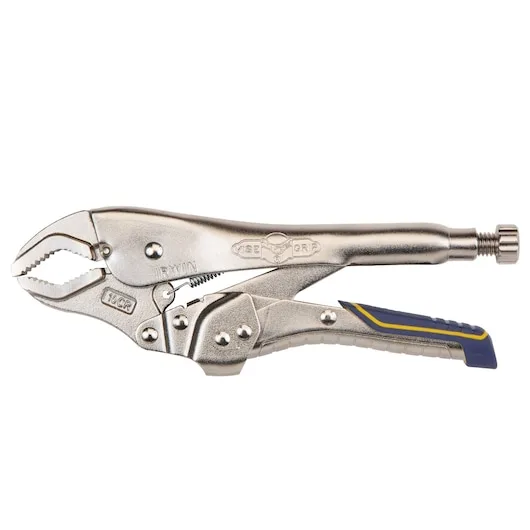
Irwin's own page carries no specifications section for it, and Irwin keeps the maximum locking force line for its trigger release models instead.
Best for: Someone who has already held one, wants the shorter hand span, and does not need to check a jaw capacity before buying.
- Irwin publishes a 20 percent reduced hand span, which is a real ergonomic difference if the usual handle stretch is a problem for you.
- The release is one handed and triggerless, which Irwin describes as 2X easier to open.
- A hex key adjusting screw and the Irwin lifetime limited warranty are both listed.
- The product page has no specifications section at all: no jaw capacity, no overall length, no weight.
- The three quantified claims, 20 percent reduced hand span, 3X gripping power and 2X easier to open, all carry footnote markers, and the footnote text does not appear on the page.
- On its Original models Irwin writes that the classic trigger release provides maximum locking force, and it makes no equivalent claim for the Fast Release, so within Irwin's own catalog this is not the maximum force option.
- Where the line does publish specifications they do not hold up: the sibling 902L3 page lists height, length, width and weight all as 0.39.
| Criteria | 102-10 10-inch Curved Jaw Locking Pliers w/ Cutter Top pick | 41 14 250 Grip Pliers with Universal Jaws, 10 in. | 48-22-3410 10 in. TORQUE LOCK Curved Jaw Locking Pliers with Grip | IRHT82573 New Fast Release Curved Jaw Locking Pliers CR, 10 in. |
|---|---|---|---|---|
| Verdict | Buy it | Buy it | It depends | Skip it |
| Best for | Anyone buying one general purpose locking plier who wants to check every number before it arrives. | Someone who clamps round stock, hex and flat material in the same day and wants the capacity for each printed rather than guessed. | Someone who expects to own the tool for a decade and wants a spring and adjusting bolt part number on file before they need it. | Someone who has already held one, wants the shorter hand span, and does not need to check a jaw capacity before buying. |
| Price tier | $$ · mid-range | $$$ · premium | $$ · mid-range | $ · budget |
| Jaw style | Curved jaw with wire cutter | Universal jaws, double prism | Curved jaw | Curved jaw, CR |
| Published jaw capacity | 2.48 in. | 1 27/64 in. for round, square and hex | Not published | Not published |
| Published overall length | 9.37 in. | 10 in. | Not published separately (10 in. in the name) | Not published |
| Jaw material as published | Forged steel | Chrome vanadium electric steel, forged | Forged alloy steel, hardened jaws | Heat-treated alloy steel |
| Published jaw hardness | Not published | Not published | Not published | Not published |
| Release mechanism | Extended release lever | Release lever | Not described | Triggerless one handed release |
| Holding the adjustment | Lock nut listed as retaining jaw adjustment | Adjusting screw, no lock nut published | Adjusting bolt kit 06-14-0105 published | Hex key adjusting screw, no service parts listed |
| Country of origin as published | Spain | Germany | Not published on the product page | Not published on the product page |
Which one is right for you?
- Anyone buying one general purpose locking plier who wants to check every number before it arrives. Buy it Channellock 102-10 10-inch Curved Jaw Locking Pliers w/ Cutter
- Someone who clamps round stock, hex and flat material in the same day and wants the capacity for each printed rather than guessed. Buy it Knipex 41 14 250 Grip Pliers with Universal Jaws, 10 in.
- Someone who expects to own the tool for a decade and wants a spring and adjusting bolt part number on file before they need it. It depends Milwaukee 48-22-3410 10 in. TORQUE LOCK Curved Jaw Locking Pliers with Grip
- Someone who has already held one, wants the shorter hand span, and does not need to check a jaw capacity before buying. Skip it Irwin IRHT82573 New Fast Release Curved Jaw Locking Pliers CR, 10 in.
How we judged the field
Five things separate a locking plier that earns its drawer space from one that annoys you. The first is jaw geometry paired with a published capacity, because a curved jaw and a straight jaw fail on opposite materials and a maker that will not print a jaw opening is asking you to guess. The second is what the jaws are made of, since the serrations do the gripping and the steel decides how long they stay sharp. The third is the release, which is either a lever in the handle or a trigger below it, and which you will operate hundreds of times more often than you will adjust the screw. The fourth is whether anything holds the adjusting screw where you set it, because a screw that walks turns a locking plier into a plier. The fifth is whether the maker publishes a wear part, since the spring and the adjusting bolt are the two things that go.
The field splits cleanly once you stop reading the bullets and start reading the tables. Two makers publish a full technical block with a jaw capacity you can check, and those became the two buys: Channellock, which adds a lock nut to hold the adjustment, and Knipex, which breaks the capacity out by material shape and names the steel. One publishes almost nothing dimensional but does publish a service parts bulletin with a spring and adjusting bolt number for every catalog number, which makes Milwaukee a genuine answer for some buyers and a poor one for others. And one publishes no specifications section at all on a page carrying three footnoted numerical claims whose footnotes are not shown, which is where the skip went. We stuck to the makers’ own pages throughout and left out anything we could not load.
Channellock 102-10 10-inch Curved Jaw Locking Pliers w/ Cutter
Buy itThe Channellock 102-10 is the tool that answers the question this category usually dodges. Channellock lists a lock nut feature that retains jaw adjustment, and none of the other three pages lists an equivalent. Around that sits the most complete dimensional table of the four: jaw capacity 2.48 in., jaw length 1.61 in., overall length 9.37 in., handle span 2.85 in., joint thickness 0.79 in., weight 1.34 lbs. The jaws are forged steel, the release lever is extended so it clears your finger, the spring is coiled, and the epoxy resin coating is described as spatter resistant, which matters if it lives near a welder. Two things to know before you buy. The published overall length is 9.37 in. even though it is sold as a 10 inch tool, so it will not necessarily drop into the same slot. And Channellock states plainly that its locking pliers are made in Spain while listing its snips, non locking pliers, drivers, pry bars and ratcheting wrenches as 100 percent made in the USA. If you want one locking plier and want to check it on paper first, this is the one.
Knipex 41 14 250 Grip Pliers with Universal Jaws, 10 in.
Buy itThe Knipex 41 14 250 is the better technical document, and for some work that is decisive. Instead of a single jaw capacity it publishes three: 1 27/64 in. for round pipe, for square stock and for hex, all measured against the same double prism universal jaw. The materials are broken out rather than described, with gripping jaws in chrome vanadium electric steel, forged, on a high strength rolled steel body, a serrated gripping surface, a bright zinc plated galvanized finish and a stated weight of 1.29 lbs. Knipex also prints Germany as the country of origin. The gaps are real. There is no hardness figure, no clamping force, no cited standard, and nothing at all about holding the adjusting screw setting. The handles are bare steel, which some people prefer and some people will not. And this particular jaw has no cutter, because in the Knipex range the wire cutter lives on the round jaw 41 04 250. Buy it if the shape of what you clamp changes through the day.
Milwaukee 48-22-3410 10 in. TORQUE LOCK Curved Jaw Locking Pliers with Grip
It dependsThe Milwaukee 48-22-3410 is the tool to buy for a reason nobody puts on the packaging. Milwaukee publishes a service parts bulletin, 54-49-3130, that lists a spring kit and an adjustment bolt kit against every locking tool it makes, and for this catalog number those are 40-50-0945 and 06-14-0105. The spring and the adjusting bolt are the two parts that actually fail on a locking plier, and none of the other makers here links anything comparable from its product page. The adjusting screw also has a screwdriver through hole for extra leverage when you set it. Then you read the product page and there is no jaw capacity and no separate length, in the page or the bulletin. The more locking force claim has no comparison behind it. If you buy tools expecting to service them, that trade is worth making. If you need to know the jaw opens far enough for your work, it is not.
Irwin IRHT82573 New Fast Release Curved Jaw Locking Pliers CR, 10 in.
Skip itThe Irwin IRHT82573 is the one to leave on the shelf, and the argument is entirely from Irwin’s own pages. Load the product page and there is no specifications section: no jaw capacity, no overall length, no weight, nothing you could check against the job in front of you. What is there is three quantified claims, a 20 percent reduced hand span, 3X gripping power and 2X easier to open, and all three carry superscript footnote markers whose text never appears on the page. Where this line does publish figures they do not survive a glance: the sibling 902L3 page lists product height, length, width and weight all as 0.39. The deciding point is Irwin’s own wording. On its Original models Irwin writes that the classic trigger release provides maximum locking force. It makes no such claim for the Fast Release. For a tool whose whole purpose is holding without slipping, buying the variant your own maker does not call the maximum force option is a strange default.
Sources
Specs in this review come from these pages.
- KNIPEX 41 14 250 Grip Pliers with Universal Jaws, technical details (knipex-tools.com)
- Channellock 102-10 Curved Jaw Locking Pliers, technical details (channellock.com)
- Milwaukee Tool 48-22-3410 TORQUE LOCK Curved Jaw Locking Pliers (milwaukeetool.com)
- Milwaukee Tool service parts bulletin 54-49-3130, TORQUE LOCK Pliers and Clamps (documents.milwaukeetool.com)
- IRWIN IRHT82573 New Fast Release Curved Jaw Locking Pliers CR (irwintools.com)
- ASME B107.500, Pliers and Shears, standard record and status (asme.org)
Channellock 102-10 10-inch Curved Jaw Locking Pliers w/ Cutter vs Knipex 41 14 250 Grip Pliers with Universal Jaws, 10 in.: which should you buy?
Both buys are honest tools and the choice comes down to which failure you care about. The Channellock 102-10 is built around the lock nut that retains the jaw adjustment, and it publishes the fullest set of dimensions of anything here, so it is the safer answer for one tool that gets set for a job and used for a week. The Knipex 41 14 250 publishes better information about the jaw itself, giving a separate opening for round, square and hex stock plus the exact steel the jaws are forged from, and it names Germany as the country of origin. Neither publishes a hardness figure or a clamping force, so do not let anyone tell you one grips harder than the other on paper.
Pick the Channellock if you want a curved jaw with a wire cutter, a lock nut on the screw, a moulded handle and a number for every dimension. Pick the Knipex if your work changes shape, if you would rather have a universal double prism jaw with a printed capacity for each geometry, and if bare steel handles do not bother you. If you already own a locking plier and it slips because the screw wanders, the Channellock is the direct fix. If you already own one and it does not open wide enough for the round stock you clamp, the Knipex is the one that will tell you in advance whether it does.
What to look for
- A published jaw capacity: if the maker will not print how wide the jaws open, you are buying a shape you have not measured, and two of the four tools here do not print it.
- A separate figure for round, square and hex: jaw capacity is not one number, and a maker that gives three of them, as Knipex does, is telling you something a single headline figure hides.
- Something that holds the adjusting screw: a lock nut, as Channellock lists, or a published replacement adjusting bolt, as Milwaukee does, is worth more day to day than any gripping claim.
- Jaw material stated as a grade, not a mood: forged chrome vanadium electric steel is a specification, maximum toughness is not, and nobody in this group publishes a hardness figure at all.
- The release you will actually use: a lever in the handle or a trigger below it, and if you release the tool constantly, hold both before you commit rather than reading the marketing.
- A wear part with a number: the spring and the adjusting bolt are what fail, so a published service parts bulletin is the difference between a repair and a replacement.
Our final take
Locking pliers look like a solved problem and the spec sheets say otherwise. Two of these four makers will not tell you how far the jaws open, none of the four publishes a jaw hardness or a clamping force, and the standard that specifically covers locking pliers has not been revised since 2002 while the current ASME pliers standard does not name them at all. In that vacuum, buy from the maker that prints the most. The Channellock 102-10 publishes every dimension and a lock nut to hold the setting. The Knipex 41 14 250 publishes three jaw openings and the steel behind them. Both will still mar a fastener, because biting into metal is how they work.
Questions, answered
Is there an actual standard for locking pliers, and is it current?
There is a document, and it is old. ANSI/ASME B107.24-2002, Locking Pliers, covers the dimensions and functional characteristics of locking pliers suitable for gripping and wrenching operations, and it is still listed with no revision history since 2002. The current umbrella pliers standard is ASME B107.500-2020, Pliers and Shears, which revises the 2010 edition and which ASME has placed on stabilized maintenance. The published scope of B107.500 lists long nose, long reach, retaining ring, gripping and cutting, adjustable joint and slip joint, and cannon plug pliers, and it does not name locking pliers. So if a maker tells you a locking plier meets a standard, ask which document and which year, because none of the four tools here cites one at all.
Should I use locking pliers on nuts and bolts?
Several makers here say yes. Irwin writes that curved jaws give four points of pressure and are ideal for heavy torque on any style of nut or bolt head, Milwaukee says its curved jaw maximizes pressure points for any bolt or nut, and Channellock describes gripping stubborn fasteners. So the premise that these are not meant for fasteners is not what the manufacturers publish. What is true is the mechanism: hardened serrations bite into the metal, and that bite is what stops the slipping. Use them on a fastener that is already rounded, seized, headless or destined for the bin, and reach for a socket or a box wrench on anything you plan to reuse or anything plated and visible.
Curved jaw, straight jaw, long nose, C-clamp, welding clamp, sheet metal: which of these are actually different tools?
All of them, and the makers' own catalogs prove it rather than a reviewer's opinion. Milwaukee's service bulletin 54-49-3130 lists curved jaw, straight jaw, long nose, C-clamp, swivel pad C-clamp, deep reach C-clamp, locking seamer, large jaw, locking chain and locking welder clamp as separate catalog numbers with their own spring and adjusting bolt kits. Knipex splits its range into grip pliers and welding pliers as different product families. The jaw is the tool. Curved jaws grip round and hex stock at multiple points, straight jaws spread the load along flat material, long nose reaches into places a full jaw cannot, and C-clamp and welding versions are clamps that happen to lock rather than pliers you can clamp with.
Does the adjusting screw hold its setting?
Only one of these four makers addresses it on its page. Channellock lists a lock nut feature that retains jaw adjustment, which is the only published mechanism in this group for stopping the screw backing off as you cycle the tool. Milwaukee takes a different route and publishes an adjustment bolt kit part number, 06-14-0105 for the 48-22-3410, so the screw is treated as a serviceable wear item rather than a permanent one. Knipex and Irwin both list an adjusting screw and we found nothing about holding its position. If you set a locking plier once for a repeated job, that difference is worth more than any headline gripping claim.
Lever release or trigger release, and can either pop open under load?
They are two ways of breaking the same over-centre toggle linkage, which is what Knipex means by high clamping pressure due to toggle lever action. A lever release, used by Knipex and Channellock, sits in the handle and is pulled to unlock; Channellock extends the lever specifically so your finger does not get pinched. A trigger release hangs below the handle, and Irwin describes its classic trigger version as providing maximum locking force while its newer Fast Release is triggerless and marketed on being easier to open. We found no claim from these makers about the tool releasing under load. Treat the difference as ergonomics and force, not safety, and set the screw properly rather than relying on the release design.
Deciding between the top two? See our head-to-head: Channellock 102-10 10-inch Curved Jaw Locking Pliers w/ Cutter vs Knipex 41 14 250 Grip Pliers with Universal Jaws, 10 in..
More Tools & DIY reviews
 The Best Log Splitters: 4 Compared (and One to Skip)
  The Best Miter Saws: 4 Compared (and One to Skip)
  The Best Moisture Meters: 4 Compared (and One to Skip)
  The Best Digital Multimeters: 4 Compared (and One to Skip)
  The Best Non-Contact Voltage Testers: 4 Compared (and One to Skip)
  The Best Oscillating Multi-Tools: 4 Compared (and One to Skip)