

Tools & DIY
The Best Oscillating Multi-Tools: 4 Compared (and One to Skip)
Four oscillating multi-tools compared on the spec that decides how fast they cut, the oscillation angle, and which makers do not publish it.
The short version
Buy the Makita XMT03Z. It publishes a 3.2 degree oscillation angle and the widest published speed range here at 6,000 to 20,000 OPM, and that 6,000 floor is what makes controlled scraping possible rather than the blade skating off the line. It is cordless, carries a 3 year warranty, and Makita states the attachment type plainly as OIS with a universal adaptor included. Buy the corded Makita TM3010CX1 instead if the tool will mostly work in one place: Makita publishes exactly the same 3.2 degree angle and 6,000 to 20,000 OPM range for it, from a 3.0 amp corded motor that never runs out, and it ships with a universal accessory adaptor so older blade types still fit. The DEWALT DCS356B is the it-depends, with the best terms in this group at 3 years limited plus a year of free service, three discrete speed settings and a universal adaptor in the box, but DEWALT publishes no oscillation angle for it on its product page, so the specification that governs cutting speed is simply absent. Skip the CRAFTSMAN CMCE500B: 18,000 OPM is the lowest published ceiling and retail listings put its angle at 2.8 degrees, which Craftsman does not confirm, from a brushed motor. Best for: anyone who assumed oscillations per minute was the spec to compare.
Our picks at a glance
- Makita TM3010CX1 Corded Oscillating Multi-Tool Kit - Buy. The same published angle and speed range as the cordless Makita, from a corded motor that never runs out mid-cut.
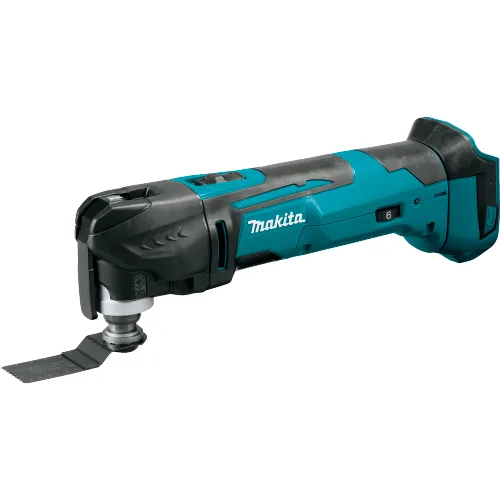
- Makita XMT03Z 18V LXT Lithium-Ion Cordless Multi-Tool - Buy. The widest published angle and speed range here without a cord, plus a 3 year warranty.
- DEWALT DCS356B 20V MAX XR 3-Speed Brushless Oscillating Multi-Tool - It depends. The best warranty and service terms here, sold without publishing the one specification that governs how fast it cuts.
- CRAFTSMAN CMCE500B V20 Cordless Oscillating Tool - Skip. The lowest published top speed here and, by retail listings, the narrowest angle, which likely means it cuts slower on both of the terms that matter.
The verdict in 30 seconds
What mattered most
- Published oscillation angle
- Speed range
- Power source
- Motor type
- Warranty
- Universal adaptor included
Two things decide an oscillating multi-tool and neither is the speed figure everyone quotes. The first is the oscillation angle, how far the blade sweeps on each stroke, because a tool running 20,000 oscillations per minute through a narrow arc removes less material than one running fewer through a wide one. Both Makita tools publish that angle on their own pages, while the DEWALT and CRAFTSMAN pages do not, which leaves those two harder to compare. The second is the blade interface. Bosch and Fein jointly developed Starlock, a patented mount with an asymmetry worth understanding before you buy: Starlock blades fit older universal tools, but a Starlock tool takes only Starlock accessories, and the Plus and Max tiers are not compatible with the older standard at all.
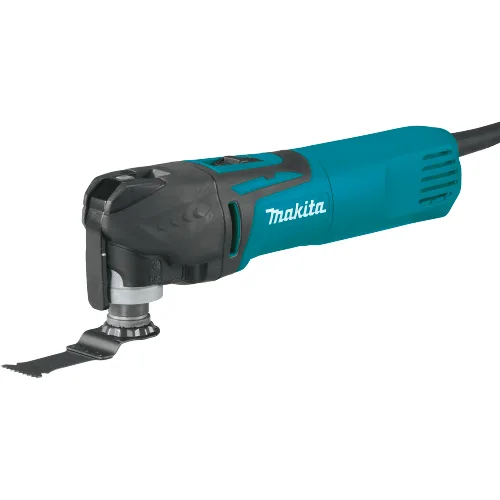
The same published angle and speed range as the cordless Makita, from a corded motor that never runs out mid-cut.
Best for: Bench and single-location work where sustained cutting matters more than reaching around a corner without a cord.
- Makita publishes a 3.2 degree oscillation angle, matching its cordless sibling.
- A 6,000 to 20,000 OPM range, the widest in this comparison, with the low floor that makes controlled scraping possible.
- Corded at 3.0 amps with soft start and electronic speed control, so output holds for as long as the job takes.
- Ships with a universal accessory adaptor and tool-less blade change, so older blade types are not stranded.
- Corded, which is awkward on a tool whose purpose is reaching into confined spaces.
- At 3.7 lb it is a tool held at arm's length in awkward positions.
- Brushed motor, so there is a wear item the cordless DEWALT does not have.
- At 11-1/8 in. overall it is long, which works against it in the tight spots this tool exists for.
The widest published angle and speed range here without a cord, plus a 3 year warranty.
Best for: General remodelling and trim work where reaching awkward spots without a cord matters as much as cutting speed.
- A published 3.2 degree oscillation angle, the widest in this comparison alongside its corded sibling.
- The widest speed range here at 6,000 to 20,000 OPM, and the 6,000 floor is the lowest, which is what controlled scraping needs.
- 3 year warranty, and Makita publishes the angle rather than leaving it to third parties.
- Cordless, which suits a tool whose entire purpose is getting into places a cord makes awkward, and Makita publishes the OIS attachment type rather than leaving blade fit to guesswork.
- Bare tool, so batteries and charger are a separate cost if you are not already on the LXT platform.
- Sustained plunge cutting through nail-embedded timber will drain a pack faster than the job takes.
- Makita's spec table lists the motor as brushed, so run time is shorter than a brushless equivalent would give.
- Makita lists the attachment type as OIS, the older interface, so Starlock blades will fit it but Starlock Plus and Max accessories will not.
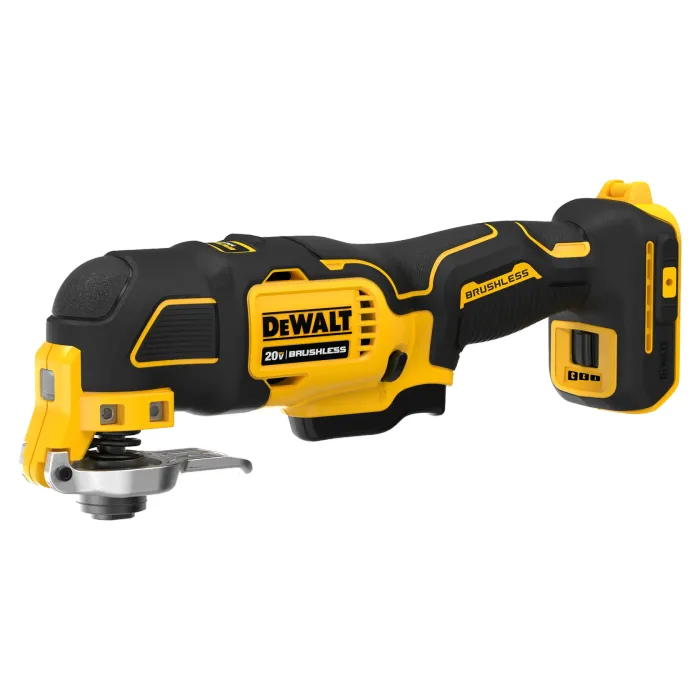
The best warranty and service terms here, sold without publishing the one specification that governs how fast it cuts.
Best for: Someone already on the 20V MAX platform who values the warranty terms and does not need to compare cutting speed on paper.
- 3 Year Limited Warranty with 1 Year Free Service and a 90 day satisfaction guarantee, the strongest terms in this group.
- Three discrete speed settings rather than a single variable dial, which makes returning to a known speed easy.
- Brushless motor, which DEWALT says delivers up to 57 percent more runtime than a similar brushed tool.
- Ships with a universal accessory adaptor, so older blade types can be fitted rather than being obsolete.
- DEWALT publishes no oscillation angle on its own product page, so the specification deciding material removal cannot be checked.
- Third-party listings quote angle figures that DEWALT does not confirm, so any comparison is unreliable.
- Bare tool, so the platform cost is on top.
- Needing a universal adaptor to fit some accessories is one more small part to lose.
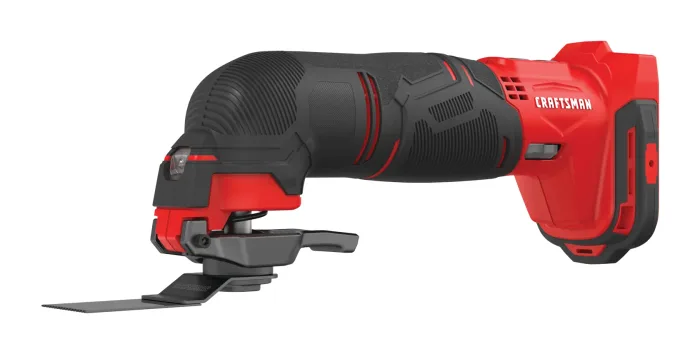
The lowest published top speed here and, by retail listings, the narrowest angle, which likely means it cuts slower on both of the terms that matter.
Best for: Occasional light scraping, caulk removal and small trim cuts where slower cutting costs patience rather than money.
- Retail listings give an oscillation angle of 2.8 degrees, though Craftsman's own product page does not state it.
- Tool-free universal attachment system, so blades from most systems fit without an adaptor.
- 3 year limited parts and labour warranty, matching the far more expensive tools here.
- Light and manageable at a genuinely low price.
- The 2.8 degree angle seen in retail listings would be the narrowest in this comparison, and Craftsman does not confirm it on its own page.
- 18,000 OPM is the lowest published top speed here, so it is likely slower on both of the factors that combine into cutting rate.
- Brushed motor, which means less efficiency, more heat and a wear item the brushless DEWALT does not have.
- The two limitations compound: narrower arc at fewer strokes per minute is a bigger gap than either figure suggests alone.
| Criteria | TM3010CX1 Corded Oscillating Multi-Tool Kit | XMT03Z 18V LXT Lithium-Ion Cordless Multi-Tool Top pick | DCS356B 20V MAX XR 3-Speed Brushless Oscillating Multi-Tool | CMCE500B V20 Cordless Oscillating Tool |
|---|---|---|---|---|
| Verdict | Buy it | Buy it | It depends | Skip it |
| Best for | Bench and single-location work where sustained cutting matters more than reaching around a corner without a cord. | General remodelling and trim work where reaching awkward spots without a cord matters as much as cutting speed. | Someone already on the 20V MAX platform who values the warranty terms and does not need to compare cutting speed on paper. | Occasional light scraping, caulk removal and small trim cuts where slower cutting costs patience rather than money. |
| Price tier | $$ · mid-range | $$$ · premium | $$$ · premium | $ · budget |
| Published oscillation angle | 3.2 degrees | 3.2 degrees | Not published | Not published by Craftsman |
| Speed range | 6,000 to 20,000 OPM | 6,000 to 20,000 OPM | 3 speed settings, OPM not stated | 8,000 to 18,000 OPM |
| Power source | Corded, 3.0 amp | 18V cordless | 20V cordless | 20V cordless |
| Motor type | Brushed | Brushed | Brushless | Brushed |
| Warranty | 3 years | 3 years | 3 years plus 1 year service | 3 years |
| Universal adaptor included | Yes | Yes | Yes | Not needed, universal mount |
| Weight | 3.7 lb | 4.9 lb with battery | Not published | Not published |
| Attachment type stated | Universal adaptor included | OIS, adaptor included | Universal adaptor included | Universal tool-free |
Which one is right for you?
- Bench and single-location work where sustained cutting matters more than reaching around a corner without a cord. Buy it Makita TM3010CX1 Corded Oscillating Multi-Tool Kit
- General remodelling and trim work where reaching awkward spots without a cord matters as much as cutting speed. Buy it Makita XMT03Z 18V LXT Lithium-Ion Cordless Multi-Tool
- Someone already on the 20V MAX platform who values the warranty terms and does not need to compare cutting speed on paper. It depends DEWALT DCS356B 20V MAX XR 3-Speed Brushless Oscillating Multi-Tool
- Occasional light scraping, caulk removal and small trim cuts where slower cutting costs patience rather than money. Skip it CRAFTSMAN CMCE500B V20 Cordless Oscillating Tool
How we judged the field
Oscillation angle first, because it is the specification that decides how much material each stroke removes and it is almost never in the marketing. Only the two Makitas publish it on their own pages, at 3.2 degrees. Speed range second, and specifically both ends of it, since a low floor allows controlled scraping and a high ceiling allows fast cutting, and the two combine with the angle into an actual cutting rate. Then the blade interface, because it is the only decision here with consequences that outlive the tool: Starlock compatibility runs in one direction and it is worth knowing which way before committing. Then warranty and motor type, which decide how long the tool lasts and how much of a charge it uses getting there.
Makita TM3010CX1 Corded Oscillating Multi-Tool Kit
Buy itThe corded Makita TM3010CX1 is the second buy and the more interesting half of a matched pair. Makita publishes exactly the same figures for it as for the cordless XMT03Z, a 3.2 degree oscillation angle and a 6,000 to 20,000 OPM range, which means the two tools cut the same way and the only real variable between them is the power source. What the cord buys is endurance: 3.0 amps with soft start and electronic speed control, held for as long as the job runs, where a battery fades under the sustained load this tool is used for. It ships with a universal accessory adaptor and tool-less blade change, so older blade types are not stranded. What the cord costs is the thing the tool exists for. This is a device designed to reach into confined spaces, and at 11-1/8 inches long and 3.7 pounds it is a long tool to hold at arm’s length, with a lead trailing behind it. Buy it if the work happens at a bench or in one room; buy the cordless one if it happens around a house.
Makita XMT03Z 18V LXT Lithium-Ion Cordless Multi-Tool
Buy itThe Makita XMT03Z is the pick because it publishes the best numbers in this comparison and pairs them with terms nobody beats meaningfully. Its 3.2 degree oscillation angle is the widest published here, and its 6,000 to 20,000 OPM range has the lowest floor published here. The bottom of that range matters more than the top: at 6,000 OPM, lower than anything else in the group, the blade can be placed and drawn along a line for scraping without skating away, which is the operation people find hardest to control on an oscillating tool. It is cordless, which for a tool built to reach into corners is close to a functional requirement rather than a convenience, and it carries a 3 year warranty. The reservations are the ordinary cordless ones plus one: it is a bare tool, so the platform cost lands on top; sustained plunge cutting through nail-embedded timber drains packs quickly; and it is a brushed motor, so it gives up run time to a brushless equivalent. It also accepts Starlock accessories without being a Starlock tool, which is worth checking rather than assuming.
DEWALT DCS356B 20V MAX XR 3-Speed Brushless Oscillating Multi-Tool
It dependsThe DEWALT DCS356B is the it-depends, and the reason is a gap rather than a flaw. Its warranty terms are the best in this group by a clear margin: three years limited, a year of free service, and ninety days satisfaction. It has three discrete speed settings rather than a dial, which is genuinely useful when you want to return to a known speed rather than hunt for it. It is brushless, and it ships with a universal accessory adaptor so older blade types are not stranded. What DEWALT does not publish, anywhere on its own product page, is the oscillation angle. Third-party listings quote figures that DEWALT does not confirm, so the number cannot be compared. If you are already on the platform and value the warranty, this is a good tool. If you are trying to work out which of these cuts fastest, it has removed itself from the comparison.
CRAFTSMAN CMCE500B V20 Cordless Oscillating Tool
Skip itThe CRAFTSMAN CMCE500B is the skip. Its own page does not state an oscillation angle, retail listings put it at 2.8 degrees, which would be the narrowest here, and at 18,000 OPM it also has the lowest published top speed. Those two do not cancel out, they compound: less material per stroke, taken fewer times per minute. It is also a brushed cordless tool, as is the XMT03Z, which on a tool that spends long periods under continuous load in confined spaces means more heat and a wear item the brushless DEWALT does not have. Against that it takes universal blades tool-free without an adaptor, it carries the same 3 year warranty as tools costing several times more, and it is cheap. For scraping old caulk and trimming the occasional piece of moulding it is entirely adequate, and the slower cutting costs patience rather than money.
Sources
Specs in this review come from these pages.
- Makita USA, TM3010CX1 corded oscillating multi-tool kit specifications (makitatools.com)
- Makita USA, XMT03Z 18V LXT cordless multi-tool (makitatools.com)
- DEWALT DCS356B 20V MAX XR 3-speed oscillating multi-tool (dewalt.com)
- CRAFTSMAN CMCE500B V20 cordless oscillating tool (craftsman.com)
- Bosch pressroom, Starlock professional interface system for multi-tool accessories (pressroom.boschtools.com)
Makita TM3010CX1 Corded Oscillating Multi-Tool Kit vs Makita XMT03Z 18V LXT Lithium-Ion Cordless Multi-Tool: which should you buy?
The two Makitas make the cleanest comparison in this batch, because Makita publishes identical figures for both: 3.2 degrees of oscillation angle and 6,000 to 20,000 OPM. Holding the cutting behaviour constant isolates exactly what the power source costs and buys. The corded TM3010CX1 gives you output that never fades, 3.0 amps with soft start, for as long as the work takes, and it includes a universal accessory adaptor. It also weighs 3.7 pounds, runs 11-1/8 inches long, and drags a lead into the confined spaces this tool is designed for. The cordless XMT03Z gives up nothing on the published cutting specification and removes the cord entirely, at the cost of buying into a battery platform and accepting that sustained plunge cutting will empty a pack. If the tool lives at a bench, the cord is free. If it is carried around a house, the cord is the whole problem.
What to look for
- A published oscillation angle: the figure that decides material removal per stroke, stated as 3.2 degrees by Makita and absent from some makers’ pages entirely.
- Whether the angle is total sweep or displacement from centre: a third-party figure far from a maker’s own may mean the conventions differ rather than the tools.
- The bottom of the speed range, not just the top: a low floor around 6,000 OPM is what makes controlled scraping possible without the blade skating away.
- Blade interface and which way compatibility runs: Starlock accessories fit older universal tools, but a Starlock tool takes only Starlock accessories, and the Plus and Max tiers narrow it further.
- Whether an adaptor is needed and supplied: a universal adaptor in the box means older blades still fit, and one more small part to lose.
- Warranty term: all four here carry 3 years, but DEWALT adds a year of free service and a 90 day satisfaction guarantee.
Our final take
Oscillations per minute is the number on the box and the least useful one in the category, because a fast tool sweeping a narrow arc removes less than a slower one sweeping a wide arc. Find the oscillation angle, check whether the maker publishes it at all, and then decide the blade interface question deliberately rather than discovering it when you next buy accessories.
Questions, answered
What does oscillation angle actually change?
It sets how far the blade sweeps on each stroke, so together with the speed it determines how much material comes off per second. A tool at 3.2 degrees moves the blade tip further per oscillation than one at 2.8, and at similar speeds it will cut faster. The trade is control: a wider angle is more aggressive and harder to place precisely, which is why fine detail work and scraping are easier on a narrower arc or a slowed-down tool. It is the most useful specification in the category and the least advertised.
Why can I not compare DEWALT's oscillation angle?
Because DEWALT does not publish one. Its own product page lists speed settings, warranty terms and included accessories but no angle. Figures do circulate from third parties, but they are not confirmed by the maker and may use different conventions, such as total sweep against displacement from centre. Without the maker stating which, the figure cannot be compared with the others, and that is why we treat it as missing rather than as low.
What is Starlock and does it lock me in?
Starlock is a blade mounting system jointly developed by Bosch and Fein, using a three-dimensional interlock in place of the older arrangement that clamps a blade between a washer and the tool. The compatibility runs one way. Starlock accessories are designed to fit older universal tools, so buying Starlock blades keeps your options open. A Starlock tool, however, accepts only Starlock accessories, and the Starlock Plus and Starlock Max tiers are not compatible with older tools at all. So the blades are the safe purchase and the tool is the commitment.
Does a brushless motor matter on an oscillating tool?
Less than on a drill, but it still matters. Brushless motors are more efficient, which on a cordless tool means more run time per charge, and they have no brushes to wear out. On this kind of tool the bigger effect is heat: oscillating tools spend long periods under continuous load in confined spaces, and a brushed motor in that duty gets hot. Of the cordless tools here, only the DEWALT is brushless; the Makita XMT03Z and the Craftsman are brushed.
Are the cheap universal blade sets worth buying?
For occasional work, yes, with one caveat. Universal blades fit almost everything and cost a fraction of branded ones, and for scraping caulk or cutting soft timber the difference is small. Where it shows is plunge cutting through anything with nails or screws in it, which is the job this tool is uniquely good at, and there the tooth material and heat treatment decide whether a blade lasts one cut or twenty. Buy cheap for scraping and branded for nail-embedded work.
Deciding between the top two? See our head-to-head: Makita XMT03Z 18V LXT Lithium-Ion Cordless Multi-Tool vs Makita TM3010CX1 Corded Oscillating Multi-Tool Kit.
More Tools & DIY reviews
 The Best Outlet Testers: 4 Compared (and One to Skip)
  The Best Pipe Wrenches: 4 Compared (and One to Skip)
  The Best Pocket Hole Jigs: 4 Compared (and One to Skip)
  The Best Precision Screwdriver Sets: 4 Compared (and One to Skip)
  The Best Random Orbital Sanders: 4 Compared (and One to Skip)
  The Best Reciprocating Saws: 4 Compared (and One to Skip)