Explained
Oscillating Multi-Tools, Explained
After reading, you'll know which spec governs cutting rate and whether a blade system is going to narrow your options later.
In this guide
Multi-tool listings compete on oscillations per minute. That number is half the story, and the other half, how far the blade travels each time, is often missing.
The 30-second version
- Angle and speed multiply, so a tool at 20,000 OPM through a narrow arc removes less material than one at 19,500 through a wider one.
- Some makers publish no angle at all, which removes the tool from any honest cutting-rate comparison regardless of how good it is.
- Angle conventions differ, and a figure far from a competitor's may be measuring displacement from centre rather than total sweep.
- Starlock compatibility runs one way, since Starlock blades fit older universal tools but a Starlock tool accepts only Starlock accessories.
- The low end of the speed range matters, because scraping and detail work need a slow setting, and a tool that only runs fast will skate off the line.
The products this guide is about
Our verdict on each, with the full reasoning on the companion review.
- Buy Makita TM3010CX1 Corded Oscillating Multi-Tool Kit The same published angle and speed range as the cordless Makita, from a corded motor that never runs out mid-cut. Amazon
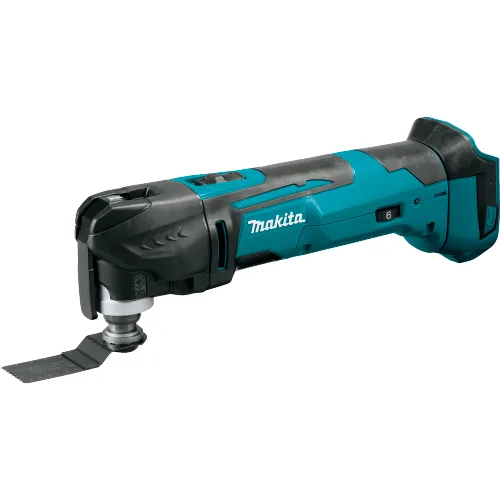
- Buy Makita XMT03Z 18V LXT Lithium-Ion Cordless Multi-Tool The widest published angle and speed range here without a cord, plus a 3 year warranty. Amazon
- It depends DEWALT DCS356B 20V MAX XR 3-Speed Brushless Oscillating Multi-Tool The best warranty and service terms here, sold without publishing the one specification that governs how fast it cuts. Amazon
- Skip CRAFTSMAN CMCE500B V20 Cordless Oscillating Tool The lowest published top speed here and, by retail listings, the narrowest angle, which likely means it cuts slower on both of the terms that matter. Amazon
What actually matters
- Oscillation angle - how far the blade sweeps per stroke, a few degrees (Makita publishes 3.2). Combined with speed it sets the cutting rate. Check whether the maker publishes it and whether the figure is total or per side.
- OPM range - oscillations per minute, usually variable. The ceiling decides fast cutting and the floor decides whether delicate scraping is controllable.
- Blade interface - universal or OIS style, Starlock, Starlock Plus or Starlock Max. Determines what accessories fit now and what will fit the next tool you buy.
- Motor type - brushless runs cooler and longer per charge, which matters on a tool used under sustained load in enclosed spaces. Corded removes the run-time question entirely.
- Warranty - varies by maker and does not necessarily track price. Registration requirements are worth reading.
- Weight and length - the tool is used at arm's length in awkward positions, so a difference of half a pound changes how long you can work accurately.
The specs, in plain English
Green flags vs red flags
Green flags
- An oscillation angle is published in degrees.
- The speed range is given as two numbers so the low end is visible.
- The blade interface is named specifically, not just described as universal.
- Whether an adaptor is required, and whether it is included, is stated.
- Warranty terms specify any registration requirement.
Red flags
- OPM is the headline and no angle appears anywhere in the specification.
- An angle is quoted with no indication of whether it is total sweep or per side.
- Compatible with most brands appears with no interface named.
- A premium price sits alongside the shortest warranty in the category.
- Only a maximum speed is given, with no floor for delicate work.
Who's who: the brands
- Makita - Publishes oscillation angle and full speed ranges plainly across both corded and cordless models, which makes the two directly comparable. The clearest disclosure in this comparison.
- FEIN - Co-developed Starlock with Bosch.
- DEWALT - Strong warranty and service terms and discrete speed settings, but does not publish an oscillation angle on its own product pages.
- CRAFTSMAN - Budget cordless tools with brushed motors and a lower published top speed. Its product page does not state an oscillation angle.
How to read a listing without getting fooled
Find the oscillation angle before anything else, and treat its absence as a missing capability figure rather than a minor omission. If it is present, check whether the maker says total or per side, because a number far from a competitor's may be a convention difference. Then read both ends of the speed range. Then work out the blade interface and which direction its compatibility runs, since that decision outlives the tool.
How much should you spend?
Budget buys a brushed cordless tool with a narrower arc and a lower top speed, which is fine for scraping and light trim. Mid-range buys a brushless motor, a published angle and a usable slow setting. Higher tiers can buy a wider arc or a corded motor that never fades, but price does not always track warranty cover, so read that before assuming it does.
Questions, answered
Will Starlock blades fit my old multi-tool?
Standard Starlock accessories are designed to be backward compatible with older OIS tools, so in most cases yes. The reverse is not true: a Starlock tool will not accept older accessories, and the Starlock Plus and Starlock Max tiers are not compatible with older tools at all. Buying Starlock blades is the low-risk move; buying a Starlock tool is the commitment.
Is a corded multi-tool still worth buying?
For sustained cutting, yes. This tool works under continuous load in confined spaces, which is exactly the duty that drains batteries fastest, and a corded motor simply does not fade. The counter-argument is strong though, because the tool exists to reach into awkward places and a cord is at its most annoying there. Cutting a lot in one place favours corded; working around a house favours cordless.
What can a multi-tool do that nothing else can?
Plunge cut into the middle of a surface, flush cut against an adjacent one, and do both in a space too tight for any rotating blade. Cutting out a section of skirting in place, trimming door casing for flooring, or removing grout without damaging tile are the jobs where nothing substitutes. For anything you could reach with a saw, a saw will be faster.
Why does my blade burn instead of cutting?
Usually too much pressure, too fast a speed, or a dull blade, and often all three together. Pressing harder narrows the effective arc and generates heat rather than removing material, which then dulls the blade and makes you press harder still. Back off, drop the speed a setting, and let the oscillation do the work. If it still burns, the blade is finished.
Or jump to the head-to-head: Makita XMT03Z 18V LXT Lithium-Ion Cordless Multi-Tool vs Makita TM3010CX1 Corded Oscillating Multi-Tool Kit.