Explained
Random Orbital Sanders, Explained
After reading, you'll know which orbit size suits your work and why a sander that cannot slow down is limited whatever its rating.
In this guide
Sander listings lead with amps and orbits per minute. The number that decides what the tool does to a surface is the orbit diameter, and it is often missing.
The 30-second version
- Orbit diameter sets the scratch, since a small stroke leaves a fine pattern and removes slowly while a large one removes fast and leaves marks to sand out.
- Woodworking sanders cluster at the fine end, with the tools we reviewed running roughly 2 to 2.8 mm, so the 3 mm against 5 mm choice described in most guides is not really on offer.
- The speed floor matters more than the ceiling, because most sanders reach 12,000 OPM and only a low setting protects finish coats and edges from burning.
- Power should match the stroke, as a small-orbit finishing sander with a big motor just gets pushed harder and leaves the marks it exists to avoid.
- Vibration figures are rare, so the specification that would tell you how long you can comfortably hold the tool is missing from many US listings.
The products this guide is about
Our verdict on each, with the full reasoning on the companion review.
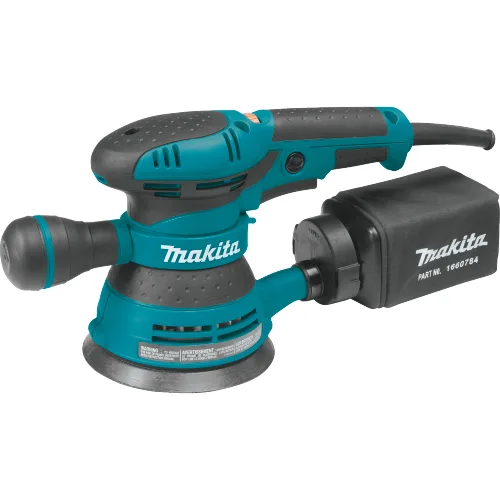
- Buy Makita BO5041 5 in. Random Orbit Sander, variable speed Publishes the largest orbit here at 2.8 mm and the widest speed range, including a genuinely slow 4,000 OPM setting. Amazon
- Buy Festool ETS 125 REQ-Plus Random Orbital Sander The smallest stroke here at 2 mm and the highest top speed, which is the correct combination for a tool that refines rather than removes. Amazon
- It depends DEWALT DWE6423 5 in. Variable Speed Random Orbit Sander A capable sander whose speed range will not go slow, which limits where it belongs. Amazon
- Skip CRAFTSMAN CMEW231 5 in. Corded Random Orbit Sander, 3 amp Publishes amps, speed and weight, and leaves out the orbit diameter that decides what kind of sander it is. Amazon
What actually matters
- Orbit or stroke diameter - how far the pad travels per orbit, in millimetres. Roughly 2 mm is a finishing stroke, 2.5 to 3 mm is general purpose, and 5 mm is aggressive removal found on automotive machines.
- Speed range in OPM - orbits per minute. Read the lower figure first: a floor of 4,000 allows delicate work, a floor of 8,000 does not, and a single fixed speed allows none.
- Power - watts or amps. Meaningful only against the stroke, since a finishing sander is deliberately modest and a levelling sander needs the headroom.
- Pad diameter - nominal 5 inch tools may carry 123 mm or 125 mm pads, which affects how abrasive discs sit at the edge and whether they catch.
- Pad replaceability - the hook-and-loop surface wears out well before the motor. A replaceable pad is the difference between a consumable and a disposable tool.
- Dust extraction - an on-board bag is convenience, a vacuum port is effectiveness, and the port size determines whether your extractor fits without an adapter.
The specs, in plain English
Green flags vs red flags
Green flags
- An orbit or stroke diameter is published in millimetres.
- The speed range is given as two numbers rather than a single maximum.
- Pad diameter is stated in millimetres, not only as a nominal inch size.
- Replacement pads are listed as a separate purchasable item.
- Dust port dimensions are specified so extractor fit can be checked.
Red flags
- Orbits per minute lead the listing and orbit diameter appears nowhere.
- Variable speed is claimed with no range given.
- The pad is described only as 5 inch with no millimetre figure.
- Amps are quoted as a proxy for capability with no stroke to interpret them against.
- Professional or heavy-duty appears with no specification supporting it.
Who's who: the brands
- Makita - Publishes orbit and pad diameters plainly, and the BO5041 reviewed here has a low 4,000 OPM floor.
- Festool - Finishing specialists with small strokes, high speeds and a system of matched pads and extraction. Priced accordingly.
- DEWALT - Straightforward sanders, with speed ranges that skew fast on the DWE6423.
- CRAFTSMAN - Budget corded sanders, light on published specification, with orbit diameter absent from the CMEW231 page.
- Rupes - Automotive-oriented machines and the place the 3 mm and 5 mm orbit choice actually exists, usually sold as distinct versions of the same tool.
How to read a listing without getting fooled
Find the orbit diameter first; if there is none, you cannot tell what the tool is for. Then read the speed range from the bottom up, because the floor decides whether finish work is possible. Check the pad diameter in millimetres before committing to a bulk pack of abrasives. Treat amps and watts as context for the stroke rather than as a capability figure of their own.
How much should you spend?
Budget buys a light single-speed sander that will flatten bare timber and tell you very little about itself. Mid-range buys a published orbit, a real speed range and a replaceable standard pad, which is where most people should stop. Flagship buys a narrower, finer tool built around a small stroke and a dust extraction system, and it is worth it only if finishing is most of your sanding.
Questions, answered
Why does my sander leave swirl marks?
Usually speed, pressure or a worn pad rather than the tool being faulty. Random orbit motion is designed so no part of the abrasive retraces its path, but pushing down hard overrides that by stalling the free spin, and a flattened hook-and-loop pad lets the disc sit unevenly. Slow the tool, let it float, and check the pad before blaming the abrasive.
Can one sander do both rough and finish work?
Yes, if its speed range is wide enough. A tool that runs from around 4,000 OPM up to 12,000 can be worked fast on bare stock and dialled down for finish coats, and grit selection covers the rest. A sander with a floor of 8,000 or a single fixed speed is committed to one end of the job.
Is a 5 inch pad better than a 6 inch one?
Five inch is easier to control on edges and in confined areas and is the common size for general woodworking. Six inch covers ground faster and is more stable on large flat panels, at the cost of a heavier tool and more expensive discs. Neither changes the finish, which is set by the orbit and the abrasive.
Do I need dust extraction or is a bag enough?
The bag is convenience and the vacuum is effectiveness. Extraction pulls dust out of the scratch pattern as it forms, which can improve the finish and help abrasives last longer, quite apart from what it does for the air you are breathing. If you sand often, matching the dust port to a real extractor is a worthwhile upgrade to the result.
Or jump to the head-to-head: Makita BO5041 5 in. Random Orbit Sander, variable speed vs Festool ETS 125 REQ-Plus Random Orbital Sander.