Explained
Rotary Hammers, Explained
After reading, you'll know how much impact energy your work needs and how to tell a rotary hammer from a hammer drill at a glance.
In this guide
Rotary hammers publish impact energy in joules, which is unusual and useful, because it is the number that actually decides how fast concrete gives way.
The 30-second version
- Joules decide drilling speed, since impact energy is what breaks material away on each blow, and the spread across common tools is more than twofold.
- Blows per minute flatters a hammer drill, because tens of thousands of light taps from ridged plates do less than a few thousand piston blows carrying real energy.
- SDS lets the bit move, sliding back and forth under the piston instead of being clamped rigid, which is why a drill chuck cannot do this job.
- Plus and Max are different tools, with 10 mm and 18 mm shanks that do not interchange, so the choice fixes both your ceiling and your bit collection.
- Chipping mode makes it a breaker, stopping rotation while the piston keeps hammering, which is what removes tile and chases channels.
The products this guide is about
Our verdict on each, with the full reasoning on the companion review.
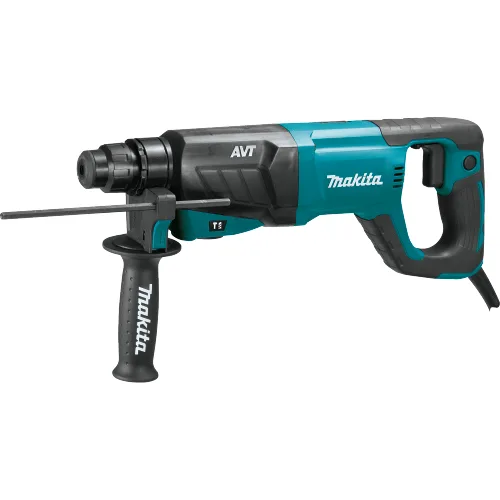
- Buy Makita HR2641 1 in. AVT Rotary Hammer, SDS-Plus The most impact energy in this comparison at 2.9 joules, with the anti-vibration system that decides how long you can keep using it. Amazon
- Buy DEWALT D25133K 1 in. SDS Plus Rotary Hammer Within a tenth of a joule of the pick on energy, with the same three modes, for noticeably less money.
- It depends CRAFTSMAN CMCH234B V20 Brushless RP SDS-Plus Cordless Rotary Hammer Two joules without a cord, which is the whole argument, and enough for anchors if not for volume. Amazon
- Skip DEWALT DCH172B ATOMIC 20V MAX 5/8 in. Brushless Cordless SDS Plus Rotary Hammer A compact anchor-setting tool at 1.4 joules, which is less than half the energy of the pick. Amazon
What actually matters
- Impact energy - joules delivered per blow. The primary performance figure, typically 1.4 to 3 joules on SDS-Plus tools, and directly related to how fast a hole appears in concrete.
- Concrete capacity - the largest practical hole diameter, usually 5/8 to 1 inch on SDS-Plus. Follows from impact energy but stated separately.
- Mode count - two modes give drilling and hammer drilling; three add chipping only, which turns the tool into a small breaker.
- Chuck system - SDS-Plus for general work, SDS-Max for demolition and large diameters. They do not share bits.
- Blows per minute - meaningful only within the rotary hammer category, and actively misleading when compared against a hammer drill's figure.
- Anti-vibration - a real mechanical feature on some tools, usually unquantified, on a class of tool where vibration exposure genuinely matters.
The specs, in plain English
Green flags vs red flags
Green flags
- Impact energy is published in joules.
- Concrete capacity is stated as a diameter.
- The chuck system is named as SDS-Plus or SDS-Max.
- Mode count is given, and chipping is named if present.
- Any anti-vibration system is described as a mechanism rather than a slogan.
Red flags
- Blows per minute leads the listing and no joules appear anywhere.
- Hammer drill and rotary hammer are used interchangeably in the same description.
- Amps or volts are given as the headline performance figure.
- Capacity is described as heavy duty with no diameter.
- SDS is claimed without specifying Plus or Max.
Who's who: the brands
- Makita - Publishes impact energy plainly and fits AVT anti-vibration on its corded hammers. Highest energy in this comparison.
- DEWALT - Broad range from compact cordless anchor tools to three-mode corded hammers, with joules published across the line.
- Bosch - Effectively invented the SDS system and remains the reference point for chuck design and bit compatibility.
- CRAFTSMAN - Cordless SDS-Plus tools at accessible prices that do publish their impact energy, which is unusual at this end.
- Hilti - Trade-focused hammers sold with service contracts, priced far above the consumer brands and specified in far more detail.
How to read a listing without getting fooled
Find the impact energy in joules first; if there is none, check whether you are looking at a hammer drill rather than a rotary hammer. Then read concrete capacity, then mode count, and check whether chipping is included. Confirm the chuck system is SDS-Plus rather than SDS-Max unless you intend to demolish. Treat blows per minute as a within-category figure only, and read amps last.
How much should you spend?
Budget and mid-range both buy corded three-mode hammers at 2.5 joules or so, which is the best value in the category and where most people should land. Cordless costs a premium and generally buys access rather than energy, with compact models trading half the impact energy for weight. Premium compact tools can deliver the least energy in a group, so check the joules before assuming price tracks capability.
Questions, answered
Can I use a rotary hammer as a regular drill?
Yes, if it has a rotation-only mode and an adapter chuck for round-shank bits, which most three-mode tools offer. It will be heavier and more awkward than a drill and is overkill for wood, but it works. What you should not do is use a rotary hammer in hammer mode on tile or masonry veneer, where the piston will shatter what you are trying to drill.
Why does my rotary hammer bit stop cutting?
Usually the carbide tip is worn or the flutes are packed. These bits clear dust up the flutes, and if the hole is full of dust the bit rides on it rather than cutting. Withdraw the bit fully every few inches to clear the hole. If it still will not cut, look at the tip: a rounded or chipped carbide edge cannot be persuaded with more pressure, and pushing harder mostly generates heat.
Is more pressure better?
No, and it is the commonest mistake. The piston does the work, and pushing hard only stops the bit rebounding properly, which reduces the energy reaching the tip and heats everything up. Steady moderate pressure, enough to keep the bit engaged, drills faster than leaning on it. If you find yourself leaning, the bit is blunt or the tool is undersized for the hole.
Do I need SDS-Max?
Only for demolition or holes well beyond an inch. SDS-Max tools are much heavier, much more expensive and take a completely different bit set, so buying into that system for occasional work is a poor trade. For anchors, conduit, cable tray and general fixing, SDS-Plus covers everything, and the sensible upgrade path within it is more joules rather than a bigger chuck.
Or jump to the head-to-head: Makita HR2641 1 in. AVT Rotary Hammer, SDS-Plus vs DEWALT D25133K 1 in. SDS Plus Rotary Hammer.