Explained
Solder Wire, Explained
After reading, you'll understand what the alloy numbers and the four-character flux codes on a spool mean, which residues you can leave alone and which you absolutely cannot, and how to choose a diameter that suits the joints you actually make.
In this guide
Almost every solder wire listing shows two things: a ratio such as 63/37 and a phrase such as 'rosin core'. That is roughly a quarter of the information you need. What trips up first-time buyers is that the flux inside the wire is a separate product with its own standard, its own activity rating and its own cleaning requirement, and that one whole family of fluxes will slowly destroy a board if you do not wash it off. The other common surprise is that lead-free is not simply the modern upgrade. It is a different alloy with a higher working temperature and different handling, chosen mainly for regulatory reasons.
The 30-second version
- Eutectic means one temperature, so Sn63Pb37 goes straight from liquid to solid at 183 °C and never passes through a slushy phase where movement ruins the joint.
- The four-character flux code is the real spec, because ROM1 or REL0 tells you the base, the activity and the halide content in a way that the words on the label do not.
- Water-soluble flux must be washed off, and this is the single choice in the category that genuinely damages hardware when a buyer treats it like ordinary rosin.
- Lead-free costs you heat, since SAC305 sits at 217 to 220 °C against 183 °C for a leaded eutectic, and that extra energy has to reach the joint somehow.
- RoHS restricts equipment, not you, because the rules apply to electrical equipment placed on the market rather than to the wire itself or to your own repairs.
The products this guide is about
Our verdict on each, with the full reasoning on the companion review.
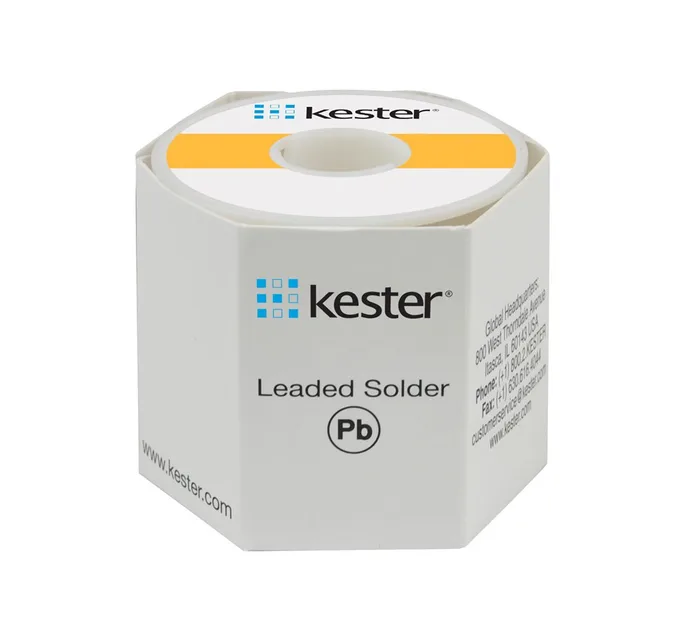
- Buy Kester 44 Flux-Cored Wire (Sn63Pb37) The reference activated-rosin wire, in a eutectic leaded alloy and just about any diameter you could want. Amazon
- Buy MG Chemicals 4880-4888 Sn63/Pb37 RA Solder Wire The same eutectic alloy and the same ROM1 rosin classification, with a data sheet that publishes real numbers and a pocket pack for small jobs. Amazon
- It depends MG Chemicals 4900 SAC305 No-Clean Solder Wire A genuinely well-documented lead-free no-clean wire that asks you to run a hotter iron and gives you exactly one diameter. Amazon
- Skip Kester 331 Flux-Cored Wire (water-soluble) An excellent production wire and a genuinely bad idea on a bench with no way to wash the board afterwards. Amazon
What actually matters
- Alloy composition - the ratio of tin to lead, or the tin, silver and copper mix in a lead-free wire, sets the melting point and the mechanical behaviour of every joint you make. It is the one spec that is on every listing, and the one people most often stop reading after.
- Eutectic behaviour - a eutectic alloy has an identical solidus and liquidus temperature, so it changes state cleanly with no intermediate mushy phase. Non-eutectic alloys give you a window in which a bump produces a disturbed joint that looks dull and cracked.
- Flux base - rosin comes from pine sap and can vary naturally, resin is modified rosin or fully synthetic and tends to be more consistent, and organic fluxes are organic acids that clean aggressively. The base determines what the residue is and whether it can stay.
- Flux activity - low, moderate and high describe how hard the flux works to strip oxide, tested through copper mirror, surface insulation resistance and halide measurements. More activity means easier soldering on dirty parts and more scrutiny of what the residue does afterwards.
- Halide content - halides are ionic activators that boost oxide removal but raise the ionic contamination potential of the residue. The last character of the flux code tells you whether the flux is under 0.05 percent by weight and therefore counts as halide-free.
- Cleaning requirement - this is a process decision made by the flux, not a preference you get to have. No-clean residues are designed to stay on the board, while water-soluble residues stay chemically active until you rinse them off.
- Wire diameter - the wire is how you meter solder into a joint, so a diameter far larger than the pad means you overshoot every time. Matching the wire to the smallest joints you do regularly is the fastest way to make your work look better.
The specs, in plain English
Green flags vs red flags
Green flags
- A downloadable technical data sheet that names the J-STD-004 flux code, the activity level and the halide range.
- An explicit statement that the alloy is eutectic, usually written as 'liquidus = solidus'.
- Purity claims tied to real standards such as J-STD-006 and ASTM B 32 rather than vague words like 'high purity'.
- A published diameter table with more than one option, so you can match wire to joint size.
- Test results attached to method numbers, for example surface insulation resistance quoted against IPC-TM-650 2.6.3.7.
Red flags
- A listing that gives only a ratio and a diameter, with no flux type, activity or standard named anywhere.
- The phrase 'rosin core' used with no indication of whether it is R, RMA, RA, or which four-character code applies.
- A water-soluble or organic acid flux sold to hobbyists with no mention of the mandatory wash step.
- Acid core solder or plumbing solder listed alongside electronics solder, which is a different and unsuitable chemistry.
- No named manufacturer at all, meaning there is no data sheet, no safety data sheet and no way to check what is in the wire.
Who's who: the brands
- Kester - Now part of MacDermid Alpha, and the maker of the 44 rosin flux that has been the reference for activated rosin cored wire for decades, with the widest published alloy and diameter matrix here.
- MG Chemicals - A Canadian maker that publishes unusually complete data sheets for hobbyist-friendly quantities, including pocket packs alongside full spools.
- AIM Solder - A long-established manufacturer whose public technical writing on flux classification and alloy selection is among the clearest available from any maker.
- Alpha - A MacDermid Alpha brand focused on electronics assembly materials, widely specified in production wave and reflow soldering.
- Chip Quik - Best known among hobbyists for low-melt removal alloys and rework kits, alongside conventional cored solder wire.
How to read a listing without getting fooled
Start at the alloy and ask one question: is it eutectic? If the maker says liquidus equals solidus, or names Sn63Pb37, you have an alloy that will not punish you for a small hand tremor. Then find the four-character flux code, which good data sheets put in a properties table alongside the standard revision it was tested against. Read it left to right: base, activity, halide content. That single string tells you more than any paragraph of description on the listing page. Next, find the cleaning statement. If it says the residue can remain, you have a no-clean or a rosin wire. If it specifies a water rinse, that is a requirement and not a suggestion. Finally check the packaging table for diameter and flux percentage, and note whether the flux percentage is published at all. If a listing gives you none of this, you are not looking at a specified product, and there is no way to know what you are putting on your board.
How much should you spend?
Solder wire is one of the few categories where the budget tier is genuinely fine, because the specification is either published or it is not, and a fully documented budget spool beats an unspecified premium-looking one every time. In the budget tier you get named-brand cored wire in small formats, pocket packs and quarter-pound spools, which is the right way to start when you do not yet know which diameter suits your work. The mid-range is where full-pound spools and the wider diameter and alloy matrices live, and where lead-free wire generally sits because tin and silver simply cost more than lead. Premium pricing in this category usually reflects a specialty alloy, a very fine diameter, or a low-temperature bismuth formulation rather than a better everyday wire. The genuinely poor value is unbranded wire with no data sheet, which is often cheap for a reason and gives you nothing to diagnose when joints will not wet.
Questions, answered
Why do experienced people still use leaded solder?
Because Sn63Pb37 is eutectic and melts at 183 °C, which makes it more forgiving in every way that matters at a bench. There is no plastic range, so a joint that shifts slightly while cooling still sets properly. The lower temperature is easier on heat-sensitive components and on iron tips. For repair work and personal projects, none of which are being placed on a regulated market, there is no regulatory reason to give that up.
Can I mix leaded and lead-free solder on the same joint?
It is generally avoided, because mixing creates an alloy whose composition and melting behaviour you no longer know. The most common real-world case is reworking a lead-free assembly with leaded wire, which changes the joint's melting point and its mechanical properties in ways nobody has characterised. If you are repairing a lead-free board and reliability matters, remove the old solder thoroughly with braid or a sucker before adding new. For a hobby repair that just needs to work, the practical risk is lower, but it is still better practice to keep one alloy per joint.
What temperature should I set my iron to?
Hotter than the alloy's melting point, by a lot, and for a physical reason. AIM Solder explains that the pad, the component lead, the plated through-hole and any attached copper planes all pull heat away from the joint, so the tip has to be much hotter to push enough energy in quickly. AIM cites typical tip temperatures between 315 °C and 370 °C depending on alloy and application. Start at the lower end for leaded eutectic work and move up for lead-free or for joints with large thermal mass.
Is the smoke from soldering dangerous?
Most of what you see is the flux breaking down, not vaporised metal. MG Chemicals' safety data sheet notes that soft soldering temperatures below 450 °C are generally too low to produce significant metal vapour, though metal oxide fume or dust and flux decomposition fumes can occur. That fume is worth taking seriously: the UK Health and Safety Executive lists rosin-based solder flux fume among substances that can cause occupational asthma. For frequent or prolonged soldering, MG recommends local exhaust, meaning a fume cabinet, a hood on a flexible arm, or a tip-mounted extractor.
Or jump to the head-to-head: Kester 44 Flux-Cored Wire (Sn63Pb37) vs MG Chemicals 4880-4888 Sn63/Pb37 RA Solder Wire.