Explained
Step Ladders, Explained
After reading, you'll know what your own working load is, which ANSI type covers it, and when aluminium is not allowed to be the answer.
In this guide
A step ladder listing gives you a height, a price and a number of pounds, and the pounds are the part people misread. It is not a bodyweight limit. It is a working load, and it is counting things you are holding.
The 30-second version
- The duty rating counts your tools, because the American Ladder Institute defines working load as the user plus clothing plus PPE plus every tool, supply and material carried or stored on the ladder.
- The type numbering runs backwards, so Type IAA at 375 pounds is the strongest and Type III at 200 pounds is the weakest, which catches people who assume III beats I.
- Fiberglass is a rule near electricity, because OSHA 1910.333(c)(7) requires nonconductive siderails wherever the worker or ladder could contact exposed energized parts.
- Reach height is not ladder height, since makers publish a separate maximum reach that already assumes an average person with a raised arm rather than someone standing on the cap.
- The warranty is the only durability figure, as no maker publishes a service life for fiberglass rails despite UV degradation being the known failure mode.
The products this guide is about
Our verdict on each, with the full reasoning on the companion review.
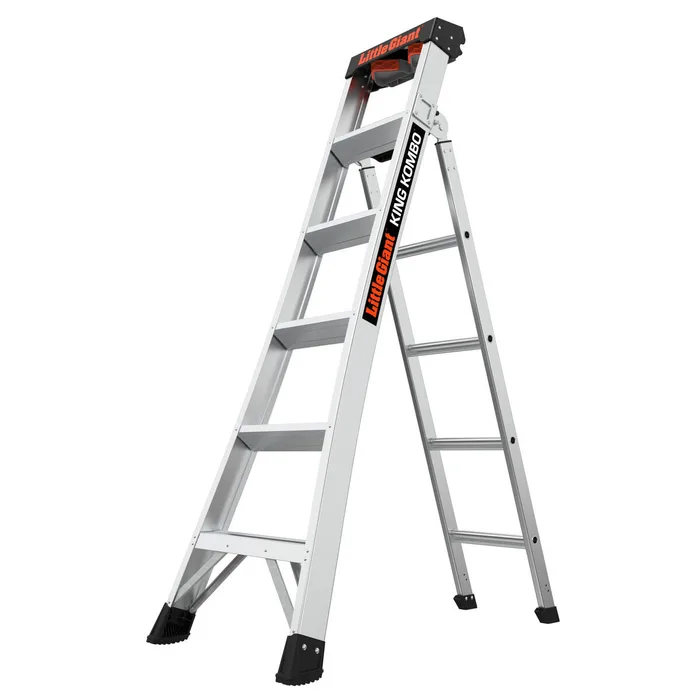
- Buy Little Giant King Kombo 2.0 3-in-1 Combination Ladder, aluminium, 6 ft (14906-001) The only ladder here that pairs a 300 pound Type IA rating with a Limited Lifetime warranty, and it converts between three configurations. Amazon
- Buy Louisville Ladder FS2006 6 ft Fiberglass Step Ladder, Type I 250 lb The cheapest way to satisfy the nonconductive siderail rule, and the lightest ladder here at 17 pounds.
- It depends Little Giant King Kombo Professional 3-in-1 Combination Ladder, fiberglass (13470-071) The highest duty rating here at Type IAA 375 pounds, sold with a published warranty far shorter than its aluminium twin.
- Skip Cosco Lite Solutions 3-Step Aluminium Folding Step Ladder, 5 ft (20-552ABL) A Type II aluminium ladder at 225 pounds, which is the wrong rating and the wrong material for the jobs it gets bought for. Amazon
What actually matters
- Duty rating - the maximum working load the ladder is built and tested to. Five grades: Type IAA at 375 lb, Type IA at 300 lb, Type I at 250 lb, Type II at 225 lb and Type III at 200 lb. The numbering runs opposite to the strength, which catches people who assume III beats I.
- Working load - what that rating has to cover. The American Ladder Institute defines it as the user, any special clothing or protective equipment worn, and the total weight of all tools, supplies and material carried onto or stored on the ladder, and states the working load shall not exceed the duty rating.
- Siderail material - fiberglass or aluminium, and near electricity it is not a preference. OSHA 1910.333(c)(7) requires nonconductive siderails where the worker or the ladder could contact exposed energized parts, and 1910.23(b)(4) and 1926.1053(b)(4) prohibit metal ladders near live conductors.
- Product weight - what you carry to the job. It varies more than people expect, from 7.48 lb for a light household ladder to around 21 lb for a full-size combination ladder, and it is the single best predictor of whether the ladder gets fetched or a chair gets used.
- Warranty term - the only durability figure any ladder maker commits to in writing. No maker publishes a service life for fiberglass rails despite UV degradation being the known failure mode, so the warranty is the proxy, and it can differ between two materials of the same model.
- Maximum standing height - the highest step the maker intends you to stand on, published separately from both the ladder size and the reach height. The top cap is a tool tray and a structural member, and the stability figures assume your weight is below it.
The specs, in plain English
Green flags vs red flags
Green flags
- The ANSI type and duty rating appear near the top of the listing rather than in a specification table at the bottom.
- A product weight is published in pounds, so you know what you are actually going to carry.
- The maker states the ladder meets or exceeds ANSI, CSA and OSHA standards by name.
- Maximum reach height and maximum standing height are given as separate figures.
- The siderail material is stated plainly as fiberglass or aluminium rather than implied by colour.
Red flags
- The listing leads on height and price and you have to hunt for the duty rating.
- A duty rating is quoted as a weight capacity with no ANSI type letter attached to it.
- Heavy duty or professional grade appears with no Type IAA, IA, I, II or III behind it.
- The same ladder is sold in two materials and only one warranty term is shown for both.
- A household or light duty ladder is photographed in use on electrical work.
Who's who: the brands
- Little Giant - Best known for multi-position and combination ladders. Publishes full spec sheets per SKU, which is how the warranty gap between their aluminium and fiberglass King Kombos becomes visible.
- Werner - The volume brand in North American professional ladders, with the LOCKTOP series spanning Type I through Type IAA. Their site is the least machine-readable of the majors.
- Louisville Ladder - Strong in fiberglass at working prices, and states its ladders meet or exceed ANSI and OSHA safety standards. The FS series is the common electrician's stepladder.
- Cosco - Household step stools and light ladders, mostly Type II and Type III. Well made for their rating, routinely bought for work beyond it.
- Gorilla Ladders - A ladder brand sold at retail across the household and light-professional range.
How to read a listing without getting fooled
Find the ANSI type before anything else, because it decides whether the rest of the listing is relevant to you. Then check the siderail material against where the ladder will actually be used. Then look for a published product weight, because that is what determines whether you fetch the right ladder or stand on a chair. Height comes last, and read the maximum standing height rather than the nominal size.
How much should you spend?
Budget buys a Type II or Type III household ladder that is honestly made for reaching a shelf. Mid-range buys a full-size Type I or Type IA fiberglass stepladder, which is the sensible default for a house with any wiring in it. Premium buys a combination ladder that replaces two or three ladders, and the money goes on hinges and conversion rather than on a higher duty rating.
Questions, answered
Is Type III fine for household use?
Only for genuinely empty-handed reaching. Type III is 200 pounds of working load, and that has to cover you, your clothes and whatever is in your hands. An adult of average weight carrying a full paint can is close to the limit before they have climbed anything.
Can I stand on the top cap of a step ladder?
No, and the maker tells you so by publishing a maximum standing height that excludes it. The cap is a tool tray and a structural member, and the ladder's stability calculations assume your weight is below it.
How long does a fiberglass ladder last outdoors?
Nobody publishes a figure, which is itself the answer. Sustained UV breaks down the resin at the surface, which shows up as chalking. Store it inside and the question mostly does not arise.
Are aluminium ladders banned outright?
No, only near electricity. OSHA restricts them where contact with exposed energized parts is possible. For carpentry, painting away from fixtures, and general reaching, aluminium is fine and lighter.
Or jump to the head-to-head: Little Giant King Kombo 2.0 3-in-1 Combination Ladder, aluminium, 6 ft (14906-001) vs Louisville Ladder FS2006 6 ft Fiberglass Step Ladder, Type I 250 lb.