Explained
Torque Screwdrivers, Explained
After reading, you'll understand what a torque screwdriver's accuracy figure actually promises, which mechanism genuinely stops a fastener, and how to read a spec sheet in a range where small errors are proportionally large.
In this guide
Torque screwdrivers look simple and the specification sheets are short, which is exactly why people get caught. Two drivers can both say plus or minus 6 percent and mean different things, because one covers the whole scale and one covers only the top 80 percent. A third can quote a number that looks tighter and is actually far worse, because it is a fixed quantity rather than a proportion. And the word that tells you whether the tool will stop the fastener or merely tell you to, cam-over, appears on some spec sheets and not others.
The 30-second version
- Percentage beats a fixed figure, because plus or minus 6 percent shrinks as you dial the setting down while plus or minus 2 in-lb does not.
- Cam-over and slip designs stop, disengaging the drive at the setting, while click and break designs only signal and stay connected.
- ISO 6789 allows a wider band down here, permitting plus or minus 6 percent at or below 10 Nm against 4 percent above it, and almost every screwdriver sits below that line.
- The accuracy claim may not cover the whole scale, so look for a stated span such as 20 to 100 percent of full scale before trusting a setting near the bottom.
- Match the units to your paperwork, because converting inch-pounds, foot-pounds, newton-metres and centinewton-metres at the bench is where the expensive mistakes happen.
The products this guide is about
Our verdict on each, with the full reasoning on the companion review.
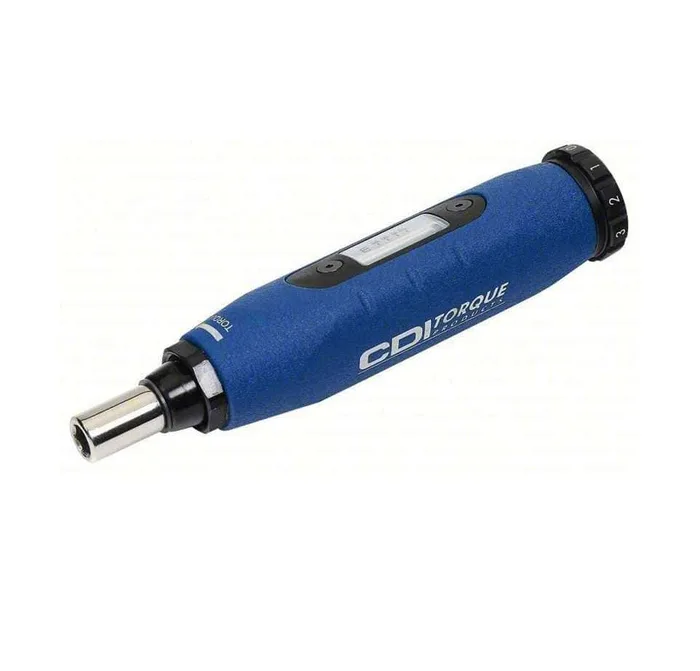
- Buy CDI Torque Products 401SM Micro-Adjustable Torque Screwdriver A cam-over clutch that disengages at the set torque, with accuracy stated as a percentage of the indicated value and a serialized certificate in the box. Amazon
- Buy Wiha 28418 SoftFinish TorqueVario-S 0.8 to 5.0 Nm A serialized, certificated adjustable driver covering 0.8 to 5.0 Nm with a 1/4 inch bit adapter, for people whose torque specs arrive in newton-metres.
- It depends Fix It Sticks Small Torque Limiters A preset slip limiter with one fixed value per unit, which is either exactly what you need or completely the wrong shape of tool. Amazon
- Skip Wheeler F.A.T. Wrench Its own instruction sheet states accuracy as a fixed plus or minus 2 in-lb below 40 in-lb, which is a much wider band than it sounds at the settings this tool is sold for. Amazon
What actually matters
- Percentage of setting versus fixed tolerance - A tolerance quoted as a percentage of the indicated value tracks your setting, so it is 0.6 in-lb at a 10 in-lb setting and 2.4 in-lb at 40. A tolerance quoted as a fixed number of inch-pounds stays the same size all the way down, which means it becomes proportionally enormous at the low settings a screwdriver exists to serve.
- The span the tolerance covers - CDI states its 6 percent applies from 20 to 100 percent of full scale. That is not a weakness, it is disclosure, and it tells you a 5 in-lb setting on a 40 in-lb tool is outside the guarantee. Makers who quote a percentage with no span attached have not told you where it applies.
- Mechanism - Cam-over and slip clutches disengage the handle from the output at the setting, so further turning ratchets and transmits nothing. Click and break types give a signal and reset while staying engaged, which means a determined hand can keep tightening past the number.
- Serialized calibration certificate - A document carrying your individual tool's serial number, the readings taken and the traceability chain is a record rather than a claim. On electrical work, inspection practice includes site verification of torque tools and their calibration certificates.
- Cycle life against calendar life - ISO 6789-2:2017 offers 12 months or 5,000 cycles, whichever comes first, as the default interval when the user has no control procedure of their own. A tool used daily hits the cycle limit long before the anniversary.
- Bit interface and retention - A 1/4 inch hex holder takes universal insert bits, usually held by a rare earth magnet or a detent. Magnetic retention is convenient but can let a bit fall out overhead; a positive lock or quick-release chuck holds it more firmly. Proprietary blade systems can be excellent but tie you to one catalogue.
- Where the specs come from - The reason to own one of these is usually a printed number: an optics maker's ring torque, an equipment maker's terminal torque, a frame builder's clamp torque. A torque wrench cannot physically reach most of them, which is what makes this a separate tool rather than a smaller version of the same one.
The specs, in plain English
Green flags vs red flags
Green flags
- Accuracy stated as a percentage of the indicated or set value, not as a fixed number of inch-pounds.
- A stated span for that accuracy, such as 20 to 100 percent of full scale, rather than an unqualified percentage.
- A serialized certificate of calibration naming your individual tool, ideally with a traceability statement.
- A named mechanism on the spec sheet, especially cam-over or slip, rather than a vague reference to clicking.
- A published cycle or interval figure, and a route to get the tool recalibrated rather than replaced.
- A 1/4 inch hex bit holder, so the tool takes ordinary insert bits in whatever drive type your fasteners use.
Red flags
- An accuracy figure given as a fixed quantity, which quietly becomes a huge percentage at low settings.
- A percentage with no direction stated, since many tools are only rated clockwise even when the head reverses.
- A very wide range on one small tool, because the bottom of the scale is where any release mechanism is least repeatable.
- No named standard at all, or a standard named without an edition, which makes the claim hard to check.
- A scale with coarse increments relative to the specs you need to hit, so you round rather than set the number.
- A tool marketed for one specific job with no application torque data or certificate to back the claim.
Who's who: the brands
- CDI Torque Products - An American torque specialist now under Snap-on Industrial Brands, known for cam-over screwdrivers sold with serialized certificates.
- Wiha - German maker whose TorqueVario line covers electronics and electrical work, with serialized, certificated adjustable drivers.
- Wera - German maker of adjustable Kraftform torque screwdrivers. Check the maker's listing for the stated tolerance and standard.
- Tohnichi - Japanese torque specialist that makes both slip and non-slip small torque drivers, so check which mechanism a given model uses.
- Fix It Sticks - American brand built around preset limiters and packable drivers, aimed at people fixing optics and bicycles away from a bench.
How to read a listing without getting fooled
Start at the accuracy line rather than the range line. Note three things about it: whether it is a percentage or a fixed quantity, what it is a percentage of, and whether the maker names the span it applies over. A listing that says plus or minus 6 percent of indicated value from 20 to 100 percent of full scale has told you more than one that says high accuracy. Next find the mechanism word. Cam-over and slip mean the tool disengages; click, break and audible signal mean it does not. Then look for a serial number and a certificate, because that is the only part of the spec sheet tied to the physical object in the box rather than to the model. Finally, check the units on the scale against the units in your torque spec, and check the increments: a driver that steps in 5 in-lb jumps cannot set an 18 in-lb spec however accurate it is. If the listing gives none of this, the maker is selling a shape rather than an instrument.
How much should you spend?
Budget buys you a preset limiter or a very simple adjustable driver. The limiters are good value when your problem is one fixed number, and some state plus or minus 6 percent, but you are buying a single value and supplying your own handle. Mid-range is where adjustable drivers with a real scale and a serialized certificate start, and it is where most people should land: this tier gets you a percentage-of-setting accuracy claim, a named standard and a usable range. Premium adds a cam-over clutch that will not pass torque past the setting, finer increments, traceable calibration documents and a recertification path. The jump from budget to mid-range buys the most, because it is the jump from a tool that indicates to a tool that documents. Above that you are paying for the mechanism and the paperwork, both of which matter if the parts you are tightening are expensive or the work gets inspected.
Questions, answered
Can I use a torque screwdriver to loosen screws?
Use it only if the maker says so. Some designs lock automatically in the counterclockwise direction specifically so the tool can back a screw out without loading the measuring mechanism. Others are rated clockwise only, and using them to break a tight screw loose can spike well past the setting and shift the calibration. Check the direction wording in the accuracy statement, because a tool that reverses is not necessarily a tool that measures in reverse.
What is a realistic torque range to look for?
It depends entirely on the fasteners, but the common consumer bands are roughly 10 to 65 in-lb for firearm optics rings and bases, 4 to 60 in-lb for bicycle components, and single-digit newton-metres for most electronics and small electrical terminals. Aim to have your usual settings sit in the middle of the tool's scale rather than at either end. If most of your work is near the floor of the range, buy a smaller tool instead of trusting the bottom of a bigger one.
Does the National Electrical Code actually require a torque tool?
Close to it. Section 110.14(D) was added in the 2017 edition requiring a torque tool where the equipment manufacturer gives a numeric value, and the 2020 and 2023 editions changed the wording to require an approved means of achieving that value, with torque tools named as an example. NEMA's guidance notes that inspection practice includes site verification of torque tools and calibration certificates. It also advises against re-torquing terminations after the initial installation, which surprises a lot of people.
Is a digital torque screwdriver better than a mechanical one?
It is a different tool rather than a better one. A digital or dial driver indicates torque as you apply it and often stores a peak reading, which is what you want for checking work or for a fastener with no fixed spec. A mechanical setting driver releases at a value you chose and does not need you to watch a display while you work. For repeating the same number many times, the mechanical setting tool is faster and less error-prone; for measuring what a joint actually took, the indicating tool is the right answer.
Or jump to the head-to-head: CDI Torque Products 401SM Micro-Adjustable Torque Screwdriver vs Wiha 28418 SoftFinish TorqueVario-S 0.8 to 5.0 Nm.