Explained
Welding Jackets, Explained
After reading, you'll understand which flame resistance claims on a welding jacket were earned against welding, which were earned against something else entirely, and how to read a jacket's construction when no test result exists at all.
In this guide
Welding jackets are sold with a confusing pile of initials: FR, ASTM, NFPA, ATPV, cal/cm2. Most buyers reasonably assume that more letters means more protection, and that any flame resistance rating is broadly the same kind of protection. It is not. The tests behind those letters were written for different hazards, and the one standard written specifically for welding clothing barely appears on jackets sold in the United States. Meanwhile the details that genuinely decide whether you get burned, the sleeve material, the collar, the snaps and the fit with your arms up, usually carry no rating at all.
The 30-second version
- Flame resistant is not one thing, and the standard behind the claim tells you which hazard it was measured against.
- Leather is still the benchmark for spatter, which is why hybrid jackets put it on the sleeves and forearms and use cloth elsewhere.
- Synthetics are the one clear no, because polyester and nylon can melt, stick to skin and turn a spark into a serious burn.
- FR cotton is treated cotton, so the flame resistance has a care regime, and bleach, softener and starch can undo it.
- Coverage is a fit problem, and the standard that tests it does so with the wearer's arms fully raised above the head.
The products this guide is about
Our verdict on each, with the full reasoning on the companion review.
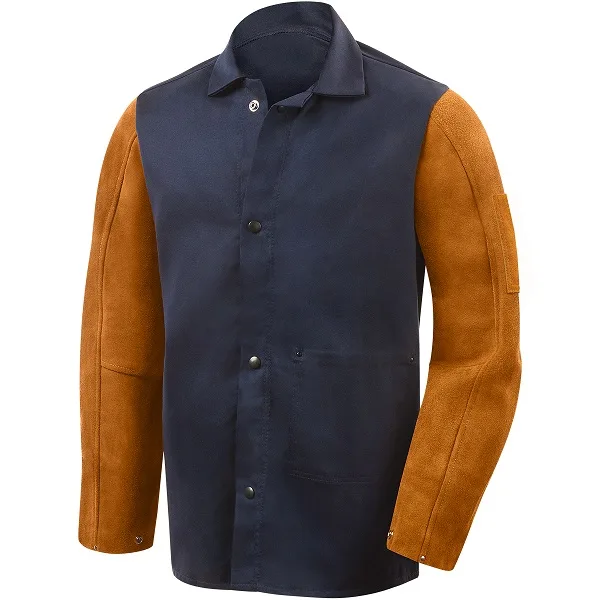
- Buy Steiner 1260 Weldlite Plus Hybrid Jacket, 30 inch Leather sleeves where the sparks land, flame retardant cotton where they do not, with the hardware details that matter done properly. Amazon
- Buy Tillman 6230 Lightweight FR Cotton Welding Jacket, 30 inch The cheapest jacket here and the one whose spec sheet tells you the most, including the thing it does not do. Amazon
- It depends Steiner 9215 Weld-Cool Premium Side Split Cowhide Jacket, 30 inch Full leather with a proper snap down welding collar, and deliberate ventilation openings that are either the best or the worst thing about it. Amazon
- Skip Black Stallion JF2220-GY NFPA 2112 and NFPA 70E FR Cotton Welding Jacket, 32 inch A well made jacket whose entire credential list was earned against flash fire and arc flash rather than welding spatter, and Black Stallion says so on the page.
What actually matters
- Sleeve material - Spatter and slag land on the forearms and the tops of the sleeves more than anywhere else. A leather sleeve resists molten metal in a way woven cotton does not, which is why hybrid jackets exist at all.
- Which standard is printed - A jacket that cites ASTM D6413 has passed a vertical flame test on the fabric. One that cites NFPA 2112 has passed a flash fire protocol. Neither is a spatter test, and knowing that changes what the label is worth to you.
- Fabric weight in ounces - Nine ounce cotton is the usual welding jacket weight and twelve ounce exists for heavier work. Heavier fabric is harder to ignite and takes longer to burn through, which is exactly what AWS guidance says about choosing heavy cotton over light.
- Wash life - Flame resistant cotton keeps its protection for a stated number of launderings under stated conditions. Some makers publish 50 home washings, some publish 100, and some publish nothing at all, which is itself information.
- Collar design - A stand-up welding collar that snaps closed shields the neck from spatter and from arc radiation. ANSI Z49.1's guidance specifically recommends keeping collars buttoned, and a jacket with a soft fold-down collar cannot do that.
- Snaps and closures - EN ISO 11611 requires welding clothing to be designed so metal fasteners cannot conduct electricity from outside to inside. Leather reinforced, covered or anodized snaps are the visible sign a maker thought about this.
- Length and overlap - A 30 inch jacket is the category norm and 32 or 36 inch versions exist. What matters is whether the jacket still overlaps your trousers when you raise your arms, which is how the welding clothing standard actually checks it.
The specs, in plain English
Green flags vs red flags
Green flags
- The maker names the fabric brand and weight, not just the words flame retardant.
- Leather appears on the sleeves and forearms, sewn with an aramid thread such as Kevlar.
- A wash life is published, with a temperature and a count for home and commercial laundering.
- The snaps are described as leather reinforced, covered or anodized rather than left bare.
- A stand-up collar that snaps closed is listed, and the sleeve cuffs adjust.
Red flags
- A temperature in degrees appears with no test method or standard behind it.
- The listing leans on an arc rating or an NFPA number without saying what those tests cover.
- The fabric is a blend containing polyester or nylon, which can melt onto skin.
- No fabric weight and no leather type is given anywhere, only adjectives.
- The jacket is short enough that raising your arms would lift it clear of your waistband.
Who's who: the brands
- Tillman - A long established American welding apparel maker that publishes plain specification sheets, including the details that do not flatter the product.
- Steiner Industries - Known for a broad range of leather, FR cotton and hybrid welding jackets, with construction described on its product pages.
- Black Stallion - The welding apparel brand from Revco Industries, with a range of FR cotton jackets that includes NFPA 2112 and arc rated models.
- Westex by Milliken - Not a jacket brand but a fabric brand, and the name behind much of the flame resistant cotton used in American welding jackets.
How to read a listing without getting fooled
Start by separating what the jacket is from what it has been tested to. The construction lines are the fabric and its weight in ounces, the leather type and where it is used, the thread, the length, the closures, the collar and the size run. The credential lines are the standards: ASTM D6413 for fabric flame behaviour, ASTM F1506 and an ATPV for electric arc, NFPA 2112 for flash fire, and EN ISO 11611 with a Class 1 or Class 2 for welding itself. If the only credential is a fabric flame test, that is normal for this category and tells you the fabric self-extinguishes. If a certificate is doing the marketing, look up which hazard it was written for before you let it move the price. And if a listing gives you a temperature or a heat claim with no standard beside it, treat it as marketing copy rather than a measurement.
How much should you spend?
Plain flame resistant cotton jackets sit at the budget tier and are cheap enough to own two, which is genuinely useful because one can stay clean while the other gets oily. Hybrid jackets with leather sleeves over a cotton body land in the mid tier and are the best value for most people, since the leather goes exactly where cloth fails. Full leather jackets and heavily certified FR cotton jackets both sit at the premium tier, and they are premium for opposite reasons: one is buying material, the other is buying test reports. Before you pay premium, decide which of those you actually need, because a certificate earned against flash fire costs the same as leather and does not stop a molten droplet any better than the budget jacket does.
Questions, answered
Do I need a welding jacket at all, or will a leather apron do?
ANSI Z49.1 treats them as separate items. It requires clothing that provides sufficient coverage and suitable materials, and then separately says durable flame resistant aprons shall be used to protect the front of the body when additional protection against sparks and radiant energy is needed. An apron is an addition, not a substitute, because it leaves your back, your sides and most of your arms uncovered. For overhead work the standard names capes, sleeves or shoulder covers with bibs specifically.
Why do welding jackets have no outside chest pockets?
Because pockets catch spatter. ANSI Z49.1's guidance recommends that pockets be eliminated from the front of clothing, and that any pockets present be emptied of flammable material and kept buttoned. EN ISO 11611 handles it by rule: external opening pockets must have a covering flap, and the flap must be at least 20 millimetres wider than the opening so it cannot be tucked inside. That is why good welding jackets put the pocket inside and give you a narrow soapstone pocket on the sleeve instead.
How should I wash a flame resistant cotton welding jacket?
Follow the garment maker's instructions first, because they set the wash count. Beyond that, the fabric makers are consistent about what damages FR cotton. Westex says to use only oxygen based bleaches and never detergents containing chlorine bleach, and to avoid starches, fabric softeners and other laundry additives entirely, because those coat the fibre. Wash FR garments separately, do not overload the machine and do not over dry. Oil and grease also matter: ANSI Z49.1 notes that a jacket kept clean of oil and grease protects better.
Is a longer jacket always better?
Longer covers more, but the real question is whether coverage survives movement. EN ISO 11611 does not just measure the garment, it checks that a correctly sized two piece outfit still overlaps between jacket and trousers when the wearer extends both arms fully above the head and then bends over until the fingertips touch the ground, and that wrists, lower arms and ankles stay covered standing upright. A 30 inch jacket that fits properly beats a 36 inch one you sized down to save weight.
Or jump to the head-to-head: Steiner 1260 Weldlite Plus Hybrid Jacket, 30 inch vs Tillman 6230 Lightweight FR Cotton Welding Jacket, 30 inch.