Explained
Work Gloves, Explained
After reading, you'll understand every character in an EN 388 code, know whether an impact claim is graded or just a pass, and be able to pick a palm coating from the liquid on your hands.
In this guide
First-time buyers almost always shop a work glove on the cut level, which is the one number that usually does not matter for general work. The figures that decide whether you like a glove are abrasion, coating chemistry and gauge, and they are all printed on the cuff or the box in a code most people never learn to read. The other trap is the word impact, which can mean a graded American rating, an optional European pass, or nothing at all. This guide covers what each character means and which ones predict how the glove will feel.
The 30-second version
- Abrasion is the number to read first, because it is the closest thing anyone publishes to how long the glove will last.
- Nitrile is the oil coating, latex is the dry grip coating, and polyurethane is the thin, tactile one that is not a liquid barrier.
- Gauge, not protection level, sets how a knit glove feels, because it is simply the number of knitting needles per inch of shell.
- An impact claim without a level is weak, since ANSI/ISEA 138 grades 1 to 3 across knuckles and fingers while the EN 388 letter P is only a pass on the claimed area.
- Touchscreen compatibility is untested by any standard, so treat it as a feature the maker validated in-house, and expect it to fade as the conductive yarn wears.
The products this guide is about
Our verdict on each, with the full reasoning on the companion review.
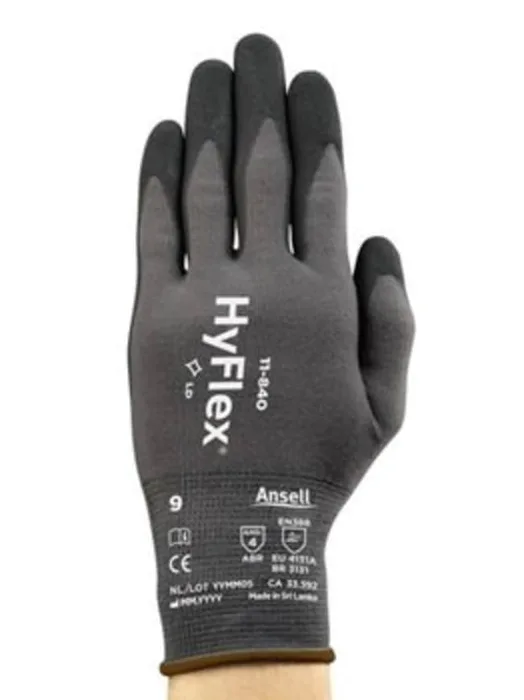
- Buy Ansell HyFlex 11-840 A 15-gauge knit with a foam nitrile palm that posts EN 388 abrasion level 4, the top band, in a glove thin enough to fasten small parts in. Amazon
- Buy SHOWA 377 The cheapest tier here, with a double foam nitrile palm that SHOWA says disperses oil. Amazon
- It depends Ironclad KONG Original SDX2 One of the few work gloves carrying a real ANSI/ISEA 138 impact level, which matters enormously if things fall on your hands and not at all if they do not. Amazon
- Skip Mechanix Wear M-Pact MPT-58 Sold as an impact glove, but its own certification block reads EN 388 2121XP, which puts abrasion two full bands below every other glove here. Amazon
What actually matters
- EN 388 abrasion level - the first digit of the code, and the best available proxy for glove life. Levels 1 to 4 correspond to 100, 500, 2,000 and 8,000 cycles on a Martindale rig, so the jump from 2 to 4 is large.
- Coating chemistry - nitrile, polyurethane and natural rubber latex behave completely differently once a liquid is involved. Nitrile keeps its grip in petroleum, latex is the best dry grip but softens in oil, and polyurethane is the thinnest and most flexible.
- Coating finish - flat, foam and sandy are three textures of the same chemistry and they are not interchangeable. Foam and sandy finishes exist to get liquid out from between your palm and the workpiece.
- Coating coverage - palm coated, three-quarter dipped and fully coated are a comfort decision as much as a protection one. Palm coated breathes; fully coated keeps liquid out and makes your hands sweat.
- Gauge - the number of knitting needles per inch in the shell, so a higher number means a finer, thinner, more dexterous glove. It is the single best predictor of whether you will keep the gloves on.
- ANSI/ISEA 138 impact level - the American back of hand standard, graded 1 to 3 by mean transmitted force from a 5 joule drop across 18 impacts. Level 3 is the strongest because it lets the least force through.
- EN 388 tear and puncture - the third and fourth digits, covering how easily an existing cut spreads and how much force a blunt stylus needs to push through. Both are useful for snagging and burst hazards and neither says anything about needles.
The specs, in plain English
Green flags vs red flags
Green flags
- A full EN 388 code printed on the product page, not just a cut level or a marketing phrase.
- The knit gauge stated as a number, which is a good sign the rest of the specification is published too.
- An abrasion level of 4, or an ANSI abrasion level of 4 or higher, on a glove you expect to wear daily.
- An ANSI/ISEA 138 level, not just the word impact or a lone letter P, on anything sold for back of hand protection.
- The maker naming the coating chemistry and the finish separately, for example foam nitrile rather than just nitrile.
Red flags
- A protection claim with no standard attached, such as maximum protection or heavy duty grip.
- A cut level quoted with no indication of whether it came from ANSI/ISEA 105 or EN 388, which are different scales.
- Impact claimed in the copy but no level and no P anywhere in the certification block.
- An abrasion level of 1 or 2 on a glove sold for daily jobsite use.
- Photographs and features listed but no EN 388 or ANSI block at all, which makes the claims hard to check.
Who's who: the brands
- Ansell - An industrial glove maker whose HyFlex line set the template for the lightweight coated knit, and which publishes gauge and test codes.
- SHOWA - Known for nitrile coating technology and for foam nitrile knits aimed at wet and oily work, with EN codes published on its product pages.
- Ironclad - Built its reputation on leather-palmed impact gloves for oil and gas, and prints a grip score alongside its EN and ANSI ratings.
- Mechanix Wear - A consumer and jobsite glove brand, known for fit, padding and TPR knuckle designs.
- Wells Lamont - An American maker with a broad coated-knit and leather range.
How to read a listing without getting fooled
Start at the pictograms, not the headline. Find the hammer symbol and read the characters after it left to right in the fixed EN 388 order: abrasion, blade cut, tear, puncture, straight-blade cut, impact. Note the first digit and stop worrying about the rest until you have. Then look for a second block: an ANSI/ISEA 105 shield with cut, abrasion and puncture numbers, and separately an ANSI/ISEA 138 level if the glove claims impact protection. Any X means not tested or not reported, which is information rather than a gap. Next find the construction line, which should name the liner material, the gauge, the coating material and whether the coating is palm only, three-quarter or full. If a listing gives you a cut level and nothing else, or uses words like maximum and heavy duty in place of a code, assume the numbers are missing because they are not flattering, and move on.
How much should you spend?
Coated knit work gloves are consumables and priced like them, so the useful comparison is per pair in a box rather than per pair at a checkout. At the budget tier you can get a published EN 388 abrasion level 4 knit from an industrial brand, which is why the value pick in our comparison sits there. The mid-range buys you finer gauge, better disclosure, more comfort technology and sometimes a thinner, better-tuned coating rather than more protection. The premium tier is where impact gloves, leather palms and moulded TPR guards live, and you should only go there if impact or heavy handling is genuinely part of your day. Spending more on a general purpose glove buys feel and fit far more often than it buys durability, and the abrasion digit is free to check before you spend anything.
Questions, answered
What gauge should I buy?
For general work, 13 or 15 gauge covers most people, with 15 being the usual sweet spot between durability and feel. Go to 18 or 21 gauge if your day involves small fasteners, connectors or anything you need to feel through the glove, and accept that a finer shell wears out sooner. Go down to 10 or 13 gauge if you want bulk and warmth and are handling large, rough objects. If a maker will not tell you the gauge, you are guessing about the one property you will notice within five minutes of putting the glove on.
Do I need a cut rating on a general purpose work glove?
Usually not, and chasing one costs you something. Cut-resistant yarns are more expensive, and on a coated knit a high cut level often comes with a coating tuned for cut work rather than for the grip you actually want. If your hazards are hand tools, fasteners, timber, packaging and general handling, buy on abrasion and coating and treat any cut rating as a bonus. If you are handling sheet metal, glass, blades or strapping, that is a different purchase with a different standard behind it.
Flat, foam or sandy nitrile: how do I choose?
Choose by how wet the job is. Flat nitrile is the tackiest in the dry and the thinnest, so it suits clean assembly and parts handling. Foam nitrile has an open-celled surface that pulls liquid away from the contact patch, which makes it the best all-rounder when things are sometimes damp or oily, and it is softer than flat. Sandy nitrile is the roughest and the choice for heavy oil and consistently wet work, at the cost of a harsher feel and more wear on whatever you are gripping.
Can I wash work gloves, and should I?
Some makers say yes explicitly and it is worth checking before you do it. Both Ironclad and Mechanix Wear state machine washable on the product pages for the gloves in our comparison, with Ironclad specifying hang dry. Washing removes the oil and grit that make a coated palm slippery, so it can restore grip on a glove that is not actually worn out. What it will not do is bring back a coating that has thinned, and heat drying can stiffen or shrink a knit shell, so air dry unless the maker says otherwise.
Or jump to the head-to-head: Ansell HyFlex 11-840 vs SHOWA 377.