

Tools & DIY
The Best Work Gloves: 4 Compared (and One to Skip)
We compared four general purpose work gloves on the numbers their makers actually print: the EN 388 abrasion, tear and puncture digits, published impact ratings under ANSI/ISEA 138, coating chemistry, and knit gauge.
The short version
The Ansell HyFlex 11-840 is our overall pick: a 15-gauge nylon and spandex knit with a foam nitrile palm, rated EN 388 4131A, which means the top abrasion band, in a glove Ansell recommends for dry handling and assembly. The SHOWA 377 is the value pick and the better choice if your hands are wet or oily, because SHOWA puts a double layer of foam nitrile on the palm to disperse oil, and still posts EN 388 abrasion level 4. The Ironclad KONG Original suits one buyer very well: anyone who needs the back of their hand protected, because Ironclad publishes an ANSI/ISEA 138 Level 2 impact rating alongside EN 388 4242AP, and it also publishes a grip score for dry, wet and oily conditions. Skip the Mechanix Wear M-Pact unless you specifically want its padding, because its own certification block reads EN 388 2121XP, which is abrasion level 2 against level 4 on everything else here, and its impact claim is the EN pass or fail letter P with no ANSI/ISEA 138 level printed. Before you buy anything, decide whether your hazard is oil, abrasion or a dropped tool, because no single glove is good at all three. Best for: anyone who wants a work glove chosen on published numbers instead of on the word tough.
Our picks at a glance
- Ansell HyFlex 11-840 - Buy. A 15-gauge knit with a foam nitrile palm that posts EN 388 abrasion level 4, the top band, in a glove thin enough to fasten small parts in.
- SHOWA 377 - Buy. The cheapest tier here, with a double foam nitrile palm that SHOWA says disperses oil.
- Ironclad KONG Original SDX2 - It depends. One of the few work gloves carrying a real ANSI/ISEA 138 impact level, which matters enormously if things fall on your hands and not at all if they do not.
- Mechanix Wear M-Pact MPT-58 - Skip. Sold as an impact glove, but its own certification block reads EN 388 2121XP, which puts abrasion two full bands below every other glove here.
The verdict in 30 seconds
What mattered most
- EN 388 code published by the maker
- EN 388 abrasion level
- EN 388 tear and puncture
- Impact rating published
- Palm material or coating
- Knit gauge published
General purpose work gloves are sold on adjectives. Grippy, tough, impact resistant, touchscreen compatible. Almost every one of those adjectives has a number behind it that sellers leave off, and the numbers live in two places: the EN 388 code stamped on the cuff, where only one of the digits is about cutting, and ANSI/ISEA 138, the American impact standard that grades back of hand protection 1 to 3. We picked four gloves that between them publish every figure that matters for grip, wear and knuckle protection, including one that publishes the least.
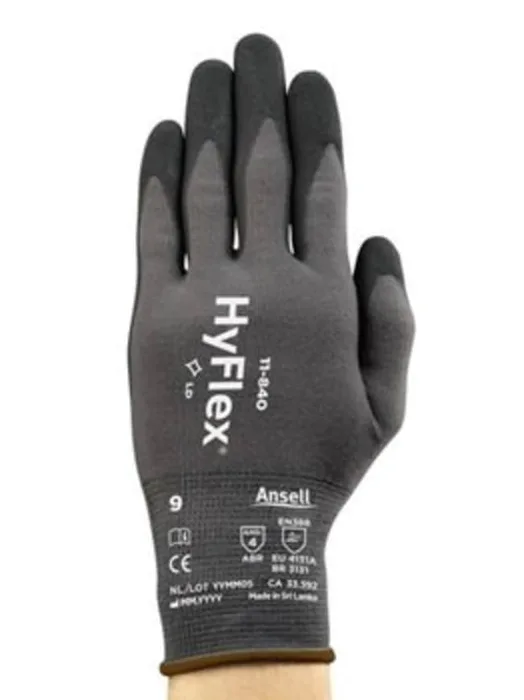
A 15-gauge knit with a foam nitrile palm that posts EN 388 abrasion level 4, the top band, in a glove thin enough to fasten small parts in.
Best for: General handling, assembly and parts work in mostly dry conditions, where you want the highest published abrasion band without giving up feel.
- Ansell publishes EN 388:2016 4131A, so abrasion is level 4, the top of the four-level scale, at roughly 8,000 cycles on the test rig.
- The specification sheet names the gauge, 15, the foam nitrile coating and the palm-coated finish.
- Palm coating only with a knitted nylon and spandex back means the glove breathes, and Ansell lists it as silicone free.
- Ansell recommends it for assembly and general handling, not wet or oily work, and the palm-only foam nitrile coating is not a liquid barrier.
- Ansell's 2x grip and up to 20 percent durability claims are measured against its own previous technology version, not another brand, and no wet or oily figure is given.
- EN 388 puncture is level 1, the lowest band, and there is no impact rating of any kind on the specification.
- It is palm coated only, with no impact rating, so the back of the hand has no protection.
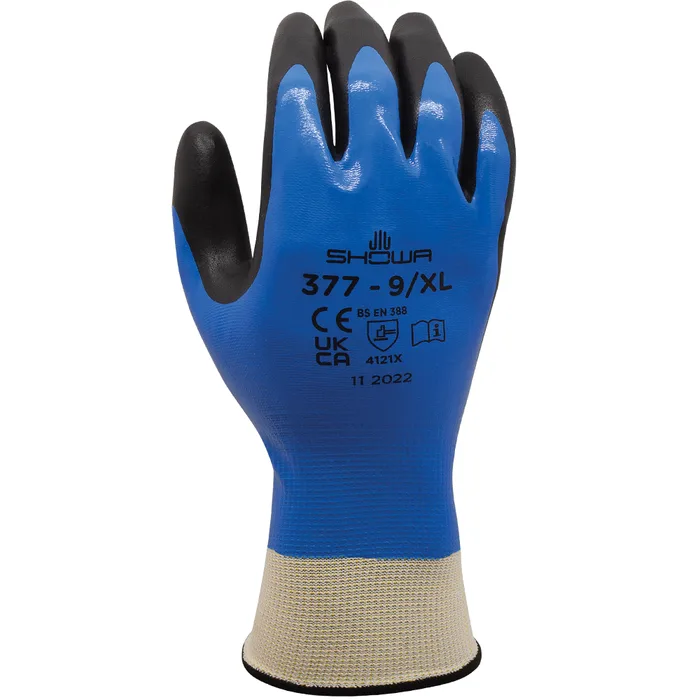
The cheapest tier here, with a double foam nitrile palm that SHOWA says disperses oil.
Best for: Anyone whose hands are wet, greasy or muddy most of the day, and who buys gloves by the box because they are consumables.
- SHOWA publishes EN 388:2016+A1:2018 4121X, so it matches the Ansell glove on abrasion level 4 at a lower tier.
- The coating is listed as nitrile plus foam nitrile, with a double layer of nitrile foam on the palm that SHOWA says disperses oil and improves grip in wet, dry or oily conditions.
- SHOWA lists it as water resistant, breathable and seamless knit, in sizes 6 through 10, and names light assembly of oil-coated pieces as an intended application.
- SHOWA does not publish the knit gauge for this model, so you cannot compare its thickness to a glove that does.
- EN 388 tear is level 2 and puncture is level 1, both below the Ironclad glove here.
- There is no impact rating and no cut rating worth the name, with the straight-blade cut position reported as X.
- No touchscreen claim on the product page.
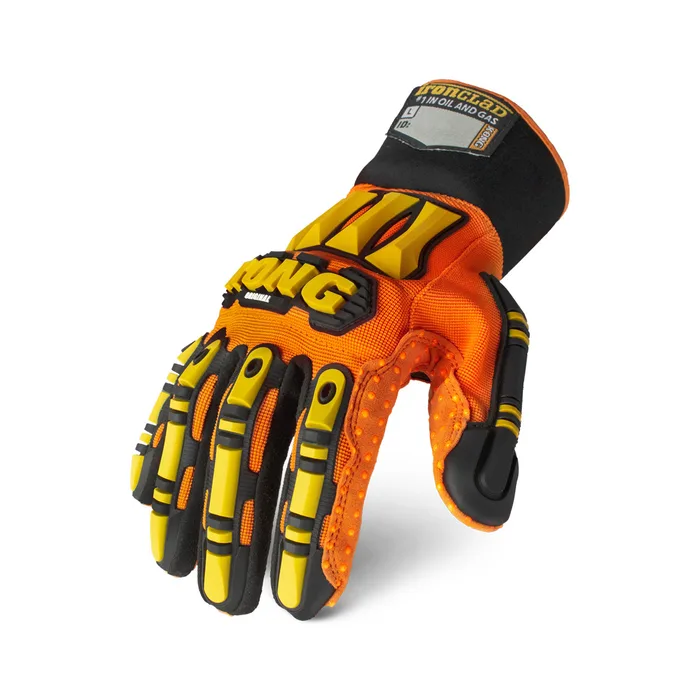
One of the few work gloves carrying a real ANSI/ISEA 138 impact level, which matters enormously if things fall on your hands and not at all if they do not.
Best for: Oil and gas, rigging, demolition and heavy material handling, where the real risk is a pipe or a load landing on the back of your hand.
- Ironclad publishes ANSI/ISEA 138 impact Level 2 and EN 388:2016 4242AP, so the impact claim is graded rather than pass or fail.
- The full set is unusually complete: ANSI cut A2, abrasion 4, puncture 3, plus EN 388 tear level 4, the top tear band in this group.
- Ironclad prints a grip rating of dry 4 out of 5, wet 4 out of 5 and oily 3 out of 5, a figure most makers leave off.
- The double layer synthetic leather palm and full coverage TPR guards make it a thick glove, so fine work is out.
- The grip rating is Ironclad's own in-house scale, not a standardised test, so it cannot be compared against another brand's number.
- The hi-viz palm and moulded guards are designed to be seen on a rig, not to blend into a workshop.
- You are paying the top tier here for impact protection that most buyers will never need.
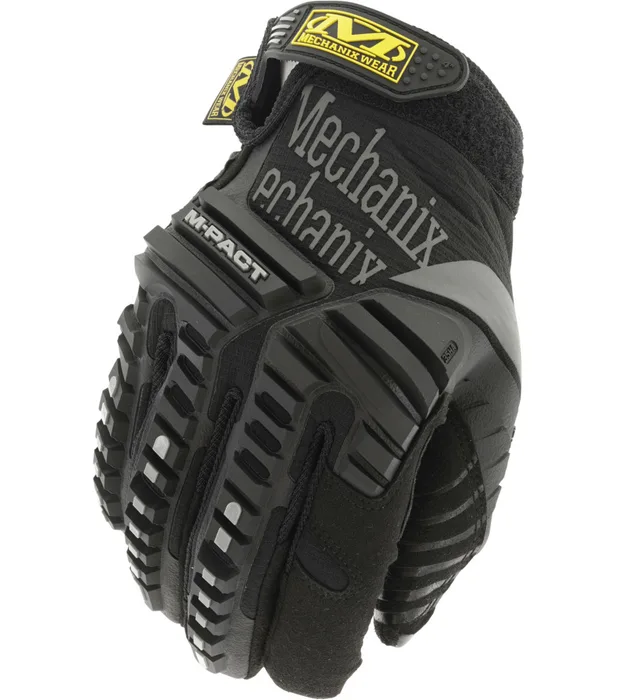
Sold as an impact glove, but its own certification block reads EN 388 2121XP, which puts abrasion two full bands below every other glove here.
Best for: Buyers who specifically want the D3O palm padding, the hook and loop cuff and the touchscreen palm, and who are not choosing on how long the glove lasts.
- Mechanix does publish a full certification block, listing ANSI/ISEA 105 abrasion 3 and EN 388 2121XP where you can read it.
- The P in that code is a genuine EN 388 impact pass, and the EN threshold of a 7 kN mean is tighter than ANSI/ISEA 138 Level 1.
- Mechanix describes a touchscreen capable 0.8 mm synthetic leather palm, plus 2 mm of D3O palm padding.
- EN 388 abrasion is level 2, roughly 500 cycles on the test rig, against level 4 and roughly 8,000 cycles on the other three gloves here.
- No ANSI/ISEA 138 level is listed for this model, so the impact claim is a pass or fail on the knuckle area rather than a graded result covering the fingers.
- Both cut positions in the EN code are 1 and X and the ANSI cut level is X, so there is no meaningful cut protection.
- EN 388 puncture is level 1 and tear is level 2, the joint lowest in this comparison.
| Criteria | HyFlex 11-840 Top pick | 377 | KONG Original SDX2 | M-Pact MPT-58 |
|---|---|---|---|---|
| Verdict | Buy it | Buy it | It depends | Skip it |
| Best for | General handling, assembly and parts work in mostly dry conditions, where you want the highest published abrasion band without giving up feel. | Anyone whose hands are wet, greasy or muddy most of the day, and who buys gloves by the box because they are consumables. | Oil and gas, rigging, demolition and heavy material handling, where the real risk is a pipe or a load landing on the back of your hand. | Buyers who specifically want the D3O palm padding, the hook and loop cuff and the touchscreen palm, and who are not choosing on how long the glove lasts. |
| Price tier | $$ · mid-range | $ · budget | $$$ · premium | $$ · mid-range |
| EN 388 code published by the maker | 4131A | 4121X | 4242AP | 2121XP |
| EN 388 abrasion level | Level 4, about 8,000 cycles | Level 4, about 8,000 cycles | Level 4, about 8,000 cycles | Level 2, about 500 cycles |
| EN 388 tear and puncture | Tear 3, puncture 1 | Tear 2, puncture 1 | Tear 4, puncture 2 | Tear 2, puncture 1 |
| Impact rating published | None | None | ANSI/ISEA 138 Level 2, plus EN 388 P | EN 388 P only, no ANSI/ISEA 138 level |
| Palm material or coating | Foam nitrile, palm coated | Nitrile plus foam nitrile, double foam layer on palm | Double layer synthetic leather with dots | 0.8 mm synthetic leather with 2 mm D3O padding |
| Knit gauge published | 15 gauge | Not published | Not a knit glove | Not a knit glove |
| What the maker says about grip | 2x grip versus its previous version, no wet figure | Disperses oil, grip in wet, dry or oily | Dry 4/5, wet 4/5, oily 3/5, own scale | Ribbed stamp pattern, no rating given |
| Touchscreen claimed by maker | Claimed, consumer and industrial screens | Not claimed | Not claimed | Claimed, and untested by any standard |
Which one is right for you?
- General handling, assembly and parts work in mostly dry conditions, where you want the highest published abrasion band without giving up feel. Buy it Ansell HyFlex 11-840
- Anyone whose hands are wet, greasy or muddy most of the day, and who buys gloves by the box because they are consumables. Buy it SHOWA 377
- Oil and gas, rigging, demolition and heavy material handling, where the real risk is a pipe or a load landing on the back of your hand. It depends Ironclad KONG Original SDX2
- Buyers who specifically want the D3O palm padding, the hook and loop cuff and the touchscreen palm, and who are not choosing on how long the glove lasts. Skip it Mechanix Wear M-Pact MPT-58
How we judged the field
Five things decide whether a general purpose work glove is worth buying, and cut resistance is not one of them. First, abrasion, because that is what actually kills a glove: EN 388’s first digit runs 1 to 4 for 100, 500, 2,000 and 8,000 cycles on a Martindale rig, so the difference between a 2 and a 4 is roughly sixteen times the rubbing. Second, coating chemistry, because nitrile holds grip in oil where natural rubber latex softens, polyurethane is the thinnest and most tactile but is not a liquid barrier, and the finish on top of the chemistry, flat, foam or sandy, decides whether liquid gets pushed out of the contact patch or sits under it. Third, gauge, the number of knitting needles per inch, which is what governs how thin a knit glove feels: 13 gauge is workmanlike, 15 gauge is the general purpose sweet spot, 18 and 21 gauge are for fine parts. Fourth, whether there is a real impact rating rather than the word impact. Fifth, whether the maker publishes any of this at all.
The field splits on how much the maker is willing to write down. At the top are the industrial brands who print a full EN 388 code, the gauge and the coating construction, and sometimes a grip figure: Ansell, SHOWA and Ironclad all publish most of these. In the middle sit the consumer and jobsite brands who publish a certification block but not the construction detail, which is where Mechanix Wear sits. At the bottom are sellers who use the words tough and heavy duty and give you nothing. We picked a lightweight knit built for dry handling, a cheap foam-palm knit built for oil, a leather-palmed impact glove that carries a graded ANSI/ISEA 138 level, and a hugely popular impact glove whose own numbers explain why it is not the one to buy.
Ansell HyFlex 11-840
Buy itAnsell’s HyFlex 11-840 is the benchmark general purpose knit, and its maker publishes more detail than most. The build is a knitted nylon and spandex liner at 15 gauge with a foam nitrile coating on the palm only, a knitwrist cuff, and sizes running 5 through 12 with a length of 200 to 275 mm. The EN 388:2016 code is 4131A: abrasion level 4, the top of that scale at roughly 8,000 cycles, coup cut 1, tear 3, puncture 1, and a straight-blade cut letter of A. Because only the palm is coated, the back of the hand breathes, and Ansell lists the glove as silicone free, which matters if you are handling parts that get painted later. The limits are on Ansell’s own page: the grip claim is 2x more grip versus its previous technology version, with no wet or oily figure at all, and the palm-only coating is not a liquid barrier. Buy it for handling, assembly and parts work in mostly dry conditions.
SHOWA 377
Buy itSHOWA’s 377 is the answer to the HyFlex 11-840’s one real weakness. Where Ansell coats the palm and leaves the back open, SHOWA puts a double layer of nitrile foam across the palm, which SHOWA says is there to disperse oil and improve grip in wet, dry or oily conditions. The published code is EN 388:2016+A1:2018 4121X with Category II, so abrasion is level 4 exactly like the Ansell glove, tear is level 2, puncture is level 1 and the straight-blade cut result is not reported. The liner is a seamless nylon and polyester knit with an elasticated wrist, in blue, in sizes 6 through 10. SHOWA lists concreting, mortar, washing and cleaning and light assembly of oil-coated pieces as intended jobs, which is a fair description of who it is for. What you give up is disclosure: no gauge is published. For wet, greasy, muddy work at the cheapest tier here, it is the obvious buy.
Ironclad KONG Original SDX2
It dependsThe Ironclad KONG Original exists to answer a hazard the other gloves cannot. Ironclad publishes an ANSI/ISEA 138 impact rating of Level 2, which means a mean transmitted force at or below 6.5 kN across 18 drops on the knuckles and fingers, and it backs that with EN 388:2016 4242AP, so abrasion 4, coup cut 2, tear 4, puncture 2, straight-blade cut A and the EN impact pass letter P. ANSI cut is A2, abrasion 4 and puncture 3. Construction is a double layer synthetic leather palm with grip dots and a hi-viz palm, a breathable nylon back, full coverage TPR guards over the fingers, thumb, knuckle and metacarpal, and an extended neoprene cuff. Ironclad is also one of the very few makers that publishes a grip score at all, rating this glove dry 4 out of 5, wet 4 out of 5 and oily 3 out of 5 on its own scale. The catch is bulk: this is a thick glove that rules out fine work, and if nothing ever lands on your hands you are paying for armour you will not use.
Mechanix Wear M-Pact MPT-58
Skip itThe Mechanix Wear M-Pact is a widely recognised work glove, and the case against it is entirely on Mechanix’s own product page. The certification block reads EN 388 2121XP and an ANSI/ISEA 105 block showing cut X, abrasion 3, puncture X. Read the EN code left to right: abrasion level 2, which is roughly 500 cycles on the same rig where the other three gloves here reach level 4 and roughly 8,000, then coup cut 1, tear 2, puncture 1, straight-blade cut not reported, and the impact pass letter P. The P is real and its threshold is tight, a 7 kN mean with no result over 9 kN, but it is a pass or fail on the area the maker claims, and no ANSI/ISEA 138 level appears for this model. What you do get is a touchscreen capable 0.8 mm synthetic leather palm, 2 mm of D3O padding and a welded TPR knuckle. If longevity is what you want from a work glove, buy on the abrasion digit instead.
Sources
Specs in this review come from these pages.
- ISEA: Selecting the Best Impact-Resistant Hand Protection (ANSI/ISEA 138 white paper) (safetyequipment.org)
- SATRA: EN 388, assessing mechanical risks (satra.com)
- SATRA: The requirements of EN ISO 21420:2020+A1:2024 (satra.com)
- Ansell: HyFlex 11-840 nitrile-coated multi-purpose gloves (ansell.com)
- SHOWA: 377 product page and datasheet (showagroup.com)
- Ironclad: KONG Original SDX2 ratings and specs (ironclad.com)
Ansell HyFlex 11-840 vs SHOWA 377: which should you buy?
The Ansell HyFlex 11-840 and the SHOWA 377 post the same abrasion level, 4, and then diverge on exactly the question most buyers get wrong. The Ansell is palm coated: nitrile foam on the working surface, bare knit across the back, which makes it breathable and light and is why Ansell pitches it at general handling and small parts. The SHOWA has a nitrile coating with a second, foamed layer on the palm, which SHOWA says is there to disperse oil and improve grip. Ansell recommends its glove for assembly and general handling and quotes a grip advantage over its own previous version. SHOWA says its glove disperses oil and grips wet, dry or oily. Neither is hedging; they are describing two different tools.
So choose on what is on your hands, not on the brand. If your work is dry, or wet only occasionally, and you spend the day picking up components, tightening fasteners and moving stock, the HyFlex is the better glove and the published 15 gauge is why: it is thin enough that you will actually keep it on. If your work involves engine oil, coolant, wet concrete, mortar, fish, or anything that makes a bare hand slip, the SHOWA is the better glove and it is also the cheaper one. Two notes in each direction: the Ansell is the only one of the pair that publishes its gauge, so you know what you are buying, and the SHOWA has a lower tear rating, level 2 against level 3, so on snagging work the Ansell should survive longer.
What to look for
- Read the first EN 388 digit first: abrasion is what wears a general purpose glove out, and level 1 to 4 maps to 100, 500, 2,000 and 8,000 cycles, so a 4 is not twice a 2, it is about sixteen times.
- Match the coating to the liquid, not the brand: nitrile is the chemistry that keeps working in oil, latex gives the best dry grip but softens in petroleum and is an allergen, and polyurethane is the thinnest and most tactile but is not a liquid barrier.
- Check the finish on top of the chemistry: flat nitrile is tacky when dry, foam nitrile channels liquid away from the contact patch, and sandy or gritty nitrile is what makers point at for heavy oil.
- Use gauge to predict feel: gauge is knitting needles per inch, so 13 gauge is thicker and blunter, 15 gauge is the general purpose middle, and 18 or 21 gauge is for work where you need to feel a washer.
- Demand a level next to the word impact: ANSI/ISEA 138 grades back of hand protection 1 to 3 across 18 drops on the knuckles and fingers, while the EN 388 letter P is a pass or fail on whatever area the maker claimed, and plenty of gloves marked impact carry neither.
- Treat touchscreen and grip claims as marketing: no standard tests touchscreen compatibility, and where a maker does publish a grip score it is an in-house scale that cannot be compared to another brand’s.
Our final take
Buy the Ansell HyFlex 11-840 if your work is dry and you want the top abrasion band in a glove thin enough to keep on all day, and the SHOWA 377 if oil, water or mud is the reason your last pair let you down. The Ironclad KONG Original is worth its premium only if impact is a live hazard, in which case its published ANSI/ISEA 138 Level 2 is the number nothing else here can match. Skip the Mechanix Wear M-Pact on longevity grounds: its own code says abrasion level 2 where the rest say level 4. Above all, work out whether your problem is wearing through, slipping, or getting hit, because no glove solves all three.
Questions, answered
Does "impact resistant" on a work glove mean anything?
It means something only if a number follows it. ANSI/ISEA 138-2019 is a real American standard for back of hand protection, and it is graded 1 to 3: a 5 joule striker is dropped on the glove over 18 impacts, 8 on the knuckles and 10 on the fingers and thumb, and the mean transmitted force has to come in at or below 9 kN for Level 1, 6.5 kN for Level 2 and 4 kN for Level 3. Lower force means better protection, so Level 3 is the top. The glove is rated at the lowest result of any point tested, and testing has to be done by an accredited third-party lab. Europe's EN 388 also has an impact test at 5 joules, but it is optional and pass or fail, reported as the letter P at the end of the code. So a glove that shows only a P has passed an impact test on the area the maker claimed, while a glove that shows a 138 level has been graded across the knuckles and the fingers.
Nitrile, polyurethane or latex: which coating actually grips in oil?
Nitrile is the one that holds up in oil, because nitrile rubber does not swell and soften in petroleum the way natural rubber latex does. Latex gives the best dry grip of the three and several makers rate its abrasion resistance above both nitrile and polyurethane, but it is poor in oil and it is a genuine allergen. Polyurethane is the thinnest and most flexible coating, which is why fine assembly gloves use it, and makers describe it as suited to dry and lightly oily work rather than wet work. Within nitrile, the finish matters as much as the chemistry: flat nitrile is tacky in the dry, foam nitrile is spongy and channels liquid away from the contact patch, and sandy or gritty nitrile is the roughest and is what makers point at for heavy oil. If your hands are wet or greasy most of the day, buy a foam or sandy nitrile palm and do not buy latex.
What do the EN 388 numbers other than the cut digit mean?
The code has up to six characters and only two of them are about cutting. The first digit is abrasion, tested on a Martindale machine that rubs the palm material against 180 grit until it holes: level 1 is 100 cycles, level 2 is 500, level 3 is 2,000 and level 4 is 8,000. The third digit is tear, the force in newtons needed to propagate an existing cut, running from at least 10 N at level 1 to at least 75 N at level 4. The fourth digit is puncture, measured by pushing a rounded stylus through the material, from at least 20 N at level 1 to at least 150 N at level 4. That puncture stylus is blunt and models a burst or a tear, not a needle. For a general purpose glove the abrasion digit is the one that predicts how long the glove lasts, and the gap between a 2 and a 4 is not two steps, it is roughly sixteen times the cycles.
Is "touchscreen compatible" tested against anything?
No. There is no standard test for it. EN ISO 21420, the general requirements standard that replaced EN 420, covers sizing, innocuousness, water vapour transmission and dexterity, and the dexterity test is a pin pickup: the smallest steel pin you can pick up three times in 30 seconds sets the level. Nothing in it addresses capacitive screens. Touchscreen capability comes from conductive yarn, usually silver or copper, knitted or printed into the fingertips so your finger's charge reaches the screen, and every maker validates it in-house or not at all. It also degrades: the conductive threads wear and the effect fades long before the glove does. Treat it as a feature claim, not a rating, and if it matters to you, test the pair you buy on your own phone through a screen protector.
Does anyone publish how long a work glove lasts?
Not in any absolute way, and that is the biggest gap in the category. The closest thing to a durability figure anyone publishes is the EN 388 abrasion cycle count, which is a lab number from a rubbing rig, not a service life. Beyond that you get relative marketing claims with no stated baseline: Ansell says the FORTIX coating on the HyFlex 11-840 gives up to 20 percent more durability, but only against its own previous technology version, not against another brand. Ironclad publishes a grip score for dry, wet and oily conditions, but that is an in-house 1 to 5 scale that cannot be compared across brands. Warranties, where they exist, are counted in days rather than in hours of wear. Use the EN 388 abrasion digit as your proxy, assume any coated knit is a consumable, and buy in quantity rather than chasing a glove that will last.
Deciding between the top two? See our head-to-head: Ansell HyFlex 11-840 vs SHOWA 377.
More Tools & DIY reviews
 The Best Work Lights: 4 Compared (and One to Skip)
  The Best Adjustable Wrenches: 4 Compared (and One to Skip)
  The Best Air Compressors: 4 Compared (and One to Skip)
  The Best Angle Grinders: 4 Compared (and One to Skip)
  The Best Bar Clamps: 4 Compared (and One to Skip)
  The Best Belt Sanders: 4 Compared (and One to Skip)