

Tools & DIY
The Best Air Compressors: 4 Compared (and One to Skip)
Four portable compressors compared on the one number that survives marketing: SCFM delivered at 90 PSI, plus what each maker will and will not put in writing about horsepower and noise.
The short version
Buy the Makita MAC2400. It delivers 4.2 CFM at 90 PSI, comfortably the most air here, and Makita is the only maker in this group that we found publishing a running horsepower figure (2.1 HP) next to the maximum (2-1/2 HP) instead of leaving you with the bigger number alone. It is oil-lubricated and 77 pounds, which is the price of that air. Buy the California Air Tools 8010 instead if the compressor lives indoors: 60 dB against Makita's 79 is the difference between a conversation and shouting, and its 8 gallon tank buffers the modest 2.2 CFM at 90 PSI for intermittent work. The DeWalt DWFP55126 is the it-depends, a 6 gallon pancake at 2.6 SCFM at 90 PSI and 165 max PSI, which is the most stored pressure here and genuinely useful for a framing nailer, though 75.5 dB is only quiet next to the Makita. Skip the Craftsman CMEC6150K: it matches the DeWalt on air at 2.6 SCFM and 90 PSI but is louder at 78.5 dB with 15 fewer PSI, and its horsepower is listed as 0.2 HP in one place and 0.8 HP in another, which tells you exactly what a compressor horsepower figure is worth. Best for: anyone sizing a compressor to a nailer, an impact wrench or a blow gun rather than to a number on the box.
Our picks at a glance
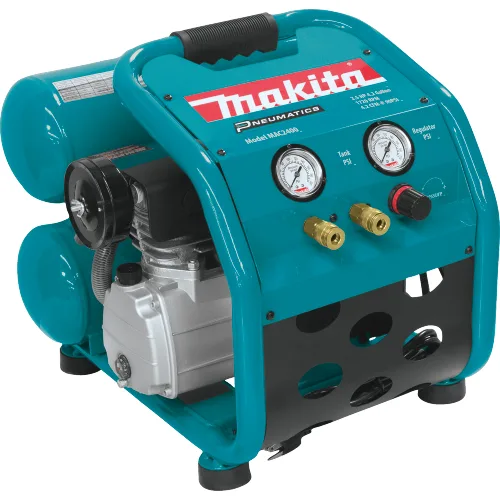
- Makita MAC2400 2.5 HP Big Bore Air Compressor - Buy. The most air at working pressure by a wide margin, and the only spec sheet here that gives you a running horsepower figure as well as a peak one.
- California Air Tools 8010 Ultra Quiet 1.0 HP Air Compressor - Buy. Sixty decibels, which is the only spec in this comparison that changes whether you can use the tool in a room with other people in it.
- DEWALT DWFP55126 6 Gallon 165 PSI Pancake Compressor - It depends. The most stored pressure here at 165 PSI, which buys you more usable shots per cycle than the airflow figure suggests.
- CRAFTSMAN CMEC6150K 6 Gallon 150 PSI Pancake Compressor - Skip. Matches the DeWalt on airflow while being louder with less pressure, and its own horsepower figure cannot be pinned down.
The verdict in 30 seconds
What mattered most
- Air at 90 PSI
- Maximum pressure
- Published noise
- Running horsepower published
- Tank
- Pump
A class action settled in the mid 2000s was supposed to end horsepower inflation on air compressors. Manufacturers agreed to rate motors on continuous output rather than on peak power, max developed power or breakdown torque, because a peak figure is a fraction of a second at startup and describes nothing you can use. Two decades on, peak horsepower is still printed on spec pages. So is a decibel number, on every compressor here, and not one of the four names the distance it was measured at. The number that survived all of this is airflow at working pressure, written as SCFM or CFM at 90 PSI, because a nailer or an impact wrench has an air appetite and the compressor either feeds it or does not.
The most air at working pressure by a wide margin, and the only spec sheet here that gives you a running horsepower figure as well as a peak one.
Best for: Anyone running air tools with a real appetite, especially two nailers at once, who can live with the weight and the noise.
- Delivers 4.2 CFM at 90 PSI and 4.8 CFM at 40 PSI, which is roughly double the California Air Tools unit at working pressure.
- Makita publishes Maximum Horsepower at 2-1/2 HP and Running Horsepower at 2.1 HP, so the usable figure is stated rather than implied.
- Oil-lubricated cast iron pump running at 1,730 RPM, which Makita ties directly to both the 79 dB figure and pump durability.
- Sustains 130 PSI in a 4.2 gallon twin-stacked tank, enough to run two nailers.
- 79 dB is the loudest here and unpleasant indoors without hearing protection.
- 77 pounds, so this is a compressor you site rather than carry.
- Oil-lubricated means checking and changing oil, and keeping the unit level.
- Makita states the dB figure with no measurement distance or test standard.
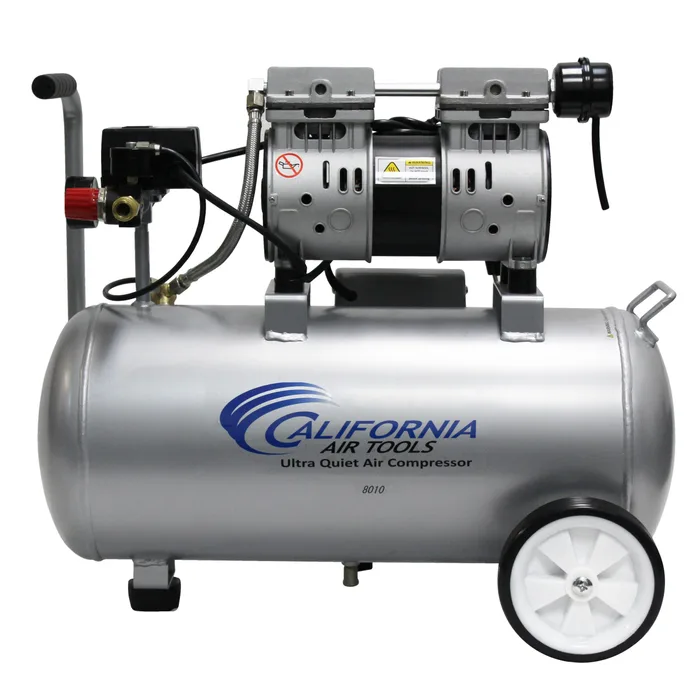
Sixty decibels, which is the only spec in this comparison that changes whether you can use the tool in a room with other people in it.
Best for: Garage, basement and indoor work where noise is the binding constraint and the air demand is intermittent.
- Published at 60 dB, nineteen below the Makita, which is the difference between talking over it and not.
- An 8 gallon tank, the largest here, which buffers a modest pump for intermittent work.
- Oil-free pump, so no oil checks and no level requirement.
- California Air Tools publishes a 70/30 duty cycle, which most makers leave out entirely.
- 2.20 CFM at 90 PSI is the least air here, so it will not keep up with a framing nailer in continuous use.
- The spec page still leads with 1.0 HP (Rated/Running) and 2.0 HP (Peak), printing a peak figure two decades after the settlement that was meant to retire them.
- One year limited warranty.
- The 60 dB claim names no measurement distance and no test standard.
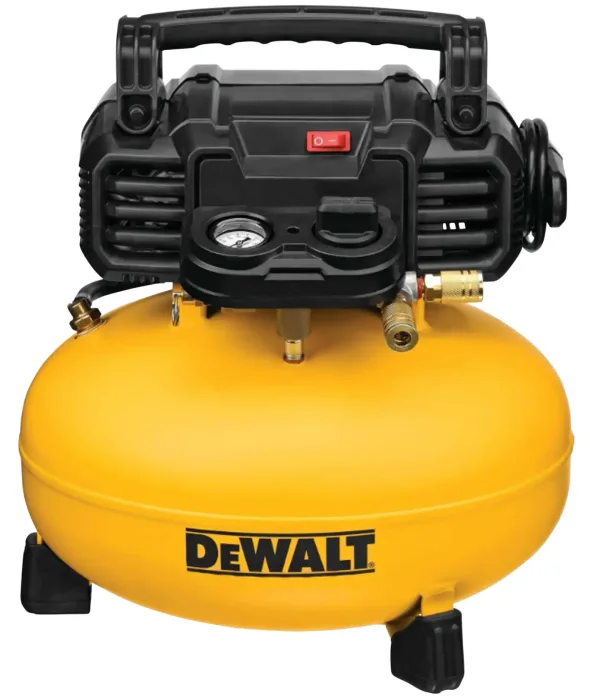
The most stored pressure here at 165 PSI, which buys you more usable shots per cycle than the airflow figure suggests.
Best for: Trim, finish and brad nailing where high stored pressure matters more than sustained airflow.
- 165 max PSI is the highest in this group, so a 6 gallon tank holds meaningfully more usable air than the same tank at 150.
- 2.6 SCFM at 90 PSI, ahead of the California Air Tools unit and enough for a finish or brad nailer.
- 75.5 dB, quieter than both the Makita and the Craftsman.
- Oil-free pump with no maintenance routine.
- 2.6 SCFM at 90 PSI is well short of the Makita for anything continuous.
- 75.5 dB is still loud enough to want ear protection in a closed garage.
- DeWalt publishes no running horsepower figure for it.
- The dB figure, again, comes with no stated distance.
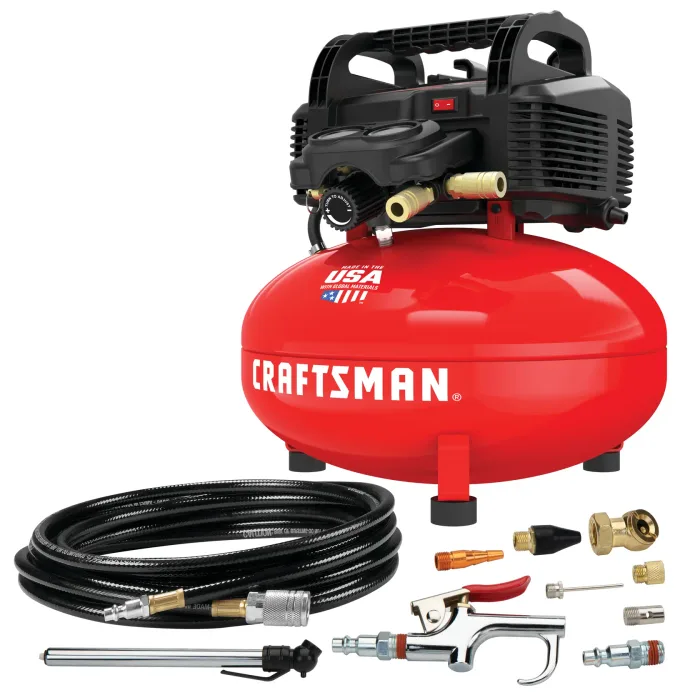
Matches the DeWalt on airflow while being louder with less pressure, and its own horsepower figure cannot be pinned down.
Best for: Tyre inflation and occasional brad nailing, if the kit price is doing the deciding.
- 2.6 SCFM at 90 PSI, the same working airflow as the DeWalt.
- Oil-free pump, so no maintenance routine.
- Usually sold as a kit with hose and fittings, which is real money if you own none.
- 78.5 dB against the DeWalt's 75.5, for the same air.
- 150 max PSI against the DeWalt's 165, so the same 6 gallon tank stores less usable air.
- Horsepower has been listed as 0.2 HP in one place and 0.8 HP in another, a four-fold disagreement about the same machine.
- No running horsepower figure and no duty cycle. The dB figure is footnoted to ISO 3744 but states no distance.
Amazon had no buyable listing for this when we last checked. The link still works if it returns.
Check price on Amazon Read our detailed assessment| Criteria | MAC2400 2.5 HP Big Bore Air Compressor Top pick | 8010 Ultra Quiet 1.0 HP Air Compressor | DWFP55126 6 Gallon 165 PSI Pancake Compressor | CMEC6150K 6 Gallon 150 PSI Pancake Compressor |
|---|---|---|---|---|
| Verdict | Buy it | Buy it | It depends | Skip it |
| Best for | Anyone running air tools with a real appetite, especially two nailers at once, who can live with the weight and the noise. | Garage, basement and indoor work where noise is the binding constraint and the air demand is intermittent. | Trim, finish and brad nailing where high stored pressure matters more than sustained airflow. | Tyre inflation and occasional brad nailing, if the kit price is doing the deciding. |
| Price tier | $$$ · premium | $$ · mid-range | $$ · mid-range | $ · budget |
| Air at 90 PSI | 4.2 CFM | 2.20 CFM | 2.6 SCFM | 2.6 SCFM |
| Maximum pressure | 130 PSI | 120 PSI | 165 PSI | 150 PSI |
| Published noise | 79 dB | 60 dB | 75.5 dB | 78.5 dB |
| Running horsepower published | Yes, 2.1 HP | No, rated 1.0 and peak 2.0 | No | No, and sources disagree 0.2 vs 0.8 |
| Tank | 4.2 gal twin stack | 8.0 gal | 6 gal pancake | 6 gal pancake |
| Pump | Oil-lubricated | Oil-free | Oil-free | Oil-free |
| Duty cycle published | Not published | Yes, 70/30 | Not published | Not published |
Which one is right for you?
- Anyone running air tools with a real appetite, especially two nailers at once, who can live with the weight and the noise. Buy it Makita MAC2400 2.5 HP Big Bore Air Compressor
- Garage, basement and indoor work where noise is the binding constraint and the air demand is intermittent. Buy it California Air Tools 8010 Ultra Quiet 1.0 HP Air Compressor
- Trim, finish and brad nailing where high stored pressure matters more than sustained airflow. It depends DEWALT DWFP55126 6 Gallon 165 PSI Pancake Compressor
- Tyre inflation and occasional brad nailing, if the kit price is doing the deciding. Skip it CRAFTSMAN CMEC6150K 6 Gallon 150 PSI Pancake Compressor
How we judged the field
One number decides a compressor and three others decide whether you enjoy owning it. The number is airflow at 90 PSI, because every air tool has a published appetite and the compressor either feeds it continuously or makes you wait. After that: maximum pressure, because usable stored air is pressure times volume and a 6 gallon tank at 165 PSI holds meaningfully more work than the same tank at 150; noise, because a compressor that cannot run while anyone is in the room is a compressor you use less; and what the maker is willing to publish, which turned out to be the most revealing test of all. Only one of the four gives a running horsepower figure. Only one gives a duty cycle. All four print a decibel number and none names the distance it was measured at.
Makita MAC2400 2.5 HP Big Bore Air Compressor
Buy itThe Makita MAC2400 is the pick because it wins the only contest that matters and is the most open about it. It delivers 4.2 CFM at 90 PSI and 4.8 CFM at 40 PSI, roughly double the California Air Tools unit where the tools actually run, and Makita states plainly that maximum horsepower is 2-1/2 HP while running horsepower is 2.1 HP. Publishing both is rarer than it should be, and the gap between them is small precisely because the figure is real. The pump is oil-lubricated with a cast iron cylinder, turning at 1,730 RPM, which Makita ties directly to the 79 dB rating and to durability, and the 4.2 gallon twin-stacked tank holds 130 PSI, enough for two nailers off one machine. The costs are exactly what that construction implies: 77 pounds, an oil routine, and the loudest number in the group. This is a compressor you put somewhere and run a hose from, not one you carry between rooms.
California Air Tools 8010 Ultra Quiet 1.0 HP Air Compressor
Buy itThe California Air Tools 8010 is the second buy because it is the only one you can run indoors without changing how everyone else in the building behaves. Sixty decibels against the Makita’s seventy-nine is not a nineteen percent difference, it is closer to four times quieter to the ear, and that single figure decides whether the machine gets used on a weekday evening. It pairs that with the biggest tank here, 8 gallons, which is the right design for a modest pump: store a lot, work in bursts, let it catch up. California Air Tools also publishes a 70/30 duty cycle, disclosure the others simply do not offer. Two things hold it back. The pump moves 2.20 CFM at 90 PSI, the least here, so continuous tools will outrun it. And the spec page still leads with 1.0 HP (Rated/Running) and 2.0 HP (Peak), which is the practice a class action settlement was supposed to have retired two decades ago.
DEWALT DWFP55126 6 Gallon 165 PSI Pancake Compressor
It dependsThe DeWalt DWFP55126 is the it-depends, and the case for it is a number people overlook. At 165 max PSI it stores the most pressure in this group, and because usable air is pressure as well as volume, its 6 gallon tank holds more real work than the Craftsman’s identical 6 gallons at 150 PSI. Airflow is a middling 2.6 SCFM at 90 PSI, which is fine for brad and finish nailing and short of the Makita for anything sustained, and 75.5 dB makes it the quietest of the three oil-free pancakes. The pump needs no maintenance. What you do not get is any disclosure beyond the headline: no running horsepower figure, no duty cycle, and a decibel number with no stated distance. Buy it for trim work where the tank does the buffering, not for a sander or an impact wrench.
CRAFTSMAN CMEC6150K 6 Gallon 150 PSI Pancake Compressor
Skip itThe Craftsman CMEC6150K is the skip, and the reason is that it is beaten on its own terms by a directly comparable machine. It delivers the same 2.6 SCFM at 90 PSI as the DeWalt, but it is louder at 78.5 dB against 75.5, and it tops out at 150 PSI against 165, so the same six gallons of tank store less usable air. Same air, more noise, less pressure. Then there is the horsepower, which has been listed as 0.2 HP in one place and 0.8 HP in another for the same model number, a four-fold disagreement that no buyer can resolve and that neatly demonstrates why the figure should be ignored on every compressor. It is not a bad machine for inflating tyres and driving the occasional brad, and the kit packaging is worth real money if you own no hose or fittings. It just has no argument against the DeWalt beyond price.
Sources
Specs in this review come from these pages.
- Makita USA, MAC2400 product specifications (makitatools.com)
- California Air Tools, 8010 Ultra Quiet product specifications (californiaairtools.com)
- DEWALT support, SCFM rating on current DEWALT air compressors (support.dewalt.com)
- Evaluating true horsepower and CFM ratings of air compressors, including the horsepower class action settlement terms (truetex.com)
- DEWALT, DWFP55126 pancake compressor product page (dewalt.com)
Makita MAC2400 2.5 HP Big Bore Air Compressor vs California Air Tools 8010 Ultra Quiet 1.0 HP Air Compressor: which should you buy?
The interesting pair is the Makita against the California Air Tools 8010, because they are not really competing for the same job. The Makita moves 4.2 CFM at 90 PSI and makes 79 dB doing it. The 8010 moves 2.20 CFM and makes 60 dB. Neither number is a compromise on the other machine’s terms: one is a tool that feeds air tools continuously and demands a space where noise does not matter, the other is a tool that fits in a room with people in it and asks you to work in bursts. The tank sizes follow the same logic in reverse, with the weaker pump getting the bigger 8 gallon buffer and the stronger pump getting 4.2 gallons it can refill quickly. Decide which constraint is real for you, air or noise, and the choice makes itself. The DeWalt and the Craftsman are the same machine class fighting over 3 dB and 15 PSI, and the DeWalt wins both.
What to look for
- SCFM or CFM at 90 PSI: the only figure that maps onto what your tools need, because airflow falls as pressure rises and 90 PSI is where most air tools are designed to run.
- Maximum pressure, read together with tank size: usable stored air is pressure as well as volume, so 6 gallons at 165 PSI is meaningfully more work than 6 gallons at 150.
- A running or rated horsepower figure, if any: a maker who publishes running horsepower next to peak is telling you the real number; one who prints only a peak figure is telling you something else.
- A decibel figure with a stated distance: every compressor quotes dB and almost none says from how far, which makes the numbers comparable only loosely and worth discounting accordingly.
- A published duty cycle: how long the pump may run in a given period. Its absence is normal and its presence, as on the California Air Tools unit, is a genuine disclosure.
- Oil-free against oil-lubricated: oil-free means no upkeep and more noise per unit of air; oil-lubricated means a maintenance routine and, usually, more air and longer life.
Our final take
Air compressors are a category where the headline number has been legally discredited and is still printed. Ignore horsepower on all four of these machines, including the one that publishes it plainly, and buy on airflow at 90 PSI against the appetite of the tool you actually own. Then let noise break the tie, because the quiet machine is the one that gets used.
Questions, answered
What does SCFM at 90 PSI actually mean, and why 90?
SCFM is standard cubic feet per minute, the volume of air the pump can deliver continuously, corrected to a standard temperature and pressure so that two machines can be compared. The 90 PSI matters because that is roughly the pressure most air tools are designed to run at, and airflow falls as pressure rises. A compressor quoting a big number at 40 PSI and a small one at 90 is telling you it struggles where you will actually use it. Match the figure to the tool: brad nailers want well under 1 CFM, framing nailers more, and impact wrenches and sanders far more again.
Why is peak horsepower still printed if a lawsuit stopped it?
The mid 2000s settlement bound the manufacturers who were party to it, requiring horsepower to be measured on the continuous output of the motor shaft rather than on peak power, max developed power or breakdown torque. It did not make peak figures illegal for everyone forever, and it did not stop later entrants using them. California Air Tools still lists 1.0 HP (Rated/Running) and 2.0 HP (Peak) on its own spec page. The practical rule has not changed: ignore horsepower entirely and read the airflow figure, because horsepower is an input and airflow is the output you buy.
Is a 60 dB compressor really half as loud as a 79 dB one?
Louder than half, in fact, because decibels are logarithmic. A 10 dB rise is roughly a doubling of perceived loudness, so 79 dB is somewhere near four times as loud as 60 dB to the ear, not 30 percent. That is why the California Air Tools unit changes what the machine is for rather than merely being pleasanter. The caveat is that none of these four states the distance the measurement was taken at, and noise falls off with distance, so the numbers are comparable only in the loosest sense.
Oil-free or oil-lubricated?
Oil-lubricated pumps generally run cooler, quieter for their output and last longer, at the cost of checking oil, changing it and keeping the machine level. Oil-free pumps have none of that upkeep and are lighter, which is why every portable pancake here is oil-free, but they wear faster and are typically noisier for the same air. The Makita is the only oil-lubricated unit in this group and has a cast iron cylinder, which is part of why it moves twice the air of the California Air Tools unit.
How big a tank do I actually need?
Tank size decides how long you can work before the pump has to catch up, not how much air you have in total. A large tank on a weak pump, which is what the 8 gallon California Air Tools unit is, buys you a burst of intermittent work followed by a wait. A smaller tank at higher pressure, like the DeWalt's 6 gallons at 165 PSI, stores more usable air than the gallon figure suggests, because usable air is a function of pressure as well as volume. For continuous tools, the pump's CFM decides everything and the tank barely matters.
Deciding between the top two? See our head-to-head: Makita MAC2400 2.5 HP Big Bore Air Compressor vs California Air Tools 8010 Ultra Quiet 1.0 HP Air Compressor.
More Tools & DIY reviews
 The Best Angle Grinders: 4 Compared (and One to Skip)
  The Best Bar Clamps: 4 Compared (and One to Skip)
  The Best Belt Sanders: 4 Compared (and One to Skip)
  The Best Bench Vises: 4 Compared (and One to Skip)
  The Best Benchtop Planers: 4 Compared (and One to Skip)
  The Best Block Planes: 4 Compared for Fine Woodworking