

Tools & DIY
The Best Benchtop Planers: 4 Compared (and One to Skip)
Four benchtop thickness planers compared on cuts per inch, the figure that predicts surface finish, and on a similar-sounding number that predicts nothing.
The short version
Buy the DEWALT DW735X. It is the only planer here with a two-speed gearbox, which lets you choose 96 cuts per inch for fast stock removal or 179 for a finish pass, and it is the only one in this group where that number is a setting rather than a fixed property. It runs a three-knife head at 10,000 RPM through a 13 inch capacity, the widest here. Buy the DEWALT DW734 if the second speed is not worth the money: same three-knife head, same 10,000 RPM, a fixed 96 cuts per inch, and a four-column carriage lock that DEWALT ties directly to reducing snipe. The Makita 2012NB is the it-depends, a two-knife head at 8,500 RPM whose Interna-Lok automated head clamp is described by Makita as eliminating snipe, at the cost of a lower cuts-per-inch figure Makita does not publish. Skip the CRAFTSMAN CMEW320 on the specification it chooses to lead with: a two-knife head at 8,000 RPM quoted as 16,000 cuts per minute, which is the same two numbers multiplied together and says nothing about finish without a feed rate. Best for: anyone comparing planers on amps, which are 15 on all four.
Our picks at a glance
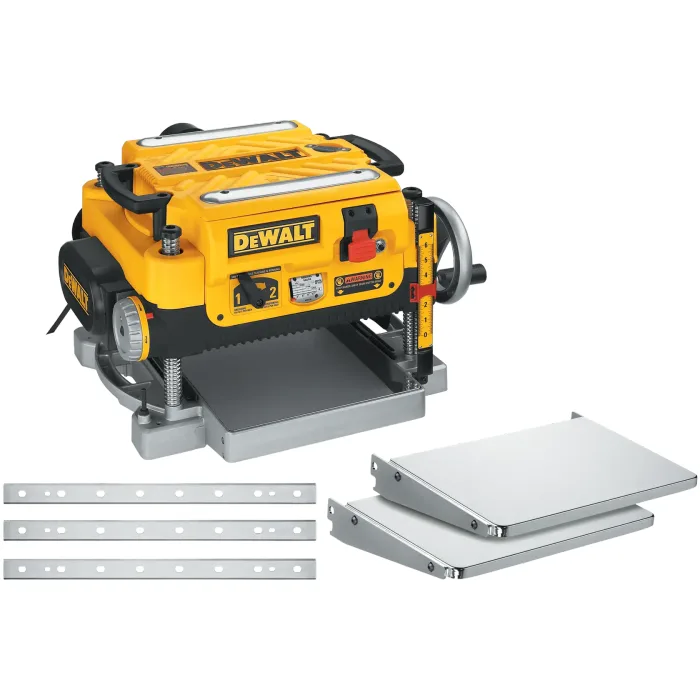
- DEWALT DW735X 13 in. Three Knife Two Speed Thickness Planer - Buy. The only planer here where cuts per inch is a setting rather than a fixed number, and the only one that publishes both figures.
- DEWALT DW734 12-1/2 in. Three Knife Thickness Planer - Buy. The same three-knife head and speed as the flagship at a fixed 96 cuts per inch, with a named mechanism for controlling snipe.
- Makita 2012NB 12 in. Portable Thickness Planer - It depends. A head clamp Makita says eliminates snipe, on a two-knife head whose cuts per inch Makita does not publish.
- CRAFTSMAN CMEW320 12 in. 15 Amp Benchtop Thickness Planer - Skip. Leads on sixteen thousand cuts per minute, which is its own two knives times its own RPM and predicts nothing about finish.
The verdict in 30 seconds
What mattered most
- Published cuts per inch
- Knives
- Cutterhead speed
- Feed speeds
- Cutting width
- Named snipe mechanism
Surface finish on a thickness planer comes down to how many knife marks land in each inch of board, and that number has a name: cuts per inch. It is knives multiplied by cutterhead speed, divided by how fast the board is fed through. Two of the four planers here publish it. The other two publish cutterhead RPM, and one of them publishes cuts per minute, which is knives times RPM and sounds impressively large while telling you nothing, because it leaves out the feed rate that does half the work. A planer quoting sixteen thousand cuts per minute may be producing fewer marks per inch than one quoting ten thousand RPM, and nothing on either box lets you find out. The second thing worth knowing is that snipe, the shallow dip planed into the ends of a board, is a mechanical problem with a named mechanism on three of these four, and worth choosing on.
The only planer here where cuts per inch is a setting rather than a fixed number, and the only one that publishes both figures.
Best for: Anyone surfacing hardwood or glued panels who wants a finish pass without changing anything but a lever.
- A two-speed gearbox giving a choice of 96 or 179 cuts per inch, so roughing and finishing are different feed rates rather than different passes.
- DEWALT publishes the cuts per inch figures directly, which is the specification that actually predicts surface finish.
- A three-knife cutterhead at 10,000 RPM, more knives and higher speed than either two-knife planer here.
- Thirteen inch capacity, the widest in this comparison, which covers glued-up panels the 12 inch machines cannot.
- By a distance the most expensive planer here, and the second speed is the main thing the money buys.
- Heavy and bulky for a benchtop machine, which matters if it has to be lifted on and off a bench.
- Three knives cost more to replace than two, and they are consumables.
- Its onboard fan-assisted chip ejection needs somewhere for the chips to go, which usually means buying extraction.
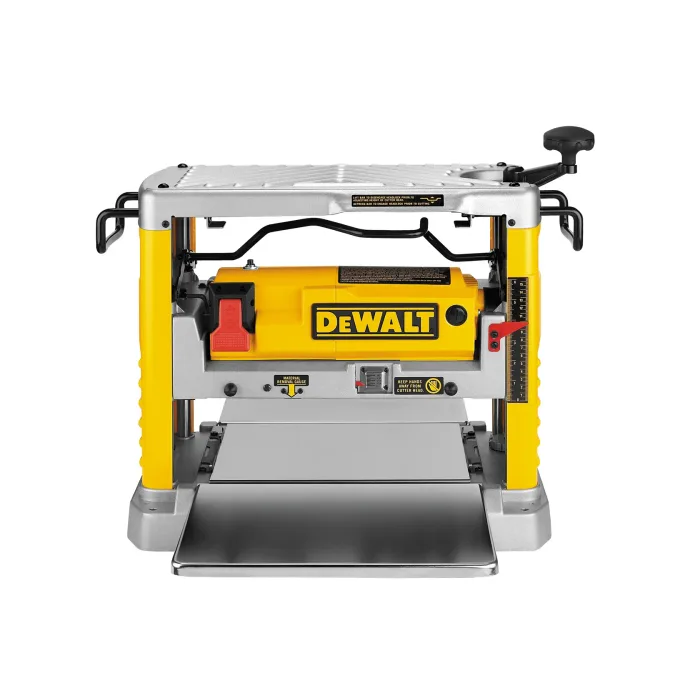
The same three-knife head and speed as the flagship at a fixed 96 cuts per inch, with a named mechanism for controlling snipe.
Best for: Most home shops, where a stated 96 cuts per inch and a three-knife head is enough and the second speed is not worth the premium.
- A three-knife cutterhead at 10,000 RPM, matching the more expensive DW735X on both counts.
- DEWALT publishes 96 cuts per inch, so the finish specification is a stated number rather than an inference.
- A four-column carriage lock that DEWALT ties directly to reducing the movement that causes snipe.
- Considerably cheaper than the DW735X while sharing its cutterhead configuration.
- Single speed, so 96 cuts per inch is what you get and a finer finish means a sanding step.
- 12-1/2 in. capacity, half an inch narrower than the DW735X.
- Three knives to replace rather than two, at three-knife prices.
- No two-speed gearbox means heavy stock removal and finishing happen at the same feed rate.
Amazon had no buyable listing for this when we last checked. The link still works if it returns.
Find it on Amazon Read our detailed assessment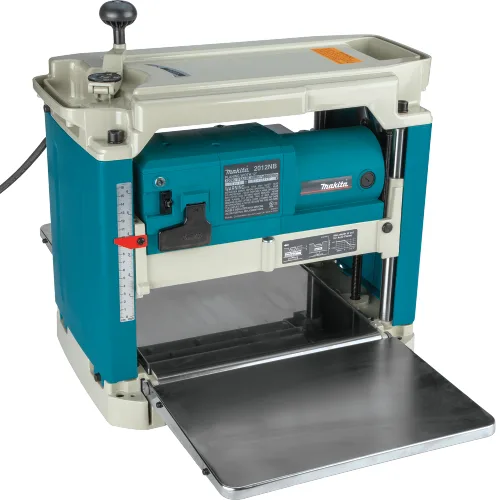
A head clamp Makita says eliminates snipe, on a two-knife head whose cuts per inch Makita does not publish.
Best for: Anyone whose main frustration is snipe and who values a low-noise, movable machine over the highest cuts-per-inch figure.
- Makita's Interna-Lok automated head clamp is described by the maker as eliminating snipe, and snipe is the defining complaint about benchtop planers.
- Makita publishes a low 83 dB sound level, which on a planer is a real quality-of-life difference.
- Compact and the lightest full-width planer here, so it can genuinely be moved and stored.
- Makita publishes cutterhead speed at 8,500 RPM plainly.
- A two-knife head at 8,500 RPM, so fewer knife marks per revolution than either three-knife DEWALT at 10,000.
- Makita publishes no cuts per inch figure, so the specification that predicts finish has to be inferred.
- Twelve inch capacity, the narrowest here (tied with the CRAFTSMAN).
- Flagship pricing for a two-knife machine, where the money buys snipe control and a stated sound level rather than cutting specification.
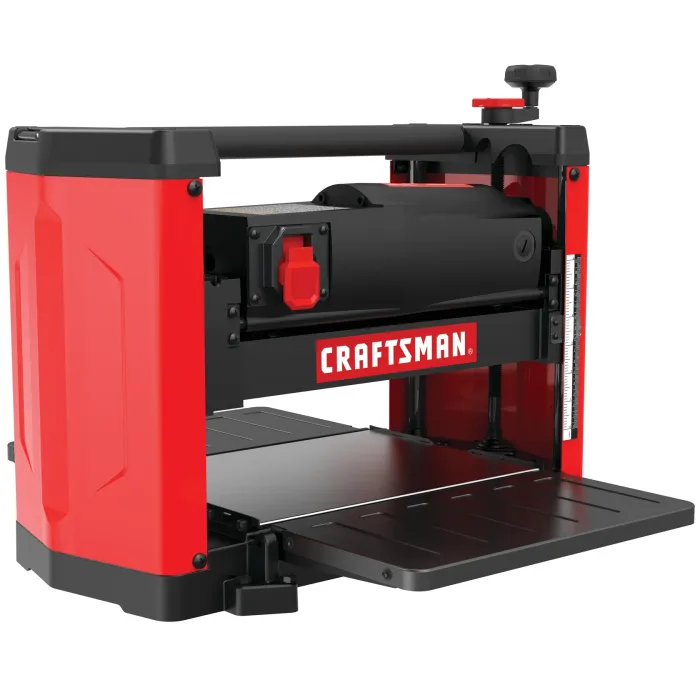
Leads on sixteen thousand cuts per minute, which is its own two knives times its own RPM and predicts nothing about finish.
Best for: Occasional dimensioning of softwood where a sanding pass afterwards is assumed and the price is doing the deciding.
- A quick-change solid steel cutterhead, so knife swaps are less of an ordeal than on some machines.
- 12 in. capacity, matching the Makita and half an inch narrower than the DW734.
- 15 amps, the same motor rating as everything else here.
- Substantially cheaper than the three flagship and premium machines.
- Quotes 16,000 cuts per minute, which is simply two knives multiplied by 8,000 RPM and omits the feed rate that determines cuts per inch.
- No cuts per inch figure published, so surface finish cannot be compared with the DEWALT machines at all.
- A two-knife head at 8,000 RPM is the lowest combination here on both counts.
- No named snipe-control mechanism, where three of the four competitors have one.
| Criteria | DW735X 13 in. Three Knife Two Speed Thickness Planer Top pick Buy it Buy | DW734 12-1/2 in. Three Knife Thickness Planer Buy it | 2012NB 12 in. Portable Thickness Planer It depends Buy | CMEW320 12 in. 15 Amp Benchtop Thickness Planer Skip it Buy |
|---|---|---|---|---|
| Best for | Anyone surfacing hardwood or glued panels who wants a finish pass without changing anything but a lever. | Most home shops, where a stated 96 cuts per inch and a three-knife head is enough and the second speed is not worth the premium. | Anyone whose main frustration is snipe and who values a low-noise, movable machine over the highest cuts-per-inch figure. | Occasional dimensioning of softwood where a sanding pass afterwards is assumed and the price is doing the deciding. |
| Price tier | $$$$ · flagship | $$$ · premium | $$$$ · flagship | $$ · mid-range |
| Published cuts per inch | 96 or 179 | 96 | Not published | Not published |
| Knives | 3 | 3 | 2 | 2 |
| Cutterhead speed | 10,000 RPM | 10,000 RPM | 8,500 RPM | 8,000 RPM |
| Feed speeds | Two-speed gearbox | Single | Single | Single |
| Cutting width | 13 in. | 12-1/2 in. | 12 in. | 12 in. |
| Named snipe mechanism | Automatic carriage lock | Four-column carriage lock | Interna-Lok automated head clamp | None named |
| Motor | 15 amp | 15 amp | 15 amp | 15 amp |
Which one is right for you?
- Anyone surfacing hardwood or glued panels who wants a finish pass without changing anything but a lever. Buy it DEWALT DW735X 13 in. Three Knife Two Speed Thickness Planer
- Most home shops, where a stated 96 cuts per inch and a three-knife head is enough and the second speed is not worth the premium. Buy it DEWALT DW734 12-1/2 in. Three Knife Thickness Planer
- Anyone whose main frustration is snipe and who values a low-noise, movable machine over the highest cuts-per-inch figure. It depends Makita 2012NB 12 in. Portable Thickness Planer
- Occasional dimensioning of softwood where a sanding pass afterwards is assumed and the price is doing the deciding. Skip it CRAFTSMAN CMEW320 12 in. 15 Amp Benchtop Thickness Planer
How we judged the field
Cuts per inch first, because it is the specification that predicts surface finish and because only half of this group publishes it. The figure is knives times cutterhead RPM divided by feed rate, and the feed rate term is what separates it from the similar-sounding cuts per minute that one maker leads with. Then knives and head speed, which are the two published inputs to that calculation, so a machine that omits CPI can at least be partly reasoned about. Then snipe, which is the defining complaint about this class of machine and which three of the four address with a named mechanism rather than a claim. Then cutting width, which decides whether glued-up panels fit. Amperage we ignored, because all four are 15 amp and the figure no longer separates anything.
DEWALT DW735X 13 in. Three Knife Two Speed Thickness Planer
Buy itThe DEWALT DW735X is the pick because it is the only machine here that treats cuts per inch as something you choose. Its two-speed gearbox offers 96 cuts per inch for taking material off quickly and 179 for a finishing pass, and switching between them is a lever rather than a second machine or a sanding session. That it publishes both figures at all puts it ahead of half this group before any comparison starts. The three-knife head at 10,000 RPM is the most knives at the highest speed here, and the 13 inch capacity is the widest, which is the difference between surfacing a glued-up panel and ripping it down first. The costs are real and mostly financial: it is by some way the most expensive machine in this comparison, and the second feed speed is the main thing the premium buys. It is heavy for a benchtop machine, three knives cost more to replace than two, and its fan-assisted chip ejection produces a volume of shavings that really wants extraction rather than a bin.
DEWALT DW734 12-1/2 in. Three Knife Thickness Planer
Buy itThe DEWALT DW734 is the second buy and, for most home shops, the more sensible purchase. It carries the same three-knife cutterhead at the same 10,000 RPM as its flagship sibling, and it publishes 96 cuts per inch, so the finish specification is a stated number rather than something to be inferred. What it lacks is the second feed speed, which means roughing and finishing happen at the same rate and a fine surface means sanding afterwards. In exchange it costs considerably less. DEWALT also names a four-column carriage lock and ties it directly to reducing the movement that causes snipe, which is the right way to talk about snipe: as a rigidity problem with a mechanical answer rather than a technique problem for the user to solve. The capacity is 12-1/2 inches, half an inch under the DW735X, and the knives are still a three-knife consumable.
Makita 2012NB 12 in. Portable Thickness Planer
It dependsThe Makita 2012NB is the it-depends, and its case rests on the failing that annoys planer owners most. Makita’s Interna-Lok automated head clamp is described by the maker as eliminating snipe, and snipe is the defining complaint about benchtop planers, so a machine whose maker says the clamp eliminates it is solving the right problem. It also publishes a sound level, 83 dB, which on a tool this loud is worth having, and it is compact and light enough to actually be moved and stored rather than living permanently on a bench. What it gives up is the cutting specification. Two knives at 8,500 RPM produce fewer cuts per revolution than three at 10,000, and Makita publishes no cuts per inch figure, so the number that predicts finish has to be inferred rather than read. At twelve inches it is also joint narrowest here, level with the CRAFTSMAN, and it is priced with the flagship DEWALT while offering a two-knife head.
CRAFTSMAN CMEW320 12 in. 15 Amp Benchtop Thickness Planer
Skip itThe CRAFTSMAN CMEW320 is the skip, and the reason is the specification it chooses to lead with. It quotes 16,000 cuts per minute, which is a large number until you notice it is simply the machine’s own two knives multiplied by its own 8,000 RPM, both of which are already listed. The term it omits is the feed rate, and the feed rate is what turns cuts per minute into cuts per inch, which is the figure that describes the surface. Publish one and not the other and the buyer is left with a big number that cannot be compared with either DEWALT’s stated CPI. Underneath the presentation, two knives at 8,000 RPM is the lowest combination in this group on both counts, and no snipe-control mechanism is named where three competitors have one. The quick-change cutterhead is genuinely useful and the price is much lower than the others, so for occasional softwood dimensioning followed by sanding it will do the job. It just cannot be compared on finish, which is what a planer is for.
Sources
Specs in this review come from these pages.
- DEWALT DW735X 13 in. three knife two speed thickness planer (dewalt.com)
- DEWALT DW734 12-1/2 in. thickness planer with three knife cutter-head (dewalt.com)
- Makita USA, 2012NB portable thickness planer specifications (makitatools.com)
- CRAFTSMAN CMEW320 12-inch 15 amp benchtop thickness planer (craftsman.com)
- Fine Woodworking review of the Makita 2012NB benchtop planer (finewoodworking.com)
DEWALT DW735X 13 in. Three Knife Two Speed Thickness Planer vs DEWALT DW734 12-1/2 in. Three Knife Thickness Planer: which should you buy?
The two DEWALTs isolate exactly what the second feed speed costs, since they share a three-knife cutterhead running at 10,000 RPM and differ mainly in the gearbox and half an inch of width. The DW734 gives 96 cuts per inch, full stop. The DW735X gives 96 or 179, and 179 is a genuinely different surface, close enough to finished that the sanding step shrinks rather than disappears. Everything else about them is nearly the same machine. So the question is narrow and answerable: how much of your work ends in a visible surface. If you are dimensioning stock that will be sanded or painted anyway, the DW734 delivers the same cutting geometry for meaningfully less money. If you are surfacing hardwood that will be finished clear, the second speed is the reason to buy the more expensive machine, and the extra half inch of width is a bonus rather than the argument.
What to look for
- A published cuts per inch figure: the number that predicts surface finish, being knives times RPM divided by feed rate, and absent from half of this group.
- Cuts per minute presented as a headline: it is knives times RPM with the feed rate left out, derived from figures already on the box, and it says nothing about the surface.
- Knives and head speed together: three knives at 10,000 RPM produce considerably more cuts per revolution than two at 8,000, which is the part of CPI you can compute yourself.
- A named snipe mechanism: a carriage lock or head clamp is a mechanical answer to the defining complaint, where silence usually means the user is expected to solve it.
- Two feed speeds: the only way to have both fast stock removal and a fine finish on one machine without changing anything but a lever.
- Cutting width against your actual work: twelve to thirteen inches sounds similar until a glued-up panel is an inch too wide.
Our final take
Planers are compared on amps, which are 15 on all four of these, and decided by cuts per inch, which only two of them publish. Where a maker gives you cuts per minute instead, notice that it is two numbers you already have multiplied together with the important one left out. Then treat snipe as a mechanical specification rather than a technique problem, and buy a machine that names how it handles it.
Questions, answered
What are cuts per inch and why does it matter?
It is the number of knife marks left in each inch of the board, and it is what surface finish actually means on a planer. The arithmetic is knives multiplied by cutterhead RPM, divided by the feed rate in inches per minute. More cuts per inch means smaller, shallower scallops and less sanding afterwards. The DW735X publishes 96 and 179 for its two feed speeds, and the DW734 publishes 96. The other two machines here publish no CPI figure at all, so their finish cannot be compared numerically with either DEWALT.
Is cuts per minute the same thing?
No, and the difference is the entire point. Cuts per minute is knives times cutterhead RPM, so the CRAFTSMAN's 16,000 is simply its two knives times its 8,000 RPM. It leaves out the feed rate, which is the term that decides how those cuts are distributed along the board. Feed a board through twice as fast and you get half the cuts per inch from exactly the same cuts per minute. It is a large-sounding number derived from two figures already on the box, and it predicts nothing about the surface you get.
What is snipe and can it be eliminated?
Snipe is the shallow dip planed into the first and last few inches of a board, caused by the cutterhead momentarily seeing less resistance while the board is under only one feed roller. It is reduced mechanically by locking the cutterhead carriage rigidly, which is what DEWALT's four-column carriage lock on the DW734 and Makita's Interna-Lok automated head clamp both do. It can also be managed by supporting the board level at both ends and by running sacrificial boards nose to tail. A machine with a named clamping mechanism starts you closer to none.
Do more knives give a better finish?
They contribute, but only through the cuts per inch calculation. Three knives at 10,000 RPM produce 50 percent more cuts per revolution than two knives at the same speed, and the two DEWALT machines here pair three knives with the higher head speed, so on identical feed rates they would leave more cuts per inch than either two-knife machine. Knives also cost money: a three-knife head costs more to re-knife than a two-knife one, and knives are a consumable on any planer.
Does amperage tell me anything about a planer?
Not in this group, because all four are 15 amp, which is the practical ceiling on a standard household circuit. The number has converged and stopped discriminating between machines. What varies is knives, head speed, feed rate and whether the maker publishes the cuts per inch figure that combines them. Read amps as a formality and spend the attention on the finish specification instead.
Deciding between the top two? See our head-to-head: DEWALT DW735X 13 in. Three Knife Two Speed Thickness Planer vs DEWALT DW734 12-1/2 in. Three Knife Thickness Planer.
More in Tools & DIY
Benchtop Planers, Explained Plain-English guide → DEWALT DW735X 13 in. Three Knife Two Speed Thickness Planer vs DEWALT DW734 12-1/2 in. Three Knife Thickness Planer Head-to-head →  The Best Block Planes: 4 Compared for Fine Woodworking
  The Best Brad Nailers: 4 Compared (and One to Skip)
  The Best Caulk Guns: 4 Compared (and One to Skip)
  The Best Circuit Breaker Finders: 4 Compared (and One to Skip)