Explained
Benchtop Planers, Explained
After reading, you'll be able to work out which planer leaves the better surface, even when the maker will not tell you.
In this guide
Planer listings quote amps, and every benchtop machine draws fifteen. The number that describes the surface you get is further down, and often missing.
The 30-second version
- Cuts per inch predicts the finish, being knives multiplied by cutterhead RPM and divided by the feed rate, which is the term that turns speed into surface quality.
- Cuts per minute is a hollow number, since it is knives times RPM with the feed rate omitted, derived entirely from figures already printed on the box.
- Snipe is a rigidity problem, caused by the head lifting slightly when the board is under only one feed roller, and answered by carriage locks and head clamps.
- Two feed speeds buy two machines, letting one planer hog material quickly and then take a finishing pass without any change but a lever.
- Amps stopped discriminating, because fifteen is the ceiling on a household circuit and every benchtop planer worth buying is already there.
The products this guide is about
Our verdict on each, with the full reasoning on the companion review.
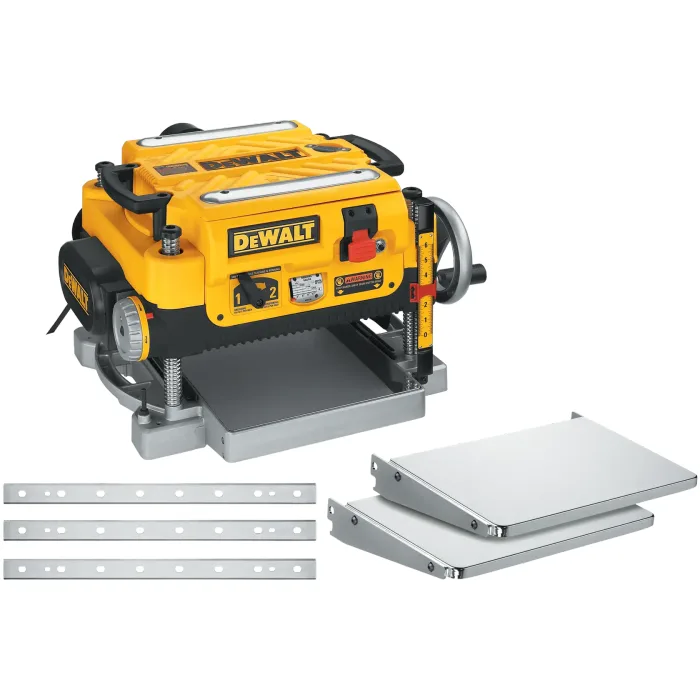
- Buy DEWALT DW735X 13 in. Three Knife Two Speed Thickness Planer The only planer here where cuts per inch is a setting rather than a fixed number, and the only one that publishes both figures. Amazon
- Buy DEWALT DW734 12-1/2 in. Three Knife Thickness Planer The same three-knife head and speed as the flagship at a fixed 96 cuts per inch, with a named mechanism for controlling snipe.
- It depends Makita 2012NB 12 in. Portable Thickness Planer A head clamp Makita says eliminates snipe, on a two-knife head whose cuts per inch Makita does not publish. Amazon
- Skip CRAFTSMAN CMEW320 12 in. 15 Amp Benchtop Thickness Planer Leads on sixteen thousand cuts per minute, which is its own two knives times its own RPM and predicts nothing about finish. Amazon
What actually matters
- Cuts per inch (CPI) - knife marks per inch of board, calculated as knives times RPM divided by feed rate in inches per minute. Higher means a finer surface and less sanding. Published by some makers and not others.
- Knife count - two or three on benchtop machines. More knives means more cuts per revolution and a higher CPI at the same speed, and a higher cost to re-knife.
- Cutterhead speed - typically 8,000 to 10,000 RPM. One of the two inputs to CPI you can usually find, even when CPI itself is not published.
- Feed rate - how fast the board travels through, in feet or inches per minute. The missing term in most listings and the one that halves or doubles your cuts per inch.
- Snipe control - a named carriage lock or head clamp that keeps the cutterhead from lifting as the board enters and leaves. The defining quality problem in this class.
- Cutting width and depth - twelve to thirteen inches wide on benchtop machines, with a maximum depth of cut per pass that is usually well under an eighth of an inch in hardwood.
The specs, in plain English
Green flags vs red flags
Green flags
- Cuts per inch is published, ideally for each feed speed.
- Knife count and cutterhead RPM are both stated.
- A snipe-control mechanism is named rather than implied.
- Feed rate is given in feet or inches per minute.
- Maximum depth of cut per pass is stated.
Red flags
- Cuts per minute is quoted as a headline with no cuts per inch anywhere.
- Amperage leads the listing, on a machine class where every model is 15 amp.
- Snipe is discussed as a technique problem for the user rather than a mechanism on the machine.
- Knife count is given with no cutterhead speed, or the reverse.
- Professional finish is claimed with no finish specification behind it.
Who's who: the brands
- DEWALT - Publishes cuts per inch directly and offers a two-speed gearbox on the DW735X, which no other machine in the review has. Three-knife heads and the widest benchtop capacities.
- Makita - Known in this category for the Interna-Lok head clamp, which Makita describes as eliminating snipe, and for publishing a sound level. Publishes head speed but not cuts per inch.
- CRAFTSMAN - Budget benchtop machines with quick-change cutterheads, leading on cuts per minute rather than cuts per inch.
- Ridgid - Long-standing benchtop planers competing on price and on indexed knife systems that make re-knifing straightforward.
- Wen - Value machines that undercut the majors substantially, typically with two-knife heads and minimal published specification.
How to read a listing without getting fooled
Look for cuts per inch first and treat its absence as the important omission, not a detail. If a listing gives cuts per minute instead, notice it is the knife count times the RPM and ignore it. Where CPI is missing, compare knives and head speed, which together set the cuts per revolution. Then look for a named snipe mechanism. Read amps last, since every machine in the class is 15.
How much should you spend?
Budget buys a two-knife machine that dimensions stock and expects you to sand afterwards. Premium buys a three-knife head at higher speed with a published cuts per inch figure and a named snipe mechanism, which is where most home shops should land. Flagship buys either a second feed speed, which is the only way to get a genuine finishing pass, or a head clamp and a published sound level, and you choose between those two rather than getting both.
Questions, answered
How do I get rid of snipe entirely?
Start with a machine that clamps its cutterhead, then support the board level with the table at both infeed and outfeed, and lift very slightly on the trailing end as the board leaves. The reliable trick is to run boards nose to tail so the snipe lands on a sacrificial piece, or to plane stock long and cut the last few inches off. Machines with a named carriage lock or head clamp start you much closer to none.
Should I upgrade to a helical cutterhead?
If you plane figured wood often, it is the single biggest improvement available, because the small carbide inserts shear rather than chop and tearout drops sharply. It is also much quieter. The cost is high relative to the machine, often a substantial fraction of the planer's price, so it makes most sense on a machine you intend to keep.
How much can I take off in one pass?
Less than people expect, and less in hardwood than in softwood. Most benchtop machines will physically remove more than they should, and the result is tearout, a bogged motor and worse snipe. Taking under a sixteenth of an inch per pass on hardwood and letting the machine recover between passes gives a better surface and longer knife life than chasing thickness in two aggressive passes.
Does a planer replace a jointer?
No, and this is the common misunderstanding. A planer makes the second face parallel to the first; it cannot make the first face flat, because the feed rollers press any bow flat while the board is under the cutterhead and it springs back afterwards. Flattening one face needs a jointer, a sled that supports the board rigidly through the planer, or hand planes.
Or jump to the head-to-head: DEWALT DW735X 13 in. Three Knife Two Speed Thickness Planer vs DEWALT DW734 12-1/2 in. Three Knife Thickness Planer.