Explained
Block Planes, Explained
After reading, you will know which block-plane controls matter for trimming and what to check before a first cut.
In this guide
A block plane listing may advertise a low angle without explaining what that angle measures. It may also say adjustable while referring only to blade depth. Read those details together with the task you want the plane to perform. This guide explains the terms used in our comparison; the linked product manuals remain the authority for setup.
The 30-second version
- Bed angle is one part, because a bevel-up plane also includes the blade bevel in its cutting geometry.
- Mouth adjustment needs a mechanism, so check whether the front opening actually moves.
- A small body favors local work, such as fitting a joint or easing an edge.
- Blade options are separate choices, even when the body name stays the same.
- Setup includes sharpening, followed by a test cut on scrap.
The products this guide is about
Our verdict on each, with the full reasoning on the companion review.
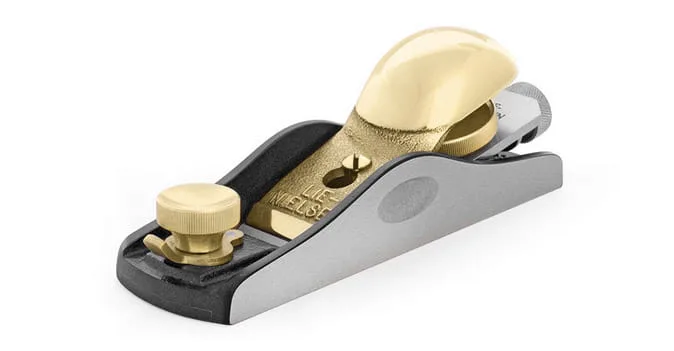
- Buy Lie-Nielsen No. 60-1/2 Low Angle Adjustable Mouth Block Plane Our premium choice for an adjustable-mouth plane with a compact body.
- Buy WoodRiver Low Angle Block Hand Plane 151125W The value choice if you want a low bed and adjustable mouth in a larger body.
- It depends Veritas Apron Plane with O1 Blade 05P27.01 A small plane for light trimming and carrying around the shop.
- Skip Stanley 220 Adjustable Block Plane 1-12-220 Skip as a first fine-work plane if you want the low bed and mouth control of our main picks.
What actually matters
- Task - Start with the cut you need to make. Local fitting and preparing a long board call for different tools.
- Grip - Handle the plane if possible. A feature list cannot establish comfort for your hand.
- Geometry - Check both the bed angle and the honed edge. The factory bevel may change as you sharpen.
- Opening - Read how the mouth is adjusted. Do not assume every adjustable plane has a movable front shoe.
- Projection - Begin with a light cut on scrap. Adjust from the result instead of assuming a visual setting is final.
- Blade access - Read how the cap releases and the blade returns. Sharpening requires repeating that process.
- Storage - Follow the maker's corrosion-prevention instructions. Protect the cutting edge when the tool is put away.
The specs, in plain English
Green flags vs red flags
Green flags
- An exact model and blade option.
- Separate descriptions of depth and mouth adjustment.
- Accessible setup instructions.
- Clearly stated body and blade dimensions.
- Replacement blades identified by the maker.
Red flags
- Adjustable in a title with no explanation of the control.
- Dimensions that change between the heading and specification table.
- A blade-only listing presented as a complete plane.
- Steel options mixed together in one set of claims.
- A promise that the tool needs no edge maintenance.
Who's who: the brands
- Lie-Nielsen - The No. 60-1/2 has a movable front shoe for mouth adjustment.
- WoodRiver - Woodcraft publishes setup and sharpening guidance for the 151125W.
- Veritas - The apron-plane range offers several blade steels in a small body.
- Stanley - Check the regional model code and its corresponding documentation.
How to read a listing without getting fooled
Identify the complete plane, its blade option and the seller's model code first. Then compare geometry, mouth control and size. If dimensions disagree, ask the seller to confirm them before buying; the contradiction is not a basis for choosing whichever number looks better. Our [four-plane comparison](/best-block-planes) keeps these uncertainties visible.
How much should you spend?
Budget for the plane and the means to keep its edge sharp. Mid-range tools can include the main adjustment features, while premium spending should solve a specific preference such as size or control layout. Our [whetstone comparison](/best-whetstones) covers sharpening surfaces separately.
Questions, answered
Can I change the cutting angle by sharpening?
Yes, on a bevel-up design a different honed bevel changes the nominal cutting angle. The maker's instructions may suggest different bevels for different woods. Keep enough edge strength for the work instead of chasing the lowest number.
What should I do when a blade setting moves unexpectedly?
Check the manual's clamping and adjustment procedure. The Veritas instructions explain taking up backlash by finishing with forward blade movement. Do not compensate by tightening the cap as hard as possible.
Do I close the mouth before advancing the blade?
Check the plane's instructions. Lie-Nielsen says to open the mouth before advancing the blade, then set the opening for the shaving. This prevents the edge from running into the front of the mouth.
Are these instructions suitable for a bench plane?
Use the manual for your exact plane. Bench-plane designs can have different blade orientation and adjustment systems. This guide concerns the small bevel-up block planes in the linked comparison.
Or jump to the head-to-head: Lie-Nielsen No. 60-1/2 Low Angle Adjustable Mouth Block Plane vs WoodRiver Low Angle Block Hand Plane 151125W.