Explained
Circular Saws, Explained
After reading, you'll know which capacity figure governs your cuts and why two saws with identical headline specs are not equivalent.
In this guide
Circular saw listings quote a cutting capacity measured with the shoe flat. Tilt it for a bevel and roughly a quarter to nearly a third of that capacity disappears, by an amount that varies between saws.
The 30-second version
- The headline depth is measured at 90 degrees, and the usable depth at 45 runs roughly 25 to 30 percent lower where it is published, by a proportion that differs between models with similar headline figures.
- Amperage has converged, because 15 amp is what a standard household circuit supports, so nearly every full-size corded saw quotes it and the number no longer discriminates.
- An electric brake is the real safety spec, stopping the blade in a fraction of the several seconds it otherwise coasts after the trigger releases.
- Magnesium buys toughness, not capacity, which is why the magnesium saw in a group can cost more without cutting any deeper, so check the listed weight.
- Cordless listings can hide the bevel figure, as the two DEWALTs here share a 90 degree capacity, but DEWALT does not publish a 45 degree figure for the cordless one.
The products this guide is about
Our verdict on each, with the full reasoning on the companion review.
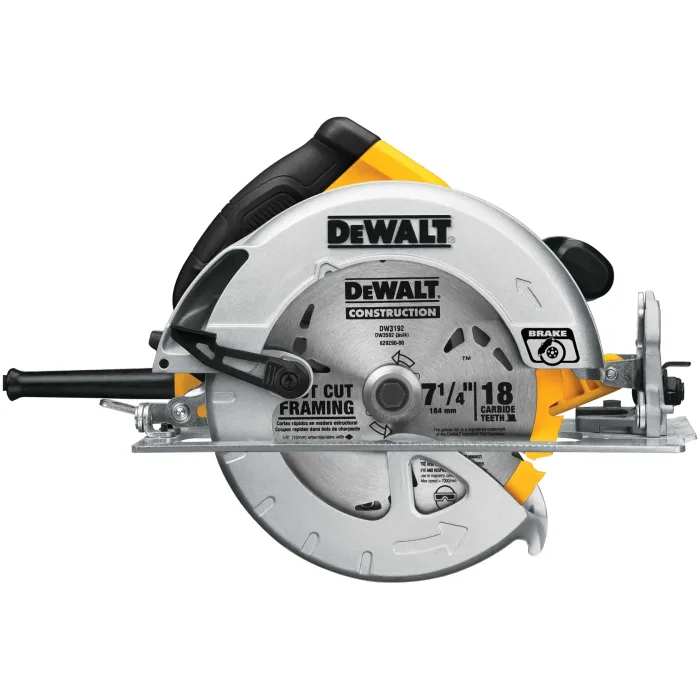
- Buy DEWALT DWE575SB 7-1/4 in. Lightweight Circular Saw with Electric Brake The deepest bevel capacity in this comparison, and the smallest gap between its 90 and 45 degree figures. Amazon
- Buy Makita 5007MG 7-1/4 in. Magnesium Circular Saw Magnesium construction and a 56 degree bevel range, giving up only a small amount of bevel depth to get there. Amazon
- It depends DEWALT DCS570P1 20V MAX XR 7-1/4 in. Brushless Circular Saw Kit The same 90 degree capacity as its corded sibling and no cord, but DEWALT does not publish a 45 degree figure for it.
- Skip CRAFTSMAN CMES510 15 Amp 7-1/4 in. Electric Circular Saw Quotes a capacity for 2x material and never publishes a 45 degree depth, which is the figure bevel work actually needs. Amazon
What actually matters
- Depth of cut at 90 degrees - the headline capacity, measured with the shoe flat. A 7-1/4 in. saw typically clears 2.5 in., which covers 2x material in one pass.
- Depth of cut at 45 degrees - the figure that governs bevelled cuts. Lower than the 90 degree figure, by roughly a quarter to nearly a third on the saws that publish it, and often not published at all.
- Electric brake - stops the blade after the trigger releases instead of letting it coast. The clearest safety differentiator in the category.
- Bevel range - how far the shoe tilts, commonly to 45, 55 or 57 degrees, usually with detents at 22.5 and 45. Range is worth little if depth at 45 is already short.
- Shoe material - stamped steel, aluminium or magnesium. Magnesium is stiff and tough and costs more. Compare listed weights, since a magnesium saw is not automatically the lighter one.
- Blade side - left-blade and right-blade saws put the motor and your sightline on opposite sides. It changes which side of the cut you can see and is largely a preference.
The specs, in plain English
Green flags vs red flags
Green flags
- Both the 90 and 45 degree cut depths are published.
- An electric brake is stated explicitly rather than implied.
- Shoe material is named, and magnesium or aluminium is specified rather than just metal.
- Bevel detent positions are listed, not just the maximum angle.
- Speed under load is discussed rather than only the no-load RPM.
Red flags
- Only one cut depth figure appears and it is the 90 degree one.
- Capacity is quoted as fitting 2x material rather than as a measurement.
- Amperage and RPM lead the listing while depth figures are hard to find.
- No mention of a brake anywhere in the specification.
- Bevel range is promoted to 55 or 57 degrees with no depth figure at 45.
Who's who: the brands
- DEWALT - Corded and cordless lines, with an electric brake on some models, such as the DWE575SB.
- Makita - Magnesium construction is the signature, and the 5007MG lists its depth at 90, 45 and 56 degrees.
- CRAFTSMAN - Budget full-size saws, occasionally with features like a magnesium shoe, and no published depth at 45 degrees on the CMES510.
- SKILSAW - The worm drive specialists, and the reason worm drive saws are called Skilsaws on much of the US west coast.
- Bosch - Makes corded sidewinder circular saws.
How to read a listing without getting fooled
Find the 45 degree depth figure first, and if there is none, treat the listing as incomplete for bevel work. Divide it by the 90 degree figure to see how much the saw loses when tilted, and compare that proportion between models rather than the headline numbers. Then check for an explicit electric brake. Read amperage and RPM last, since they have converged across the category.
How much should you spend?
Budget buys a full-size corded saw that will cross-cut 2x material and may not tell you its bevel capacity. Mid-range can buy published depth figures at both angles plus an electric brake, which is where most people should land. Premium buys magnesium construction, or it buys cordless, and a cordless listing may not tell you its depth at 45 degrees.
Questions, answered
Can any 7-1/4 inch saw cut a 2x4 at 45 degrees?
The two saws here that publish a 45 degree figure can, since dressed 2x material is about 1.5 in. thick and the shallower of the two figures is 1.75 in. The cordless DEWALT and the Craftsman publish no 45 degree figure, so for them it cannot be confirmed from the maker. The margin is what varies. Once you move to thicker stock, doubled material or 5/4 decking on edge, the difference between 1.75 and 1.9 inches decides whether the cut happens in one pass.
Is cordless as powerful as corded now?
For most cutting, yes: brushless motors hold speed under load well enough that power is no longer the deciding factor. What has not equalised is what is published and endurance. The cordless saw here matches its corded sibling at 90 degrees, but DEWALT does not publish a 45 degree figure for it, and sustained ripping still drains batteries in a way a cord does not.
Why do some saws have the blade on the left?
It changes which side of the cut you can see. A right-handed user on a right-blade saw sights across the motor; on a left-blade saw the cut line is directly visible but the offcut falls on the other side. Neither is better, and switching between them is the awkward part, so most people pick one and stay with it.
Does a more expensive blade matter more than the saw?
Often, yes. Tooth count, kerf width and carbide quality decide finish and cutting effort more than a few hundred RPM does, and a good blade on a mid-range saw will out-cut a stock blade on an expensive one. The saw decides depth, bevel and braking; the blade decides how the cut looks.
Or jump to the head-to-head: DEWALT DWE575SB 7-1/4 in. Lightweight Circular Saw with Electric Brake vs Makita 5007MG 7-1/4 in. Magnesium Circular Saw.