Explained
Clamp Meters, Explained
After reading, you'll understand why some clamp meters cannot read DC at all, why one can show zero on a live cord, and how to tell a real safety rating from a printed claim.
In this guide
The appeal of a clamp meter is obvious: you get a current reading without cutting anything or breaking a connection. What first-time buyers miss is that the jaw is a sensor with real physical limits, and two meters that look identical can differ on whether they sense direct current at all, how small a current they can resolve, and whether the safety category stamped on the case was ever checked by anyone outside the factory. Many disappointing purchases in this category trace back to one of those three.
The 30-second version
- The jaw is a transformer, so on its own it senses alternating current, and reading DC needs a Hall effect device built into a gap in the core.
- Clamp one conductor at a time, because the fields of a supply and a return cancel and the meter will read zero or nonsense.
- Resolution matters more than range, since a single 1000 A range with 0.1 A steps cannot see a control circuit drawing a few hundred milliamps.
- True RMS is about waveform shape, and an averaging meter on a distorted waveform can be badly wrong in either direction.
- A safety category can be self declared, so look for an independent lab's symbol and listing number rather than trusting the printing alone.
The products this guide is about
Our verdict on each, with the full reasoning on the companion review.
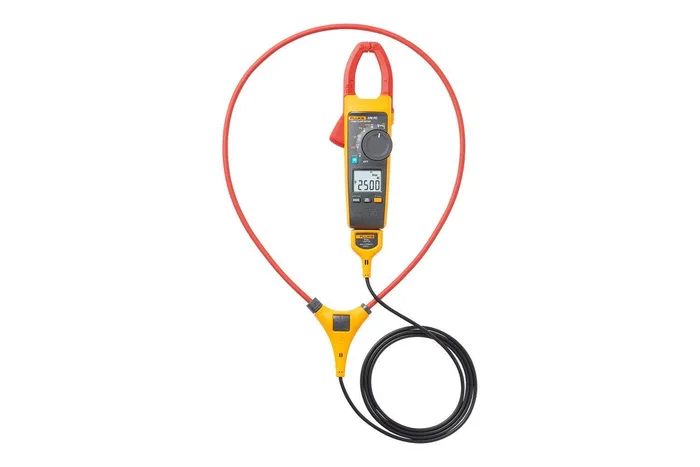
- Buy Fluke 376 FC True-RMS Clamp Meter with iFlex The most capable meter here, with a flexible 2500 A probe in the box and published accuracy for everything it claims. Amazon
- Buy Klein Tools CL810 600A AC/DC Auto-Ranging TRMS Clamp Meter Covers most of what the Fluke does, resolves far smaller currents, and adds a thermocouple input. Amazon
- It depends Fieldpiece SC680 Job Link System Power Clamp Meter A superb clamp meter for HVAC service and an awkward one for anything else. Amazon
- Skip Klein Tools CL120 400A AC Auto-Ranging Digital Clamp Meter A tidy, well made meter whose published specification tells you it will not keep up. Amazon
What actually matters
- AC versus DC sensing - a transformer jaw responds to a changing magnetic field, which is why it reads alternating current and ignores steady direct current. Adding DC means a Hall effect sensor in the core gap, and it is the single biggest capability divide in the category.
- True RMS - a true RMS meter computes the actual heating value of a waveform rather than assuming it is a clean sine wave. An averaging meter can read well off on a distorted waveform, and modern loads such as variable speed drives and computer power supplies are full of distortion.
- Low current resolution - the smallest step the display can move on the lowest current range. A meter built for 600 A feeders often cannot resolve a fraction of an amp, and a separate microamp range is what lets a meter check flame sensors and control loops.
- Inrush capture - a dedicated mode that records the peak current at the moment a motor or transformer starts. Fluke captures the maximum over the first 100 milliseconds of the start cycle, and Fieldpiece specifies the same 100 millisecond period, which is roughly what the protective device sees.
- Jaw opening - the physical limit on what you can get the meter around. Fluke's own troubleshooting guidance points out that the clamp may simply not be big enough for the conductor you need, and that pulling live conductors apart to make room is the hazard you were trying to avoid.
- Flexible probes - a wound flexible coil, often called a Rogowski coil, that loops around a conductor instead of clamping it. Fluke's iFlex is specified for AC current and extends the range to 2500 A, and it slides into crowded panels where a rigid jaw will not fit.
- Measurement category and voltage - the category describes how close to the incoming supply the meter may be used and the voltage is the limit within that category. They only mean something read as a pair, and neither means much without an independent listing behind it.
The specs, in plain English
Green flags vs red flags
Green flags
- A published range and resolution table rather than a single headline amp figure.
- The symbol and listing number of an independent lab such as UL, CSA or TUV, not just a CE mark.
- A stated crest factor limit, which means the maker has characterised the front end on distorted waveforms.
- Both a low current range and a full range, so the meter is useful at both ends.
- A jaw opening quoted in millimetres or inches alongside the current rating.
Red flags
- Wording such as "designed to meet" a safety standard instead of a listing you can look up.
- A large amp figure with no accuracy or resolution specification anywhere on the page.
- True RMS claimed in the marketing copy but absent from the specification table.
- A DC amps function claimed without any mention of a Hall effect sensor or a DC current range in the specs.
- A safety category printed on the case with no standard number, no listing mark and no downloadable manual.
Who's who: the brands
- Fluke - Professional electrical test gear, with published specifications that include crest factor and probe position sensitivity for the 376 FC.
- Klein Tools - Electrician focused tools that publish full range and resolution tables and state UL conformance and CSA certification in their manuals.
- Fieldpiece - Built specifically for HVAC and refrigeration service, with true power, power factor and thermocouple inputs on their clamp meters.
- Amprobe - Makes clamp meters, though we did not review one here.
- Hioki - Makes clamp on power meters and leakage clamps, though we did not review one here.
How to read a listing without getting fooled
Start at the current specification and ignore the headline number on the front of the box. You want a table with ranges, resolution and accuracy, and you want to see whether DC current appears there at all rather than only DC voltage, because plenty of listings say "AC/DC" when only the voltage function does both. Then find the lowest current range and its resolution, since that decides whether the meter is any use on small loads. Check the jaw opening in millimetres or inches and hold it against the conductors you actually work on. Look for true RMS in the specification table rather than the marketing paragraph, and look for a crest factor figure, which tells you the maker has tested on distorted waveforms. Finally, read the safety line for a standard number and an independent lab's mark. A page that gives you a category and a voltage but no standard, no listing and no manual to download has told you nothing you can verify.
How much should you spend?
At the budget tier you are buying an AC only jaw with a coarse display and no inrush or temperature functions. These are honest tools for checking a steady 60 Hz load current and nothing more, and they are the ones most likely to be outgrown quickly. The mid-range tier is where the category becomes genuinely useful: true RMS, a jaw that reads DC as well as AC, a low current range, inrush capture and a thermocouple input, usually with a category rating backed by a UL or CSA listing you can check. The premium tier buys wider current coverage, a flexible probe for conductors a rigid jaw cannot reach, tighter published accuracy, logging and better durability, or a trade specific feature set such as true power and dual air temperature for HVAC service. For most buyers the jump from budget to mid-range changes what you can measure, while the jump from mid-range to premium mostly changes how far and how precisely.
Questions, answered
Can a clamp meter measure voltage too?
Most can, but through the test leads rather than the jaw. The jaw only senses current. The meters in our comparison measure AC and DC voltage with leads, and several add resistance, continuity, capacitance and frequency, which makes them workable as a general purpose meter. The exception is that clamp meters usually have coarser resolution on the small ranges than a dedicated bench or handheld multimeter.
Why does the reading change when I move the wire inside the jaw?
Because the sensor is not perfectly uniform across the opening. The field a conductor produces falls off with distance, so a wire pressed against one side of the jaw is sensed slightly differently from one in the centre. Better makers publish this as a position sensitivity figure. The fix is free: centre the conductor and close the jaw fully so the two halves meet cleanly.
Do I need to zero a clamp meter before measuring DC?
Yes, and it matters more than people expect. Hall effect sensors have a small offset that drifts with temperature and with any residual magnetism in the jaw, so a meter can show a non zero reading with nothing clamped. DC capable meters give you a zero button for exactly this. Press it with the jaw closed and empty, away from other current carrying conductors, before you take the measurement.
Is a clamp meter accurate enough to check my energy use?
For a rough figure, yes, but current alone is not power. Multiplying amps by volts gives apparent power, which overstates real consumption on motors and other inductive loads because current and voltage are out of step. To get real power you need a meter that measures both together and reports watts and power factor, which is a specific feature rather than a given. The Fieldpiece SC680 in our comparison lists this; the other three do not list true power.
Or jump to the head-to-head: Fluke 376 FC True-RMS Clamp Meter with iFlex vs Klein Tools CL810 600A AC/DC Auto-Ranging TRMS Clamp Meter.