

Tools & DIY
The Best Clamp Meters: 4 Compared (and One to Skip)
We compared four clamp meters on the things that are specific to a clamp: whether the jaw reads DC as well as AC, how small a current it can resolve, whether it captures inrush, how wide the jaw opens, and what the maker will actually put in writing about safety approval.
The short version
The Fluke 376 FC is the pick if the reading has to be right the first time: 999.9 A AC and DC through a 34 mm jaw, a 2500 A flexible probe in the box, inrush capture and a low pass filter for drives. The Klein Tools CL810 is the value buy and actually beats the Fluke at the small end, with a 60 A range resolving to 10 mA and a separate 200 microamp DC range. The Fieldpiece SC680 is the depends pick: true power, power factor and two thermocouple ports make it excellent for HVAC service and awkward for anyone wiring a building. The Klein Tools CL120 is the skip, because Klein publishes 400 A AC only, no DC current, no true RMS and a 2000 count display. Read the safety category and the voltage together rather than chasing the bigger number, and look for a listing mark from an independent lab. Best for: anyone who needs amps on a live circuit without opening it.
Our picks at a glance
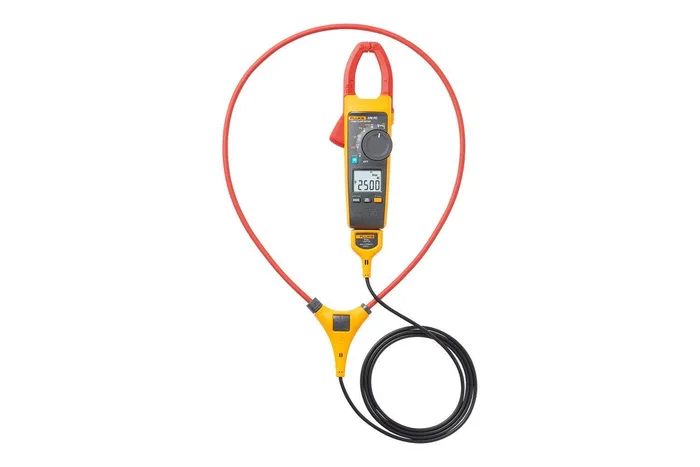
- Fluke 376 FC True-RMS Clamp Meter with iFlex - Buy. The most capable meter here, with a flexible 2500 A probe in the box and published accuracy for everything it claims.
- Klein Tools CL810 600A AC/DC Auto-Ranging TRMS Clamp Meter - Buy. Covers most of what the Fluke does, resolves far smaller currents, and adds a thermocouple input.
- Fieldpiece SC680 Job Link System Power Clamp Meter - It depends. A superb clamp meter for HVAC service and an awkward one for anything else.
- Klein Tools CL120 400A AC Auto-Ranging Digital Clamp Meter - Skip. A tidy, well made meter whose published specification tells you it will not keep up.
The verdict in 30 seconds
What mattered most
- Current through the jaw
- Finest current resolution
- Sub-amp DC range
- True RMS
- Inrush capture
- Jaw opening
A clamp meter exists to do one thing an ordinary multimeter cannot: read current without breaking the circuit. Everything else on the dial is a bonus. That single job splits the category in ways the marketing rarely makes obvious, because a plain transformer jaw reads alternating current only, and reading DC through the jaw needs different hardware inside it. We picked four meters that are sold now, checked the numbers against the makers' own datasheets and manuals where we could, and looked hard at where each one stops being useful.
The most capable meter here, with a flexible 2500 A probe in the box and published accuracy for everything it claims.
Best for: Electricians and maintenance techs measuring feeders, motors and service conductors where the number has to be defensible.
- Reads 999.9 A of both AC and DC through the 34 mm jaw at 2% plus 5 digits.
- The included iFlex flexible probe extends AC current to 2500 A and weaves around conductors a rigid jaw cannot reach.
- Inrush capture and an integrated low pass filter for adjustable speed drives and electronic ballasts.
- One current range, 999.9 A, at 0.1 A resolution, so small control currents are below what it can resolve.
- No temperature input, which rules it out as a single tool for HVAC service work.
- Fluke's own crest factor spec adds 2% above a crest factor of 2, so very peaky waveforms still cost you accuracy.
- At 395 g it is heavier than the CL810's 369 g, and it is priced at the premium tier.
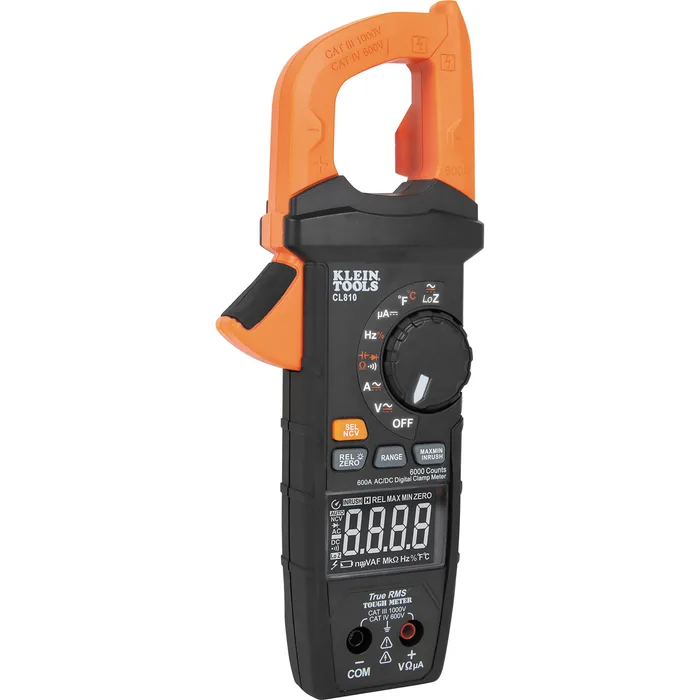
Covers most of what the Fluke does, resolves far smaller currents, and adds a thermocouple input.
Best for: The electrician or serious DIYer who wants one clamp meter that handles both big loads and small ones.
- Two current ranges, 60.00 A resolving to 10 mA and 600.0 A resolving to 100 mA, on both AC and DC.
- A separate 200.0 microamp DC range at 0.1 microamp resolution for flame sensors and control loops.
- Inrush at 600.0 A, a K type temperature input, LoZ for ghost voltages, jaw mounted voltage sensing and a worklight.
- 600 A ceiling, so large service conductors are out of range.
- No flexible probe option, so the 1.4 in jaw is the only way in.
- Klein specifies the current ranges over 50 to 60 Hz only.
- Rated for indoor use, and the IP40 rating offers no water protection.
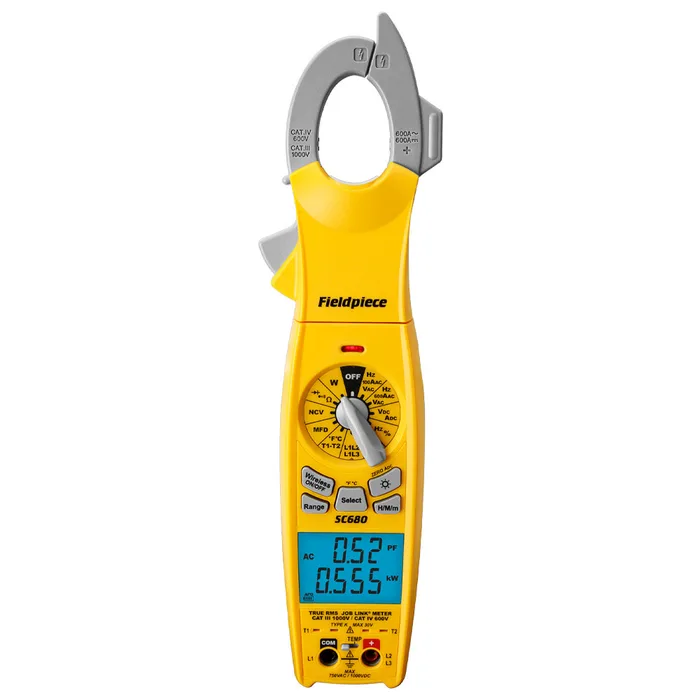
A superb clamp meter for HVAC service and an awkward one for anything else.
Best for: HVAC and refrigeration techs who want amps, true power and air temperature from one instrument.
- Measures true power in watts, VAr and VA plus power factor, over an effective current range of 2 A to 600 A.
- Two Type K ports read entering and leaving air temperature at the same time as amps.
- The swivel head reaches mini split connectors that a fixed body cannot, and readings push to the Job Link app.
- The 1.2 in jaw opening is the smallest of these four.
- The dial is organised around refrigeration tasks, which slows down general electrical troubleshooting.
- Runs on a single 9 V cell rather than common AA or AAA cells.
- The low pass filter limits voltage measurement to below 1000 Hz, which Fieldpiece warns about directly.
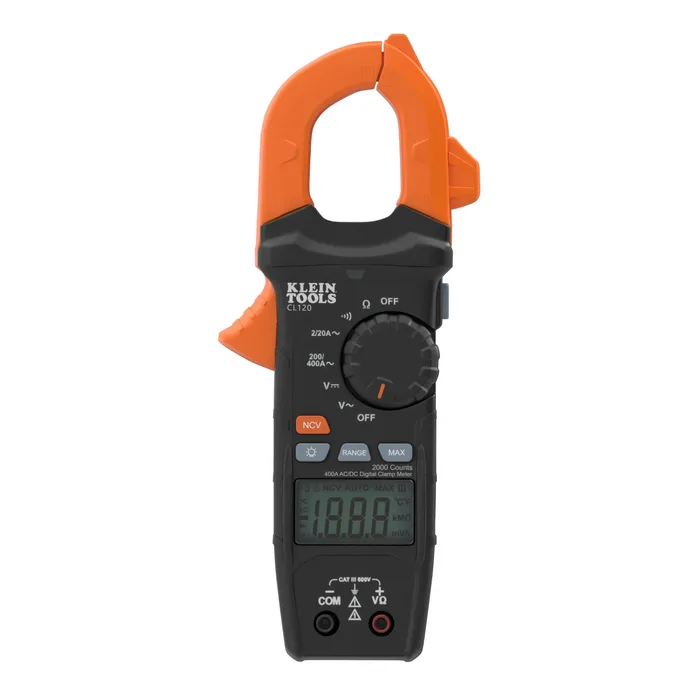
A tidy, well made meter whose published specification tells you it will not keep up.
Best for: Someone who only ever checks a sinusoidal 60 Hz load current and will never touch a drive, an inverter or a DC circuit.
- The 1.6 in jaw is the widest here, so it fits conductors the others will not.
- Klein's manual states it conforms to UL 61010-1 and is certified to the CSA equivalent.
- Rated CAT III 600 V with double insulation and 6.6 ft drop protection.
- 400 A AC only through the jaw, with no DC current function at all.
- Klein does not list true RMS for this model, and the AC current spec is defined only across 50 to 60 Hz.
- 2000 count display against 6000 on the CL810.
- No inrush capture, no temperature input and no capacitance.
| Criteria | 376 FC True-RMS Clamp Meter with iFlex Top pick | CL810 600A AC/DC Auto-Ranging TRMS Clamp Meter | SC680 Job Link System Power Clamp Meter | CL120 400A AC Auto-Ranging Digital Clamp Meter |
|---|---|---|---|---|
| Verdict | Buy it | Buy it | It depends | Skip it |
| Best for | Electricians and maintenance techs measuring feeders, motors and service conductors where the number has to be defensible. | The electrician or serious DIYer who wants one clamp meter that handles both big loads and small ones. | HVAC and refrigeration techs who want amps, true power and air temperature from one instrument. | Someone who only ever checks a sinusoidal 60 Hz load current and will never touch a drive, an inverter or a DC circuit. |
| Price tier | $$$ · premium | $$ · mid-range | $$$ · premium | $ · budget |
| Current through the jaw | 999.9 A AC and DC | 600.0 A AC and DC | 600 A AC and DC | 400 A AC only |
| Finest current resolution | 0.1 A on a single 999.9 A range | 10 mA on the 60 A range | 0.01 A on the 100 A range | 1 mA on the 2 A range, at plus or minus 2.5% and 30 digits |
| Sub-amp DC range | None listed | 200.0 microamps at 0.1 microamp | 1000 microamps at 0.1 microamp | None listed |
| True RMS | Yes | Yes | Yes | Not listed by the maker |
| Inrush capture | Yes | Yes, 600.0 A, detects above 2 A | Yes, 100 millisecond capture period | No |
| Jaw opening | 34 mm | 1.4 in (3.6 cm) | 1.2 in (30 mm) | 1.6 in (4.1 cm) |
| Flexible probe | iFlex included, 2500 A AC | None | None | None |
| Safety category and voltage | CAT III 1000 V, CAT IV 600 V | CAT IV 600 V, CAT III 1000 V | CAT III 600 V marked on the dial | CAT III 600 V |
Which one is right for you?
- Electricians and maintenance techs measuring feeders, motors and service conductors where the number has to be defensible. Buy it Fluke 376 FC True-RMS Clamp Meter with iFlex
- The electrician or serious DIYer who wants one clamp meter that handles both big loads and small ones. Buy it Klein Tools CL810 600A AC/DC Auto-Ranging TRMS Clamp Meter
- HVAC and refrigeration techs who want amps, true power and air temperature from one instrument. It depends Fieldpiece SC680 Job Link System Power Clamp Meter
- Someone who only ever checks a sinusoidal 60 Hz load current and will never touch a drive, an inverter or a DC circuit. Skip it Klein Tools CL120 400A AC Auto-Ranging Digital Clamp Meter
How we judged the field
Five things decide whether a clamp meter is worth owning. First, what the jaw can sense: a plain jaw works by transformer action and reads alternating current, while reading DC needs a Hall effect device in a gap in the core, so an AC only jaw is a hard limit rather than a missing convenience. Second, resolution at the bottom of the scale, because a meter with one 1000 A range and 0.1 A steps cannot see a control circuit no matter how accurate it is at the top. Third, inrush capture, which records the peak over the first fraction of a second of a motor start instead of the settled running current. Fourth, jaw opening measured against the conductors you actually meet, since Fluke’s own troubleshooting guidance notes that the clamp you are using may simply not be big enough to go around the conductor you need to measure. Fifth, whether the safety rating is backed by an independent listing rather than the maker’s own word.
The field splits along the DC line and then again along who the meter is built for. On one side sit inexpensive AC only jaws that are fine on a clean 60 Hz load and out of their depth anywhere near a drive or an inverter. On the other sit true RMS AC and DC meters, which then divide into general electrical tools and trade specific ones loaded with functions a generalist will never turn on. We picked one meter from each corner: the Fluke 376 FC as the general purpose flagship, the Klein Tools CL810 as the meter that gets most of the way there while resolving much smaller currents, the Fieldpiece SC680 as the trade specific case, and the Klein Tools CL120 as the AC only meter that a lot of people buy first and regret.
Fluke 376 FC True-RMS Clamp Meter with iFlex
Buy itThe 376 FC is the one to buy if the reading has to be right the first time. Fluke publishes a 999.9 A range for both AC and DC through the 34 mm jaw at 2% plus 5 digits, a 2500 A AC range through the included iFlex flexible probe at 3% plus 5 digits, inrush capture and an integrated low pass filter for adjustable speed drives and electronic ballasts. It is rated CAT III 1000 V and CAT IV 600 V and runs on two AA cells. The trade-off is resolution at the bottom. Fluke lists a single current range, 999.9 A, with 0.1 A steps, so a few hundred milliamps in a control circuit is simply not something this meter resolves, and there is no temperature input. Fluke also publishes a crest factor of 3 at 500 A and adds 2% above a crest factor of 2, a useful reminder that a true RMS front end still has limits on very peaky waveforms. For feeders, motors and service conductors it is the one we would choose of these four.
Klein Tools CL810 600A AC/DC Auto-Ranging TRMS Clamp Meter
Buy itThe CL810 covers most of what the Fluke does and beats it in the one place that trips people up. Klein publishes two current ranges, 60.00 A resolving to 10 mA and 600.0 A resolving to 100 mA, on both AC and DC, plus a separate 200.0 microamp DC range at 0.1 microamp. That means it reads small loads the 376 FC cannot see at all. Inrush is specified at 600.0 A with a stated detection threshold above 2 A, and you also get a K type temperature input, LoZ mode for ghost voltages, non contact voltage sensing built into the jaw and a worklight. Jaw opening is 1.4 in and the rating is CAT IV 600 V and CAT III 1000 V, with the manual stating conformance to UL 61010-1 and certification to the CSA standard. What you give up is the flexible probe and the Fluke’s 999.9 A jaw range. For most electricians that is a fair trade, and it is the meter we would hand to someone buying their first good one.
Fieldpiece SC680 Job Link System Power Clamp Meter
It dependsThe SC680 is built around HVAC service rather than general electrical work, and that is the whole decision. Fieldpiece specifies 100 A and 600 A ranges for both AC and DC at 0.01 A resolution, an inrush measurement period of 100 milliseconds, a 1000 microamp DC range, and true power in watts, VAr and VA with power factor over an effective current range of 2 A to 600 A. Two Type K ports let you watch entering and leaving air temperature at the same time as amps, and the swivel head reaches mini split connectors that a fixed body cannot. Readings push to Fieldpiece’s Job Link app. The dial is marked CAT III 600 V and the manual lists UL 61010-1 Third Edition. The catches are real: the 1.2 in jaw is the smallest here, the dial is laid out for refrigeration tasks rather than troubleshooting a panel, and it runs on a single 9 V cell. Buy it if you service equipment. Look elsewhere if you wire buildings.
Klein Tools CL120 400A AC Auto-Ranging Digital Clamp Meter
Skip itThe CL120 is the meter people grab because it is cheap and on the shelf, and its own published specification is the reason it is the wrong first clamp meter. Klein lists 400 A AC through the jaw and nothing at all for DC current, which rules out battery banks, solar strings and DC controls. Klein does not list true RMS for this model, and the AC current specification is defined only across 50 to 60 Hz, which is exactly the wrong shape for a variable speed drive or an electronic ballast. The display is 2000 counts against 6000 on the CL810, and there is no inrush, no temperature and no capacitance. It is not junk. The build is solid, the 1.6 in jaw is the widest here, and Klein publishes UL and CSA conformance. It is simply a meter you will outgrow in a month.
Sources
Specs in this review come from these pages.
- Fluke, Clamp Meter ABC's application note (media.fluke.com)
- Fluke, Clamp meter readings: problems and solutions (fluke.com)
- Fluke, Fluke 376 FC product specifications (fluke.com)
- Klein Tools, CL810 instruction manual (data.kleintools.com)
- Klein Tools, CL120 instruction manual (data.kleintools.com)
- Fieldpiece, SC680 operator's manual (resources.fieldpiece.com)
Fluke 376 FC True-RMS Clamp Meter with iFlex vs Klein Tools CL810 600A AC/DC Auto-Ranging TRMS Clamp Meter: which should you buy?
The honest way to choose between the 376 FC and the CL810 is to ask which end of the scale you spend your time at. If your work is feeders, three phase motors, service entrances and anything where the conductor is too fat or too crowded to get a rigid jaw around, the Fluke wins outright. Its 999.9 A jaw range plus the 2500 A iFlex probe covers currents the Klein cannot approach, and the flexible probe is the answer to a problem Fluke’s own troubleshooting notes describe: the clamp may simply not be big enough for the conductor, and weaving a flexible loop around it beats tugging live conductors apart to make room. Fluke also publishes a position sensitivity table for the iFlex, for example 1.4 in. from optimum for a 0.5 percent error on the 18 inch probe, so it is open about how much placement inside the loop matters.
If your work is branch circuits, appliances, controls and small motors, the CL810 is the better instrument despite costing less. A 60 A range with 10 mA steps and a 200 microamp DC range mean it reads things the Fluke rounds to zero, and the thermocouple input turns it into a genuinely general troubleshooting tool. Both are true RMS, both capture inrush, and both carry CAT IV 600 V and CAT III 1000 V. Buy the Fluke if the currents are large or the conductors are awkward. Buy the Klein if the currents are small and varied. If you can only own one and you do a bit of everything, the Klein loses less.
What to look for
- A jaw that reads DC, if you need it: a plain jaw works by transformer action and senses alternating current only, and reading direct current requires a Hall effect device in a gap in the core, so this is a hardware difference you cannot add later.
- Resolution at the bottom, not just the top: a meter with one 1000 A range and 0.1 A steps is useless on a 300 mA control circuit, so check whether there is a low current range and what its smallest step actually is.
- A listing mark you can look up: Fluke’s clamp meter application note states that a manufacturer may self certify as CAT II or CAT III with no independent verification, and tells you to look for the symbol and listing number of a lab such as UL, CSA or TUV, and to distrust wording like “Designed to meet specification”.
- The category and the voltage together: the measurement category says how close to the incoming supply the meter may be used, and the voltage is the ceiling within that category, so a bigger voltage number in a lower category is not the safer meter.
- A jaw opening matched to real conductors: jaw openings here run from 1.2 in to 1.6 in, and if the meter will not close around a service conductor you will end up pulling live wires apart to make room, which is exactly what a flexible probe is for.
- Inrush, if anything you touch has a motor in it: inrush mode records the peak over roughly the first 100 milliseconds of a start, which a normal display refreshing a few times per second will never catch.
Our final take
Buy the Fluke 376 FC if the currents are large, the conductors are awkward or the answer has to hold up to scrutiny. Buy the Klein Tools CL810 if you want one meter that handles a 400 A feeder and a flame sensor drawing microamps, which is most people. The Fieldpiece SC680 is excellent and specific: get it for HVAC service and nothing else. Skip the Klein Tools CL120, not because it is badly built but because Klein’s own specification sheet says AC current only, no true RMS and 2000 counts, and modern loads are full of distorted waveforms it was never characterised for. Whatever you choose, clamp one conductor at a time, and check the safety rating against an independent listing rather than the printing on the case.
Questions, answered
Why does my clamp meter read zero when I clamp a lamp cord?
Because you have both conductors inside the jaw. Fluke puts it plainly: clamping around two or more conductors will cause the magnetic fields to cancel each other, and the resulting reading, if it is not zero, will be completely wrong. The jaw senses the magnetic field around a conductor, and a supply and return carrying the same current produce fields that oppose each other. You have to get around one conductor on its own. On a cord that means using a line splitter accessory or measuring at a point where the conductors are already separated, such as inside a panel or a junction box.
Do I need a meter that reads DC current through the jaw?
Only if you work on DC. A plain jaw works by transformer action, so it responds to a changing field and reads alternating current. Reading direct current needs a Hall effect device sitting in a gap in the jaw's core, which is extra hardware and extra cost. If you touch solar strings, battery banks, vehicle charging systems or anything with an inverter on the DC side, you need it. If you only ever check branch circuit and motor loads on mains, an AC only jaw will do. All three of our buy and depends picks read DC through the jaw. The CL120 does not.
What does inrush mode actually measure?
It captures the surge a motor or transformer draws in the moment it starts, before the current settles to its running value. Fluke's implementation records the maximum current over the first 100 milliseconds of the start cycle, and Fieldpiece states the same 100 millisecond measurement period for the SC680. That window matters because it is roughly what a circuit breaker or fuse sees. Without inrush mode you are watching a display that updates a few times per second and will simply miss the peak. If you troubleshoot compressors, well pumps or anything that trips a breaker on start, it is not optional.
Is a higher voltage rating always safer?
No, and this is where people get caught. A safety rating has two halves, the measurement category and the voltage, and they only mean something read together. The category describes how close to the incoming supply the meter is allowed to be used, because the further upstream you go the more energy a transient can dump into the instrument. A meter marked with a large voltage number in a lower category is not automatically better than one with a smaller number in a higher category. Match the category to where you actually work first, then check the voltage is high enough for that circuit.
How do I know the safety rating printed on the meter is real?
By looking for someone else's mark, not the maker's. Fluke's own application note on clamp meters states that a manufacturer is allowed to self certify its meters as CAT II or CAT III without any independent verification, and warns you to be wary of wording such as "Designed to meet specification", because a designer's plans are not a substitute for an actual independent test. Fluke's advice is to look for the symbol and listing number of an independent testing lab such as UL, CSA or TUV. Klein's CL810 manual states conformance to UL 61010-1 and certification to the CSA standard. Fieldpiece lists UL 61010-1 Third Edition for the SC680. If a listing you can check is absent, treat the printed category as a claim rather than a result.
Deciding between the top two? See our head-to-head: Fluke 376 FC True-RMS Clamp Meter with iFlex vs Klein Tools CL810 600A AC/DC Auto-Ranging TRMS Clamp Meter.
More Tools & DIY reviews
 The Best Cordless Drills: 4 Compared (and One to Skip)
  The Best Cordless Ratchets: 4 Compared (and One to Skip)
  The Best Crimping Tools: 4 Compared (and One to Skip)
  The Best Cut-Resistant Gloves: 4 Compared (and One to Skip)
  The Best Digital Calipers: 4 Compared (and One to Skip)
  The Best Drill and Driver Bit Sets: 4 Compared (and One to Skip)