

Tools & DIY
The Best Cordless Ratchets: 4 Compared (and One to Skip)
We compared four cordless ratchets on published torque, head size, speed and motor type, and found the two DeWalts list the highest torque while the Makita is the fastest, lightest and shortest.
The short version
Makita's RW01Z is the pick: 35 ft-lbs of published torque, 0 to 800 RPM, 2.35 lbs with a battery, and a drive anvil that swaps between 3/8 inch and 1/4 inch. DeWalt's 12V MAX DCF503B is the value buy if you are on that platform, with a brushless motor, 60 ft-lbs of max torque and the slimmest listed body here at 2.52 in. The 20V ATOMIC DCF513B is the depends pick, because it lists 70 ft-lbs but runs the same 250 RPM as the 12V while being 1.6 in longer and heavier, so it only makes sense if 20V MAX is the only battery you own. Skip the Craftsman CMCF930B: it is the one brushed motor in the group and the bulkiest listed body at 3.5 in, which is the dimension that decides whether the tool fits the fastener. Best for: anyone spinning down long bolts in a spot a drill will not reach.
Our picks at a glance
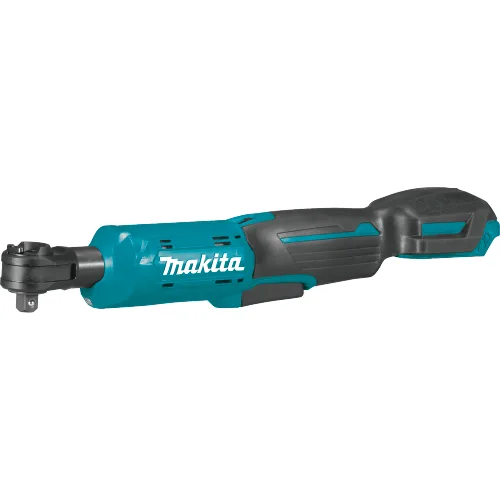
- Makita RW01Z 12V max CXT 3/8 in. and 1/4 in. Cordless Ratchet - Buy. The lightest and shortest tool in the group, with three times the free speed of either DeWalt and an interchangeable 3/8 in. and 1/4 in. anvil.
- DeWalt DCF503B 12V MAX Brushless 3/8 in. Ratchet - Buy. Brushless, 60 ft-lbs of max torque, the slimmest listed body here, and the sensible choice if your batteries are already DeWalt 12V.
- DeWalt DCF513B ATOMIC COMPACT 20V MAX Brushless 3/8 in. Ratchet - It depends. The same 250 RPM as the 12V version, with a higher 70 ft-lbs torque listing, in a body that is 1.59 in. longer and heavier, so the reason to buy it is the battery.
- Craftsman CMCF930B V20 Cordless 3/8 in. Drive Ratchet - Skip. Its published torque trails the DeWalts, and it loses on the two things that actually decide a ratchet.
The verdict in 30 seconds
What mattered most
- Published max torque
- Free speed
- Motor
- Square drive
- Listed height
- Listed length
A cordless ratchet exists for one situation: a fastener that a hand ratchet can reach but that would take fifty swings of a stubby handle. It is a speed tool, not a power tool, and the two numbers that decide whether it works for you are how much torque it makes and how thick the head is. We pulled the published specs from the maker pages for four models. The torque figures run from 35 to 70 ft-lbs, and the Makita is the only one that publishes no head height.
The lightest and shortest tool in the group, with three times the free speed of either DeWalt and an interchangeable 3/8 in. and 1/4 in. anvil.
Best for: Anyone who wants the smallest tool that still makes real torque, and who works across both 3/8 in. and 1/4 in. sockets.
- 35 ft-lbs of maximum torque, stated on Makita's spec sheet alongside the metric figure of 47 N-m, which is well below the DeWalts' listed figures.
- 0 to 800 RPM variable, more than three times the free speed of either DeWalt here.
- The square drive is interchangeable between 3/8 in. and 1/4 in., so one tool covers both socket sets.
- 2.35 lbs with a battery and 13-7/16 in. long, the smallest numbers in this comparison.
- Runs on 12V max CXT, a smaller platform than Makita's own 18V LXT line.
- Makita does not publish a head height, so you cannot compare its profile against the DeWalts on paper.
- Bare tool, with the battery and charger sold separately.
- No published motor type, so whether it is brushed or brushless is not stated.
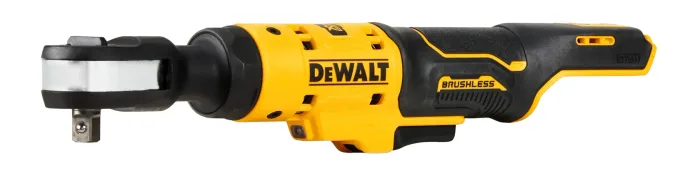
Brushless, 60 ft-lbs of max torque, the slimmest listed body here, and the sensible choice if your batteries are already DeWalt 12V.
Best for: DeWalt 12V MAX owners who want a slim brushless ratchet with high listed torque and can accept a slower free speed.
- Brushless motor with 60 ft-lbs of max torque, the second-highest figure listed in this group.
- 2.52 in. listed height, the slimmest body of the three that publish the figure.
- Glass-filled nylon housing, which DeWalt states is there to resist oils and solvents.
- Variable speed trigger and an onboard LED, at 2.43 lbs bare.
- 250 RPM free speed, less than a third of the Makita's.
- The spec table lists Total Number of Batteries as 3 on a tool DeWalt sells as bare, which is a data error.
- 12V MAX is a smaller platform than DeWalt's own 20V MAX line.
Amazon had no buyable listing for this when we last checked. The link still works if it returns.
Find it on Amazon Read our detailed assessment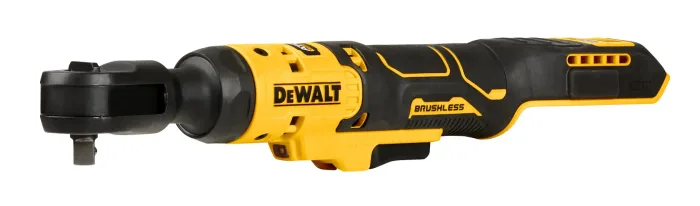
The same 250 RPM as the 12V version, with a higher 70 ft-lbs torque listing, in a body that is 1.59 in. longer and heavier, so the reason to buy it is the battery.
Best for: People who own 20V MAX batteries and nothing else, and who would rather carry one battery platform than gain a slimmer tool.
- Runs on 20V MAX, which is the platform most DeWalt owners already have.
- Brushless motor, 70 ft-lbs of max torque (the highest figure in this group) and a glass-filled nylon housing.
- Detent pin anvil and a variable speed trigger.
- 250 RPM, identical to the 12V DCF503B, so the larger battery buys no extra speed on paper.
- 15.79 in. long against the 12V's 14.2 in., and 2.63 lbs against 2.43 lbs.
- 2.8 in. listed height, thicker through the body than the 12V.
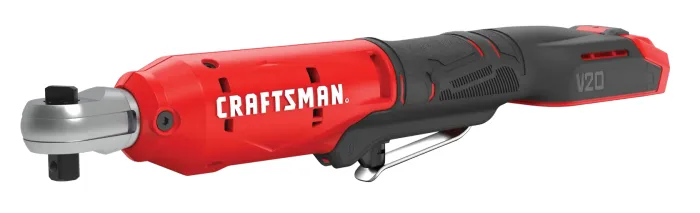
Its published torque trails the DeWalts, and it loses on the two things that actually decide a ratchet.
Best for: Almost nobody. If you are on the Craftsman V20 platform and use a ratchet twice a year it will spin bolts, but the head profile is the wrong place to save money.
- 35 ft-lbs of maximum torque published, matching the Makita's figure but well below the DeWalts.
- 300 RPM, slightly faster free speed than either DeWalt.
- 2.3 lb listed weight, the lightest bare figure in the group.
- Craftsman's spec table lists a brushed motor, the only one in this comparison.
- 3.5 in. listed height, the bulkiest body here, which is the dimension that decides whether it reaches the fastener.
- 14.57 in. long, longer than both the Makita and the 12V DeWalt.
- Power Source is listed as Integrated Batteries on a tool sold bare, which contradicts the rest of the page.
| Criteria | RW01Z 12V max CXT 3/8 in. and 1/4 in. Cordless Ratchet Top pick Buy it Buy | DCF503B 12V MAX Brushless 3/8 in. Ratchet Buy it | DCF513B ATOMIC COMPACT 20V MAX Brushless 3/8 in. Ratchet It depends Buy | CMCF930B V20 Cordless 3/8 in. Drive Ratchet Skip it Buy |
|---|---|---|---|---|
| Best for | Anyone who wants the smallest tool that still makes real torque, and who works across both 3/8 in. and 1/4 in. sockets. | DeWalt 12V MAX owners who want a slim brushless ratchet with high listed torque and can accept a slower free speed. | People who own 20V MAX batteries and nothing else, and who would rather carry one battery platform than gain a slimmer tool. | Almost nobody. If you are on the Craftsman V20 platform and use a ratchet twice a year it will spin bolts, but the head profile is the wrong place to save money. |
| Price tier | $$ · mid-range | $$ · mid-range | $$ · mid-range | $ · budget |
| Published max torque | 35 ft-lbs (47 N-m) | 60 ft-lbs | 70 ft-lbs | 35 ft-lbs |
| Free speed | 0 - 800 RPM | 250 RPM | 250 RPM | 300 RPM |
| Motor | Not published | Brushless | Brushless | Brushed |
| Square drive | 3/8 in. and 1/4 in., interchangeable | 3/8 in. | 3/8 in. | 3/8 in. |
| Listed height | Not published | 2.52 in. | 2.8 in. | 3.5 in. |
| Listed length | 13-7/16 in. | 14.2 in. | 15.79 in. | 14.57 in. |
| Weight | 2.35 lbs with battery | 2.43 lbs bare | 2.63 lbs bare | 2.3 lbs bare |
| Battery platform | 12V max CXT | 12V MAX | 20V MAX | V20 |
Which one is right for you?
- Anyone who wants the smallest tool that still makes real torque, and who works across both 3/8 in. and 1/4 in. sockets. Buy it Makita RW01Z 12V max CXT 3/8 in. and 1/4 in. Cordless Ratchet
- DeWalt 12V MAX owners who want a slim brushless ratchet with high listed torque and can accept a slower free speed. Buy it DeWalt DCF503B 12V MAX Brushless 3/8 in. Ratchet
- People who own 20V MAX batteries and nothing else, and who would rather carry one battery platform than gain a slimmer tool. It depends DeWalt DCF513B ATOMIC COMPACT 20V MAX Brushless 3/8 in. Ratchet
- Almost nobody. If you are on the Craftsman V20 platform and use a ratchet twice a year it will spin bolts, but the head profile is the wrong place to save money. Skip it Craftsman CMCF930B V20 Cordless 3/8 in. Drive Ratchet
How we judged the field
Five things decide a cordless ratchet. Listed torque comes first, because it is what tells you whether the tool will move a fastener rather than just spin one that is already loose. Head and body thickness comes second, since the entire reason to own one of these is reaching places a hand ratchet cannot be swung. Third is free speed, which is what turns a fifty-swing job into a five-second one. Fourth is motor type, because brushless holds output better as the tool warms up. Fifth is drive size and whether the anvil can be changed, since a tool that covers both 3/8 in. and 1/4 in. replaces two.
The field splits by battery platform more than by capability. There are 12V-class tools built to be small, and there are tools on the big 18V and 20V platforms that are bigger without necessarily being stronger, which is exactly what the two DeWalts here demonstrate. We took one tool from each of the three largest platforms plus the second DeWalt specifically to show what the bigger battery buys, which on paper turns out to be a higher torque listing, a bigger body and battery compatibility, with the same free speed.
Makita RW01Z 12V max CXT 3/8 in. and 1/4 in. Cordless Ratchet
Buy itThe RW01Z is the tool that answers the most questions. Makita publishes 35 ft-lbs of maximum torque with the metric equivalent beside it, which is well below the DeWalts’ 60 and 70 ft-lbs, and it runs 0 to 800 RPM against their 250. That speed difference is the whole point of the category: a ratchet that spins three times faster turns a long bolt in a third of the time. It is also the smallest tool here at 2.35 lbs with a battery fitted and 13-7/16 in. long, which is a genuinely different object to hold than a 15.79 in. tool. The interchangeable anvil is the quiet feature that matters most day to day, since swapping between 3/8 in. and 1/4 in. drive means one tool covers a full socket set rather than half of one. The gaps are in what Makita omits: no head height, and no motor type, so you cannot tell from the page whether it is brushless. Buy it for speed and size, unless you are locked to another battery or want the highest torque listing.
DeWalt DCF503B 12V MAX Brushless 3/8 in. Ratchet
Buy itThe DCF503B is the tool to buy if your batteries say DeWalt 12V MAX. It is brushless, it uses a glass-filled nylon housing that DeWalt specifically states is there to resist oils and solvents, and at 2.52 in. it has the slimmest listed body of the three tools here that publish the figure. That last number is the one that decides whether the tool fits behind a bracket. It lists 60 ft-lbs of max torque, nearly double the Makita’s 35. Against that, 250 RPM is a third of the Makita’s free speed. The spec table also lists Total Number of Batteries as 3 for a tool sold bare, which is a plain data error and a small sign of how carefully the page was filled in. Take it for the platform and the slim body.
DeWalt DCF513B ATOMIC COMPACT 20V MAX Brushless 3/8 in. Ratchet
It dependsThe DCF513B is the one worth pausing over, because on the page it looks like the bigger, better version and on the numbers it is not. It runs 250 RPM, exactly the same as the 12V DCF503B, and lists 70 ft-lbs of max torque against the 12V’s 60. It is 15.79 in. long against the 12V’s 14.2 in. It weighs 2.63 lbs bare against 2.43 lbs. It is 2.8 in. through the body against 2.52 in. Every size dimension moves the wrong way, and the free speed does not move at all. What you get in exchange is the higher torque listing and the platform: it runs on 20V MAX, which is the platform most DeWalt owners already have batteries for, and that saves buying into a second system for one tool. If you own 20V MAX packs and no 12V packs, buy it and accept the size. If you own neither, buy the smaller tool.
Craftsman CMCF930B V20 Cordless 3/8 in. Drive Ratchet
Skip itThe CMCF930B is the one to leave, and the frustrating part is that it lists lower torque than the DeWalts while being the bulkiest. Craftsman states 35 ft-lbs of maximum torque and 300 RPM, and at 2.3 lbs it has the lightest bare weight in the group. Then the spec table gives away why it is cheap. The motor is brushed, the only one in this comparison, so output will fade as the brushes wear. More importantly it is 3.5 in. through the body, roughly an inch thicker than the 12V DeWalt, and thickness is the dimension a ratchet lives or dies on. A tool that makes the same torque as the Makita but cannot reach the fastener has not saved you anything. The page also lists Power Source as Integrated Batteries on a bare tool, which contradicts the rest of the listing. Skip it.
Sources
Specs in this review come from these pages.
Makita RW01Z 12V max CXT 3/8 in. and 1/4 in. Cordless Ratchet vs DeWalt DCF503B 12V MAX Brushless 3/8 in. Ratchet: which should you buy?
The Makita RW01Z and the DeWalt DCF503B are close, and they are close in different ways. The Makita wins on speed and size: 800 RPM against 250, 13-7/16 in. against 14.2 in., 2.35 lbs with a battery against 2.43 lbs without one. The DeWalt lists the higher torque, 60 ft-lbs against 35. The interchangeable 3/8 in. and 1/4 in. anvil is a real advantage if you own both socket sets, and it is the only tool here that offers it.
The DeWalt’s case is narrower and still valid. It is confirmed brushless where Makita says nothing about the motor, lists nearly double the torque, and at 2.52 in. through the body it is the slimmest tool with a published height, which on a ratchet is worth a lot. If you already own DeWalt 12V MAX packs, the price of switching to Makita is a charger and two batteries, and that changes the arithmetic completely. Buy on platform first. If you are starting fresh, the Makita wins on speed and size, and the DeWalt wins on listed torque, so decide which matters more for your fasteners.
What to look for
- A listed torque figure: it runs from 35 to 70 ft-lbs across the tools here, and it is the number that decides whether the ratchet will break a hand-tight fastener loose.
- Body height, not just length: the dimension that stops a ratchet fitting is how thick it is through the head, and it ranges from 2.52 in. to 3.5 in. across the tools here that publish it.
- Free speed in RPM: the whole reason to own one of these is speed, and the spread here runs from 250 to 800 RPM.
- Brushless where the price allows: it is standard above the budget tier, and a brushed motor at a mid-range price tells you where the savings came from.
- Whether the anvil is interchangeable: a tool that swaps between 3/8 in. and 1/4 in. drive covers a whole socket set instead of half of one.
- Which battery you already own: a cordless ratchet is not worth starting a second battery platform for, and the platform decision usually settles the tool decision.
Our final take
This is a category where speed, size and torque pull in different directions. The Makita RW01Z is the fastest, the smallest and lightest thing here, and takes both common drive sizes on one anvil. The DeWalt DCF503B is the answer if your batteries are already DeWalt 12V, and it is genuinely slim and lists far more torque, at the cost of free speed. The 20V ATOMIC exists so 20V MAX owners do not have to buy a second charger, and it trades a bigger body for a higher torque listing with no gain in speed. The Craftsman lists the same torque as the Makita and then loses on head size and motor type, which is the wrong pair of things to give up on a tool whose entire job is fitting into places.
Questions, answered
How much torque does a cordless ratchet actually need?
The tools here list 35 ft-lbs (Makita and Craftsman), 60 ft-lbs (DeWalt DCF503B) and 70 ft-lbs (DeWalt DCF513B) of maximum torque. That is enough to run most fasteners down, but not for anything torqued with a wrench and left to corrode, which is why a cordless ratchet is a speed tool rather than a breaking tool. The normal working pattern is to crack the fastener loose with a hand ratchet or a breaker bar, spin it out with the cordless, and reverse that on the way back in.
Can I compare the torque figures across brands?
Only loosely. Each maker lists a maximum torque for its own tool, and Makita and Craftsman list 35 ft-lbs against DeWalt's 60 and 70 ft-lbs. We did not find a rating method stated on the maker pages, so treat the numbers as a rough tier rather than a measured head-to-head result. It is still the number that tells you most about whether the tool will move a fastener, so check it alongside speed and head height.
Does the head height really matter that much?
It is usually the deciding factor. A cordless ratchet earns its place in spots where a socket wrench fits but your hand cannot swing it, and in those spots the limiting dimension is how thick the tool is through the head and body. Across the three tools here that publish it, the range runs from 2.52 in. to 3.5 in., which is close to an inch of difference in the dimension that decides whether the tool goes in at all. Measure the tightest place you actually work before you shop.
Can I use a cordless ratchet to final-torque a fastener?
No. None of these tools measures torque, and the published figure is a maximum output rather than a setting. Anything with a specified torque value, which includes most fasteners on a vehicle, needs a torque wrench for the last step. The right sequence is to run the fastener down with the cordless until it seats and then switch to a torque wrench, which is also the only way to know that a fastener was not left loose.
Brushed or brushless: does it matter on a tool this small?
Less than on a high-draw tool, but it still matters. A brushless motor has no wearing carbon contacts, runs cooler, and holds output more consistently as it heats up under a sustained pull. On a ratchet, which spends most of its life spinning freely and only loads up at the end of a fastener's travel, the practical difference over a year of home use is small. Over years of daily use it is the reason the brushless tools cost more.
Deciding between the top two? See our head-to-head: Makita RW01Z 12V max CXT 3/8 in. and 1/4 in. Cordless Ratchet vs DeWalt DCF503B 12V MAX Brushless 3/8 in. Ratchet.
More in Tools & DIY
Cordless Ratchets, Explained Plain-English guide → Makita RW01Z 12V max CXT 3/8 in. and 1/4 in. Cordless Ratchet vs DeWalt DCF503B 12V MAX Brushless 3/8 in. Ratchet Head-to-head →  The Best Crimping Tools: 4 Compared (and One to Skip)
  The Best Cut-Resistant Gloves: 4 Compared (and One to Skip)
  The Best Digital Calipers: 4 Compared (and One to Skip)
  The Best Drill and Driver Bit Sets: 4 Compared (and One to Skip)