Explained
Cordless Ratchets, Explained
After reading, you'll understand what a cordless ratchet is genuinely for, and which two numbers decide whether one will work in your hands.
In this guide
Cordless ratchets sit awkwardly between a hand ratchet and an impact wrench, and the marketing does not help. They are sold on speed and photographed next to engines, which suggests more capability than the mechanism has. Torque figures are quoted without a common method, head dimensions are given under names that vary by brand, and a bigger battery does not mean a stronger tool. The specs are readable once you know which two of them matter.
The 30-second version
- It is a speed tool, meant to spin a fastener you already broke loose, not to break it loose for you.
- Head thickness decides everything, because reaching the fastener is the only reason the tool exists.
- A bigger battery is not a stronger tool, as the two DeWalts here demonstrate at identical free speed.
- Torque is not always published, and a page without it is asking you to buy on the badge.
- An interchangeable anvil is quietly valuable, since one tool then covers both 3/8 in. and 1/4 in. sockets.
The products this guide is about
Our verdict on each, with the full reasoning on the companion review.
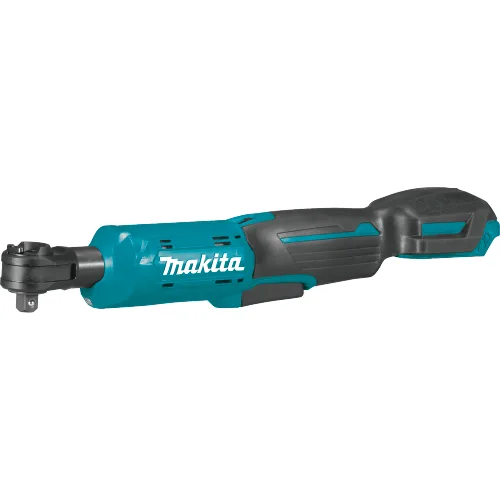
- Buy Makita RW01Z 12V max CXT 3/8 in. and 1/4 in. Cordless Ratchet The lightest and shortest tool in the group, with three times the free speed of either DeWalt and an interchangeable 3/8 in. and 1/4 in. anvil. Amazon
- Buy DeWalt DCF503B 12V MAX Brushless 3/8 in. Ratchet Brushless, 60 ft-lbs of max torque, the slimmest listed body here, and the sensible choice if your batteries are already DeWalt 12V.
- It depends DeWalt DCF513B ATOMIC COMPACT 20V MAX Brushless 3/8 in. Ratchet The same 250 RPM as the 12V version, with a higher 70 ft-lbs torque listing, in a body that is 1.59 in. longer and heavier, so the reason to buy it is the battery. Amazon
- Skip Craftsman CMCF930B V20 Cordless 3/8 in. Drive Ratchet Its published torque trails the DeWalts, and it loses on the two things that actually decide a ratchet. Amazon
What actually matters
- Maximum torque - the most twisting force the tool can apply, usually quoted in ft-lbs. The tools we compared list 35 to 70 ft-lbs, which is enough to run most fasteners down, though not to free a corroded one.
- Free speed (RPM) - how fast the anvil turns with nothing on it. This is what converts a long bolt from a minute of swinging into a few seconds, and the spread across tools is large.
- Head and body height - the thickness of the tool through its working end. It is the dimension that determines whether the ratchet fits the space, and brands publish it under several different names or not at all.
- Square drive size - most commonly 3/8 in., with 1/4 in. found on smaller tools. A few tools take an interchangeable anvil so one body covers both.
- Motor type - brushless motors hold output better and last longer; brushed motors are cheaper and fade as the brushes wear. On a light-duty tool the practical gap is smaller than on a saw or a grinder.
- Variable speed trigger - lets you start a fastener slowly enough to catch the threads. Without it the tool has one speed and cross-threading becomes easy.
- Weight with a battery - manufacturers quote weight either bare or with a pack, and rarely label which. A 2.3 lb bare tool can be over 3 lbs in your hand.
The specs, in plain English
Green flags vs red flags
Green flags
- A maximum torque figure stated in ft-lbs or N-m on the product page.
- A head or body height published, so you can compare the profile against the space you work in.
- Free speed given as a variable range rather than a single top number.
- Motor type named explicitly in the specification list.
- Weight stated with the battery condition made clear.
Red flags
- No torque figure anywhere on the page.
- A brushed motor at a mid-range price where competitors are brushless.
- A larger battery platform sold as more capability, with identical speed to the smaller version.
- A spec table that contradicts how the tool is sold, such as a battery count on a bare tool.
- No head dimension published at all.
Who's who: the brands
- Makita - Publishes torque and speed, and is unusual in offering an interchangeable 3/8 in. and 1/4 in. anvil on one body.
- DeWalt - Cordless ratchets across two battery platforms (12V MAX and 20V MAX), with listed torque of 60 and 70 ft-lbs on the two models we compared.
- Milwaukee - The other major professional platform, with a long-running line of cordless ratchets aimed at automotive work.
- Craftsman - Budget entry on the V20 platform, where brushed motors and bulkier housings are still common.
- Ingersoll Rand - An air tool company with a long history in pneumatic ratchets for shops already running a compressor.
How to read a listing without getting fooled
Look for a torque figure first, and notice if there is not one. If a page lists speed, weight and dimensions but no torque, the manufacturer has chosen to leave out the number that decides capability, and you should weight everything else accordingly. Then find whatever dimension describes the thickness of the tool, which may be called height, and compare it to the tightest place you actually need to reach. Read free speed as a range rather than a headline. Check the motor line, because brushless is standard above the budget tier. Finally read the weight together with the battery note, since a bare-tool figure and an in-hand figure can differ by most of a pound.
How much should you spend?
Budget cordless ratchets usually mean a brushed motor and a thicker body, and the thickness is the part that will annoy you rather than the motor. They work for occasional use where the fastener is easy to reach. The mid-range is where brushless appears and where the bodies get slim enough to earn their place, and for most people that tier is the whole answer. Premium in this category mostly buys a larger battery platform and jobsite durability rather than more capability, which is worth knowing before you spend up. If money is tight, put it into the smaller, slimmer tool rather than the bigger battery.
Questions, answered
Is a cordless ratchet better than an impact wrench for car work?
They do different jobs. An impact wrench breaks fasteners loose and torques them down, using a hammer mechanism that produces hundreds of ft-lbs. A cordless ratchet applies smooth continuous torque in the range of 35 to 70 ft-lbs and fits places an impact wrench cannot. Most people who do their own maintenance end up wanting both, and if you can only have one, the impact wrench does more.
Why does my ratchet stall on a bolt that a hand ratchet moves?
Because you can generate far more torque with a foot of handle and your body weight than a motor rated at tens of ft-lbs can. That is normal and it is how the tool is meant to be used. Break the fastener free by hand, then let the ratchet spin it out. If the tool stalls on a fastener that was not tight, check the battery, since a low or cold pack cannot supply the current the motor wants.
Do I need impact sockets on a cordless ratchet?
No. A ratchet applies smooth rotational force with no hammering, so ordinary chrome hand sockets are fine and their thinner walls are an advantage in tight spots. Impact sockets are for impact tools, where repeated hammer blows can crack a chrome socket. Using impact sockets on a ratchet is harmless, just bulkier than it needs to be.
Can I leave the battery on it in a toolbox?
It is better not to. Lithium packs self-discharge slowly, and leaving one attached means the tool's electronics keep drawing a trickle, so the pack sits at a lower state of charge for long periods. Storing packs off the tool at a partial charge, somewhere that does not get very hot or very cold, is what many manufacturers' manuals recommend. A pack left flat in a hot vehicle is the fastest way to lose capacity.
Or jump to the head-to-head: Makita RW01Z 12V max CXT 3/8 in. and 1/4 in. Cordless Ratchet vs DeWalt DCF503B 12V MAX Brushless 3/8 in. Ratchet.