Explained
Electric Screwdrivers, Explained
After reading, you'll understand torque ratings, clutch settings, speed and bit types, and whether you need a pen-style screwdriver or a 12V driver.
In this guide
Buyers usually compare electric screwdrivers on peak torque, but the more useful number is how low and how finely the torque can be set. Too much force strips screws and cracks plastic. The other specs that matter are speed, battery type, charging and which bits come in the box.
The 30-second version
- Low torque matters, because small screws strip and plastic cracks when the tool is too strong.
- More torque steps mean more control, so you can match the force to each screw.
- N·m and in.-lbs. both measure torque, and 1 N·m is about 8.85 in.-lbs.
- Pen drivers suit light work, while 12V drivers handle wood screws and cabinets.
- Missing specs are a signal, since a maker that publishes nothing gives you nothing to compare.
The products this guide is about
Our verdict on each, with the full reasoning on the companion review.
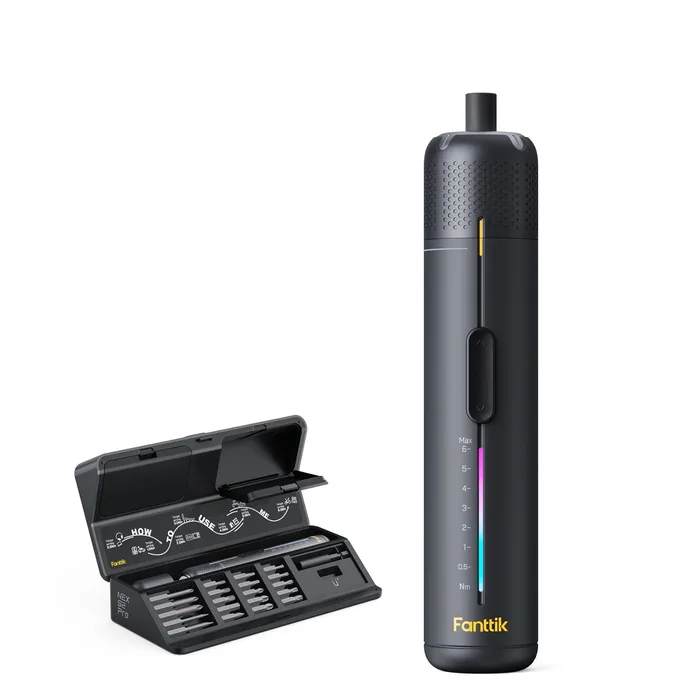
- Buy Fanttik S2 Pro Cordless Electric Screwdriver A pen-style electric screwdriver with seven torque steps that goes low enough for electronics.
- Buy Bosch PS21-2A 12V Max Two-Speed Pocket Driver Kit A compact 12V driver with far more torque and a real clutch for bigger fastening jobs.
- It depends Ryobi USB Lithium Screwdriver Kit (FVD50K) A cheap pivoting screwdriver that shares a battery with Ryobi's USB Lithium tools.
- Skip HOTO 3.6V Electric Screwdriver Kit A good-looking kit whose torque range and control fall short of drivers at a similar price.
What actually matters
- Maximum torque - The most twisting force the tool can apply. Pen-style drivers usually top out at a few N·m; 12V drivers go far higher.
- Minimum torque - The gentlest setting. It decides whether the tool is safe on electronics and small plastic parts.
- Torque steps or clutch - The number of settings between minimum and maximum. More steps give finer control.
- Speed (RPM) - How fast the bit turns. Higher speed runs long screws in faster; lower speed gives more control.
- Battery - Built-in batteries charge over USB; removable packs can be swapped and often share a tool platform.
- Bits - Most tools take 1/4 in. hex bits. Precision sets for electronics often use smaller bits.
- Form factor - Pen-style bodies reach tight spaces; pistol grips let you push harder.
The specs, in plain English
Green flags vs red flags
Green flags
- Published minimum and maximum torque.
- Several torque steps or a clutch.
- USB-C charging or a shared battery platform.
- 1/4 in. hex compatibility and a useful bit set.
- Published speed and battery capacity.
Red flags
- No torque figures at all.
- Only a peak torque with no low setting.
- Proprietary bits that are hard to replace.
- A kit sold mainly on its case or looks.
- No warranty information.
Who's who: the brands
- Fanttik - Consumer tool brand known for pen-style electric screwdrivers and precision kits.
- Bosch - German power tool maker whose 12V Max line includes compact drivers.
- Ryobi - Tool brand known for shared battery platforms, including USB Lithium and 18V ONE+.
- HOTO - Design-focused tool brand selling compact screwdrivers and household kits.
- Wera - German hand tool maker known for screwdrivers and bits.
How to read a listing without getting fooled
Look for the torque range first: both the lowest and highest setting, and how many steps sit between them. Then check the speed, the battery type and capacity, and how it charges. Next, see what bits are included and whether they are standard 1/4 in. hex. If a maker lists only a peak number, or no numbers at all, compare it against a brand that publishes the full range. Finally, check the warranty and whether the battery is removable.
How much should you spend?
Budget electric screwdrivers cover light household jobs, often with few torque settings or unpublished specs. Mid-range pen-style drivers add fine torque control, bigger batteries and better bit sets. Premium options are usually 12V drivers with clutches, two speeds and removable batteries, which are worth it if you drive many screws into wood.
Questions, answered
Can an electric screwdriver drill holes?
Pen-style screwdrivers are not built for drilling. A 12V driver with a hex chuck can drill small holes with hex-shank bits. For regular drilling, use a drill.
Why does my electric screwdriver strip screws?
Usually the torque is set too high, the bit doesn't match the screw, or the tool isn't held straight. Start at a low setting and step up. Worn bits also cause cam-out.
Is an electric screwdriver safe for electronics?
Only on a low torque setting, ideally under 1 N·m, with the right precision bits. Many pen drivers aren't designed for tiny screws. A dedicated precision screwdriver is safer for phones and laptops.
How long do built-in batteries last?
It depends on the model and use. Built-in batteries can't be swapped, so when they wear out the tool may need replacing. Removable batteries on a platform like 12V Max can be replaced separately.
Or jump to the head-to-head: Fanttik S2 Pro Cordless Electric Screwdriver vs Bosch PS21-2A 12V Max Two-Speed Pocket Driver Kit.