Explained
Grease Guns, Explained
After reading, you'll understand why flow rate matters more than pressure, and what the numbers on a tub of grease mean.
In this guide
Grease guns are sold on pressure, and pressure is the spec that discriminates least in the cordless class, where 10,000 PSI is close to universal. What varies is how fast grease moves, how far the hose reaches, and whether you can slow the tool down for a small bearing. Around the gun sits a second vocabulary nobody explains: NLGI grades, zerk fittings, coupler types and the difference between lithium complex and polyurea grease.
The 30-second version
- Pressure is close to universal, with 10,000 PSI stated on most cordless guns, so it rarely decides anything.
- Flow rate is the real spec, and it varies by a factor of two among guns sharing that pressure ceiling.
- The hose decides usability, because a gun that cannot reach the fitting has no pressure where it counts.
- Grease types do not all mix, and combining incompatible thickeners can turn grease to liquid in the bearing.
- Dirt kills grease guns, so wiping the fitting and capping the coupler matters more than any feature.
The products this guide is about
Our verdict on each, with the full reasoning on the companion review.
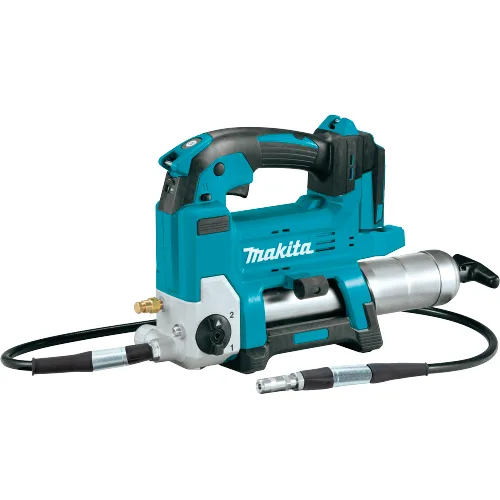
- Buy Makita XPG01Z 18V LXT Cordless Grease Gun The highest published flow rate here at 10 fl oz per minute, at the same 10,000 PSI ceiling as everything else. Amazon
- Buy DeWalt DCGG581B 20V MAX 2-Speed Grease Gun Nearly the Makita's flow with a two-speed transmission and a published figure for tubes per charge. Amazon
- It depends DeWalt DCGG571B 20V MAX Cordless Grease Gun Same 10,000 PSI ceiling as its own replacement and roughly half the flow, which is the whole story. Amazon
- Skip Milwaukee 2446-20 M12 Cordless Lithium-Ion Grease Gun A compact, light M12 gun that lists a run time, but states the lowest pressure here, no flow rate and a single speed. Amazon
What actually matters
- Maximum pressure - the highest pressure the pump can generate, usually 10,000 PSI on cordless guns. It is what pushes past a partially blocked fitting, and beyond a point it is not the limiting factor.
- Flow rate - how much grease the gun delivers per minute, in fluid ounces. This is the spec that decides how long a job takes, and it varies far more between guns than pressure does.
- Hose length and construction - how far you can reach without moving the gun, and whether the hose is reinforced. Longer reaches more and holds more grease you have to push through first.
- Speed control - a two-speed transmission or a variable trigger. Low speed matters for sealed bearings, where too much grease too fast pushes past the seal and lets dirt in.
- Runtime - usually quoted as tubes dispensed per charge if it is quoted at all. It is the practical planning number and most manufacturers omit it.
- Coupler type - the fitting that clamps onto the zerk. Standard three-jaw couplers are cheap and can leak when worn; locking couplers stay on hands-free.
- Filtration - a screen between the cartridge and the pump. Abrasive contamination is the main wear mechanism in a high-pressure grease pump.
The specs, in plain English
Green flags vs red flags
Green flags
- A flow rate published in ounces per minute, alongside the pressure figure.
- A hose length stated, with a note on whether it is reinforced.
- Two speeds or a stated variable speed control, not just a trigger.
- A runtime figure such as tubes dispensed per charge.
- A pump filter screen mentioned in the specifications.
Red flags
- No maximum pressure published anywhere on the page.
- No flow rate, so the pressure figure stands alone with nothing to interpret it.
- A hose length that is not stated on a tool whose usefulness depends on reach.
- A single speed on a gun sold for sealed-bearing work.
- Feature bullets in place of numbers throughout the specification list.
Who's who: the brands
- Makita - Publishes both pressure and flow rate consistently, and builds the highest-flow cordless gun in this comparison.
- DeWalt - Two current cordless guns on one battery platform at the same pressure and very different flow, with the most complete published specs here.
- Milwaukee - A large cordless grease gun line aimed at fleet and equipment maintenance, built around one battery system. Its M12 gun lists a run time but states more than 8,000 PSI and no flow rate.
- Lincoln Lubrication - A lubrication specialist rather than a power tool brand, and the reference point for manual lever guns, couplers and fittings.
How to read a listing without getting fooled
Find the flow rate first. If the page gives you a pressure figure and no flow, you have been told the number that separates nothing and not the one that separates everything. Three guns at 10,000 PSI can be twice as fast as each other. Next check the hose, both length and whether it is reinforced, because reach is what makes the gun usable on the fitting that is actually hard to get at. Look for a second speed, which is what lets you fill a small sealed bearing gently. Then look for any runtime statement, usually phrased as tubes per charge, and treat its presence as a sign the page was written by someone who uses the tool. Weight is the last thing to check and the one you will notice most.
How much should you spend?
The budget tier in cordless grease guns can buy the same headline features, two speeds, an LED and a hose, so check what conditions the quoted flow figure assumes and what else the page publishes. Mid-range is where a stated pressure and a stated flow rate both appear, and where a single-speed gun at half the flow of its own replacement can hide, so read the flow figure rather than the model number. Premium buys the top of the flow range, longer reinforced hoses, lock-on switches and published runtimes. Whatever you spend, spend a little of it on a locking coupler, which improves every gun in the category more than any feature on the tool does.
Questions, answered
Can I mix different greases in the same fitting?
Not safely as a habit. Greases are compatible or not depending on their thickener, and mixing incompatible thickeners such as some lithium complex and polyurea combinations can soften the mixture until it runs out of the bearing, which leaves the bearing dry. If you are changing grease type, purge the old grease out until fresh comes through, and where possible stick to one product across a machine.
How do I know when a bearing has enough grease?
On a fitting with a relief or a visible seal, until fresh grease appears. On a sealed bearing, much sooner than most people think, because forcing grease past a seal lets dirt and water in afterwards. Manufacturer schedules usually specify a number of pumps rather than a feel, and a cordless gun makes it very easy to overfill. That is the main argument for a low speed setting.
Why won't a fitting take grease?
Usually the zerk itself. The check ball can seize with hardened grease or corrosion, and no amount of pressure from the gun will move it. The fix is to replace the fitting, which costs very little and takes a wrench. Before that, try seating the coupler square and clean, since a coupler at an angle leaks around the nipple instead of pushing through it.
Is a cordless gun worth it over a lever gun?
If you have more than a handful of fittings, yes, and the reason is your hands rather than the machine. A lever gun makes plenty of pressure and is entirely adequate for a few zerks, but working one for a long list is genuinely tiring and encourages skipping fittings. A cordless gun also lets you hold the coupler steady with one hand while it runs, which is what makes awkward fittings possible at all.
Or jump to the head-to-head: Makita XPG01Z 18V LXT Cordless Grease Gun vs DeWalt DCGG581B 20V MAX 2-Speed Grease Gun.