Explained
Impact Drivers, Explained
After reading, you'll know why two drivers quoting the same torque may not be comparable, and which numbers to buy on instead.
In this guide
Every impact driver is sold on inch-pounds. No standard says how that figure is produced, and it usually describes undoing a fastener rather than driving one.
The 30-second version
- No standard governs impact torque, so set time, fastener size and rig are the manufacturer's own choices, and figures are not reliably comparable between brands.
- The headline is usually breakaway torque, the force to loosen a seized fastener, while real fastening output is usually well below it.
- Head length decides more jobs than torque, because a driver that will not fit between joists or inside a cabinet cannot apply any of its output.
- Impacts per minute drive the speed, since a long fastener goes in on the rate of hammer blows as much as on the force behind each one.
- A low mode prevents the common failures, as bits walking at the start and screws burying in soft material cause more ruined work than insufficient torque does.
The products this guide is about
Our verdict on each, with the full reasoning on the companion review.
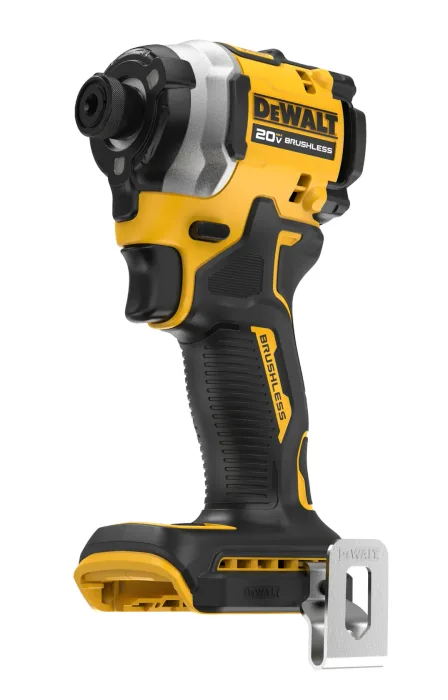
- Buy DEWALT DCF850B ATOMIC 20V MAX 1/4 in. 3-Speed Brushless Impact Driver Nearly the torque of the biggest tool here in a head under four inches, which is the spec that decides whether the driver fits the job at all. Amazon
- Buy Milwaukee 2953-20 M18 FUEL 1/4 in. Hex Impact Driver The highest published torque here at 2,000 in-lb, in a head you pay for in inches. Amazon
- It depends Makita XDT20Z 18V LXT Brushless Quick-Shift Mode 4-Speed Impact Driver A mid-pack headline torque, paired with assist modes that are the actual answer to stripped screws and walked bits.
- Skip CRAFTSMAN CMCF813B V20 BRUSHLESS RP 1/4 in. Impact Driver Behind all three on every published figure, with the thinnest specification sheet of the group. Amazon
What actually matters
- Torque in inch-pounds - the headline, produced by an unregulated in-house test. Use it to place a tool in a rough tier, not to make fine comparisons. Convert if needed: 1,000 in-lb is about 113 Nm.
- Fastening versus breakaway - breakaway is loosening force and is the bigger figure. If a maker does not say which it is quoting, assume the flattering one.
- Head length - front to back, the dimension that determines access in stud bays, cabinets and engine bays. Unambiguous and directly comparable, and frequently unpublished on budget tools.
- Impacts per minute - the hammer blow rate. Together with RPM it sets how quickly a fastener actually seats, which torque alone does not describe.
- Speed settings and assist modes - a dialled-down mode or a soft-start assist prevents cam-out and over-driving. More useful on trim and cabinetry than raw output.
- Battery platform - a bare tool price is not the purchase price. The platform you join determines what every future tool and battery costs.
The specs, in plain English
Green flags vs red flags
Green flags
- Head length is published as a number rather than described as compact.
- The torque figure is explicitly labelled as fastening or as breakaway.
- Impacts per minute are published alongside RPM.
- Speed and impact figures are given for every mode, not just the maximum.
- A warranty term is stated in years, with any service period spelled out.
Red flags
- A torque figure leads with no indication of how or on what it was measured.
- Compact is claimed but no head length appears anywhere.
- Impacts per minute are missing while torque is prominent.
- Breakaway torque is quoted and then compared against rivals' fastening figures.
- The specification table is shorter than the feature list.
Who's who: the brands
- DEWALT - The ATOMIC line competes on head length and compactness at mainstream prices, with strong warranty terms and moderate published detail.
- Milwaukee - M18 FUEL leads on published torque in this comparison, and publishes head length and weight on the product page.
- Makita - Builds control features rather than headline torque, with multi-mode assist settings and per-mode figures published in full.
- CRAFTSMAN - Budget brushless tools on the V20 platform. Adequate output, and the thinnest published specifications of the major brands.
- Bosch - Strong in compact professional drivers, generally competing on ergonomics and control rather than on the largest torque number.
How to read a listing without getting fooled
Read the head length first, because it decides whether the tool can do the job at all, and treat its absence as a warning. Then check whether the torque figure is labelled fastening or breakaway, and if it is not, assume breakaway. Look for impacts per minute next to RPM. Only then compare torque numbers, and only as a rough tier, since no two makers measured them the same way.
How much should you spend?
Budget buys a brushless driver with enough torque for framing and assembly and very little published about it. Mid-range buys a compact head, multiple speed settings and a real warranty. Premium buys the highest output and impact rates, or the control modes that stop you ruining soft material, and you generally choose between those two rather than getting both.
Questions, answered
Can I use an impact driver to drill holes?
You can with impact-rated hex shank bits, and it will be worse than a drill. The hammering that makes an impact driver good at fasteners is unhelpful for cutting, producing rougher holes and more bit wear. It also takes only hex shanks, so ordinary round-shank drill bits will not fit at all.
Will more torque strip more screws?
Yes, if you drive everything at full speed. Stripping is usually a control problem rather than a power one, which is why assist modes and low speed settings exist. A high-torque tool with a usable low mode is safer on soft material than a low-torque tool with a single speed.
Why do impact drivers need special bits?
Because the hammer blows fatigue ordinary bits until they shatter. Impact-rated bits use a more ductile steel and often a torsion zone that flexes to absorb each blow. Using standard bits in an impact driver is the fastest way to snap one, and the pieces come out at speed.
Is 1,500 in-lb enough?
For deck screws, framing and flat-pack assembly, comfortably. The figures above 1,800 buy headroom for lag screws and seized fasteners rather than everyday capability. Given that none of these numbers was produced under a common standard, the gap between 1,500 and 1,825 is smaller in practice than it looks on paper.
Or jump to the head-to-head: DEWALT DCF850B ATOMIC 20V MAX 1/4 in. 3-Speed Brushless Impact Driver vs Milwaukee 2953-20 M18 FUEL 1/4 in. Hex Impact Driver.