Explained
Work Knee Pads, Explained
After reading, you'll understand what EN 14404 Types and Levels mean, why almost no knee pad sold in the US is certified at all, and which parts of a knee pad listing are measurements rather than marketing.
In this guide
Most people buy their first pair of work knee pads on thickness and price, then abandon them within a month because the strap behind the knee goes numb or the pad slides down the shin. Neither of those problems is about cushioning. The other trap is assuming that because knee pads are safety gear, somebody certifies them, which in the United States is not the case. Learning to spot the three or four checkable facts in a listing full of adjectives is most of the skill here.
The 30-second version
- There is no US performance standard, so OSHA requires knee protection only where a hazard assessment calls for it, and ISEA says ANSI/ISEA 510 will define testing in future tense.
- EN 14404 is the real certification, and it tests penetration resistance, force distribution and peak transmitted force rather than just describing comfort.
- Type matters as much as Level, because a Type 2 pad is certified together with a specific garment and carries no rating outside it.
- The strap kills more pads than the padding, and the design answer is a thigh strap that anchors above the knee rather than across the crease behind it.
- Gel versus foam is unmeasured, but foam's tendency to take a compression set and bottom out over time is a documented, real difference.
The products this guide is about
Our verdict on each, with the full reasoning on the companion review.
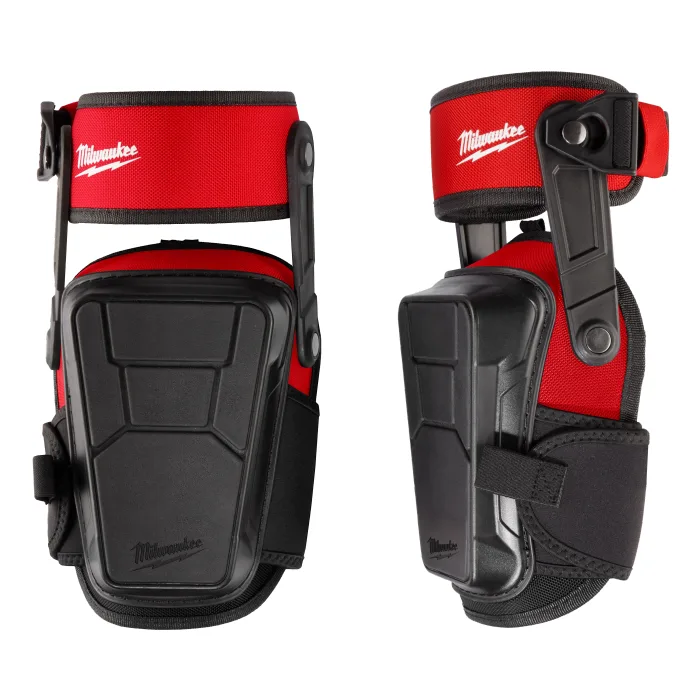
- Buy Milwaukee Stabilizer Knee Pad with Thigh Strap (48-73-6051) A hinged thigh strap takes the load off the back of the knee, and the large flat cap keeps you steady when you are working in one spot.
- Buy Klein Tools Lightweight Gel Knee Pads (60184) Light, low profile gel and EVA pads with a slip resistant cap, made for kneeling in bursts rather than settling in for the afternoon. Amazon
- It depends Snickers Workwear XTR D3O Craftsmen Kneepads (9191) The one genuinely certified option here, rated EN 14404 Type 2 Level 1, but the certificate covers the pad inside a specific pair of Snickers trousers and nothing else.
- Skip Bucket Boss Megasoft Knee Pads (GX4) Bucket Boss lists the cap type as soft with a 1680 poly fabric face over molded EVA foam, which is comfortable on a clean floor and offers nothing against anything sharp.
What actually matters
- EN 14404 - the European standard for knee protection for work in a kneeling position, and the only certification you can look up on a work knee pad. It sets Types by how the protection attaches and Levels by how much penetration and pressure it handles.
- Type - describes the form of the protection, not its strength. Type 1 straps to the leg on its own, Type 2 is a pad inside a certified garment pocket, Type 3 is a mat you kneel on, and Type 4 is a kneeling system or support device.
- Level - the performance tier within EN 14404. Level 0 offers no penetration protection and suits flat floors, Level 1 covers penetration at 100 N, and Level 2 asks for more penetration resistance for rough and difficult surfaces.
- Cap - the outer shell that meets the floor. A rigid cap is what actually stops a nail or tack strip, a soft fabric face does not, and cap shape decides whether you can hold a position or pivot.
- Thigh strap - an upper strap that anchors on the thigh, often on a hinge, instead of running around the joint. This is the standard fix for straps that bunch, slip or cut off circulation behind the knee.
- Compression set - how much a foam fails to spring back after being squashed repeatedly. D3O notes typical EVA foams have poor compression set, which is why cheap foam pads flatten and start bottoming out after a few months.
- Non-marring - a maker's explicit statement that the contact surface will not scar or mark finished floors. Several brands sell non-marring variants specifically because standard hard caps can and do leave marks.
The specs, in plain English
Green flags vs red flags
Green flags
- An EN 14404 marking that states both the Type and the Level, ideally moulded into the pad itself rather than printed on the box.
- A hinged or cushioned thigh strap that anchors the pad above the knee instead of around it.
- A published material breakdown, weight and dimensions rather than adjectives alone.
- An explicit non-marring statement if the pad is intended for finished floors.
- A rigid or semi-rigid cap with a stated shape, flat for stationary work or rocker for moving along a floor.
Red flags
- 'Third party tested' or 'meets safety standards' with no standard named and no result published.
- A soft or fabric-faced cap on a pad marketed for construction, flooring or demolition work.
- Two thin elastic straps and no thigh strap on a pad sold for all day kneeling.
- A Type 2 trouser insert bought without the matching certified trousers, which leaves you with an uncertified pad.
- Thickness quoted as the headline number with no mention of what the cushioning is or how it behaves after repeated compression.
Who's who: the brands
- Milwaukee - Tool-brand pads built around cap geometry and strap layout, including thigh strap and non-marring variants, but sold without a named certification.
- Klein Tools - Electrician-focused range that publishes weights and material percentages, spanning light gel pads through heavy duty hinged models.
- Snickers Workwear - European workwear brand whose kneepads are certified to EN 14404 as Type 2 systems together with its trousers.
- ToughBuilt - Known for thigh support stabilisation designs with a lower platform that lifts the shin, plus separate gel and foam and non-marring lines.
- Bucket Boss - Budget-focused range spanning soft fabric-faced pads through molded gel and hard cap swivel models aimed at flooring work.
How to read a listing without getting fooled
Read a knee pad listing by looking for the handful of things that are facts rather than adjectives. Start with the cap: is it described as hard, semi-rigid or soft, and is its shape flat, domed, rocker or swivel? Then find the padding description and note whether there is a gel layer, a foam layer, or both, and whether the maker says anything about how it holds up after repeated compression. Next, count the straps and work out where the top one sits: a thigh strap above the knee is a different product from two wraps around the leg, even if the photos look similar. Then search the page for a standard number. If EN 14404 appears without a Type and a Level, it is close to meaningless, and if it appears as Type 2 you need the matching garment. Finally, treat published weights, dimensions and material percentages as a good sign in themselves, because they give you something checkable.
How much should you spend?
Budget pads get you a soft or thin-capped foam pad on elastic wraps, which is fine for occasional light work on a clean floor and wrong for anything with a fastener or a shard on it. The mid-range is where most trade pads live and where the meaningful features appear: a rigid cap in a deliberate shape, a gel layer over foam, buckles that hold their adjustment, and increasingly a hinged thigh strap. Going premium buys you one of two things. Either a certified system, meaning an EN 14404 insert plus the trousers it is co-certified with, which is a pricey entry point because you are buying trousers too, or a heavily engineered strap-on with thigh support, a lower shin platform and reinforced hardware. Spending more does not necessarily buy you a published protection number in this category, because outside EN 14404 few makers publish one.
Questions, answered
Why does EN 14404 Type 2 keep coming up, and does it apply to me?
Type 2 is the European workwear model, where the pad lives in a knee pocket on the trousers and the two are certified together. Snickers, for instance, states its kneepads as Type 2, co-certified with its trousers. It applies to you only if you buy into the garment system, since the same pad in another brand's pockets is no longer covered. If you wear ordinary work trousers, a Type 1 strap-on pad is your category, and you should be looking for a Type 1 marking rather than a Type 2 one.
Can I use sports, tactical or gardening knee pads for trade work?
Sometimes, but check the cap before you commit. Volleyball and skate pads prioritise flexibility and impact from a fall rather than sustained pressure and puncture, and many have no rigid cap at all. Tactical pads are usually closer to trade pads in construction and some are perfectly serviceable on a jobsite. Gardening pads are typically soft foam and are aimed at soil rather than tack strips or screws. The question to ask of any of them is whether something rigid sits between your kneecap and whatever is on the floor, and whether the pad stays put through a full shift.
How long should a pair of work knee pads last?
Makers rarely publish a service life, so you have to judge it by feel and by inspection. The failure mode to watch for is the foam taking a compression set, which D3O describes as the pad not fully recovering after repeated compression until it flattens and bottoms out. Press the pad hard with your thumb and see whether it springs back or stays dented. The other failure points are straps stretching until they will not hold tension and buckles cracking. If you are catching the floor through the pad, it is finished regardless of how the outside looks.
Are knee pads or a kneeling mat better?
They are different Types under EN 14404 and they suit different work. A mat is Type 3, sits on the floor, and is generally more comfortable and thicker than anything you can strap to a leg, so it wins when you are working in one spot for a long time and can drag it along. Strap-on pads win when you are constantly moving, climbing, or working somewhere you cannot place a mat. Plenty of trades carry both, using a mat for bench-height work at floor level and pads for everything else.
Or jump to the head-to-head: Milwaukee Stabilizer Knee Pad with Thigh Strap (48-73-6051) vs Klein Tools Lightweight Gel Knee Pads (60184).