Explained
Log Splitters, Explained
After reading, you'll understand how much splitting force you need, what cycle time and log capacity mean in practice, and whether gas or electric suits your wood.
In this guide
Most first-time buyers fixate on tonnage and ignore everything else. Then the splitter arrives and the real limits show up: the round is too wide for the cradle, the extension cord trips the breaker, or every log has to be lifted onto a beam at shin height. Tonnage matters, but so do cycle time, capacity, power and working height. This guide explains each spec and what it means once you start splitting.
The 30-second version
- Buy tonnage for your hardest rounds, since a splitter that handles the average log but stalls on the big ones still leaves you swinging a maul.
- Cycle time adds up fast, so a 20-second electric takes far longer through a cord than an 11-second gas towable.
- Log diameter is the spec most often left out, and electric splitters that do publish it often stop at 10 inches.
- Electric splitters need the right outlet, with short heavy-gauge cords and sometimes a dedicated 20 A circuit.
- Working height saves your back, which is why a stand or a vertical mode is worth more than an extra ton or two.
The products this guide is about
Our verdict on each, with the full reasoning on the companion review.
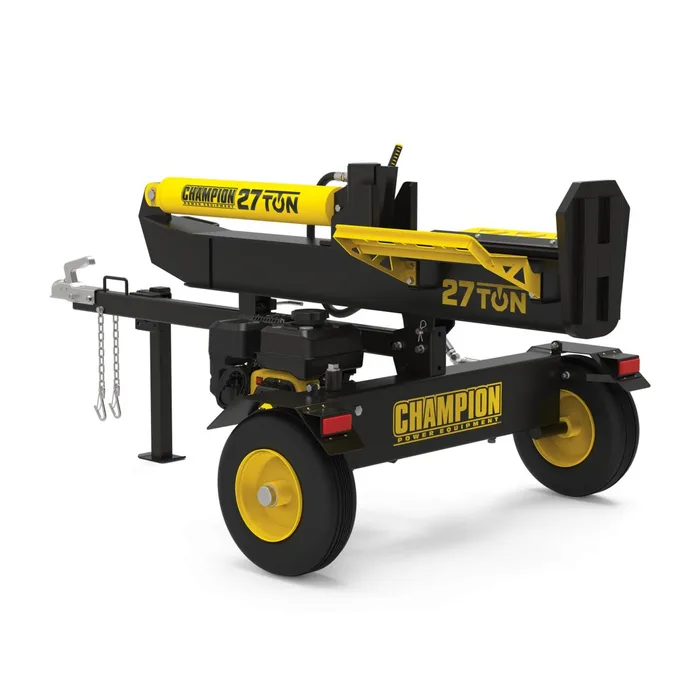
- Buy Champion Power Equipment Champion 27-Ton Log Splitter (100424) A towable 27-ton gas splitter with an 11-second cycle, auto return and a vertical mode for heavy rounds.
- Buy WEN 56208 6.5-Ton Electric Log Splitter with Stand A 6.5-ton electric splitter with a removable 34-inch stand, never-flat wheels and a 20-second cycle.
- It depends Boss Industrial 10 Ton Electric Log Splitter (ED10T20) A 10-ton electric splitter that splits on both strokes and runs one-handed, but needs a 20 A circuit.
- Skip Sun Joe LJ602E 5-Ton Electric Log Splitter A best-selling 5-ton electric splitter that takes the same logs as the WEN with less force and costs more.
What actually matters
- Splitting force - Rated in tons, it is how hard the ram pushes the round into the wedge. Small electric units run 5 to 10 tons; gas towables commonly run 20 tons and up.
- Cycle time - The seconds for the ram to extend and retract. It sets your pace more than anything else once the splitter is strong enough.
- Log capacity - Maximum length and diameter. Length should match your cut length; diameter is the limit you hit with big rounds.
- Power source - Gas means portability and power with fuel, noise and exhaust. Electric means quiet, fume-free work tied to an outlet.
- Orientation - Horizontal beams need you to lift logs. Vertical modes let you roll heavy rounds into place.
- Weight and transport - Electrics weigh roughly 90 to 220 pounds and roll by hand; gas towables weigh hundreds of pounds and need a hitch.
- Return and controls - Auto return, one-handed versus two-handed controls and double-direction splitting change how fast and how safely you work.
The specs, in plain English
Green flags vs red flags
Green flags
- A published maximum log diameter as well as length.
- Cycle time stated in seconds rather than described as fast.
- A stand, raised cradle or vertical mode so you are not working at ground level.
- Clear electrical requirements, including cord gauge and circuit size.
- A downloadable manual with a full spec table and fluid recommendations.
Red flags
- Tonnage advertised with no cycle time or log capacity alongside it.
- No published log diameter on an electric splitter.
- A higher price than a similar unit with more force and the same capacity.
- No mention of the circuit or extension cord the motor needs.
- Vague warranty terms or different coverage for home and commercial use that is not spelled out.
Who's who: the brands
- Champion Power Equipment - Known for generators and gas outdoor power equipment, including towable gas log splitters.
- WEN - A budget tool brand whose electric splitters come with long spec sheets and downloadable manuals.
- Boss Industrial - Focuses on electric log splitters, including 10-ton double-direction models aimed at heavier home use.
- Sun Joe - Mass-market electric yard tools sold through its own store and big-box retailers, with compact 5-ton splitters among its best sellers.
How to read a listing without getting fooled
Start with the tonnage, then read the cycle time and log capacity right next to it, because tonnage alone tells you nothing about speed or size. Check whether the listing gives both maximum length and maximum diameter; many leave out diameter, which is the number big rounds run into. For electrics, look for the motor's amperage and any circuit or cord requirement, then open the manual, where cord gauge tables usually live. For gas models, look at engine size, pump type and GPM, tow rating and assembled weight. Finally, note the working height: a stand, cradle height or vertical mode tells you how much lifting each log takes.
How much should you spend?
Small electric splitters in the 5 to 7 ton range sit in the budget tier, and within that tier, compare force and capacity carefully because some cost more while doing less. Heavier electrics around 10 tons, especially double-direction models, move into the premium tier and approach the cost of entry-level gas towables. Gas towables in the 20 to 30 ton range are premium purchases, and the money buys speed, log size and a vertical mode. Rent a gas splitter for a weekend if you only split once a year.
Questions, answered
Can I use an electric log splitter in the rain?
Treat it like any corded power tool and keep it dry. WEN's manual tells you to use a ground fault circuit interrupter if you must work in a damp location. Wet logs and wet extension cord connections are both risks. Split under cover or wait for a dry day.
Do I need to bleed a log splitter before first use?
Some electric splitters have a bleed screw that must be loosened one or two turns before use so trapped air can escape from the hydraulic system. WEN's 56208 manual shows a bleed screw and drain bolt. WEN warns that skipping this step can damage the hydraulic seals, so check your own manual before the first split.
How long should a log be for a log splitter?
Cut logs a little shorter than the splitter's rated maximum length so the ram does not bottom out. For 20.5-inch electrics that means rounds under about 20 inches; WEN's manual says no longer than 21 inches. Also cut to fit your stove or fireplace, which is often shorter.
Gas or electric for a few cords a year?
For a few cords of seasoned wood split near the house, electric is usually enough and far easier to live with. Go gas if your rounds are large or green, if you split far from power, or if you heat mainly with wood. Gas towables are faster and stronger, but they bring fuel, maintenance and much more weight.
Or jump to the head-to-head: Champion Power Equipment Champion 27-Ton Log Splitter (100424) vs WEN 56208 6.5-Ton Electric Log Splitter with Stand.