Explained
Non-Contact Voltage Testers, Explained
After reading, you'll understand what a non-contact voltage tester can and cannot tell you, how to read its rating and certification, and what to use instead when you need to prove a circuit dead.
In this guide
Almost everyone buys a non-contact voltage tester for the same reason: it is the fastest way to answer is this wire hot. What trips up first-time buyers is the other half of the question. These tools are built to say yes reliably and are not built to say no reliably, and every manufacturer writes that into its own manual in different words. The specification sheet is where the useful information lives, and most of it is three or four abbreviations deep.
The 30-second version
- A pen proves a wire live, and never proves one dead, because no indication can mean no voltage or a tester that is not working.
- NFPA 70E does not accept a non-contact instrument as the absence of voltage test at 1000 V or less, and permits it above 1000 V only as a specific exception.
- A CAT number needs a voltage beside it, and a certification mark behind it, or it is a claim rather than a verified rating.
- Ghost voltage comes from capacitive coupling, which is why sensitivity modes exist and why low-impedance contact testers do not suffer from it.
- Self-test features vary enormously, from a power-on lamp check to a continuous heartbeat flash to nothing published at all.
The products this guide is about
Our verdict on each, with the full reasoning on the companion review.
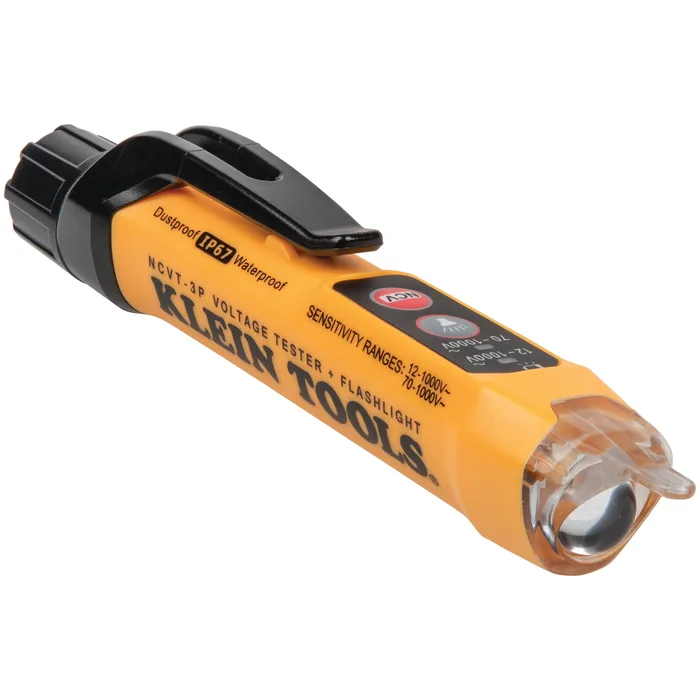
- Buy Klein Tools NCVT3P Dual-Range Non-Contact Voltage Tester with Flashlight The best documented pen in the category, with two sensitivity modes and a self-test that runs every time you switch it on. Amazon
- Buy Milwaukee 3202-20 Voltage Detector with LED A tough single-range pen with the same CAT IV 1000 V rating and a work light you can run on its own.
- It depends Klein Tools ET60 Electronic AC/DC Voltage Tester, 12 to 600V A two-probe contact tester with low input impedance, which is the kind of instrument NFPA 70E actually accepts for an absence of voltage test. Amazon
- Skip Fluke 2AC VoltAlert Non-Contact Voltage Tester A well-made always-on pen whose published specification gives you less to verify against than its own stablemates. Amazon
What actually matters
- Detection floor - the lowest voltage the tester is specified to see, and the number that decides whether it works on control and doorbell circuits. A 90 V pen held against a live 24 V transformer output stays completely silent, which looks exactly like a dead wire.
- Measurement category with voltage - CAT II, III and IV describe how much transient energy the instrument is built to survive at a stated working voltage. The category and the voltage only mean something together, because CAT III 600 V and CAT IV 1000 V are very different tools.
- Named product standards - IEC and UL 61010-1 cover general safety for measurement equipment, and 61010-2-030 adds the particular requirements for equipment with testing or measuring circuits. A sheet that names both tells you more than one that names neither.
- Certification body - a listing or testing mark from UL, CSA or Intertek means an independent laboratory checked the claim. Without one, the rating on the housing is the manufacturer's own assertion.
- Self-test behaviour - some testers light every LED at power-up, some flash continuously to show they are alive, some disable secondary functions to protect detection when the battery is low, and some publish nothing. This is the feature that addresses the category's central failure mode.
- Sensitivity control - either a switchable range or a signal-strength display. It lets you tell a strong field from a conductor you are touching apart from a weak coupled field bleeding off a neighbouring circuit in the same conduit.
- Ingress and drop ratings - IP54 resists dust and splashes, IP67 adds immersion, and a stated drop height in metres tells you what the housing survived in test. Check these against the operating environment the manufacturer specifies, which is sometimes indoor even when the IP number is high.
The specs, in plain English
Green flags vs red flags
Green flags
- The specification names both a category and a working voltage, such as CAT IV 1000 V, rather than a category alone.
- The maker names IEC or UL 61010-1 and 61010-2-030, and names the body that certified or tested the product.
- There is a published self-test, battery-condition indicator or continuous status flash, described in the manual rather than only on the box.
- The manual contains an explicit list of conditions under which the tester will not or may not detect voltage.
- The detection range covers the lowest voltage you will actually encounter, and ideally offers a switchable low range.
Red flags
- A category printed on the housing with no working voltage, no standard named and no certification mark anywhere in the listing.
- No self-test, no power-on indicator and no battery indicator mentioned in the specification or the manual.
- Marketing copy that describes the tool as confirming a circuit is safe or de-energised rather than detecting voltage.
- A listing that quotes a detection range that disagrees with the range printed on the product in the seller's own photographs.
- No manual available before purchase, so the failure conditions and the operating environment are hidden until the box is open.
Who's who: the brands
- Klein Tools - Publishes unusually complete instruction sheets, with explicit will-not-detect and may-not-detect lists, named 61010 standards and a stated independent testing body.
- Fluke - The VoltAlert pen line is a category standard, and the 1AC II model publishes a continuous self-test, with a tip that blinks red to show the unit is working.
- Milwaukee - Rugged CAT IV 1000 V detectors with strong integrated work lights, though the published specifications are lighter on standards and self-test detail.
- Southwire - Sells non-contact detectors aimed at trade users; check each model's sheet for its listing and self-test details.
- Greenlee - A long-established electrical tool brand whose testers are aimed at trade users, sold mainly through electrical distribution rather than general retail.
How to read a listing without getting fooled
Start at the bottom of the listing, not the top. Find the safety rating and check that a voltage is quoted with the category; if it says only CAT IV, treat the rating as unverified until the manual says otherwise. Next find the standards line and look for 61010-1 and 61010-2-030 together, plus a named body such as UL, CSA or Intertek, because conforms to and certified to are different claims and both beat silence. Then find the detection range and compare its floor to the lowest circuit you touch. Then hunt for the words self-test, power-on indicator or battery check, and read the footnote, because at least one manufacturer explicitly says its battery check is not a substitute for a live-source check. Finally, download the instruction sheet before you buy. The warnings page tells you more about the tool than the entire product description, and it is where you will find the operating environment, which is sometimes specified as indoor even on a tester marked IP67.
How much should you spend?
This is a category where the budget tier is genuinely usable. A budget pen from a known electrical brand will typically give you CAT IV 1000 V, a single detection range starting somewhere between 50 and 90 V, a work light and a two-year warranty, and that is enough for line-voltage work if you verify it live before and after every use. Stepping to mid-range buys the things this guide cares about: a switchable low range down to about 12 V, a published power-on self-test, higher ingress and drop ratings, and a specification sheet that names its standards and its certifying body. A two-probe contact tester sits in the same mid-range band and is the more important purchase if your work involves proving circuits dead rather than finding them live. Premium spending in this space goes to permanently mounted absence of voltage testers and full-function meters, which are a different tool for a different job. Nobody needs to spend premium money on a pen.
Questions, answered
Why does the tester stop working when I wear gloves?
A single-pole detector completes its circuit through your body to earth, so anything that breaks that path weakens or kills the indication. Klein's manual lists being insulated from the tester by a glove or other material as a condition under which the tester may not detect voltage, and being isolated from an effective earth ground as one under which it will not. Standing on a ladder, an insulated mat or dry rubber boots has the same effect. If you must wear gloves, treat every no-indication result as meaningless and confirm with a contact tester.
Is a two-pole tester better than a pen?
It is better at a different job. A two-probe contact tester touches the conductors, so it can measure phase-to-phase and phase-to-ground, which is what a formal absence of voltage test requires, and its low input impedance loads down capacitively coupled ghost voltage instead of reporting it. A pen is faster, works through insulation and needs no exposed metal, which makes it the better first pass. Most trade users carry both and use the pen to find, the contact tester to prove.
What does it mean if my pen beeps on a wire I know is disconnected?
Almost always capacitive coupling from live conductors sharing the raceway, which is the ghost voltage effect. It is more common on long runs, in crowded conduit and when the tester is in a high-sensitivity mode. Switching to the less sensitive range, or moving to a low-impedance contact tester, will usually make the phantom reading disappear. Never assume the reverse, though: a beep you cannot explain is a reason to investigate, not to ignore.
How often should I replace a non-contact voltage tester?
There is no calibration interval for a go or no-go detector, so the trigger is condition rather than time. NFPA 70E 110.6(D) requires visual inspection for external defects and damage before each use, and removal from service if anything is wrong. Manufacturers say the same in blunter terms: do not use it if it appears damaged or is not operating properly, and if in doubt, replace it. Register the product so recall notices reach you, and replace batteries the moment a low-battery indication appears rather than finishing the day on it.
Or jump to the head-to-head: Klein Tools NCVT3P Dual-Range Non-Contact Voltage Tester with Flashlight vs Milwaukee 3202-20 Voltage Detector with LED.