Explained
Outlet Testers, Explained
After reading, you'll understand exactly which wiring faults a plug-in tester can find, which ones it is documented to miss, and when you need an instrument that measures instead of one that indicates.
In this guide
Almost everyone buys an outlet tester expecting it to answer the question "is this outlet safe". It does not answer that question, and the standard it is built to says as much out loud. What it answers is narrower: does the voltage pattern across three pins match the pattern a correctly wired receptacle would produce. That is genuinely useful, and it is also why a receptacle with its ground jumpered to neutral behind the wall lights up green.
The 30-second version
- The standard disclaims the tool, UL 1436 states these devices are not intended to be a comprehensive instrument or to determine the quality of the grounding circuit.
- Three green lights are a pattern, not a verdict, because a bootleg ground produces the same pattern as a properly grounded receptacle.
- A GFCI test creates a real ground fault, so a tester cannot trip a GFCI on a receptacle that has no equipment grounding conductor.
- An AFCI button is an indicator, and the breaker manufacturers direct you to the push-to-test button on the breaker itself.
- Measuring is a different category, and only a circuit analyser that applies a load and reads conductor impedance can tell you whether a ground will carry fault current.
The products this guide is about
Our verdict on each, with the full reasoning on the companion review.
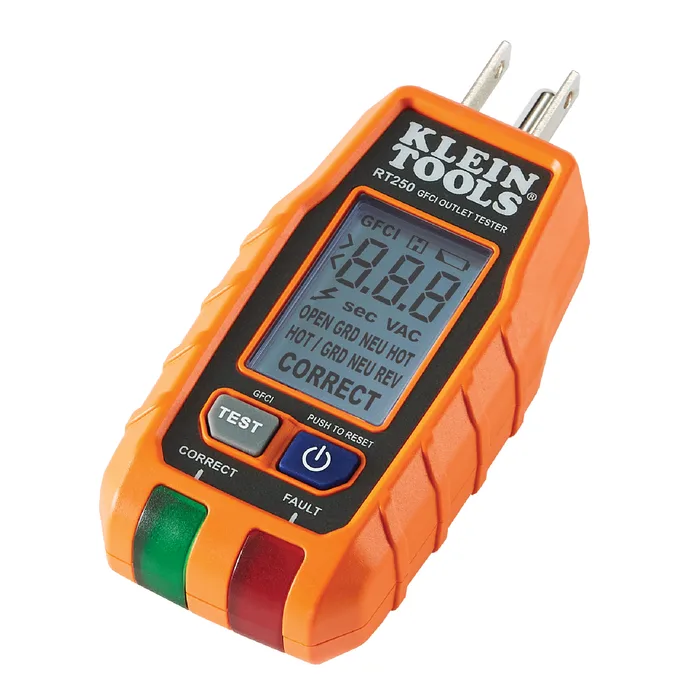
- Buy Klein Tools RT250 GFCI Receptacle Tester with LCD The tester that shows you an actual voltage and an actual GFCI trip time instead of asking you to decode three lamps. Amazon
- Buy IDEAL Electrical 61-502 120V AC GFCI Receptacle Tester A plain lamp tester with a GFCI button, certified to the same wiring standard as the screens, and honest on its own product page about needing a real ground. Amazon
- It depends Extech CT70 GFCI and AC Circuit Analyzer The one unit here that measures the thing UL 1436 testers are explicitly not built to judge: conductor impedance, ground included. Amazon
- Skip Klein Tools RT310 AFCI / GFCI Outlet Tester A competent wiring tester whose headline feature, the AFCI button, is the part breaker makers tell you not to rely on. Amazon
What actually matters
- UL 1436 - the standard for outlet circuit testers and similar indicating devices, and the ceiling on what any of them can claim. Its scope explicitly excludes determining the quality of the grounding circuit, so no lamp pattern is evidence about your ground.
- Conditions not indicated - the list the better instruction sheets print alongside the fault table. It typically includes quality of ground, multiple hot wires, reversal of neutral and ground conductors, and combinations of defects, and it is the most useful paragraph in the manual.
- Bootleg ground - an equipment grounding conductor jumpered to neutral at the receptacle so the tester reads correct. It defeats the fault path the ground exists to provide, and no plug-in lamp tester indicates it.
- Reverse-polarity bootleg ground - the same jumper with hot and neutral also swapped, which energises the ground pin and any bonded metal while the tester still reads correct. This is the case a non-contact voltage pen near a cover-plate screw is good at catching.
- GFCI trip test - the tester passes a small current, commonly 6 to 9 mA, from hot to the grounding conductor to create the imbalance a GFCI is built to detect. No grounding conductor means no path and no trip, however good the GFCI is.
- Ground impedance - the resistance of the return path, measured in ohms, and the number that actually tells you whether fault current can flow. One published guideline puts it under 1 ohm for personal protection and nearer 0.25 ohm for equipment protection.
- Voltage drop under load - the percentage the supply sags when a known load is applied, which reveals undersized conductors, long runs and bad splices. The commonly cited target is no more than 5 percent at the furthest receptacle on a circuit.
The specs, in plain English
Green flags vs red flags
Green flags
- The instruction sheet is published and names the specific standards, for example UL 61010-1, 61010-2-030 and 1436.
- The manual prints a list of conditions the tester does not indicate, rather than only the ones it does.
- The maker states the fault current the GFCI button injects, such as 6 mA to 9 mA.
- The listing gives a measurement category and voltage, not just "120 V".
- For an analyser, the impedance measurement range and its accuracy are both published, along with what happens outside that range.
Red flags
- Marketing that says the tester confirms an outlet is safe or checks the grounding, which the governing standard rules out.
- An AFCI feature promoted as a test rather than an indication, with no mention of the breaker's own push-to-test button.
- No instruction sheet or manual available before purchase, so the blind spots are undocumented.
- A claimed ground or impedance capability with no ohms range, no accuracy figure and no units anywhere in the specification.
- A listing that copies a spec table from a different model in the same family, a common sign the numbers were never checked.
Who's who: the brands
- Klein Tools - Electrical hand tool maker whose testers ship with instruction sheets that spell out the conditions the tool does not indicate, which makes them easy to buy honestly.
- IDEAL Electrical - Long-established electrical trade brand whose receptacle testers are cULus certified to UL 1436, and which used to make the SureTest circuit analysers that have now left the catalogue.
- Extech - Instrument brand under Teledyne FLIR, and the source of the CT70, one of the few plug-in units still sold that measures conductor impedance and voltage drop under load.
- Amprobe - Test instrument brand whose INSP-3 wiring inspector covered similar ground to the circuit analysers and is now listed among its legacy tools.
- Southwire - Wire and cable manufacturer with a tools line that includes receptacle testers both with and without an LCD readout.
How to read a listing without getting fooled
Start at the standards line, usually near the bottom of the specification block. If it says UL 1436 and nothing else about measurement, you are looking at an indicating device and the fault table is the whole story, so read that table and then hunt for the note about conditions not indicated. If the sheet also lists UL 61010-1 and 61010-2-030, the tool measures something, and you should then look for ranges and accuracies: an impedance figure without an ohms range and a tolerance is a claim, not a specification. Check the measurement category and voltage together, since CAT II 135 V and CAT III 135 V describe different intended locations. Note the fault current the GFCI button injects and whether a separate 30 mA function exists. Finally, treat any AFCI capability as a separate question and check what the breaker manufacturer says about it before you let it drive the purchase.
How much should you spend?
The budget tier buys a certified lamp tester with a GFCI button, and that is a perfectly respectable tool if you understand what UL 1436 covers. The mid-range tier buys a screen: line voltage, the fault spelled out in words, and a GFCI trip time, which is the single biggest jump in useful information in this category and the one worth paying for if you own only one tester. Above that, the same mid-range money can also buy an AFCI button, which is the weakest reason to trade up given what the standard and the breaker makers say about it. The premium tier is a genuinely different tool: a circuit analyser with a load bank that measures conductor impedance, voltage drop and available short circuit current. Only cross into it if ground quality or voltage drop is a question you ask regularly, because for everyone else it is a large step up in cost for numbers they will never use.
Questions, answered
Do I need a tester at all if my outlets work?
Working and correctly wired are different things. Reversed polarity, an open ground and a bootleg ground all leave appliances running normally while removing protection you are supposed to have. A basic tester takes seconds per outlet and finds the common cases. It just will not find the uncommon ones, which is the point of the list of conditions not indicated in the manual.
Why does my tester trip the GFCI but the reset feels normal?
That is the expected result. The tester creates a small hot-to-ground imbalance, typically 6 to 9 mA, the GFCI senses it and cuts power, and you press reset to restore it. A model that also shows the trip time turns that into a measurement rather than a yes or no. If the device does not trip, check first whether the receptacle actually has an equipment ground before concluding the GFCI is faulty.
Can an outlet tester damage anything?
The main risks are documented in the manuals rather than dramatic. Load testers draw real current and their manuals ask for a pause between tests to avoid heat build-up, and one warns against using the tool on the output of an uninterruptible power supply, a light dimmer or a square wave generator. Ground impedance tests intentionally push current into the grounding conductor and will trip a GFCI on that circuit. Unplug appliances on the circuit first, since equipment on the line can skew readings.
What should I use instead of a tester to check a ground?
You need something that measures rather than indicates. A circuit analyser that applies a load and reports hot, neutral and ground impedance will tell you whether the return path can carry fault current, with published guidance putting ground impedance under 1 ohm for personal protection. Failing that, an electrician with a low resistance tester and access to the panel can verify the path directly. A lamp pattern at the receptacle is not a substitute for either.
Or jump to the head-to-head: Klein Tools RT250 GFCI Receptacle Tester with LCD vs IDEAL Electrical 61-502 120V AC GFCI Receptacle Tester.