Explained
Pocket Hole Jigs, Explained
After reading, you'll know what a pricier jig buys you and how to choose the screw that makes the joint hold.
In this guide
Pocket hole jigs all drill the same hole. What separates them is how much of the setup they do for you, and what they cost in time when they do none of it.
The 30-second version
- Every jig drills the same hole, at the same angle with the same stepped bit, so the joint strength is identical whichever model made it.
- You are buying clamping and repeatability, meaning how fast and how consistently the identical hole gets produced, not how good the hole is.
- Thickness setting positions the screw's exit, and getting it wrong is the commonest fault, either blowing out the far face or leaving nothing holding.
- Screw thread is chosen by material, coarse for softwood, plywood and particle board, fine for hardwood, and no jig makes that choice for you.
- A jig without a clamp is not a finished tool, because holding it by hand lets it shift under drill pressure, so the face clamp is part of the price.
The products this guide is about
Our verdict on each, with the full reasoning on the companion review.
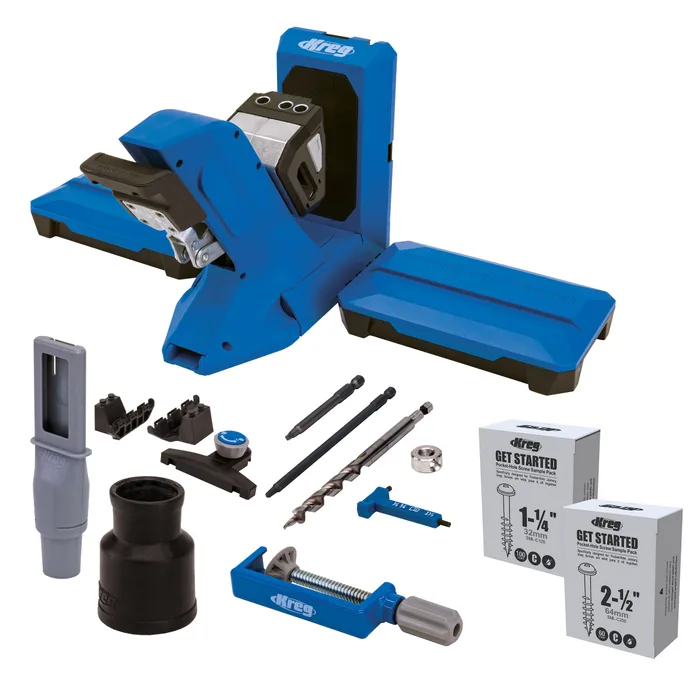
- Buy Kreg Pocket-Hole Jig 720PRO Sets the material thickness automatically as it clamps, which removes the one setup step that ruins pocket holes. Amazon
- Buy Kreg Pocket-Hole Jig 520PRO A built-in clamp and three thickness presets, which is most of the flagship's usefulness for considerably less money. Amazon
- It depends Kreg Pocket-Hole Jig 320 The cheapest route to a standard pocket hole, sold without the clamp it needs to be usable. Amazon
- Skip Kreg Pocket-Hole Jig 310 Drills a correct pocket hole one at a time, and asks you to reposition the guide by hand for every one of them. Amazon
What actually matters
- Clamping mechanism - automatic, built-in clamp, or none. The feature that most separates jigs, because an unclamped jig moves and moved jigs drill misaligned holes.
- Material thickness setting - automatic, preset or manual. Positions the hole so the screw exits centred in the joining face. The commonest setup mistake in pocket hole work.
- Guide holes - one or two, and whether they are fixed. A single guide means repositioning for every hole, which is slow and drifts out of alignment.
- Workpiece support - wings or arms that keep long stock square to the guide. Without them a long rail tips and the hole angle changes.
- Screw length - chosen from the thickness of the piece being drilled. Too short wastes holding power, too long comes through the far face.
- Screw thread type - coarse threads bite into softwood, plywood and particle board; fine threads avoid splitting hardwood. Nothing on the jig sets this.
The specs, in plain English
Green flags vs red flags
Green flags
- The clamping mechanism is described specifically rather than as easy clamping.
- The material thickness range or the preset thicknesses are stated.
- Whether a clamp is included is stated plainly.
- The number of guide holes is given.
- Screw selection guidance by material and thickness is provided by the maker.
Red flags
- A jig is priced against ones that include clamps without mentioning it needs one.
- Stronger joints is claimed for a more expensive jig in the same range.
- Thickness setting is not mentioned in the specification at all.
- Professional or heavy-duty appears with no mechanical difference behind it.
- Screw compatibility is vague about coarse and fine threads.
Who's who: the brands
- Kreg - The best known name in the category, with a range of jigs that all drill the same hole and differ in clamping, thickness setting and support.
- Massca - A Kreg competitor offering pocket hole jigs, often at lower prices.
- Armor Tool - Pocket hole jigs with their own clamping designs, including bench-mounted systems.
- General Tools - Budget jigs and kits.
- Milescraft - Inexpensive jigs and accessories, sold in a range of kits.
How to read a listing without getting fooled
Start by ignoring any claim that one jig in a range makes a better joint, because within a maker's line they drill the same hole. Read the clamping mechanism first, then how thickness is set, then whether a clamp is included, since the cheapest jig plus a required clamp is often not the cheapest setup. Then check the guide hole count, and finally read the maker's screw chart, which is where the joint is actually decided.
How much should you spend?
Budget buys a jig that drills correct holes and leaves the clamping to you, so add a face clamp to the price before comparing. Mid-range buys integrated clamping and thickness presets, which is where most people should land. Premium buys automatic thickness setting, workpiece support and onboard storage, which are worth it in volume production and not much otherwise.
Questions, answered
How do I choose pocket screw length?
From the thickness of the piece you are drilling into the edge of, not the piece you are screwing into. Use the maker's screw chart for the pairing, since each stock thickness has its own recommended length. Too short and you lose holding power, too long and the tip comes through the far face, which is the most visible way to ruin a piece.
Coarse or fine thread?
Coarse for softwood, plywood and particle board, because the widely spaced threads need to bite into fibre that offers little resistance. Fine for hardwood, because a coarse thread acts like a wedge in dense grain and splits it. This choice is made entirely by you and no jig influences it, which is why a good jig with the wrong screws still produces a weak or split joint.
Are pocket hole joints strong enough for furniture?
For most casework, face frames and shop furniture, yes, and they hold up better than many people expect. Where they are weaker is racking and in end grain that gets loaded repeatedly, so a chair taking constant sideways force is a poor application. They are also mechanical rather than glued joints in practice, which means they can be taken apart and reassembled, an advantage over many traditional joints.
Why did my screw come through the face of the board?
Almost always the thickness setting, either on the jig or on the drill bit's stop collar, left at a setting for thicker stock. Both need to match the material. Check them together whenever you change stock thickness, and drill a test hole in offcuts of the same material before committing to the workpiece.
Or jump to the head-to-head: Kreg Pocket-Hole Jig 720PRO vs Kreg Pocket-Hole Jig 520PRO.