Explained
Roof Rakes, Explained
After reading, you'll understand how much reach you need, why wheels and pads matter, how slide rakes differ, and what a roof rake can and cannot do about ice dams.
In this guide
First-time buyers tend to shop by the biggest reach number on the box, then find the pole stops short because the roof slopes away from them. Others expect a rake to break up ice dams, which makers themselves say it will not do. Head design matters as much as length, because a bare blade dragged across shingles behaves very differently from one on wheels. And the safest rake is the one you can use with both feet on the ground, away from power lines.
The 30-second version
- Reach is not wall height, because the pole has to go up and in across the roof slope.
- Wheels or glide pads protect the roof, leaving a thin layer of snow instead of scraping the surface.
- Roof rakes clear snow, not ice dams, so they reduce the meltwater that feeds a dam but do not remove one.
- Slide rakes cut and carry, trading setup and cost for longer reach and less pulling.
- Stay on the ground, take a foot or so at a time and keep the pole well clear of power lines.
The products this guide is about
Our verdict on each, with the full reasoning on the companion review.
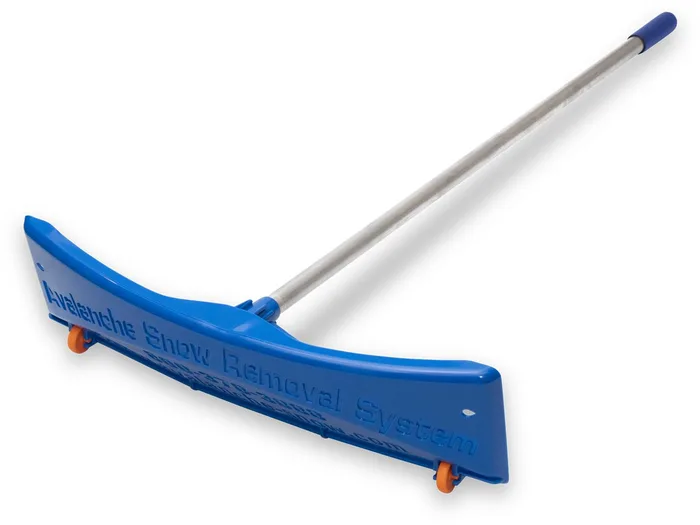
- Buy Avalanche! SnowRake! Deluxe 20 (SRD20) A 24-inch plastic pull rake on built-in wheels with about 20 feet of aluminum pole, listed for shingle, shake, tile, metal and solar panel roofs.
- Buy Snow Joe Roofer Joe RJ204M 21-Foot Telescoping Roof Rake A light telescoping rake whose Twist-n-Lock pole runs from 6.2 to 21 feet with a 25-inch polycarbonate blade. Amazon
- It depends PolarMade (SnowPeeler) SnowPeeler Premium Roof Rake 30 ft (POL-3003) A slide-style rake: an aluminum cutting frame and a 10-foot snow slide on up to 30 feet of sectional aluminum pole. Amazon
- Skip Suncast 20' Extendable Roof Rake (SRR2100) A widely stocked 24-inch rake that goes from about 10 to 20 feet with add-on extension poles, but publishes little else.
What actually matters
- Usable reach - The distance from where you stand to the snow you want to move, along the roof slope. Makers quote pole length or overhead reach, and these are not the same thing.
- Roof protection - Wheels or glide pads hold the head a little off the surface. That leaves a thin layer of snow and spares the shingles from a dragged edge.
- Head type - Blade rakes pull snow down toward you. Slide rakes cut under the snow and let it ride down a sheet, which changes both effort and where the snow lands.
- Head width - A wider head moves more snow per pull but gets heavier at full extension. The blade heads compared here run 24 to 25 inches.
- Pole construction - Telescoping poles lock at any length in seconds. Sectional poles snap or bolt together and are slower to resize but have fewer moving joints.
- Roof-type approval - Metal, tile, shake and solar panel roofs need more care than asphalt shingles. If the maker names your roof type, that is real guidance.
- Warranty and published specs - A maker that publishes weight, materials and a clear warranty is easier to hold to account. A short warranty on a tool you load at full extension is a warning sign.
The specs, in plain English
Green flags vs red flags
Green flags
- The maker publishes pole length, not just overhead reach
- Wheels, rollers or glide pads on the head
- Your roof type is named in the maker's listing
- Published weight and head material
- A warranty of a year or more stated in writing
Red flags
- Only an overhead reach figure, or several conflicting reach numbers
- No roof protection listed on a blade you will drag across shingles
- No published weight or blade material
- A warranty measured in days
- Marketing that suggests the rake removes ice dams
Who's who: the brands
- Avalanche! (MARSHALLTOWN) - Made in the USA with global materials; known for wheeled roof rakes and slide-style roof snow removal tools.
- Snow Joe - Broad line of budget and mid-range snow tools, including telescoping and wheeled roof rakes.
- PolarMade (SnowPeeler) - Canadian maker of slide-style roof rakes with long sectional aluminum poles.
- Suncast - Plastic home and garden products and snow tools widely stocked at hardware stores.
- Garant - Canadian tool maker whose telescopic aluminum roof rakes list a 5-year warranty.
How to read a listing without getting fooled
Start with the pole length, then check whether the reach figure on the box is pole length or an overhead reach estimate that adds your own height and arms. Look for what touches the roof: wheels, rollers or pads, and whether the maker names your roof type. Find the head width and material, the pole style (telescoping or sections), and the weight, which matters at full extension. Read the manual's assembly and warnings section; a good one tells you to work from the ground and keep away from power lines. If several reach numbers disagree, trust the smallest one.
How much should you spend?
Budget rakes ($ tier) usually mean a plastic blade, an aluminum pole and few protective features, which is fine for an ordinary shingle roof if you use a light touch. The mid-range ($$) tends to add wheels, broader roof-type approval and sturdier construction. Premium tools ($$$) are often slide-style rakes with long sectional poles, worth it for big or shallow roofs where reach and speed matter. Paying more makes the most sense when your roof is metal, tile or has solar panels, or when your roof is too deep for a 20-foot pole.
Questions, answered
When should I rake my roof?
Many owners rake after heavy snowfalls rather than every storm, focusing on the lower few feet above the eaves where ice dams form. Clearing that band reduces the snow that can melt and refreeze at the edge. If you are worried about the total load on the roof structure, that is a question for a roofer or structural professional, not a rake.
Can I use a roof rake on a metal roof?
Only if the maker says so. The Avalanche! SnowRake! Deluxe 20 lists metal roofs, and PolarMade says SnowPeeler glide pads adjust to 2 1/4 inches to clear metal roof ribs. Snow can also slide off metal roofs suddenly, so stand well clear of the drop zone.
Is a longer pole always better?
No. A longer pole is heavier and harder to control at full length, and it brings you closer to overhead wires. Buy enough reach for your roof and no more.
Can a roof rake be used from a ladder?
We do not recommend it. A roof rake exists so you can stay on the ground, and pulling snow while balanced on a ladder adds a fall risk on top of falling snow. If you cannot reach from the ground with the maker's stated pole length, call a professional.
Or jump to the head-to-head: Avalanche! SnowRake! Deluxe 20 (SRD20) vs Snow Joe Roofer Joe RJ204M 21-Foot Telescoping Roof Rake.