Explained
Scroll Saws, Explained
After reading, you'll understand which scroll saw specs affect the cut, which blade type your projects need, and how to spot a saw you will outgrow.
In this guide
Scroll saws look alike on a store shelf, and most listings lead with throat depth and speed. The things that trip up first-time buyers are elsewhere: how much the saw vibrates, which blade ends it accepts, and how easy it is to thread the blade for inside cuts. Those decide whether fretwork feels relaxing or fiddly. This guide walks through the jargon so you can read a spec sheet with confidence.
The 30-second version
- Throat depth sets your maximum panel size, and 16 inches covers most hobby projects.
- Blade end type matters more than speed, because plain-end blades allow the small pilot holes that fine fretwork needs.
- Vibration is the enemy of accuracy, so weight, arm design and a cast-iron table count for more than headline specs.
- Inside cuts mean frequent rethreading, so a lifting arm, quick clamps or a foot switch save real time.
- A missing spec is a signal, since makers confident in stroke length and capacity tend to publish them.
The products this guide is about
Our verdict on each, with the full reasoning on the companion review.
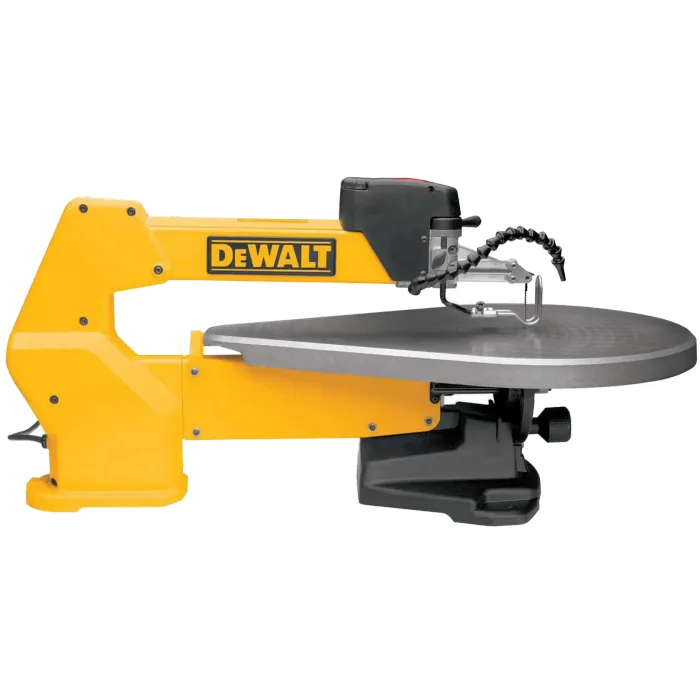
- Buy DeWalt DW788 20 in. Variable Speed Scroll Saw A 20-inch parallel-arm saw with a lifting arm, front-mounted controls and a cast-iron table that bevels both ways.
- Buy WEN 3922 16-inch Variable Speed Scroll Saw A budget 16-inch saw that takes pinned, pinless and spiral blades and has a flip-open panel for blade changes.
- It depends JET JWSS-22B 22" Scroll Saw with Foot Switch The biggest throat here at 22-3/8 inches, with a tilting arm, a foot switch and a five-year warranty.
- Skip Ryobi SC165VS 1.2 Amp Corded 16 in. Scroll Saw A common 16-inch hardware-store saw that costs more than the WEN without matching its published capability.
What actually matters
- Throat depth - The distance from blade to rear arm limits how wide a piece you can cut to its center. Bigger is useful for wall art and intarsia, but it adds size and cost.
- Blade end type - Pinned blades are easy to fit but need a larger pilot hole. Plain-end blades thread through tiny holes and come in finer sizes for detail work.
- Arm design - Parallel-link arms keep the blade moving straight up and down and are designed to reduce vibration. That makes following a line easier and leaves a cleaner edge.
- Frame and table mass - A heavy saw with cast iron stays put while the blade reciprocates. Lighter saws benefit from being bolted to a solid bench or stand.
- Speed range - Slow speeds help with plastics, metals and thin or hard materials. Fast speeds suit softwoods and straight-ish cuts.
- Tilt method - Most saws tilt the table for bevel cuts, while some tilt the arm and keep the table flat. A flat table is easier to work on for bevelled inlay.
- Blade access - A lifting arm, tool-free clamps or an opening side panel decide how quickly you can move from one inside cut to the next. On fretwork, this is the difference between minutes and hours.
The specs, in plain English
Green flags vs red flags
Green flags
- A published stroke length and maximum cut thickness
- A cast-iron table or base and a stated saw weight
- Clear blade compatibility, ideally including plain-end blades
- A lifting arm, tool-free clamps or another quick blade-access feature
- A downloadable manual and replacement parts listed by the maker
Red flags
- No stroke length or cut capacity on the spec sheet
- Pinned blades only, with no plain-end option
- A very light saw with no mention of mounting holes or a stand
- No variable speed
- A price close to a better-specified saw from another brand
Who's who: the brands
- DeWalt - Its DW788 is a long-running 20-inch parallel-arm saw; the current manual carries a 1997 copyright.
- JET - A machinery brand from JPW Industries whose scroll saws aim at heavy, long-cycle shop use.
- WEN - A budget tool brand that publishes detailed specs and keeps replacement parts in stock.
- Ryobi - A homeowner tool brand sold through The Home Depot, best known for its 18V ONE+ cordless system.
How to read a listing without getting fooled
Start with throat depth and blade compatibility, because those two decide what projects the saw can take on. Then look for the numbers that budget listings tend to skip: stroke length, maximum cut thickness and weight. Check how the bevel works, whether by tilting the table or the arm, and whether the arm lifts or the blade holders release quickly for inside cuts. Read the warranty term and look for a downloadable manual, which often lists the blade type the saw requires more clearly than the product page does.
How much should you spend?
Budget scroll saws are usually 16-inch machines with tilting tables and pinned-blade support, and the better ones publish their specs and include a cast-iron base. Mid-range saws often carry a familiar brand name more than extra capability, so compare them line by line with the budget leaders. Premium saws add a deeper throat, a parallel-link or tilting arm, heavier construction and longer warranties, and they make sense once you know you will use the saw often.
Questions, answered
Do I need a stand for a scroll saw?
Not necessarily, but the saw needs to be fastened to something solid. A sturdy bench works if you bolt or clamp the base down. A dedicated stand helps you set a comfortable working height for long sessions. Lighter saws benefit most from firm mounting.
How do I make inside cuts?
Drill a small pilot hole inside the waste area, release the top of the blade, thread it through the hole and reclamp. Saws with lifting arms or quick-release clamps make this faster. Plain-end blades let you use smaller pilot holes than pinned blades.
Can a scroll saw cut metal or plastic?
Yes, with the right blade and a slow speed. Thin non-ferrous metal and acrylic both cut well at low strokes per minute, which keeps heat down. Check the manual for material guidance before you start.
What blade should a beginner start with?
A medium-tooth blade in a size suited to 3/4-inch softwood is a good first choice. If your saw takes pinned blades, they are easier to fit while you learn. Move to finer plain-end blades once you start fretwork.
Or jump to the head-to-head: DeWalt DW788 20 in. Variable Speed Scroll Saw vs WEN 3922 16-inch Variable Speed Scroll Saw.