Explained
Splitting Axes and Mauls, Explained
After reading, you'll understand the difference between splitting axes, mauls and hatchets, and which specs tell you whether a tool suits your wood.
In this guide
First-time buyers often grab a felling axe or a short hatchet and wonder why rounds bounce or the blade sticks. Splitting tools are shaped to push wood apart, not slice it, and their weight and length decide what size wood they suit. Maker pages also hide important rules, such as whether you may hit a wedge with the back of the head. Knowing what to look for saves you a sore back and a broken handle.
The 30-second version
- Splitting axes are for speed, and mauls are for force on big or knotty rounds.
- Length matters as much as weight, because a full two-handed swing is both safer and more effective.
- Most handles break just below the head, so look for a collar or guard there.
- Not every axe may strike a wedge, and some allow only non-steel wedges.
- Short splitting hatchets suit kindling, not full firewood rounds.
The products this guide is about
Our verdict on each, with the full reasoning on the companion review.
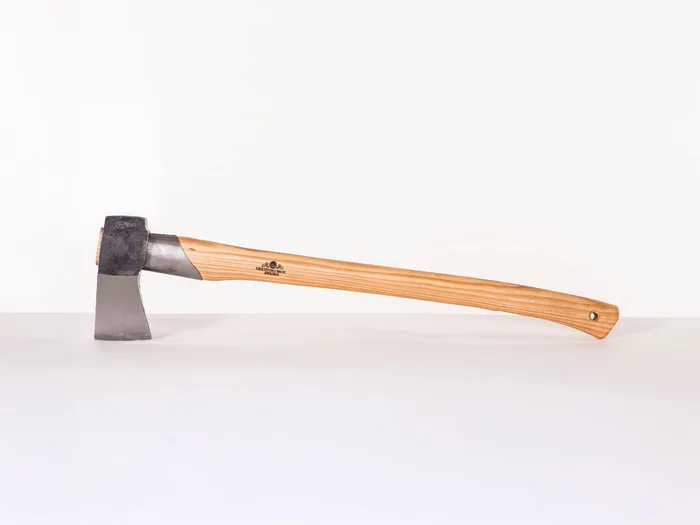
- Buy Gränsfors Bruk Gränsfors Large Splitting Axe A hand-forged Swedish splitting axe with a concave, fairly thin bit, a hickory handle and a 20 year warranty on axes.
- Buy Husqvarna Composite Splitting Axe (Large) A 27.5 in composite-handled splitting axe with a coated 5.07 lb head and a milled back for tapping in non-steel wedges.
- It depends Council Tool 7 lb Splitting Maul, Axe Eye "Ol' No. 7" (70MA) A 7 lb American-made maul on a 36 in hickory handle, built for big rounds where a lighter axe bounces.
- Skip Estwing Fireside Friend Splitting Tool (E3-FF4) A well-made, one-piece forged steel splitter that is only 14 in long, which makes it a kindling tool rather than a firewood splitter.
What actually matters
- Tool type - Splitting axes, mauls and hatchets cover different sizes of wood. Picking the wrong type is the most common mistake.
- Head weight - More mass opens tougher rounds but tires you faster. Match it to your wood and your strength.
- Overall length - A longer handle increases head speed and keeps the edge away from your legs. Short tools need a very different, less safe stance on full rounds.
- Bit geometry - A concave, thin bit enters the wood, and a wide body behind it does the splitting. A high centerline helps prevent sticking.
- Handle material - Hickory is shock absorbing and replaceable, while composite resists weather and overstrikes. Either works if it is protected below the head.
- Poll and wedge use - The back of the head may or may not be built to strike wedges. Read the maker's rule before you buy wedges.
- Warranty and steel - A stated steel grade and a long warranty indicate a head built to last. Vague descriptions tell you less.
The specs, in plain English
Green flags vs red flags
Green flags
- A named steel grade and a clear head weight
- A collar or guard protecting the handle below the head
- A clear statement on whether the tool may strike wedges
- A full-length handle suited to a two-handed swing
- A real sheath or edge cover and a long warranty
Red flags
- A short tool sold for splitting full firewood rounds
- No weight listed for the head or the whole tool
- A felling axe marketed as a splitter
- No guidance on wedge use
- A handle with no protection where overstrikes land
Who's who: the brands
- Gränsfors Bruk - A Swedish forge that has made hand-forged axes since 1902, with a 20 year warranty on its axes.
- Husqvarna - The forestry and chainsaw brand also sells splitting axes with composite and wooden handles.
- Council Tool - Makes axes, mauls and other striking tools in Lake Waccamaw, North Carolina.
- Estwing - Best known for one-piece forged steel hammers and axes made in the USA with a shock-reducing grip.
- Fiskars - Known for composite-handled splitting axes aimed at homeowners.
How to read a listing without getting fooled
Start with the tool type, because a splitting axe, a maul and a hatchet are built for different wood. Then look for two weights, the head and the whole tool, plus the overall length; a listing that gives only one number, or none, makes comparison hard. Read the head description for the bit shape and steel grade, and check what protects the handle just below the head. Finally, search the page for the word wedge: some makers explicitly allow hammering wedges, some allow only non-steel ones, and some forbid it, and that rule decides what else you need to buy.
How much should you spend?
Composite-handled splitting axes from big outdoor brands and American-made mauls sit in the mid-range tier and cover most homeowners well. Hand-forged Scandinavian axes sit in the premium tier, which buys better steel, a finished hickory handle, a leather sheath and a long warranty. Budget tools exist, but check the head weight, length and handle protection carefully, because a cheap tool that bounces or breaks its handle costs you more in the end.
Questions, answered
How heavy should a splitting maul be?
Heavier is not always better, because accuracy and stamina matter as much as mass. Council Tool designed its 7 lb maul to sit between a 6 lb maul it found too light and an 8 lb one it found too heavy. Most people split more wood, more safely, with a weight they can swing accurately for a whole session. Try lifting a tool before buying if you can.
Should I sharpen a splitting axe like a felling axe?
No, a splitting edge does not need to be razor sharp, because the wedge body does most of the work. A clean, moderately sharp edge helps the bit enter the wood. An over-thin edge can roll or chip on knots and dirt. Touch it up with a file or stone when it starts to bounce off rounds.
What is a chopping block and do I need one?
A chopping block is a large, flat round you stand your firewood on while splitting. It raises the wood so the head finishes its swing in the block, not the ground, which protects the edge and your shins. Pick a wide, stable hardwood round at roughly knee height. Never split on concrete or rocky ground.
How do I store a splitting axe?
Keep the edge covered with its sheath or edge cover and store the tool somewhere dry. Wooden handles shrink and swell with moisture, which can loosen the head, so do not leave them outside. Wipe the head and give it a light coat of oil if it will sit for months. Hang it or store it where nobody can brush against the edge.
Or jump to the head-to-head: Gränsfors Bruk Gränsfors Large Splitting Axe vs Husqvarna Composite Splitting Axe (Large).