Explained
Tape Measures, Explained
After reading, you'll know which of a tape's published numbers describe the tool and which one describes you.
In this guide
A tape measure listing leads with feet of reach and a drop rating. Neither tells you how accurately the thing measures, and one of them is partly a description of your arm.
The 30-second version
- Reach includes about three feet of you, because it is defined as blade standout plus an allowance for the average user's arm, so it is not purely a property of the tape.
- Standout is the honest stiffness number, since it measures how far the blade extends horizontally before buckling under its own weight.
- EC classes are the only accuracy figures around, giving permissible error as a formula in the tape's length, verified by type examination rather than self-declared.
- Blade width produces standout, as a wider blade holds a deeper curve that resists buckling, which is why stiff tapes tend to be bulkier.
- The hook is supposed to move, sliding by exactly its own thickness so a measurement taken by pushing agrees with one taken by pulling.
The products this guide is about
Our verdict on each, with the full reasoning on the companion review.
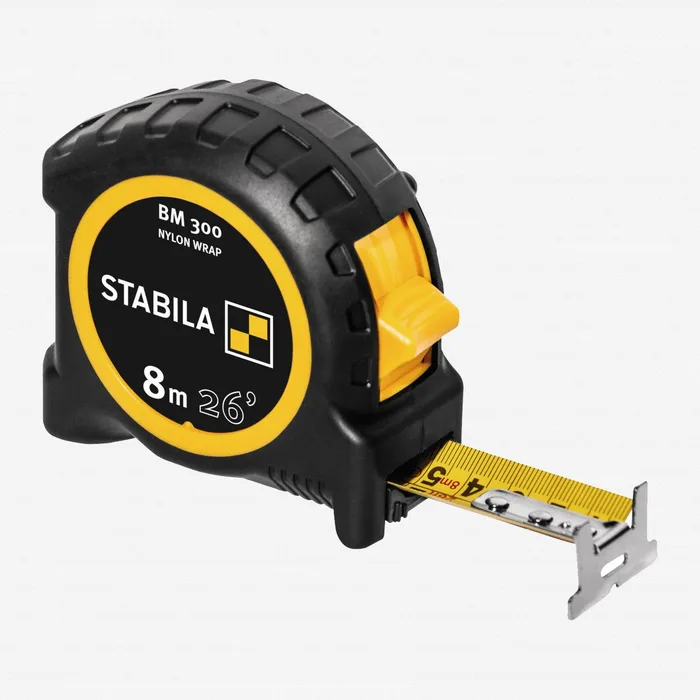
- Buy Stabila BM 300 Pocket Tape, 8 m / 26 ft, double-sided scale The only tape in this comparison with a published accuracy class, an error formula and a type examination certificate behind it. Amazon
- Buy Milwaukee 48-22-1216 16 ft Wide Blade Tape Measure Publishes standout and reach as two separate numbers, which lets you use the one that is a property of the tape. Amazon
- It depends STANLEY FATMAX 33-725 Tape Measure, 25 ft The default tape in most toolboxes, with a wide blade and long standout, and nothing published about how accurately it measures. Amazon
- Skip DEWALT DWHT36225S XP Tape Measure, 25 ft x 1-1/4 in A genuinely tough tape whose entire published specification is about surviving damage rather than measuring anything.
What actually matters
- Accuracy class - EC Class I permits ±(0.1 + 0.1L) mm, Class II ±(0.3 + 0.2L) mm and Class III ±(0.6 + 0.4L) mm, with L in metres. Over ten metres that is roughly 1.1, 2.3 and 3.7 mm respectively, defined at a specified pulling force and temperature.
- Standout - horizontal extension before the blade collapses. A genuine property of the steel and its curvature, and the figure to compare when a maker publishes it.
- Reach - standout plus roughly three feet of assumed arm length. Useful shorthand for what one person can span, misleading if read as a property of the tape.
- Blade width - often around 1 inch to 1-1/4 inch on US tapes. Wider generally means stiffer and more standout, at the cost of a bulkier case and more weight in the pocket.
- Hook travel - the deliberate play in the end hook, equal to its own thickness, that makes inside and outside measurements agree. Bent hooks are the commonest cause of a tape reading short.
- Blade coating - nylon or thermoplastic layers, usually concentrated in the first several inches where blades break. A durability feature with no bearing on accuracy.
The specs, in plain English
Green flags vs red flags
Green flags
- An accuracy class is stated, with the error formula or the millimetre figure alongside it.
- Standout is published as its own number rather than only as reach.
- Blade width appears in the specification table.
- A certificate or metrology marking is named rather than implied.
- Both inch and millimetre graduations are shown if you work across systems.
Red flags
- Reach is the only distance figure given, with no standout number anywhere.
- Drop height and case toughness lead the specification while accuracy is absent.
- Precision or accurate appears as a word with no class, tolerance or formula behind it.
- Blade width is not published on a tape whose headline claim is standout.
- A standout figure is quoted with no indication of whether the blade was horizontal.
Who's who: the brands
- Stabila - German, and the reason accuracy classes appear in this comparison at all. Sells steel tapes in EC Class II as standard, with certification named.
- Milwaukee - Wide-blade tapes competing on standout, and clear in separating standout from reach in its published figures.
- STANLEY - A 1-1/4 inch FatMax blade with a reach figure on the listing. Widely sold and inexpensive, with no published accuracy specification.
- DEWALT - The XP line is engineered around surviving damage, with drop ratings and hook-end coatings as headline specs. Names blade width in the product title, but publishes no accuracy figure.
- Crescent Lufkin - Long-standing US tape maker that also competes on standout figures. Check its listings for the same things: standout, blade width and any accuracy statement.
How to read a listing without getting fooled
Look for an accuracy class first, and if there is none, accept that you are buying on stiffness and durability rather than documented precision. Then find standout, and if the listing gives only reach, subtract about three feet. Check whether blade width is published, since it is the property producing the standout. Read drop ratings and coatings last: they tell you how long the tape survives, not how well it measures.
How much should you spend?
Budget buys a competent wide-blade tape with a long standout and no published accuracy. Mid-range buys either a certified accuracy class or a heavily armoured case, rarely both, because the two are different design briefs. Premium in this category usually means durability engineering rather than better measurement.
Questions, answered
Is my tape measure accurate enough for cabinetry?
Very likely for a single measurement, and the risk is cumulative error over repeated ones. A Class II tape is held to roughly 2.3 mm over ten metres, and an unclassified tape may be better or worse without telling you. The practical defence is to use one tape for a whole project rather than mixing tapes, so any error is consistent and cancels out of your differences.
Why do two tapes disagree by a couple of millimetres?
Usually the hooks. The end hook slides by its own thickness by design, and if one has been bent by a drop, that tape now reads short or long by the error. Check by hooking both over the same edge and comparing at the same graduation. Beyond that, unclassified tapes carry undisclosed tolerances, so a small disagreement between two brands is expected.
Does a longer tape lose accuracy?
Yes, and the classes are written to account for it. Every EC class states error as a fixed part plus a part proportional to length, so permissible error grows as the tape gets longer. That is why a class figure is quoted as a formula rather than a single number, and why a 10 metre tape is held to a tighter absolute error than a 30 metre one.
Is a wide blade always better?
For standout, generally yes, and for pocketability, no. The width buys a deeper blade curve, which is what resists buckling and lets you span a room alone. It also produces a bigger, heavier case, and it does nothing at all for the accuracy of the printed graduations.
Or jump to the head-to-head: Stabila BM 300 Pocket Tape, 8 m / 26 ft, double-sided scale vs Milwaukee 48-22-1216 16 ft Wide Blade Tape Measure.