

Tools & DIY
The Best Tape Measures: 4 Compared (and One to Skip)
Four tape measures compared on the difference between a spec that describes the tool and one that describes you: certified measuring accuracy against the standout and reach figures the US market actually advertises.
The short version
Buy the Stabila BM 300. It is the only tape here sold with a stated measuring accuracy, EC Class II, which caps error at plus or minus (0.3 + 0.2L) millimetres, about 2.3 mm over ten metres, and carries CE marking, metrology marking and an EC Type Examination Certificate to back it. The NYLON-WRAP blade coating is the durability story, and the double-sided inch and millimetre scale suits anyone working in both. Buy the Milwaukee 48-22-1216 if you want the US-market strengths and honest framing of them: Milwaukee publishes 13 feet of standout and 16 feet of reach as two separate figures, so you can use the one that describes the tool and ignore the one that includes your arm. The Stanley FatMax 33-725 is the it-depends, a widely owned tape with a wide blade and a 14 foot reach figure, but nothing published about accuracy. Skip the DEWALT XP DWHT36225S if you are buying a measuring instrument: it is an excellent tough tape, with 13 feet of standout, a 9 inch thermoplastic coating at the hook end and a survivable 60 foot drop, and its published specification is entirely about survival rather than measurement. Best for: anyone who assumed a tape measure's headline number described how well it measures.
Our picks at a glance
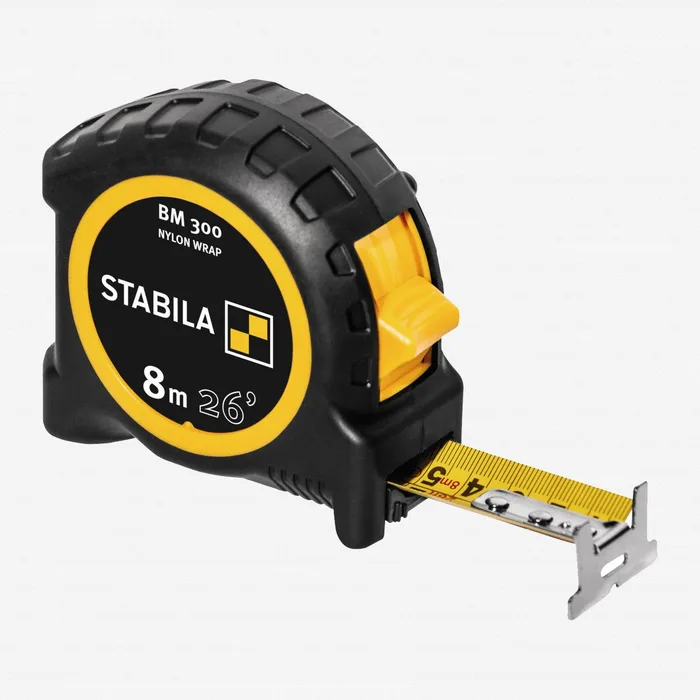
- Stabila BM 300 Pocket Tape, 8 m / 26 ft, double-sided scale - Buy. The only tape in this comparison with a published accuracy class, an error formula and a type examination certificate behind it.
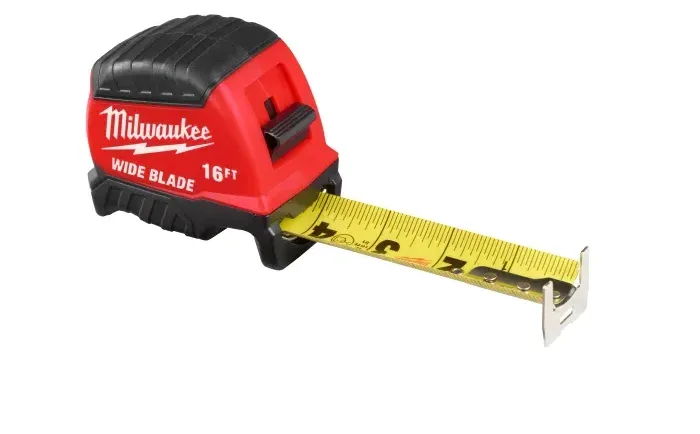
- Milwaukee 48-22-1216 16 ft Wide Blade Tape Measure - Buy. Publishes standout and reach as two separate numbers, which lets you use the one that is a property of the tape.
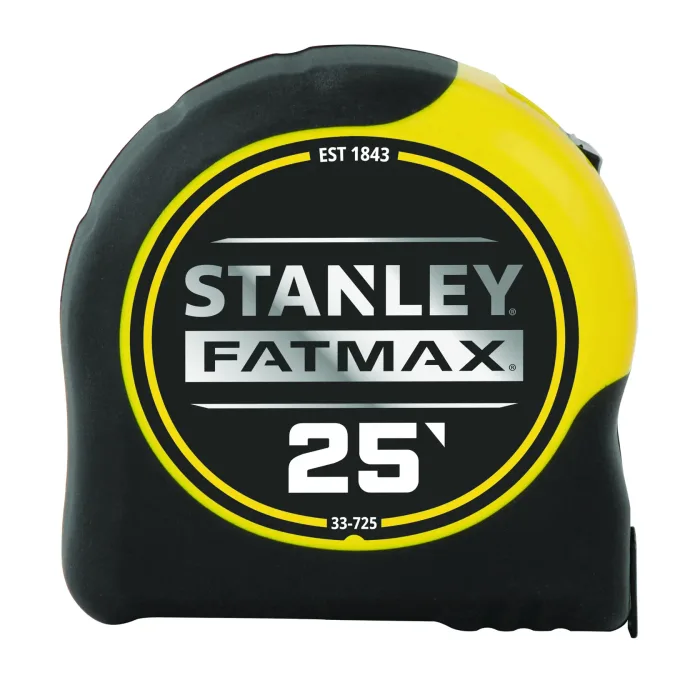
- STANLEY FATMAX 33-725 Tape Measure, 25 ft - It depends. The default tape in most toolboxes, with a wide blade and long standout, and nothing published about how accurately it measures.
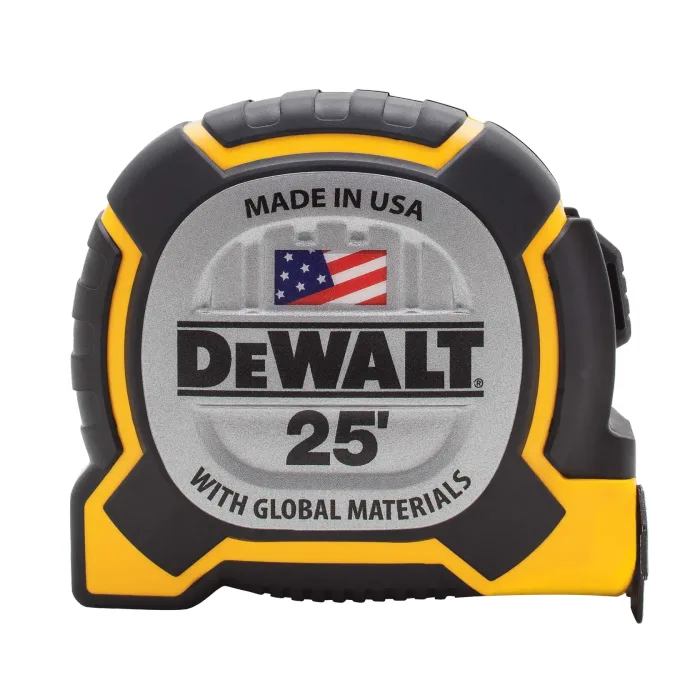
- DEWALT DWHT36225S XP Tape Measure, 25 ft x 1-1/4 in - Skip. A genuinely tough tape whose entire published specification is about surviving damage rather than measuring anything.
The verdict in 30 seconds
What mattered most
- Published accuracy
- Certification behind it
- Published standout
- Reach quoted separately
- Blade width published
- Length
Tape measures are sold on a number that includes part of the buyer. Standout is how far the blade will extend before it buckles under its own weight, which is a real property of the steel. Reach is standout plus roughly three feet of assumed arm length, and it is the figure that now leads the listings. Meanwhile the number you would expect a measuring instrument to carry, how accurate the graduations are, is absent from every US tape in this comparison. It is not absent everywhere: European tapes are sold in accuracy classes with a published error formula and a type examination certificate behind them. The gap between those two ways of describing the same tool is the whole of this review.
The only tape in this comparison with a published accuracy class, an error formula and a type examination certificate behind it.
Best for: Anyone doing work where a couple of millimetres over a long span actually matters, and who wants that guaranteed rather than hoped for.
- Sold as EC Class II, which caps permissible error at plus or minus (0.3 + 0.2L) mm, roughly 2.3 mm over ten metres, so the accuracy is a number rather than an assumption.
- Carries CE marking, metrology marking and an EC Type Examination Certificate, meaning the class was verified rather than self-declared.
- Double-sided scale with both inch and millimetre graduations, useful for anyone working across both systems.
- Stabila states that accuracy class II applies as standard across its steel tape measures (maker page did not load on recheck).
- No standout or reach figure is published, so blade stiffness is the one thing you cannot compare against the US tapes.
- Class II is the middle grade; Class I exists and is roughly twice as accurate at plus or minus (0.1 + 0.1L) mm.
- Metric-led design, and the shorter 8 m length will not suit anyone who regularly measures long spans.
- Harder to find in US shops than the other three, and generally sold through specialist tool retailers.
Publishes standout and reach as two separate numbers, which lets you use the one that is a property of the tape.
Best for: Trades and DIY work where extending unsupported across a room matters more than millimetre-level certainty.
- Milwaukee publishes 13 feet of standout and 16 feet of reach separately, so the figure describing the blade is available rather than folded into the marketing number.
- Wide blade construction, which is what buys the standout and makes one-person measuring across a room practical.
- Double-sided printing with an architectural scale, and a finger stop for controlled retraction.
- No accuracy figure of any kind appears in the published specification.
- Blade width is not stated on the product page either, despite being the property that produces the standout the listing leads on.
- Reach, the headline number, is standout plus roughly three feet of assumed arm length, so part of the specification is a description of the user.
- Sixteen feet is short for anything architectural, and the longer models are heavier in the pocket.
The default tape in most toolboxes, with a wide blade and long standout, and nothing published about how accurately it measures.
Best for: General site and household work where a tape is a consumable and near enough is genuinely near enough.
- A 1-1/4 inch wide blade and a BladeArmor coating at the hook, per Stanley's page.
- Twenty-five feet covers most domestic and site work in one tape.
- Widely sold and cheap, so replacing a damaged one costs little.
- A long-running model, which means the hook, blade and case behaviour are widely known quantities.
- No accuracy class or error formula appears in the published specification.
- Stanley's page quotes 14 ft of reach based on the maximum extension of an average professional user, which describes the user as much as the blade, and gives no separate standout figure.
- The case is bulky next to a compact tape, which is the cost of the wide blade.
A genuinely tough tape whose entire published specification is about surviving damage rather than measuring anything.
Best for: Sites where tapes die by being dropped rather than by being wrong, and the tool is bought as consumable armour.
- Thirteen feet of published blade standout, level with the Milwaukee and useful for solo work.
- Nine inches of heavy-duty thermoplastic coating at the hook end, where blades actually break.
- Built around a twin-spring Dual-Core mechanism in an impact-resistant case, and rated to survive a 60 foot drop.
- One-and-a-quarter inch blade width is published in the product name, which Milwaukee's page does not state.
- No accuracy figure, no class and no error formula anywhere in the published specification.
- Every headline number describes durability rather than measurement: drop height, coating length, case construction.
- Heavier and bulkier than a standard 25 foot tape, which is the cost of the twin-spring case.
- Priced above the Stanley while publishing no more about measuring performance than it does.
| Criteria | BM 300 Pocket Tape, 8 m / 26 ft, double-sided scale Top pick | 48-22-1216 16 ft Wide Blade Tape Measure | FATMAX 33-725 Tape Measure, 25 ft | DWHT36225S XP Tape Measure, 25 ft x 1-1/4 in |
|---|---|---|---|---|
| Verdict | Buy it | Buy it | It depends | Skip it |
| Best for | Anyone doing work where a couple of millimetres over a long span actually matters, and who wants that guaranteed rather than hoped for. | Trades and DIY work where extending unsupported across a room matters more than millimetre-level certainty. | General site and household work where a tape is a consumable and near enough is genuinely near enough. | Sites where tapes die by being dropped rather than by being wrong, and the tool is bought as consumable armour. |
| Price tier | $$ · mid-range | $$ · mid-range | $ · budget | $$ · mid-range |
| Published accuracy | EC Class II, ±(0.3 + 0.2L) mm | Not published | Not published | Not published |
| Certification behind it | CE and metrology marking, EC Type Examination Certificate | None stated | None stated | None stated |
| Published standout | Not published | 13 ft | Not published as a figure, 14 ft reach quoted | 13 ft |
| Reach quoted separately | No | Yes, 16 ft | No | No |
| Blade width published | Not published | Not on the page | Yes, 1-1/4 in | Yes, 1-1/4 in |
| Length | 8 m / 26 ft | 16 ft | 25 ft | 25 ft |
| Headline claim is about | Measuring accuracy | Standout and reach | Standout | Surviving a 60 ft drop |
Which one is right for you?
- Anyone doing work where a couple of millimetres over a long span actually matters, and who wants that guaranteed rather than hoped for. Buy it Stabila BM 300 Pocket Tape, 8 m / 26 ft, double-sided scale
- Trades and DIY work where extending unsupported across a room matters more than millimetre-level certainty. Buy it Milwaukee 48-22-1216 16 ft Wide Blade Tape Measure
- General site and household work where a tape is a consumable and near enough is genuinely near enough. It depends STANLEY FATMAX 33-725 Tape Measure, 25 ft
- Sites where tapes die by being dropped rather than by being wrong, and the tool is bought as consumable armour. Skip it DEWALT DWHT36225S XP Tape Measure, 25 ft x 1-1/4 in
How we judged the field
We judged these on whether the published specification describes the tool’s ability to measure, and found that only one of the four does. The first test was an accuracy statement: a class, a tolerance, an error formula, anything. The second was whether the stiffness figures are reported in a form you can use, which means standout on its own rather than reach, since reach silently includes about three feet of the buyer’s arm. The third was blade width, because it is the property that produces standout and it is missing from most listings that lead on standout. The fourth was what the maker chooses to headline, which turns out to be the most revealing question of all: one leads on measuring accuracy, two on stiffness, and one on surviving a fall from a roof.
Stabila BM 300 Pocket Tape, 8 m / 26 ft, double-sided scale
Buy itThe Stabila BM 300 is the pick because it is the only one of the four that behaves like a measuring instrument in its paperwork. It is sold in EC Class II, which is not a marketing grade but a defined limit: permissible error of plus or minus (0.3 + 0.2L) millimetres, where L is length in metres, which works out at roughly 2.3 mm over ten metres, measured under a specified pulling force and temperature. Behind that sit CE marking, metrology marking and an EC Type Examination Certificate, so the class was verified by someone other than the manufacturer. Stabila states that class II applies as standard across its steel tapes, making this a line-wide commitment rather than a single flattering model. The blade carries a NYLON-WRAP coating for wear and corrosion, and the double-sided scale gives inches and millimetres. What you do not get is any standout figure, so the one property the US tapes compete on is the one you cannot compare. For work where a couple of millimetres across a long span changes the outcome, that trade is easy.
Milwaukee 48-22-1216 16 ft Wide Blade Tape Measure
Buy itThe Milwaukee 48-22-1216 is the second buy and the best of the US tapes, largely because of how it reports itself. Milwaukee publishes 13 feet of standout and 16 feet of reach as two separate numbers. That matters because reach is standout plus roughly three feet of assumed arm length, and a listing that quotes only reach has folded a description of the buyer into a specification of the tool. Having both, you can use the honest one. The wide blade is what produces that standout, and it makes solo measuring across a room practical in a way a narrow blade does not. The double-sided printing includes an architectural scale, and the finger stop gives you control on retraction, which is where blades get kinked. Against it: the published specification contains no accuracy figure at all, and not even a blade width, despite blade width being the property doing the work. Sixteen feet is also short for anything architectural.
STANLEY FATMAX 33-725 Tape Measure, 25 ft
It dependsThe Stanley FatMax 33-725 is the it-depends, and it is the tape most readers already own. The wide FatMax blade is 1-1/4 inches, twenty-five feet covers most domestic and site work, and it is cheap and widely sold, which matters for a tool that gets dropped, run over and lost. As a known quantity it is hard to argue with. As a specification it is thin: no accuracy class, no error formula, and a 14 ft reach figure that is based on an average professional user’s arm rather than the blade alone. Buy it as the general-purpose tape it is, and do not mistake ubiquity for documented precision.
DEWALT DWHT36225S XP Tape Measure, 25 ft x 1-1/4 in
Skip itThe DEWALT XP is the skip, and it is genuinely a good tool being bought for the wrong reason. Read its published specification and notice what every number is about: thirteen feet of standout, nine inches of thermoplastic coating at the hook end, a twin-spring Dual-Core mechanism in an impact-resistant case, and survival of a 60 foot drop. That is a coherent and well-executed design brief, and if your tapes die by being dropped off scaffolding it is the right purchase. It also states its blade width, at one and a quarter inches. But there is no accuracy figure, no class and no tolerance anywhere, and it costs more than the Stanley while disclosing no more about measuring. If you are choosing a measuring instrument rather than a piece of site armour, that is the wrong set of numbers to be paying for.
Sources
Specs in this review come from these pages.
- Stabila, tape measure quality and accuracy, including accuracy class II as standard (stabila.com)
- Stabila BM 300 pocket tape product specifications (stabila.com)
- Milwaukee Tool, 16 ft Wide Blade Tape Measure 48-22-1216 specifications (milwaukeetool.com)
- Milwaukee Tool press release, next generation tape measures with standout and reach figures (milwaukeetool.com)
- DEWALT, 25 ft XP Tape Measure DWHT36225S product page (dewalt.com)
- EC accuracy class error tables for steel measuring tapes (richter-messzeuge.de)
Stabila BM 300 Pocket Tape, 8 m / 26 ft, double-sided scale vs Milwaukee 48-22-1216 16 ft Wide Blade Tape Measure: which should you buy?
The Stabila against the Milwaukee is really a contest between two definitions of what a tape measure is. The Stabila answers the question a measuring instrument should answer, and answers it with a certified class and an error formula, but tells you nothing about how far the blade will reach unsupported. The Milwaukee answers the question the US market actually asks, how far can one person span alone, and answers it twice over with a standout figure and a reach figure, while saying nothing about accuracy. Neither is hiding anything; they are optimised for different jobs and disclose accordingly. If your work is layout and joinery where cumulative error compounds, the certified class is worth more than the stiffness. If your work is framing and site measuring where you are alone at one end of a room, the standout is worth more than the millimetres.
What to look for
- An accuracy class, if there is one: EC Class I, II or III comes with a published error formula in the tape’s length, which is the only accuracy number in this category that means anything.
- Standout quoted separately from reach: reach is standout plus roughly three feet of assumed arm, so a listing giving only reach has built the buyer into the specification.
- Blade width: the property that actually produces standout, and frequently missing from listings that lead on standout.
- What the headline number is about: a tape whose top specifications are drop height and coating length is a durability product, which is a legitimate thing to buy but not the same as a measuring one.
- A hook that slides by its own thickness: it is designed to move so that pushed and pulled measurements agree, and a hook that has been bent is the usual cause of a tape reading short.
- Double-sided or architectural scales: worth real money if you work across inch and metric or read plans, and free to check before buying.
Our final take
Every tape here measures well enough for most work, and only one of them will tell you so in writing. If you want a documented tolerance, that currently means buying a European tape sold in an accuracy class. If you want to span a room on your own, buy on standout, and remember to subtract about three feet whenever a listing quotes reach instead.
Questions, answered
What is the difference between standout and reach?
Standout is how far the blade extends horizontally before it buckles under its own weight, and it is a genuine property of the steel and its curvature. Reach is standout plus roughly three feet, an allowance for the average arm of the person holding it. Milwaukee publishes both: 13 feet of standout and 16 feet of reach on the tape here. When a listing gives only reach, subtract about three feet to get back to the number that describes the tool.
What do EC accuracy classes actually mean?
They are graded limits on how far the printed graduations may deviate, expressed as a formula in the tape's length L in metres. Class I permits plus or minus (0.1 + 0.1L) mm, about 1.1 mm over ten metres. Class II permits plus or minus (0.3 + 0.2L) mm, about 2.3 mm over ten. Class III permits plus or minus (0.6 + 0.4L) mm, about 3.7 mm. The figures are defined under a specified pulling force and temperature, which is why they are reproducible rather than promotional.
Do American tape measures have an accuracy standard?
Not one that is routinely printed on the product. None of the three US tapes here publishes an accuracy class, an error formula, or a tolerance of any kind, and Milwaukee's page does not state blade width either. That does not mean they are inaccurate; it means the accuracy is undisclosed, and the specifications that are disclosed describe stiffness and toughness instead. If you want a number, you are currently buying a European tape to get one.
Does a wider blade measure better?
It measures further unsupported, which is a different thing. A wider blade holds a deeper curve, and that curvature is what resists buckling, so wide blades produce the long standout figures the US market competes on. It does nothing for the accuracy of the graduations. A wide blade is also bulkier in a pocket and, at the hook end, no less prone to the bending and tearing that kills tapes.
Why does the hook wiggle, and is mine broken?
It is meant to. The hook slides by exactly its own thickness so that the tape reads correctly whether you hook it over an edge and pull, or butt it against a surface and push. If it were fixed, one of those two measurements would be wrong by the thickness of the hook. A hook that has been bent or that slides further than its own thickness is a genuine fault, and it is the most common reason a tape starts reading short.
Deciding between the top two? See our head-to-head: Stabila BM 300 Pocket Tape, 8 m / 26 ft, double-sided scale vs Milwaukee 48-22-1216 16 ft Wide Blade Tape Measure.
More Tools & DIY reviews
 The Best Thermal Imaging Cameras: 4 Compared (and One to Skip)
  The Best Torque Screwdrivers: 4 Compared (and One to Skip)
  The Best Utility Knives: 4 Compared (and One to Skip)
  The Best Welding Gloves: 4 Compared (and One to Skip)
  The Best Auto-Darkening Welding Helmets: 4 Compared (and One to Skip)
  The Best Welding Jackets: 4 Compared (and One to Skip)