

Outdoors & Fitness
The Best Auto-Darkening Welding Helmets: 4 Compared (and One to Skip)
We compared four auto-darkening helmets on the numbers manufacturers actually publish and can be held to: optical class, light state shade, sensor count, switching time, UV and IR protection, and how the power supply is replaced.
The short version
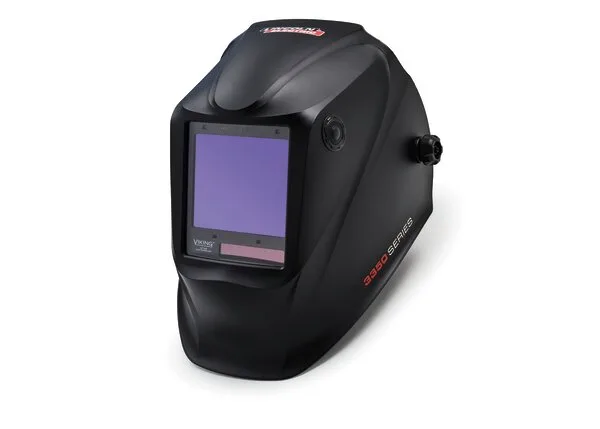
The Lincoln Electric VIKING 3350 is the pick: a published 1/1/1/1 optical class, a 12.5 square inch window, four arc sensors, UV and IR protection to shade DIN 16 at all times, and a five year warranty. The ESAB Savage A41 is the value buy, with the same four sensors and an external grind button in a smaller, lighter shell, though ESAB does not publish a four-digit optical class for it. The optrel crystal2.0 is the pick that depends on you: a shade 2.0 light state and fully automatic shade control make it the brightest and most hands-off helmet here, but it grades 1/1/1/2, runs three sensors, and has a small window. Skip the YESWELDER LYG-1980GK, whose panoramic side windows come with a sealed rechargeable battery, UV and IR protection published only to DIN 13, and no warranty terms on the product page. The single most useful fact in this whole category is that the UV and IR filtering is passive and constant, so a lens sitting in its pale light state is still blocking the radiation that causes arc eye. The shade change is only about visible light. Best for: anyone buying their own helmet who would rather read a spec sheet than a marketing page.
Our picks at a glance
- Lincoln Electric VIKING 3350 - Buy. The helmet that publishes every number you would want to check, and grades well on all of them.
- ESAB Savage A41 - Buy. Four sensors, an external grind button and a published ISO 16321 marking, in a small light shell.
- optrel crystal2.0 - It depends. The brightest light state and the most hands-off shade control here, bought with a smaller window and a 1/1/1/2 grade.
- YESWELDER LYG-1980GK Panoramic - Skip. A panoramic budget helmet whose published numbers get worse in exactly the places that matter.
The verdict in 30 seconds
What mattered most
- Optical class published
- Viewing area
- Light state and weld shades
- Arc sensors
- Switching time as published
- UV and IR protection
A welding helmet is one of the few things you buy where the important numbers are printed on the product, on the lens, and in the manual, and almost nobody reads them. The four-digit optical class, the light state shade, the arc sensor count and the switching time are all published, all comparable, and all checkable before you spend anything. For this comparison we pulled specs from manufacturer manuals and technical data sheets rather than shopping listings, and left out anything a maker would not state in writing. What survived is four helmets that show exactly how this category splits.
The helmet that publishes every number you would want to check, and grades well on all of them.
Best for: Someone who welds often enough to care about window size and wants a spec sheet the manufacturer can be held to.
- The manual lists a 1/1/1/1 optical class along with ANSI Z87.1, CSA 94.3, EN 379 and AS/NZS 1338.1 compliance.
- A 95 by 85 mm window (12.5 square inches) with four arc sensors, which is what keeps the lens triggering when the arc is out of your direct line of sight.
- Lincoln states UV and IR protection up to shade DIN 16 at all times, and the CR2450 lithium cell is user replaceable with solar assist behind it.
- Lincoln lists a total weight of 606 g for the black shell but never says whether that figure includes the X6 headgear.
- The published weight disagrees between the product page, the spec sheet and the manual, which makes it hard to compare against helmets weighed a different way.
- Sensitivity is described only as variable with no numeric range, and battery life is not published at all.
- It is the most expensive helmet in this group and a bulkier shell than the optrel.
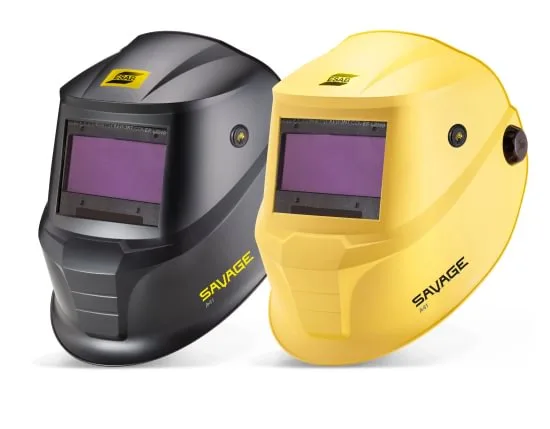
Four sensors, an external grind button and a published ISO 16321 marking, in a small light shell.
Best for: A hobbyist or occasional fabricator who wants four sensors and a swappable battery without paying for a large window.
- Four arc sensors and an externally activated grind button, which is the feature set most mid-priced helmets cut back on first.
- ESAB publishes the switching time with the temperature it was measured at, 0.07 ms at 23 C, which is more honest than a bare fraction.
- One replaceable CR2450 lithium cell with solar assist, plus a digital interface with an LED readout for the exact shade, delay and sensitivity setting.
- ESAB does not publish a four-digit optical class for the A41, only the ISO 16321 marking W4/8-13 V2, where V2 is the angle dependence class.
- The window is 100 by 50 mm, a little over half the height of the Lincoln's.
- The dark range starts at shade 8, so there is no 5 to 7 band for low amperage work or plasma cutting.
- The warranty is two years against Lincoln's five, and no operating temperature range or UV and IR shade figure is published for this model.
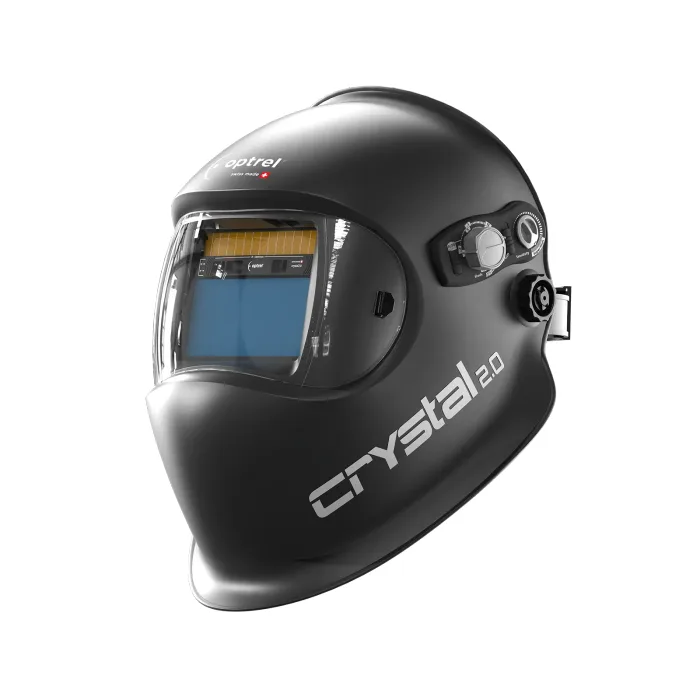
The brightest light state and the most hands-off shade control here, bought with a smaller window and a 1/1/1/2 grade.
Best for: A TIG or fine-detail welder who values a bright light state and automatic shade selection over window size and sensor count.
- A shade 2.0 light state, paler than the 2.5 to 4 the others publish, so you can see the joint and your surroundings without lifting the hood.
- ShadeTronic sets the dark shade automatically, and optrel publishes the switching time at two temperatures: 100 microseconds at 23 C and 70 microseconds at 55 C.
- The technical data sheet states maximum UV and IR protection in both light and dark conditions, with roughly 2500 hours of operating time on two replaceable CR2032 cells.
- It grades 1/1/1/2 under EN 379, with the 2 sitting in angle dependence of luminous transmittance, which is a real difference from the 1/1/1/1 helmets even if makers argue about how much it matters.
- Three arc sensors rather than four, and a field of view of 50 by 100 mm.
- optrel publishes 460 g on the product page and technical data sheet but 495 g for the non-PAPR version in the manual.
- Two year warranty, three if you register within six months, against Lincoln's five, and optrel states the helmet is not suitable for laser welding.
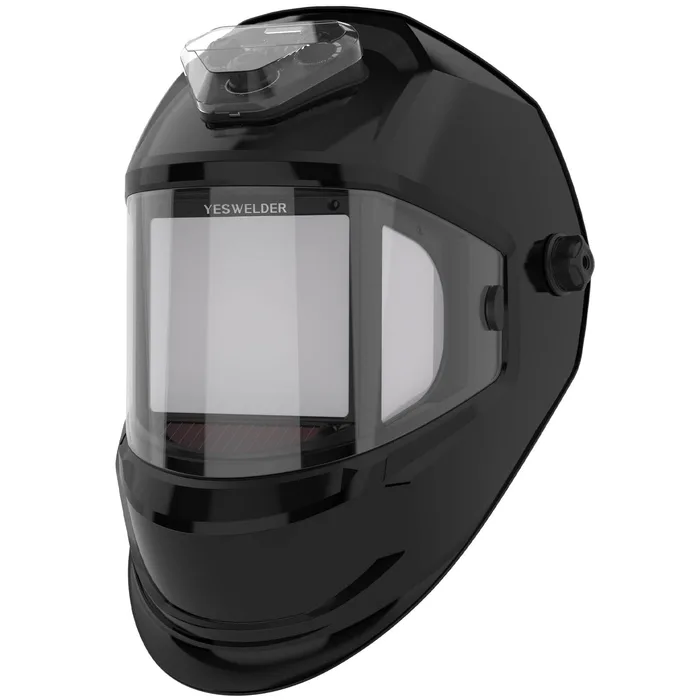
A panoramic budget helmet whose published numbers get worse in exactly the places that matter.
Best for: Only a buyer who wants the widest possible field of view and knowingly accepts a sealed battery and a lower published UV and IR figure to get it.
- The main window is 109.5 by 97 mm with two side windows, the widest field of view in this group.
- Six arc sensors, four on the main lens and two on the sides.
- The product page does state ANSI Z87.1, EN 379 CE and CSA Z94.3, along with a 1/1/1/1 optical clarity claim.
- Power is a built-in 3000 mAh rechargeable pack charged over USB-C, not a coin cell you can swap mid-job or replace in five years.
- UV and IR protection is published at DIN 13, where Lincoln and ESAB publish DIN 16 at all times and optrel publishes maximum protection.
- The stated working temperature floor is 23 F, warmer than the 14 F that Lincoln and optrel publish, so a cold shop falls outside the stated range sooner.
- YESWELDER publishes no manual for any of its helmets, so you cannot read the lens markings before buying, and its own product pages name a standard on only one model out of seven.
- The warranty is one year, and only in the site policy pages rather than on the product page, against five years from Lincoln.
| Criteria | VIKING 3350 | Savage A41 | crystal2.0 | LYG-1980GK Panoramic |
|---|---|---|---|---|
| Verdict | Buy it | Buy it | It depends | Skip it |
| Best for | Someone who welds often enough to care about window size and wants a spec sheet the manufacturer can be held to. | A hobbyist or occasional fabricator who wants four sensors and a swappable battery without paying for a large window. | A TIG or fine-detail welder who values a bright light state and automatic shade selection over window size and sensor count. | Only a buyer who wants the widest possible field of view and knowingly accepts a sealed battery and a lower published UV and IR figure to get it. |
| Price tier | $$ · premium | $ · mid-range | $$ · premium | $ · budget |
| Optical class published | 1/1/1/1, EN 379 | Not published; ISO 16321 marking W4/8-13 V2 | 1/1/1/2, EN 379 | 1/1/1/1 claimed on the product page |
| Viewing area | 95 x 85 mm, 12.5 sq in | 100 x 50 mm | 50 x 100 mm | 109.5 x 97 mm plus two side windows |
| Light state and weld shades | DIN 2.5 light, 5 to 13 weld | Shade 4 light and grind, 8 to 13 weld | Shade 2.0 light, 4 to 12 automatic | DIN 4 light, 5 to 13 weld |
| Arc sensors | 4 | 4 | 3 | 6 (4 main, 2 side) |
| Switching time as published | 1/25,000 s light to dark | 0.07 ms at 23 C | 100 microseconds at 23 C, 70 at 55 C | 1/30,000 s, no temperature stated |
| UV and IR protection | Up to shade DIN 16 at all times | Not published as a shade number | Maximum in light and dark conditions | DIN 13 |
| Power source | Solar assist plus 1 replaceable CR2450 | Solar assist plus 1 replaceable CR2450 | Solar plus 2 replaceable CR2032 | Solar plus built-in 3000 mAh rechargeable pack |
| Published weight | 606 g, basis not stated | 500 g | 460 g on the data sheet, 495 g in the manual | Not published |
Which one is right for you?
- Someone who welds often enough to care about window size and wants a spec sheet the manufacturer can be held to. Buy it Lincoln Electric VIKING 3350
- A hobbyist or occasional fabricator who wants four sensors and a swappable battery without paying for a large window. Buy it ESAB Savage A41
- A TIG or fine-detail welder who values a bright light state and automatic shade selection over window size and sensor count. It depends optrel crystal2.0
- Only a buyer who wants the widest possible field of view and knowingly accepts a sealed battery and a lower published UV and IR figure to get it. Skip it YESWELDER LYG-1980GK Panoramic
How we judged the field
Five things separate one auto-darkening helmet from another, and all five are published. The first is the four-digit optical class from EN 379, which grades optics, diffusion of light, variation in luminous transmittance and angle dependence, and which is printed on the filter so you can check it. The second is the light state shade, the number the lens sits at when nothing is arcing, because that is what decides whether you can line up a joint without lifting the hood. The third is arc sensor count, which matters the moment you weld anywhere other than square to a bench. The fourth is the power supply, specifically whether the cell comes out. The fifth is how the maker publishes switching time, because a figure quoted with the temperature it was measured at tells you the company understands its own product.
The field splits cleanly along those lines. At the top are helmets from the established welding brands that publish a full spec table and a compliance list you can look up, and the Lincoln VIKING 3350 is the most complete of them. In the middle are shells from the same brands with the sensors and the grind button kept but the window shrunk and some of the paperwork thinned, which is where the ESAB Savage A41 sits. Off to one side is the specialist approach, a very pale light state and automatic shade selection in a small light shell, which is optrel’s crystal2.0. At the bottom is the budget panoramic category, where the field of view goes up and the published protection figures, the battery arrangement and the compliance detail quietly go down. We picked one of each so you can see what you gain and lose moving between them.
Lincoln Electric VIKING 3350 - buy
The VIKING 3350 is the helmet to beat because Lincoln publishes the whole table. The manual lists a 1/1/1/1 optical class, a 95 by 85 mm window that works out to 12.5 square inches, four arc sensors, a DIN 2.5 light state, welding shades from 5 to 13, a light-to-dark switch of 1/25,000 of a second, a delay adjustable from 0.1 to 1.0 seconds, and compliance with ANSI Z87.1, CSA 94.3, EN 379 and AS/NZS 1338.1. It also states, in the same table, UV and IR protection up to shade DIN 16 at all times. Power is a single replaceable CR2450 lithium cell with solar assist, the grind button is external, and the warranty is five years. The catch is the weight reporting: Lincoln lists 606 g for the black shell in the manual and different figures on the product page and spec sheet, and never says whether any of them includes the X6 headgear. Battery life is not published either. For anyone who welds regularly and wants a big window with nothing hidden, this is the one.
ESAB Savage A41 - buy
The Savage A41 is the value pick because it keeps the two features that budget helmets usually drop. It has four arc sensors and an externally activated grind button, plus a digital push-button interface with an LED readout so you can see the exact shade, delay and sensitivity you have dialled in. ESAB publishes a 0.07 ms light-to-dark switch and prints the 23 C measuring temperature alongside it, a 0.1 to 0.9 second dark-to-light delay, a 500 g weight, a single replaceable CR2450 with solar assist, and a certification list of CE EN ISO 16321 W4/8-13 V2, ANSI Z87.1+ and CSA Z94.3. Two things hold it back. ESAB does not publish a four-digit optical class for this model, and the ISO 16321 marking shows V2 for angle dependence rather than the V1 on its own Sentinel A60. And the window is 100 by 50 mm, small enough that you will notice it after the Lincoln. For occasional work it is a lot of helmet for the money.
optrel crystal2.0 - it depends
The crystal2.0 is the helmet that is either exactly right for you or clearly wrong. Its light state is shade 2.0, paler than anything else here, which means you can see the workpiece and the shop around you without flipping the hood up. ShadeTronic then sets the dark shade automatically from 4 to 12 rather than making you pick, and Fadetronic opens it back up gradually. optrel is unusually open with the numbers: 100 microseconds at 23 C and 70 microseconds at 55 C for switching, roughly 2500 hours of operating time, two replaceable CR2032 cells with solar cells, an operating range of minus 10 to 70 C, and maximum UV and IR protection in both light and dark conditions. The trade-offs are real. It grades 1/1/1/2 under EN 379 with the lower mark in angle dependence, it runs three sensors, the field of view is only 50 by 100 mm, and the warranty is two years or three with registration. optrel also states it is not suitable for laser welding. Buy it for the light state, not the spec sheet.
YESWELDER LYG-1980GK Panoramic - skip
The LYG-1980GK is the one to skip, and not because it is cheap. The panoramic idea is genuinely appealing: a 109.5 by 97 mm main window with two side windows and six arc sensors gives you more peripheral awareness than anything else here. But look at what the page publishes underneath that. UV and IR protection is stated as DIN 13, where Lincoln and ESAB both publish DIN 16 at all times and optrel publishes maximum protection. Power is a sealed 3000 mAh rechargeable pack charged over USB-C, so there is no coin cell to swap when it dies on a Sunday and no cell to replace when the pack ages out. The stated working temperature floor is 23 F, warmer than the 14 F the Lincoln and optrel publish. The warranty is one year, buried in the site policies rather than stated on the page. And YESWELDER publishes no manual for any helmet it sells, so the lens markings are unreadable until the box arrives, while its own LYG-M800H page claims the same 1/1/1/1 clarity and names no standard at all.
Lincoln Electric VIKING 3350 vs ESAB Savage A41: which should you buy?
The VIKING 3350 and the Savage A41 are separated by window size and paperwork, not by capability. Both give you four arc sensors, an external grind button, a replaceable CR2450 lithium cell with solar assist, and a switching time in the same order of magnitude. The Lincoln adds a 95 by 85 mm window against the ESAB’s 100 by 50 mm, a light state of DIN 2.5 against shade 4, a welding range that reaches down to shade 5 for low amperage and cutting rather than stopping at 8, and a published 1/1/1/1 optical class where ESAB publishes only the ISO 16321 marking with its V2 angle dependence class. The Lincoln also carries a five year warranty, and its manual states UV and IR protection to DIN 16 at all times, a figure the A41 page does not give as a shade number.
So the choice comes down to how much you weld and where. If the helmet is going to be on your head for hours at a time, or you weld out of position, or you do low amperage TIG and plasma cutting as well as MIG, buy the Lincoln: the taller window and the wider shade range are the difference between comfortable and merely adequate, and the fuller spec table means fewer surprises. If you weld in short sessions at a bench, mostly on one process, and would rather keep the money, the Savage A41 gives you the two features that actually protect you, four sensors and a real grind mode, in a 500 g shell. The one thing not worth trading away in either direction is the sensor count.
What to look for
- Find the four-digit class: it is printed on the filter itself, in the order optical class, diffusion of light, variation in luminous transmittance, angle dependence, and 1 is the best grade in each position.
- Read the light state number, not the colour marketing: true colour, natural colour and similar names are trade names that appear in no standard, while the light state shade is a published number you can compare directly.
- Count the sensors and think about your posture: two is enough at a bench square to the work, but overhead, in a corner, or with a flange shadowing the lens you want four independent chances to catch the flash.
- Check whether the cell comes out: a replaceable CR2450 or CR2032 is a two-minute fix years from now, while a sealed rechargeable pack means the helmet’s life is the pack’s life.
- Look for a temperature next to the switching time: the number is measured warm, and optrel publishes 100 microseconds at 23 C against 70 at 55 C, which tells you the figure moves with the lens temperature.
- Ignore the UV and IR fear entirely: compliant filters block it constantly and passively, with Lincoln publishing protection to shade DIN 16 at all times and 3M labelling its figure permanent, so a pale light state is not a gap in your protection.
Our final take
Buy the Lincoln Electric VIKING 3350 if you weld enough for the helmet to matter. It publishes the most complete spec table of any helmet here, it grades 1/1/1/1, and the window and shade range cover everything from low amperage TIG to plasma cutting. The ESAB Savage A41 is the sensible spend for occasional work, keeping four sensors and a real grind button in a small light shell. The optrel crystal2.0 is worth its price only if a shade 2.0 light state and automatic shade selection are things you specifically want, because you pay for them with window size and a 1/1/1/2 grade. Skip the panoramic budget helmets with sealed batteries and thin compliance detail, however wide the view looks.
Questions, answered
What does a 1/1/1/1 optical class actually mean?
It is four separate grades from the EN 379 welding filter standard, printed in order on the lens itself. ESAB's own manual decodes its marking for you: the digits are optical class, diffusion of light class, variation in luminous transmittance class, and angle dependence of luminous transmittance class, followed by the number of the standard. In plain terms they cover how sharply the filter focuses, how much light it scatters into haze, how evenly dark it is across the window, and how much the shade shifts when you look through the lens at an angle instead of straight on. A 1 is the best grade in each category, so 1/1/1/1 is a clean sweep, while optrel's crystal2.0 publishes 1/1/1/2 with the lower grade in angle dependence. Worth knowing that this is not a settled argument: Miller deliberately ships 1/1/1/2 lenses and argues on its own site that the fourth digit only shows up at extreme viewing angles and is not worth what chasing it costs elsewhere in the lens. Because the grades appear on the filter itself, you can at least check the claim against the product in your hands rather than trusting the listing.
Does the lens still protect my eyes if the battery dies or it fails to darken?
The ultraviolet and infrared filtering does not depend on the electronics at all. 3M is the most explicit about it: the Speedglas 9100 technical specification says the filter has permanent protection equivalent to shade 13 against harmful UV and IR radiation regardless of whether the filter is in the light or dark state, or whether the auto-darkening function is operational. optrel describes the cassette as combining a passive UV filter and a passive IR filter with an active filter whose transmittance in the visible range changes with the arc, and Lincoln puts the same thing in its spec table as UV and IR protection up to shade DIN 16 at all times. What the shade change actually controls is visible light, which is the part that blinds you rather than the part that burns your corneas. So a helmet sitting in its pale light state is not leaving your eyes exposed. The American Welding Society says the same thing in its own fact sheet: an auto-darkening filter includes a special filter that blocks harmful radiation even if the main switching element fails. That said, if a lens stops darkening you should stop welding, because the visible glare will still hurt and the makers warn that a cracked or damaged filter may have compromised protection.
Is true colour a real specification or just marketing?
It is a trade name, not a graded property. Lincoln calls its version 4C Lens Technology, ESAB calls it OpTCS True Color, optrel calls it Crystal Lens Technology, Miller calls it ClearLight 4x and 3M calls it Natural Colour Technology, and none of those terms appears anywhere in the EN 379 or ISO 16321 markings. The four graded digits cover optics, diffusion, evenness and angle dependence, and colour rendering is not among them. That does not mean the effect is imaginary, because these lenses really do look less green than older filters. The comparable number underneath the marketing is the light state shade: the optrel publishes 2.0, the Lincoln 2.5, and both the ESAB and the YESWELDER publish 4. A lower light state number is a paler, clearer view when you are not welding, and unlike the marketing name it is printed on the lens.
How many arc sensors do I actually need?
Sensors are the reason a lens darkens at all, so the question is really whether any of them can see the arc from where you are working. Two sensors are fine when you are sitting at a bench looking straight down at the joint with the helmet square to the work. They start failing when the helmet is tipped, when you are welding overhead or into a corner, or when a flange or your own hand shadows part of the lens, because a blocked sensor cannot trigger. Four sensors give the filter more independent chances to catch the flash from an awkward angle, which is why the Lincoln VIKING 3350 and the ESAB Savage A41 both use four. The optrel crystal2.0 uses three with an adjustable sensor slider that narrows the detection angle so a neighbour's arc does not trip your lens. More sensors is not automatically better, but if you weld anywhere other than a bench, do not go below four.
Why is switching time quoted so many different ways, and does the number matter?
Makers publish it as a fraction, in milliseconds, or in microseconds, which makes comparison harder than it should be. Lincoln quotes 1/25,000 of a second for the VIKING 3350, ESAB quotes 0.07 ms for the Savage A41, and optrel quotes 100 microseconds for the crystal2.0, all of which are the same order of magnitude. The more important detail is that the figure is tied to a temperature. ESAB prints 23 C next to its number and optrel publishes both 100 microseconds at 23 C and 70 microseconds at 55 C, which tells you plainly that a liquid crystal filter switches faster when it is warm and slower when it is not. Every helmet here also has a stated minimum operating temperature, from 14 F on the Lincoln and optrel to 23 F on the YESWELDER. The American Welding Society is blunter than any manufacturer about why this matters, listing blocked sensors, dead batteries, wrong sensitivity settings and use in very cold temperatures as things that can stop a filter switching when an arc is struck, leaving you with a temporary blind spot like a camera flash. In practice any of these numbers is fast enough that you will never see the transition, so treat switching time as a tie-breaker and spend your attention on optical class, sensor count and light state instead.
More Outdoors & Fitness reviews
 The Best Wheelbarrows & Garden Carts: 4 Compared (and One to Skip)
  The Best Yoga Mats: Grip, Cushioning, and Durability Compared
  The Best Golf Bags: 4 Compared (and One to Skip)
  The Best Punching Bags: 4 Compared (and One to Skip)
  The Best Smart Bike Trainers: 4 Compared (and One to Skip)
  The Best Snowshoes: 4 Compared (and One to Skip)