Explained
Auto-Darkening Welding Helmets, Explained
After reading, you'll understand what every number on an auto-darkening filter means, which ones are graded by a standard, which ones are trade names, and how to tell a well-documented helmet from a vague one before you buy.
In this guide
Most first-time buyers shop welding helmets on shade range and viewing area, which are the two specs least likely to go wrong. What trips them up is the four-digit code nobody explains, a widespread and completely unnecessary fear that a pale lens means unprotected eyes, and a pile of trademarked colour technologies that sound like specifications but are not graded by anything. There is also a quiet split between helmets whose makers publish a full table with test temperatures and compliance lists, and helmets whose pages state a claim and stop. Learning to spot that split is most of the skill.
The 30-second version
- The four digits are graded, covering optical class, diffusion of light, variation in luminous transmittance and angle dependence, with 1 the best mark in each slot.
- UV and IR protection never switches off, because it is a passive filter in the glass rather than something the electronics do, so a light-state lens is still blocking it.
- The shade change is about visible light, which is the glare that stops you seeing, not the radiation that causes arc eye.
- True colour is a trade name, so compare the published light state shade number instead, where lower means a paler and clearer view.
- Sensor count is about posture, since a sensor that cannot see the arc cannot trigger the lens, and four beats two the moment you leave the bench.
The products this guide is about
Our verdict on each, with the full reasoning on the companion review.
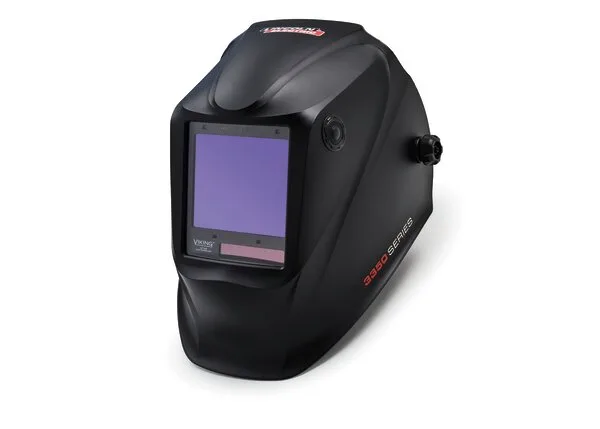
- Buy Lincoln Electric VIKING 3350 The helmet that publishes every number you would want to check, and grades well on all of them. Amazon
- Buy ESAB Savage A41 Four sensors, an external grind button and a published ISO 16321 marking, in a small light shell. Amazon
- It depends optrel crystal2.0 The brightest light state and the most hands-off shade control here, bought with a smaller window and a 1/1/1/2 grade. Amazon
- Skip YESWELDER LYG-1980GK Panoramic A panoramic budget helmet whose published numbers get worse in exactly the places that matter. Amazon
What actually matters
- Optical class - the first of the four graded digits, describing how sharply the filter renders what you are looking at. A 1 here means the lens is not adding blur of its own, which is the difference between chasing a puddle and guessing at one.
- Angle dependence - the fourth digit, describing how much the shade shifts when you look through the lens off-centre rather than straight on. It is the digit that most often comes back as a 2, and the only one manufacturers openly argue about: Miller ships 1/1/1/2 lenses on purpose and says the fourth rating only shows up at extreme viewing angles.
- Light state shade - the number the filter sits at when nothing is arcing, typically between 2.0 and 4. This is the single spec that decides whether you can tack, position and inspect without lifting the helmet, and it is the honest version of the true colour claim.
- Arc sensors - the photocells that detect the flash and tell the filter to darken. Their value is redundancy rather than speed: if a hand, a flange or the angle of your head blocks one, the others still see the arc.
- Switching time - how long the lens takes to go from light to dark, usually in microseconds or as a fraction of a second. All modern filters are far faster than your blink reflex, so treat it as a tie-breaker and pay attention to whether the maker states the temperature it was measured at.
- Power source - solar assist keeps a coin cell alive, but the coin cell is what actually runs the filter. A replaceable CR2450 or CR2032 is a consumable, while a sealed rechargeable pack turns the helmet into one.
- Grind mode - a setting that locks the filter in a light shade so it does not darken at every spark from an angle grinder. An external button is worth paying for, because an internal one means taking the helmet off to switch.
The specs, in plain English
Green flags vs red flags
Green flags
- A four-digit optical class printed on the product and repeated in the manual, not just in the listing copy.
- A published compliance list naming specific standards, such as ANSI Z87.1, CSA Z94.3, EN 379 and EN 175 or ISO 16321.
- A switching time quoted with the temperature it was measured at, which shows the maker knows the figure moves.
- A named, replaceable battery type such as CR2450 or CR2032, with solar assist as a supplement rather than the whole story.
- A downloadable manual with a full spec table, an operating temperature range and a stated warranty term.
Red flags
- No optical class and no named standard anywhere on the page, or a compliance claim citing a standard with no edition year attached.
- A sealed rechargeable battery presented as a feature, with no way to replace the cell when it stops holding charge.
- UV and IR protection published at a lower shade equivalent than the DIN 16 that established brands state.
- Marketing terms such as true colour or ultra-clear doing the work that a published light state shade number should be doing.
- Inconsistent claims across the same brand's own product pages, where one model lists standards and a near-identical one lists none.
- No downloadable manual, which means you cannot read the lens markings or the fail-safe behaviour until the helmet is already in your hands.
Who's who: the brands
- Lincoln Electric - A large American welding equipment maker whose VIKING helmets publish full spec tables and carry a five year warranty, using the 4C name for its lens technology.
- ESAB - A long-established welding brand with a tiered line from the budget Savage shells up to the Sentinel series, and unusually clear documentation that decodes its own lens markings.
- optrel - A Swiss specialist known for automatic shade control and very pale light states, and for publishing switching times at more than one temperature.
- 3M Speedglas - The premium end of the market, including the curved-filter G5-02 aimed at TIG welders, with Natural Colour Technology as its colour trade name.
- Miller Electric - One of the biggest names in American welding, and the outlier on optical class: its ClearLight 4x helmets ship a 1/1/1/2 rating on purpose and Miller publishes its reasoning.
How to read a listing without getting fooled
Start at the bottom of the listing, not the top. Find the specification table and look for four things in this order: a four-digit optical class, a named standard with its number, a light state shade, and a battery type. If all four are there, the rest of the page is probably honest and you can move on to comparing window size and sensor count. If the optical class is missing, or a helmet claims compliance without naming a standard, or the battery is described only as rechargeable, treat every other number on the page as a marketing figure. Then download the manual, which is where makers put the things they are legally obliged to state but would rather not advertise: the operating temperature range, the exact marking on the lens, the weight, and any note about what the compliance claim excludes. Where the manual and the product page disagree, as they sometimes do on weight and shade numbers, the manual is the document that has to be right.
How much should you spend?
Budget helmets buy you a large window and a low number, and what they usually give up is the paperwork: no published optical class, a sealed battery, or a compliance claim with no standard behind it. Some are fine and some are not, and the only way to tell without wearing one is whether the maker will commit the numbers to writing. Mid-range is where the category gets sensible, because that is the first tier where four arc sensors, an external grind button and a replaceable coin cell all appear together, and for occasional work that combination is most of what a premium helmet gives you. Premium buys three things specifically: a bigger and taller window, a documented 1/1/1/1 optical class, and a longer warranty, plus in some cases a specialist trick like automatic shade selection or a curved filter. If you weld a few weekends a year, mid-range is the right stop. If the helmet is on your head for hours at a time, the window size alone justifies moving up.
Questions, answered
Do I still need safety glasses under an auto-darkening helmet?
Yes. ESAB's manual is explicit that you should always wear safety glasses with side shields in any work area even when a welding helmet or face shield is also required. The helmet protects you while it is down and pointed at the work, and a lifted hood, a chipping hammer or someone else's grinder is exactly the moment it is not. Treat the helmet as the arc protection and the glasses as the everything-else protection.
What does grind mode actually do, and why should the button be outside?
Grind mode locks the filter in a fixed light shade so it stops reacting to the sparks coming off an angle grinder, which would otherwise make it flicker between light and dark. The shade it locks to is usually somewhere between 3 and 4, dark enough to be comfortable but light enough to see what you are cutting. An external button means you can switch modes with the helmet on and gloves still on, whereas an internal control means lifting the hood every time. Most helmets also blink an internal LED while grind mode is active so you cannot strike an arc having forgotten to switch back.
Why does the same helmet get listed at different weights?
Because makers do not all weigh the same thing. Some figures are the complete helmet with headgear, some are the shell and filter, and some are the filter cassette on its own, and the basis is often not stated. optrel publishes 460 g for the crystal2.0 on its product page and technical data sheet but 495 g for the non-PAPR version in the manual. Lincoln publishes three slightly different figures for the VIKING 3350 across its page, spec sheet and manual and never says whether the headgear is included. Use published weights to compare within a brand, and be sceptical of small differences between brands.
Will the lens still work outside in cold weather?
Within the range the maker publishes, yes, but that range has a floor and it is higher than you might expect. Lincoln lists an operating range of 14 to 131 F for the VIKING 3350, optrel lists minus 10 to 70 C for the crystal2.0, and YESWELDER lists 23 to 131 F for the LYG-1980GK. Below the stated floor the manufacturer is no longer telling you how the filter behaves. Jackson Safety's Insight manual goes further and tells you to warm the helmet to ambient temperature before welding if it has been stored somewhere extremely cold. Since these are liquid crystal filters and optrel's own published switching times get faster as the lens warms, the sensible habit is to keep the helmet indoors rather than leaving it in a truck bed overnight.
Or jump to the head-to-head: Lincoln Electric VIKING 3350 vs ESAB Savage A41.