Explained
Wire Strippers, Explained
After reading, you'll understand why a wire stripper's AWG marking is only half a specification, and what the other half is.
In this guide
First time buyers reasonably assume a wire stripper is a solved problem: pick the hole with your gauge on it and squeeze. The trouble is that the number on the tool describes the metal, and the tool has to get through the plastic around the metal, which is not standardised in the same way. That gap is where the damage happens, and it is invisible when it happens. A second surprise is that self-adjusting does not mean adjustment free, and the makers say so in the small print.
The 30-second version
- The failure is the nick, not a messy cut, because a scored strand is a crack that shows up weeks later under vibration or load.
- AWG describes the conductor, so the same marking can behave differently under thin PVC and under a thicker jacketed building wire.
- Solid and stranded are different diameters, at the same gauge, which is why good tools carry two scales or ship two blade sets.
- Self-adjusting has a floor, and at least two major makers publish a manual knob or thumb wheel for gauges below 20 AWG.
- Blades wear silently, so a published replacement blade part number is a better durability signal than any warranty length.
The products this guide is about
Our verdict on each, with the full reasoning on the companion review.
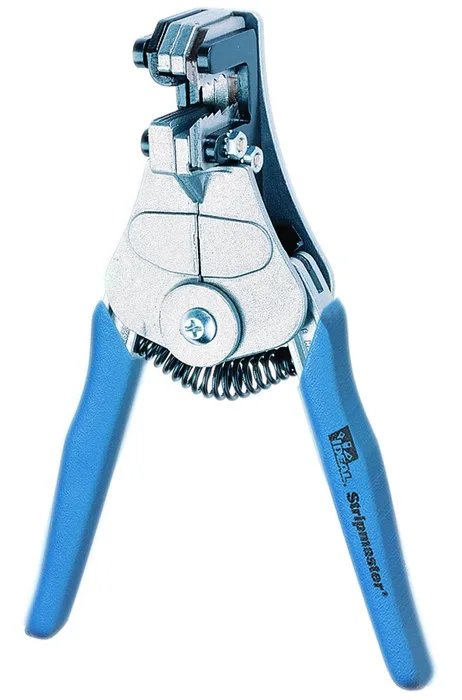
- Buy IDEAL Electrical Stripmaster Wire Stripper 45-092, 10-22 AWG The one tool here whose maker publishes a hole diameter and a tolerance for every gauge it claims. Amazon
- Buy Klein Tools 11055 Wire Stripper and Cutter, Solid and Stranded Copper A plain fixed hole stripper that puts the solid and stranded scales in separate columns on the tool face, where you can see them. Amazon
- It depends Knipex 12 52 195 PreciStrip16 Automatic Wire Stripper, 28-6 AWG A blade type automatic stripper with a fine adjustment dial and a wide range, from a maker that tells you in writing what it will not strip. Amazon
- Skip IRWIN VISE-GRIP 2078300 Self-Adjusting Wire Stripper, 8 inch IRWIN's own page says a knob micro-adjusts it for gauges smaller than 20 AWG, which is where you wanted the self-adjusting part to work. Amazon
What actually matters
- Stripping hole diameter - the actual cut size of the hole, which should be slightly larger than the conductor it is marked for. IDEAL publishes these per gauge with a plus .001 inch tolerance, which is the clearest statement of intent any maker here makes.
- Insulation type - the plastic the tool was designed to cut through, not the metal underneath. Knipex names THHN as an exclusion on two of its automatic strippers, and most other listings say nothing at all.
- Solid versus stranded - the same AWG number is a single round conductor in one case and a bundle in the other, with a different overall diameter. Tools either give you two scales or sell you two blade sets.
- Mechanism - fixed hole, automatic fixed die, or blade type. Each is genuinely better at something, and the marketing rarely says which.
- Strip length control - an adjustable stop that makes every strip the same length. It matters more than it sounds once you are making the same termination repeatedly into a terminal block.
- Blade replacement - whether the cutting parts are a serviceable item with a part number or the whole tool is the consumable. This determines what the tool costs over five years, not the purchase price.
- Insulated versus not - a plastic dipped handle is a grip, not electrical protection. Klein, Knipex and IDEAL all state on these product pages that the tools here are not insulated.
The specs, in plain English
Green flags vs red flags
Green flags
- The maker publishes a stripping hole diameter or blade dimension per gauge, ideally with a tolerance.
- The listing names the insulation type the tool was designed for, or names one it will not handle.
- Solid and stranded ranges are given separately rather than as a single AWG span.
- Replacement blades, cassettes or frames are sold under their own catalog numbers.
- There is an adjustable length stop if the tool is meant for repeat work.
Red flags
- A single wide AWG range with no mention of solid, stranded or insulation type.
- Self-adjusting claimed at fine gauges with a manual tension knob buried in the feature list.
- Precision or professional used as the only description of the cutting geometry.
- A crimper in the same jaw as the stripper with no ratchet, cycle or crimp height published.
- Specifications that contradict each other between the overview text and the bullet list on the same page.
Who's who: the brands
- IDEAL Electrical - Makes the Stripmaster line of lever action precision strippers and is unusual in publishing stripping hole diameters, tolerances and replacement blade and frame catalog numbers.
- Klein Tools - A widely used US electrician brand, with fixed hole strippers, the automatic Katapult and a self-adjusting model specified for 12/2 and 14/2 Romex and other type NM cable.
- Knipex - German maker of automatic and blade type strippers with wide ranges and fine adjustment, and notably willing to state on its own pages which insulation a tool will not strip.
- IRWIN - Sells the VISE-GRIP self-adjusting stripper and combination stripper crimper tools aimed at general and occasional use, backed by a lifetime limited warranty.
- Southwire - Builds strippers specified for particular cables rather than gauges, including several dedicated to 12/2 and 14/2 NM-B jackets.
How to read a listing without getting fooled
Start at the range and ask what it leaves out. A listing that says 10-22 AWG and nothing else has not told you whether that is solid, stranded or both, and it has not told you what insulation the geometry assumes. Then look for a number that is not a gauge: a hole diameter, a tolerance, a strip length, a crimp height. Makers who measure things publish them, and makers who do not fall back on words like precision and professional. Next find the parts list, because a page that names a replacement blade set is a page admitting the blades wear, which is more useful than a warranty length. Finally read the feature bullets rather than the headline, since that is where the qualifications live: a swivel knob for smaller gauges, a tensioning thumb wheel, a note that the tool is not insulated. Those sentences are the specification.
How much should you spend?
Budget buys a competent fixed hole stripper from a serious brand, and at that tier the tool is a consumable you replace when the holes round over. It also buys most self-adjusting combination tools, which is a fair trade for occasional work but not for precision. Mid-range is where lever action precision strippers with replaceable blade sets start, and that is the tier where the maintenance path matters more than the initial outlay, because the frame outlives several sets of blades. Premium buys wide range blade type automatics with fine adjustment dials and length stops, which is worth it if your gauges vary constantly or run fine, and hard to justify if you strip two sizes of building wire all week. Across every tier, the better signal is not what you pay but whether the maker will put a dimension in writing.
Questions, answered
How do I tell the difference between the solid and stranded markings?
Good tools separate them. The Klein 11055 carries two labelled columns on the tool face, one headed AWG SOLID running 10 to 18 and one headed AWG STRANDED running 12 to 20, so the same physical hole serves a heavier solid conductor and a lighter stranded one. That is not a quirk, it is geometry: a stranded conductor of a given gauge is slightly larger overall than a solid one because of the gaps between strands. IDEAL takes the same idea further and sells separate blade sets for its Stripmaster Lite at overlapping gauges, one described for all stranded wire and one for 12 and 14 AWG solid with 16 and 18 AWG stranded. If a listing gives you a single AWG span with no mention of which, assume it was cut for one of them and treat the other as approximate.
How do I know when the blades are worn out?
There is no warning light, which is the problem. The symptoms are gradual: insulation that tears rather than parting cleanly, slugs that need a tug, and more visible scoring on the copper than you used to get. Because it happens over months, most people adapt to it without noticing. The practical answer is to buy tools whose makers sell blades separately, because that gives you a cheap way to reset the tool rather than a decision about replacing it. None of the makers we checked publishes a cycle life or a number of strips before replacement, so there is no figure to work to.
Can I use a wire stripper on a live circuit?
Not any of the tools compared here. Klein states the 11055 is not insulated and that plastic dipped handles are not intended for protection against electrical shock. IDEAL lists the Stripmaster as not insulated. Knipex lists the PreciStrip16 as not 1000 volt insulated and prints a warning to switch off power first. Insulated hand tools are a separate category with their own marking and testing regime, and even those are meant as a last line of defence rather than a licence to work energized. De-energize, verify, then strip.
What about flat cable like NM-B, and do I need a separate tool?
Usually yes, or at least a tool that names it. NM-B, often called by the Romex trade name, is two or three insulated conductors and a bare ground inside a flat outer jacket, so there are two stripping jobs: the jacket first, then each conductor. Klein's self-adjusting 11061 is specified for 12/2 and 14/2 Romex and other type NM sheathed cable alongside its AWG ranges. Southwire builds several strippers around the cable rather than the gauge, dedicated to 12/2 and 14/2 NM-B. A general purpose conductor stripper will handle the individual wires once the jacket is off, but it is not the right tool for the jacket.
Or jump to the head-to-head: IDEAL Electrical Stripmaster Wire Stripper 45-092, 10-22 AWG vs Klein Tools 11055 Wire Stripper and Cutter, Solid and Stranded Copper.